
| 영문 | ovary | 한글 | 난소 |
|---|---|---|---|
| 설명 | 여성의 성기관으로 수정에 필요한 난자를 만든다. 자궁의 주위 양쪽으로 2개가 있으며, 여성호르몬을 생성하여 여성으로서의 2차성징 발달에 기여한다. 난소에 생성된 난자는 난관에서 수정이 되거나, 혹은 수정이 되지 않은 채, 자궁관을 따라 자궁에 이르게 되고 이후 황체기를 맞이한 난소에서 나오는 황체호르몬에 의해 월경이 시작된다(수정이 되면, 난소에서는 황체의 형성이 일어나지 않으며, 월경이 발생하지 않고 임신을 유지하게 된다). 난소에서는 호르몬의 자극으로 난자를 생성하게 된다. 또한 이것은 월경의 형성과 밀접한 관계가 있다. 여성의 월경은 정해준 순서에 의해 일어나게 된다. 먼저 난포자극호르몬(FSH)이 뇌에서 분비되어 여성의 난소를 자극하게 되면 난포가 자극받아 난포호르몬을 분비하게 되고 이것은 다시 되먹이기 기전에 의해 뇌에 작용을 하여 황체화호르몬이 뇌에서 분비되고 이것이 이른바 절정(다른 말로 이것을 LH 절정이라고 부른다)에 이르렀을 때, 난포에서 배란(난자가 난소밖으로 나가는 현상)이 일어나게 된다. 이후 난포는 황체로 변하게 되며, 배란된 난자가 수정되지 아니하면, 황체는 황체호르몬(프로제스테론, progesteron)을 분비한뒤 퇴화되고 곧이어 월경이 일어나게 된다. 이 일은 정상적인 대부분의 여성에서 28일을 주기로 일어나며, 대개 LH 절정이후 마지막은 14일로 일정하다고 한다. |
||
| 영문 | muscle cell(=muscle fiber) | 한글 | 근육세포 |
|---|---|---|---|
| 설명 | 근육은 수의근(의식에 의해서 조절이 가능한 근육: 예를 들어 다리, 팔, 얼굴근육 등)과 불수의근(의식과 무관하게 조절하지 않아도 움직이는 근육: 예를 들어 심장근, 소화기관에 분포하는 근육 등)으로 나누어지며, 근육세포의 모양은 다음과 같다(수의근, 불수의근 외에 심장에 있는 심장근은 불수의근에 해당하지만 그 모양은 수의근과 같아 따로 분류한다).  |
||
| 영문 | white blood cell(WBC), leukocyte | 한글 | 백혈구 |
|---|---|---|---|
| 설명 | 혈액내에 골수구계세포와 림프계세포, 단핵구계세포를 모두 통틀어 말한다. 백혈구의 증가가 있으면 대개 감염이 있거나, 혹은 탈수현상이 있음을 의미한다. 또한 지나친 백혈구수의 감소는 인체내 면역기능이 떨어져 있음을 의미하며, 다른 질병에 의해 나타나는 이차적인 현상이 아닌지 꼭 진단을 받아보아야 한다. |
||
| 영문 | mast cell | 한글 | 비만 세포 |
|---|---|---|---|
| 설명 | 동물의 결합 조직 가운데 널리 분포하는 세포. 결합조직과 점막조직 내에 있는 호염기성 색소로 이염색성(metachromasia)을 나타내는 과립을 가진 방추형의 세포에 작은 둥근 핵을 가진다. 비만세포의 표면에는 IgE에 대한 수용체가 존재하며, 수용체에 결합한 IgE 분자들끼리 다가의 항원에 의해 서로 연결되면 비만세포 과립탈출 반응이 일어나, 히스타민, 세로토닌, 헤파린 등의 화학전달 물질이 방출되어, 즉시형 알레르기 반응 등의 증상을 일으킨다. 피부, 장막, 혈관 주위, 점막 주변에 있다. |
||
| 영문 | cell | 한글 | 세포 |
|---|---|---|---|
| 설명 | 생명체를 이루는 구조적, 기능적 단위. 핵의 유무에 따라서 유핵세포와 무핵세포로 나눌 수가 있다. 무핵세포란 핵이 없는 세포를 말한다. 핵이란 유전정보를 가지고 있는 염색체를 보관하는 곳인데 무핵세포에서는 염색체가 세포속에 그냥 노출되어 있다. 대개 세포 하나하나가 독립된 생명체의 역할을 하는 단세포생물로서 외부환경으로부터 자신을 보호할 수 있는 견고한 세포벽을 가지고 있다. 유핵세포란 핵을 가지고 있어서 유전정보가 있는 염색체가 세포의 다른 부분과 구분되어 핵속에 들어있다. 세포속에서 핵외의 부분(이를 세포질이라 한다)에는 여러 가지 세포의 소기관이 있어서 세포의 다양한 기능을 분담한다. ◈유핵세포의 기본 구조 1.세포막-세포를 둘러싸서 주위환경과 분리하여 세포의 내환경을 유지한다. 2.형질내세망(endoplasmic reticulum)-단위막으로 둘러쌓여 있는 불규칙한 망상구조이다. 이 망상구조의 내부를 소강, 소조라고 부른다. 여기에는 표면이 매끈한 무과립형질내세망과 표면이 불규칙한 과립형질내세망의 두 가지가 있다. 과립형질내세망의 경우는 표면에 단백질을 합성하는 리보솜이라는 것이 부착되어 있다. 이곳은 주로 세포밖으로 분비할 단백질을 합성하는 장소이다. 무과립형질내세망은 표면에 리보솜이 부착되어 있지 않은 것을 말하며, 이곳에서는 주로 해독작용, 글리코겐의 합성, 스테로이드호르몬의 합성 등이 일어난다. 3.리보솜-단백질을 합성하는 역할을 하는 곳이다.이것은 세포질에 존재하는 자유리보솜과 과립형질내세망에 부착이 되어 존재하는 부착리보솜의 두 가지로 나눈다. 자유리보솜은 주로 세포내에서 필요한 단백질을 만드는 역할을 하고 부착리보솜은 세포밖으로 분비할 단백질을 만드는 역할을 한다. 4.골지장치(Golgi apparatus)-핵주위에 분포하는 납작해진 주머니모양의 것이 중첩되어 형성된 층판 모양의 구조물로 과립형질내세망에서 생성되어 외부로 분비될 단백질을 모아서 농축, 포장하여 과립을 만드는 역할을 한다. 5.사립체(mitochondria)-구형, 난형의 긴 막대기 모양으로 크기가 다양한 구조물. 생물체의 에너지 저장물질인 ATP를 생산하는 역할을 한다. 또 세포와 다른 자신만의 유전정보를 가진 DNA, RNA를 가지고 있다. 모양, 크기가 세균과 비슷하며 자체증식성 등 독립된 생명체로서 필요한 요건을 갖추고 있어서 세포와 공생관계를 가진 독립된 세포로 생각하고 있다. 6.용해소체(lysosome)-작은 구형의 소체로 여러 가지 분해효소를 가진다. 세포외계에서 들어온 물질과 결합하여 그 물질들을 용해하는 역할을 하고, 오래된 세포소기관들을 제거하는 역할도 한다. 7.세포핵(nucleus)-구형, 난형으로 세포의 중심에 위치한다. 핵내에는 유전정보가 있는 물질인 염색체가 존재한다. 8.중심소체(centrosome)-핵주위에 존재하면서 핵의 분열시에 양쪽의 염색체를 당기는 작은 섬유를 만드는 역할을 하는 곳. 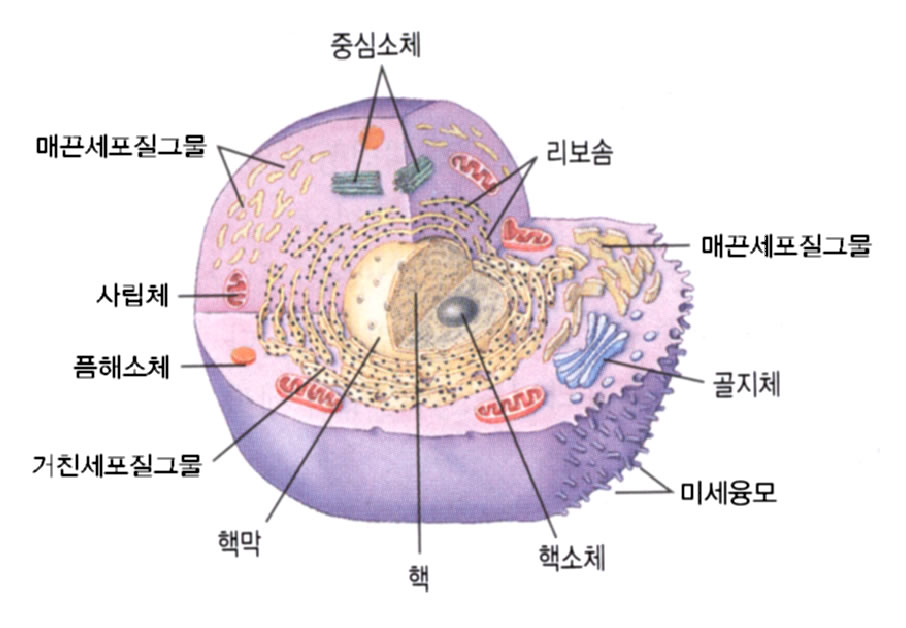 |
||
| CHO | carbohydrate; Chinese hamster ovary; chorea |
|---|---|
| CH | case history; Chediak-Higashi [syndrome]; chiasma; Chinese hamster; chloral hydrate; cholesterol; Ch... |
| CHA | Canadian Hospital Association; Catholic Health Association; Chinese hamster; chronic hemolytic anemi... |
| CHEF | Chinese hamster embryo fibroblast |
| CHL | Chinese hamster lung; chlorambucil; chloramphenicol |
| CHO/HGPRT | Chinese hamster ovary cell hypoxanthine guanine phosphoribosyl transferase |
|---|---|
| CHO | Chinese hamster ovary cell line |
| CHO | 3-Chinese hamster ovary |
| CHO-K1 | Chinese Hamster Ovary |
| CHO | Chinese Hamster Ovary Cells |
| chinese hamster ovary cell | <cell culture> Cells from the ovaries of Chinese hamsters that are used to grow viruses, including the ones from the family Herpesviridae. (05 Jan 1998) |
|---|
| hamster | <zoology> A small European rodent (Cricetus frumentarius). It is remarkable for having a pouch on each side of the jaw, under the skin, and for its migrations. A common name used to describe a subfamily of the muridae. Four of the more common genera are cricetus, cricetulus, mesocricetus, and phodopus. All hamsters are seed and plant feeders, store food, hibernate in winter, and breed throughout the year under laboratory conditions. Origin: G. Hamster. (06 Mar 2000) |
|---|---|
| hamster test | <investigation> The hamster test is a test of the ability of a man's sperm to penetrate a hamster egg stripped of its outer membrane, the zona pellucida. (09 Oct 1997) |
| hilar cell tumour of ovary | A small benign masculinizing ovarian tumour derived from hilar cells, which resemble Leydig cells of the testis. (05 Mar 2000) |
| medicine, chinese traditional | A system of traditional medicine which is based on the beliefs and practices of the chinese culture. (12 Dec 1998) |
| Chinese cinnamon | Cinnamomum cassia Nees (family Lauraceae); the unofficial source of most of the cinnamon in the shops; the source of cinnamon oil. Synonym: Chinese cinnamon. (05 Mar 2000) |
| Chinese ginger | The pungent aromatic rhizome or tuber of certain East Indian or Chinese species of Alpinia (A. Galanga and A. Officinarum) and of the Kaempferia Galanga), all of the Ginger family. Origin: OE. Galingale, OF. Galingal, garingal, F. Galanga (cf. Sp. Galanga), prob. Fr. Ar. Khalanjn. Source: Websters Dictionary (01 Mar 1998) |
| chinese restaurant syndrome | <syndrome> An acute hypersensitivity reaction to monosodium glutamate, a preservative common in Chinese food. This is characterised by a sudden onset of headache, heartburn, palpitations, sweating, swelling and flushing of the face. Some report a sense of increased facial pressure or tingling in the face. Symptoms generally start within 2 hours of eating foods rich in monosodium glutamate. This condition is generally self-limited and will resolve. Antihistamines can be helpful in some cases. (05 Jan 1998) |
| Chinese wax | A vegetable wax, a wax secreted by a scale insect, Coccus ceriferus or C. Pela, and deposited in the twigs of a species of ash tree; used in China to make candles and also medicinally. (05 Mar 2000) |
| drugs, chinese herbal | Chinese herbal or plant extracts which are used as drugs to treat diseases or promote general well-being. The concept does not include synthesised compounds manufactured in china. (12 Dec 1998) |
| cancer, ovary | Cancer of the egg sac of females. most ovarian growths in women under age 30 are benign, fluid-filled cysts. There are several types of ovarian cancer. Symptoms of ovarian cancer can be vague. Detection of ovarian cancer involves physical examination (including pelvic exam), ultrasound, X-ray tests, CA-125 blood test and biopsy of the ovary. (12 Dec 1998) |
| medial pole of ovary | The rounded medial end of the ovary, usually directed toward the uterus. Synonym: extremitas uterina ovarii, medial pole of ovary. (05 Mar 2000) |
| medial surface of ovary | The surface of the ovary that faces the pelvic cavity. Synonym: facies medialis ovarii. (05 Mar 2000) |
| residual ovary syndrome | <syndrome> The development of a pelvic mass, pelvic pain, and occasionally dyspareunia following hysterectomy without removal of both ovaries. (05 Mar 2000) |
| resistant ovary syndrome | <syndrome> An obsolete term for amenorrhoea associated with hypergonadotrophism and normal ovarian follicles. Synonym: resistant ovary syndrome. Origin: after the surname of the first reported patient (05 Mar 2000) |
| rete cyst of ovary | A cyst derived from the germinal cords in the hilum of the ovary. (05 Mar 2000) |
제품명 |
판매사 |
보험코드 | 성분/함량 | 구분/보험급여 |
|---|
제품명 |
판매사 |
보험코드 | 성분/함량 | 구분/보험급여 |
|---|