
| 영문 | alimentary tract | 한글 | 소화관, 영양관 |
|---|---|---|---|
| 설명 | 입에서 시작하여 항문으로 끝나는 소화를 담당하는 이르는 말. 위창자관이라고도 불린다. |
||
| 영문 | burn | 한글 | 화상 |
|---|---|---|---|
| 설명 | 화상이란 열에 의한 신체조직의 손상을 말한다. 1. 화상의 정도 피부는 신체의 가장 겉에서 신체를 보호하는 역할을 하는 것이므로 대부분의 화상은 피부를 손상시킨다. 피부는 해부학적으로 진피, 표피, 그리고 피하조직의 3개의 층으로 나뉜다. 화상의 정도는 피부의 손상정도에 따라 1, 2, 3, 4도 화상을 분류한다. -1도화상-표피만이 열로 손상을 받은 경우를 말한다. 화상을 입은 피부는 붉은 색을 뛰고 매우 아프다. 대개 1주일 이내로 완전 회복이다. -2도화상-표피의 전층과 일부분의 진피가 손상을 받은 경우를 말한다. 화상부위가 아프며 붉은 색을 띠고 물집이 생긴다. 대개 2주이내에 완전 회복이 된다. -3도화상-진피의 전층과 피하조직의 대부분이 손상을 받은 경우를 말한다. 피부의 감작을 느끼는 신경의 말단은 진피층에 존재하고 있으므로 이 경우에는 화상을 입은 부위에 감각이 없고 아프지도 않다. 그리고 피부의 혈액을 공급하는 혈관도 역시 피하지방층과 진피층의 사이에 존재하므로 이 경우에 혈관도 손상을 받아서 화상을 입은 부위가 매우 건조하게 보인다. 그리고 피부이식이 있기 전에는 완전 회복이 있을 수가 없다. -4도화상-피하조직의 전층과 피하지방층 아래에 존재하는 부분의 손상이 있는 경우를 말한다. 이 경우 화상의 부위의 특징은 거의 3도 화상과 같고 피부이하 부위의 손상에 의한 증상이 보태질 수 있다. 2. 화상의 범위 화상의 범위를 결정하는 것은 화상의 치료법과 예후를 결정하는 데에 아주 중요한 역할을 한다. 화상의 범위를 정하는 방법은 여러 가지가 있으나 9의 규칙(rule of nine)이 간단하고 보편적으로 많이 쓰인다. 머리부위-9%, 팔한쪽-9%, 몸통의 앞면-18%, 몸통의 뒷면-18%, 다리가 각각-18% 해당한다. 즉 머리전체와 한쪽 다리가 화상을 입을 경우의 화상의 범위는 몸 전체의 27%가 화상을 입은 것이다. |
||
| 영문 | alimentary canal | 한글 | 소화관 |
|---|---|---|---|
| 설명 | 입에서 항문에 이르는 음식의 소화-흡수에 관여하는 관상 또는 확대되어 낭상으로 된 부분의 총칭. 소화기관 중 소화샘을 제외한 것이다. 고등척추동물에서는 구강→인두→식도→들문→위→날문→작은창자(샘창자→돌창자)→큰창자(잘룩창자→곧창자)→항문까지 하나로 잊는 관으로 작은창자 말단부와 큰창자가 시작되는 곳의 접점에는 막창자이 연결된다. 구강에서 위에 이르는 소화관의 전반부에서는 ① 음식의 섭취와 그 확보, ② 씹는 일, ③ 음식의 저류가 이루어지는 데, 소화는 구강 안에서의 침 속의 프티알린에 의한 녹말 일부의 분해, 위에서의 펩신에 의한 단백질 일부의 분해뿐이며, 흡수는 알코올 및 알코올에 녹은 물질이 위벽에서 흡수될 뿐이다. |
||
| 영문 | biliary tract | 한글 | 쓸개길, 담도, 담관 |
|---|---|---|---|
| 설명 | 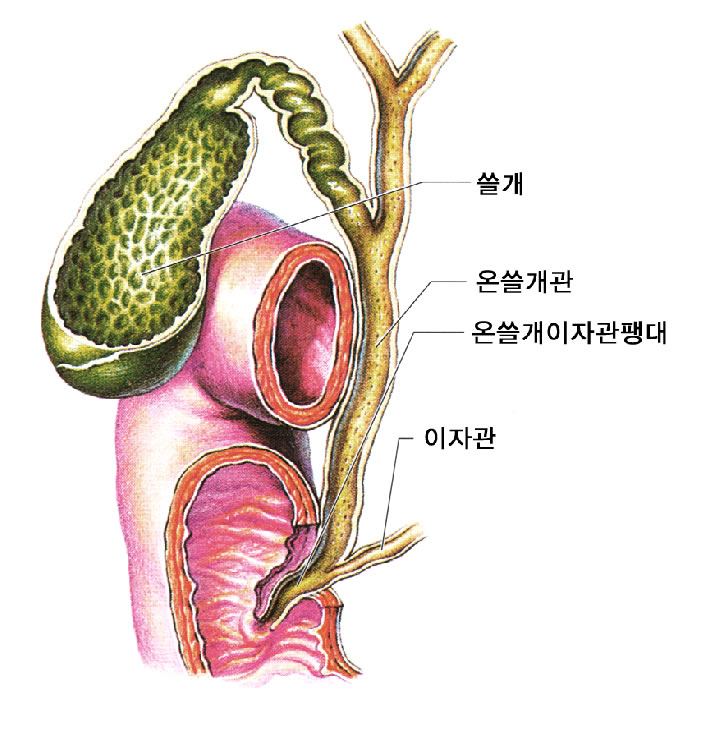 간에서 만들어진 쓸개즙을 수송하는 관조직의 일부. 간에서 만들어진 담즙은 간관, 쓸개관을 거쳐서 쓸개에 보관되었다가 온쓸개관을 통해서 샘창자로 보내진다. 이처럼 간에서 만들어진 담즙이 샘창자까지 배설되는 길로서 길이는 6~7cm 이며 간관, 쓸개관, 온쓸개관 따위로 이루어져 있다. |
||
| 영문 | urinary tract | 한글 | 요로 |
|---|---|---|---|
| 설명 | 오줌을 몸 밖으로 배출하기 위한 길. 콩팥, 요관, 방광, 요도로 이루어져 있다. |
||
| ECG | Electro-Cardio-Graphy(-Gram); 심전도 = EKG 1. Conducting System Structu... |
|---|---|
| ATA | alimentary toxic aleukia; American Thyroid Association; aminotriazole; antithymic activity; antithyr... |
| BAPV | bovine alimentary papilloma virus |
| LRI | lamina rara interna; lower respiratory [tract] illness; lower respiratory [tract] infection; lymphoc... |
| LRTI | lower respiratory tract illness; lower respiratory tract infection |
| CARDIAC | Cardiovascular Disease and Alimentary Comparison |
|---|---|
| ppm | parts/million |
| MBI | Maslach Burn-out Inventory |
| PBD | post burn days |
| % TBSA | Total burn surface area |
| alimentary tract | The passage leading from the mouth to the anus through the pharynx, oesophagus, stomach, and intestine. Synonym: alimentary canal, alimentary tract, digestive tube, tubus digestorius. (05 Mar 2000) |
|---|---|
| alimentary tract smear | A group of cytologic specimens containing material from the mouth (oral smear), oesophagus and stomach (gastric smear), duodenum (paraduodenal smear), and colon, obtained by specialised lavage techniques; used principally for the diagnosis of cancer of those areas. (05 Mar 2000) |
| parts of human body | The head, neck, trunk, and limbs. Synonym: partes corporis humani. (05 Mar 2000) |
| soft parts | The nonbony and noncartilaginous tissues of the body. (05 Mar 2000) |
| other-directed | Pertaining to a person readily influenced by the attitudes of others. (05 Mar 2000) |
| transferases (other substituted phosphate groups) | <enzyme> A class of enzymes that transfers substituted phosphate groups. Registry number: EC 2.7.8 (12 Dec 1998) |
| alimentary | <gastroenterology> Pertaining to food or nutritive material or to the organs of digestion. (18 Nov 1997) |
| alimentary apparatus | The organs that are responsible for getting food into and out of the body and for making use of food to keep the body healthy. These include the mouth, oesophagus, stomach, liver, gallbladder, pancreas, small intestine, colon, and rectum. (12 Dec 1998) |
| alimentary canal | <anatomy> The digestive tract. (27 Sep 1997) |
| alimentary diabetes | Glycosuria developing after the ingestion of a moderate amount of sugar or starch, which normally is disposed of without appearing in the urine, because rate of intestinal absorption exceeds capacity of the liver and the other tissues to remove the glucose, thus allowing blood glucose levels to become high enough for renal excretion to occur. Synonym: alimentary diabetes, digestive glycosuria. (05 Mar 2000) |
| alimentary glycosuria | Glycosuria developing after the ingestion of a moderate amount of sugar or starch, which normally is disposed of without appearing in the urine, because rate of intestinal absorption exceeds capacity of the liver and the other tissues to remove the glucose, thus allowing blood glucose levels to become high enough for renal excretion to occur. Synonym: alimentary diabetes, digestive glycosuria. (05 Mar 2000) |
| alimentary lipaemia | Relatively transient lipaemia occurring after the ingestion of foods with a large content of fat. Synonym: postprandial lipaemia. (05 Mar 2000) |
| alimentary osteopathy | Bone disease due to dietary deficiency. (05 Mar 2000) |
| alimentary system | The organs that are responsible for getting food into and out of the body and for making use of food to keep the body healthy. These include the mouth, oesophagus, stomach, liver, gallbladder, pancreas, small intestine, colon, and rectum. (12 Dec 1998) |
| broadcast burn | Controlled fire over the entire surface of a designated area. (05 Dec 1998) |
제품명 |
판매사 |
보험코드 | 성분/함량 | 구분/보험급여 |
|---|
제품명 |
판매사 |
보험코드 | 성분/함량 | 구분/보험급여 |
|---|