
| 영문 | Apgar score | 한글 | 아프가점수 |
|---|---|---|---|
| 설명 | 신생아의 건강 상태를 알아보기 위해서 태어나자마자 시행하는 검사. 신생아의 피부색깔, 심박수, 호흡, 근육의 힘, 자극에 대한 반응 등의 5가지 항목을 검사하며 각 항목당 2점씩으로 채점하여 10점 만점으로 한다. 10점 만점인 경우가 가장 좋으며, 6점이하인 경우엔 태아의 가사 상태를 의미하며 즉시 응급처치가 필요하다. 아프가점수의 채점은 생후 1분과 5분에 각각 두번 판정하여 점수를 낸다. 생후 1 분에 측정한 아프가점수는 신생아의 가사의 유무를 판단하여 응급 처치의 필요성 여부를 조사하는 지표가 되며, 생후 5분에 측정한 아프가점수는 신생아의 예후를 판정하는데 좋은 지표가 된다. 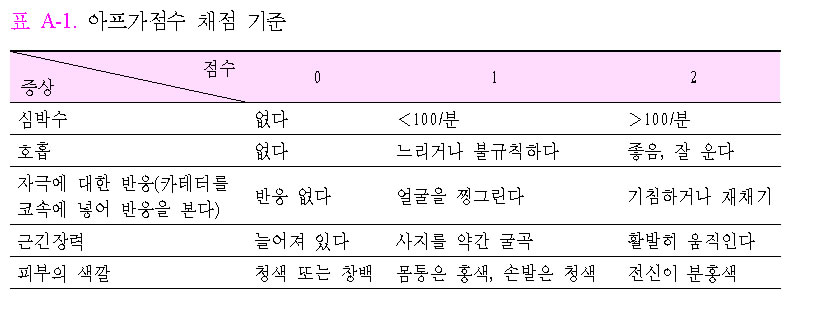 |
||
| APGAR | American Pediatric Gross Assessment Record |
|---|
| apgar | Short for Apgar score. (12 Dec 1998) |
|---|---|
| APGAR score | <paediatrics> A recording of the physical health of a newborn infant, determined after examination of the adequacy of respiration, heart action, muscle tone, skin colour and reflexes. Total numerical score is 10. (10 Jan 1998) |
| Apgar, Virginia | <person> U.S. Anaesthesiologist, 1909-1974. See: Apgar score. (05 Mar 2000) |
| score, apgar | A practical method to assess a newborn infant, the Apgar score is a number arrived at by scoring the heart rate, respiratory effort, muscle tone, skin colour, and response to a catheter in the nostril. Each of these objective signs can receive 0, 1, or 2 points. An apgar score of 10 means an infant is in the best possible condition. The apgar score is done routinely 60 seconds after the complete birth of the infant. An infant with a score of 0-3 needs immediate resusitation. The apgar score is commonly repeated 5 minutes after birth and in the event of a difficult resusitation, the apgar may be done again at 10, 15, and 20 minutes. An apgar score of 0-3 at 20 minutes of age is predictive of high morbidity (disease) and mortality. The score is named for the american anaesthesiologist virginia apgar (1909-1974) at columbia university in new york who originated the scoring method. (12 Dec 1998) |
제품명 |
판매사 |
보험코드 | 성분/함량 | 구분/보험급여 |
|---|
제품명 |
판매사 |
보험코드 | 성분/함량 | 구분/보험급여 |
|---|