
| 영문 | tumor | 한글 | 종양 |
|---|---|---|---|
| 설명 | 조절할 수 없이 계속 진행되는 세포분열에 의한 조직의 새로운 증식 및 증대. 신생물. (1) 분류 A. 침윤과 전이의 유무에 따라 i)양성종양: 침윤과 전이가 없고 역형성이 낮은 세포로 구성됨. 대개 치료에 반응이 높고, 생명에 크게 지장이 없으며, 재발하는 경우도 적다. 증상은 단지 주위조직에 대한 압박정도이다. ii)악성종양: 침윤과 전이가 있고 퇴화도가 높은 세포로 구성됨. 기원세포가 상피조직일 경우 암종, 비상피성일 경우 육종으로 나누기도 한다. 치료에 잘 반응하지 않고, 재발을 잘 하며, 생존율이 낮다. 흔히 말하는 “암”을 의미한다. B. 조직학적 특징에 따라 샘종, 지방종, 근종 등으로 나누기도 한다. (2) 병리조직학적 특징 A. 육안적 소견 덩어리를 형성하기도 하고 정상조직에 스며들듯이 판상구조를 이루기도 하는 등 다양한 형태를 보인다. 양성의 경우 피막을 가진 경우가 많고 악성의 경우 없는 경우가 많다. 육안소견에 따라 다음과 같이 나눈다. 낭성, 융기성, 괴사성, 폴립모양, 궤양형 등이 있다. 또는 세포의 크기와 모양이 비정상적인 형태로 변화한다. 핵의 극성이 사라지고 핵의 염색성이 짙어진다. 세포질의 염색성도 변화하며 세포들간의 세포주기가 매우 다양해져 많은 세포분열을 보인다. 이러한 일련의 변화를 역형성이라 한다. 역형성의 정도에 따라 조직학적 등급을 나눈다. 또한 각 종양에 따라 각기 다른 병리조직학적 명칭을 붙인다. |
||
| 영문 | muscle cell(=muscle fiber) | 한글 | 근육세포 |
|---|---|---|---|
| 설명 | 근육은 수의근(의식에 의해서 조절이 가능한 근육: 예를 들어 다리, 팔, 얼굴근육 등)과 불수의근(의식과 무관하게 조절하지 않아도 움직이는 근육: 예를 들어 심장근, 소화기관에 분포하는 근육 등)으로 나누어지며, 근육세포의 모양은 다음과 같다(수의근, 불수의근 외에 심장에 있는 심장근은 불수의근에 해당하지만 그 모양은 수의근과 같아 따로 분류한다).  |
||
| 영문 | white blood cell(WBC), leukocyte | 한글 | 백혈구 |
|---|---|---|---|
| 설명 | 혈액내에 골수구계세포와 림프계세포, 단핵구계세포를 모두 통틀어 말한다. 백혈구의 증가가 있으면 대개 감염이 있거나, 혹은 탈수현상이 있음을 의미한다. 또한 지나친 백혈구수의 감소는 인체내 면역기능이 떨어져 있음을 의미하며, 다른 질병에 의해 나타나는 이차적인 현상이 아닌지 꼭 진단을 받아보아야 한다. |
||
| 영문 | mast cell | 한글 | 비만 세포 |
|---|---|---|---|
| 설명 | 동물의 결합 조직 가운데 널리 분포하는 세포. 결합조직과 점막조직 내에 있는 호염기성 색소로 이염색성(metachromasia)을 나타내는 과립을 가진 방추형의 세포에 작은 둥근 핵을 가진다. 비만세포의 표면에는 IgE에 대한 수용체가 존재하며, 수용체에 결합한 IgE 분자들끼리 다가의 항원에 의해 서로 연결되면 비만세포 과립탈출 반응이 일어나, 히스타민, 세로토닌, 헤파린 등의 화학전달 물질이 방출되어, 즉시형 알레르기 반응 등의 증상을 일으킨다. 피부, 장막, 혈관 주위, 점막 주변에 있다. |
||
| 영문 | cell | 한글 | 세포 |
|---|---|---|---|
| 설명 | 생명체를 이루는 구조적, 기능적 단위. 핵의 유무에 따라서 유핵세포와 무핵세포로 나눌 수가 있다. 무핵세포란 핵이 없는 세포를 말한다. 핵이란 유전정보를 가지고 있는 염색체를 보관하는 곳인데 무핵세포에서는 염색체가 세포속에 그냥 노출되어 있다. 대개 세포 하나하나가 독립된 생명체의 역할을 하는 단세포생물로서 외부환경으로부터 자신을 보호할 수 있는 견고한 세포벽을 가지고 있다. 유핵세포란 핵을 가지고 있어서 유전정보가 있는 염색체가 세포의 다른 부분과 구분되어 핵속에 들어있다. 세포속에서 핵외의 부분(이를 세포질이라 한다)에는 여러 가지 세포의 소기관이 있어서 세포의 다양한 기능을 분담한다. ◈유핵세포의 기본 구조 1.세포막-세포를 둘러싸서 주위환경과 분리하여 세포의 내환경을 유지한다. 2.형질내세망(endoplasmic reticulum)-단위막으로 둘러쌓여 있는 불규칙한 망상구조이다. 이 망상구조의 내부를 소강, 소조라고 부른다. 여기에는 표면이 매끈한 무과립형질내세망과 표면이 불규칙한 과립형질내세망의 두 가지가 있다. 과립형질내세망의 경우는 표면에 단백질을 합성하는 리보솜이라는 것이 부착되어 있다. 이곳은 주로 세포밖으로 분비할 단백질을 합성하는 장소이다. 무과립형질내세망은 표면에 리보솜이 부착되어 있지 않은 것을 말하며, 이곳에서는 주로 해독작용, 글리코겐의 합성, 스테로이드호르몬의 합성 등이 일어난다. 3.리보솜-단백질을 합성하는 역할을 하는 곳이다.이것은 세포질에 존재하는 자유리보솜과 과립형질내세망에 부착이 되어 존재하는 부착리보솜의 두 가지로 나눈다. 자유리보솜은 주로 세포내에서 필요한 단백질을 만드는 역할을 하고 부착리보솜은 세포밖으로 분비할 단백질을 만드는 역할을 한다. 4.골지장치(Golgi apparatus)-핵주위에 분포하는 납작해진 주머니모양의 것이 중첩되어 형성된 층판 모양의 구조물로 과립형질내세망에서 생성되어 외부로 분비될 단백질을 모아서 농축, 포장하여 과립을 만드는 역할을 한다. 5.사립체(mitochondria)-구형, 난형의 긴 막대기 모양으로 크기가 다양한 구조물. 생물체의 에너지 저장물질인 ATP를 생산하는 역할을 한다. 또 세포와 다른 자신만의 유전정보를 가진 DNA, RNA를 가지고 있다. 모양, 크기가 세균과 비슷하며 자체증식성 등 독립된 생명체로서 필요한 요건을 갖추고 있어서 세포와 공생관계를 가진 독립된 세포로 생각하고 있다. 6.용해소체(lysosome)-작은 구형의 소체로 여러 가지 분해효소를 가진다. 세포외계에서 들어온 물질과 결합하여 그 물질들을 용해하는 역할을 하고, 오래된 세포소기관들을 제거하는 역할도 한다. 7.세포핵(nucleus)-구형, 난형으로 세포의 중심에 위치한다. 핵내에는 유전정보가 있는 물질인 염색체가 존재한다. 8.중심소체(centrosome)-핵주위에 존재하면서 핵의 분열시에 양쪽의 염색체를 당기는 작은 섬유를 만드는 역할을 하는 곳. 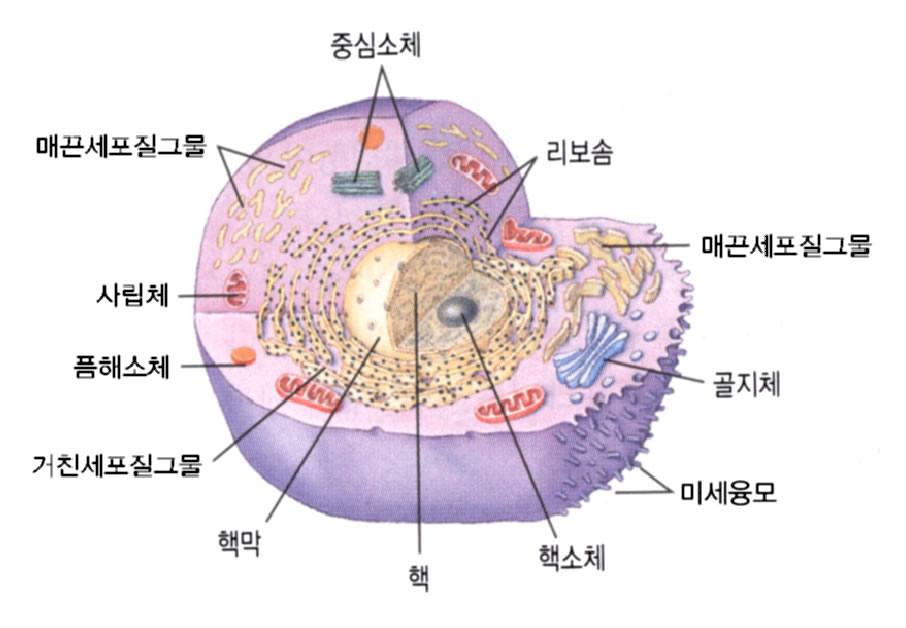 |
||
| ICT | icteric, icterus; indirect Coombs test; inflammation of connective tissue; insulin coma therapy; int... |
|---|---|
| SS | disulfide; sacrosciatic; saline soak; saline solution; saliva sample; saliva substitute; Salmonella-... |
| GC | ganglion cell; gas chromatography; general circulation; general closure; general condition; generali... |
| LCCSCT | large-cell calcifying Sertoli cell tumor |
| CPA tumor | Cerebello-Pontine Angle(소뇌교각부) tumor |
| steroid hydroxylases | <enzyme> Registry number: EC 1.14.- (12 Dec 1998) |
|---|---|
| steroid isomerases | <enzyme> Enzymes that catalyze the transposition of double bond(s) in a steroid molecule. Registry number: EC 5.3.3.- (12 Dec 1998) |
| steroid metabolic clearance rate | A measure of the rate of metabolism of a given steroid within the body, usually expressed as liters of body fluid that contain the amount of steroid metabolised per day. (05 Mar 2000) |
| steroid monooxygenases | Enzymes catalyzing addition of hydroxyl groups to the steroid rings utilizing O2; differentiated into, for example, steroid 11b-monooxygenase, steroid 17a-monooxygenase, and steroid 21-monooxygenase, in accordance with the position of the catalytically introduced hydroxyl group. Synonym: steroid hydroxylases. (05 Mar 2000) |
| steroid N-acetylglucosaminyltransferase | <enzyme> Substrate steroids may be replaced by specific cpds Registry number: EC 2.4.1.- (26 Jun 1999) |
| steroid nucleus | tetracyclic steroid nucleus |
| steroid production rate | The total quantity of a given steroid formed in the body, usually expressed as milligrams per day; represents the sum of the glandular secretion of the steroid and extraglandular formation of it from various steroid precursors. (05 Mar 2000) |
| steroid receptor | Family of nuclear transcription factors, most of which are receptors for hormones of the steroid family, for example androgen, oestrogen, glucocorticoid, mineralocorticoid, progesterone, retinoic acid, ecdysone, thyroid hormone and the Drosophila transcription factors knirps, ultraspiracle and seven up. This family contains a conserved domain (the steroid finger motif) containing two C4 type zinc fingers. (18 Nov 1997) |
| steroid secretory rate | The rate of glandular secretion of a given steroid, usually expressed as milligrams per day; does not include any amount of the steroid that might be formed extraglandularly. (05 Mar 2000) |
| steroid sulfatase deficiency | A form of ichthyosis, due to 3-beta-hydroxysteroidsulfate sulfatase deficiency, that appears at birth or in early infancy and affects males; characterised by scaling predominantly on the neck and trunk but not on the palms and soles; histologically, there is hyperkeratosis, a granular layer in the epidermis, and normal epidermal cell turnover. Synonym: steroid sulfatase deficiency. (05 Mar 2000) |
| steroid sulfotransferase | <enzyme> Catalyses the reaction of 3'-phosphoadenylyl sulfate and a phenolic steroid to form adenosine 3',5'-bisphosphate and steroid o-sulfate; has broad specificity Registry number: EC 2.8.2.15 Synonym: phenolic steroid sulfotransferase (26 Jun 1999) |
| steroid ulcer | An ulcer, usually on the leg or foot, developing from a wound in patients undergoing long-term steroid therapy; results from the wound-healing inhibitory effects characteristic of steroids. (05 Mar 2000) |
| steroid withdrawal syndrome | <syndrome> A condition exhibited by persons who previously had been receiving large therapeutic doses of glucocorticoid hormones for long periods of time; pituitary-adrenocortical insufficiency is manifested, particularly during stress, for as long as a year or more thereafter and varying degrees of emotional disturbance may be exhibited. (05 Mar 2000) |
| 17-ketogenic steroid assay test | A colourimetric test, based on the Zimmermann reaction, which indicates metabolites or adrenal and testicular steroids excreted as 17-ketones in the urine; increased values are most striking in adrenocortical tumours, decreased values in Addison's disease or in panhypopituitarism. Synonym: ketogenic corticoids test. (05 Mar 2000) |
| 3 beta-hydroxy-delta 5-C(27)-steroid dehydrogenase | <enzyme> Second enzyme in the sequence that converts cholesterol to bile acids; deficiency leads to chronic liver disease in childhood Registry number: EC 1.1.1.- Synonym: 7 alpha-hydroxycholesterol 3 beta-dehydrogenase, 7-hydroxycholesterol 3-dehydrogenase, 3 beta-hydroxy-delta(5)-c(27)-steroid oxidoreductase, 5-cholestene-3beta,7alpha-diol oxidase (26 Jun 1999) |