
| 영문 | heart | 한글 | 심장 |
|---|---|---|---|
| 설명 | 심장은 가슴의 중앙에 위치하며 오른쪽과 왼쪽반으로 나눌 수 있다. 각각은 정맥에서 피가 들어오는 방과 동맥으로 피를 내보내는 실이 있다. 심장은 정중앙선에서 왼쪽에 놓여 있다. 심장의 2개의 심방과 2개의 심실, 그리고 심방사이의 심방중격, 심실사이의 심실중격이 존재한다. 심실은 혈액을 주로 순환시키는 힘을 내는 곳으로 강한 근육층이 존재를 한다. 반면에 심방은 심실에 들어가기전에 일시적으로 피가 모이는 곳으로 근육층의 발달이 미약하다. 심방과 심실사이에 삼첨판과 승모판, 심실의 유출로에 대동맥판과 폐동맥판이 있다. 이것들은 혈액이 흐르는 방향에 거슬러 진행하는 것을 막는 기능을 한다. 그리고 심장에는 심장의 근육에 혈액을 공급하는 관상동맥이 있다. 이 심장동맥은 심장을 쌓듯이 존재한다. 심장박동의 신호는 특수한 장치에 의해서 발생이 되고 특수한 전도계를 통해서 전체의 심장으로 전도된다. 심장박동의 신호는 우선 우심방에 위치하는 동방결절(SA node)라는 곳에서 우선 생긴다. 여기에서 보내는 전기적 신호가 바로 심장을 뛰게하는 신호인 것이다. 이 신호로 말미암아 심방이 우선 수축을 한다. 그리고는 심방과 심실사이에 위치하는 방실결절(AV node)라는 곳에 일정하게 정해진 통로없이 전체의 심방을 통해서 전달이 되고 이 신호를 받은 방실결절(AV node)는 히스 다발(His bundle)과 심장전도근육섬유를 통해서 심실의 심장근육에게 이 신호를 보내주어 심실근육을 수축하게 한다. 히스다발과 심장전도근육섬유는 전체의 심실의 심근섬유에 동시에 전기적 신호를 보내어 줄 수 있게 하는 일종의 전기줄과 같은 역할을 한다. 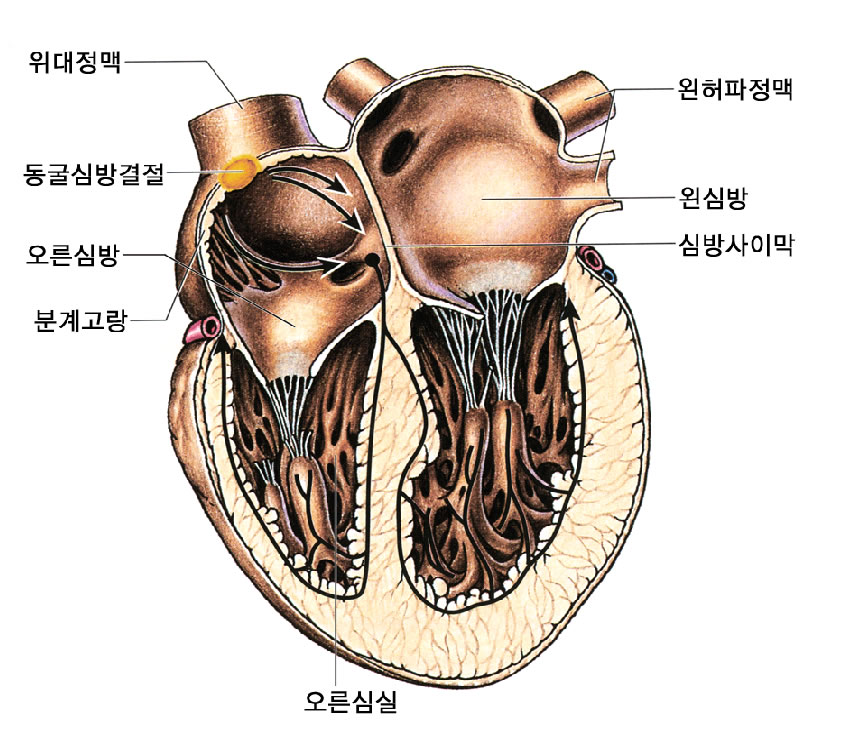 |
||
| 영문 | heart failure | 한글 | 심장기능상실 |
|---|---|---|---|
| 설명 | 몸의 조직이나 기관에서 대사에 필요한 만큼 충분한 양의 혈액을 공급할 수 없을 정도로 심장기능이 저하되어 있는 상태이다. 심장기능상실은 심근이 수축할 능력이 저하되었을 때나 심장에 심박출을 하기 위한 압력이 정상보다 증가되어 정상의 심장의 수축으로는 충분한 양의 혈액을 공급할 수 없는 경우, 그리고 심장근육, 심장에 걸리는 압력은 정상이나 심장박동의 이상에 의해서 정상적인 수축이 불가능할 경우에 생긴다. |
||
| 영문 | pacemaker(of heart) | 한글 | 심장박동기 |
|---|---|---|---|
| 설명 | 심장의 전기적 자극이 병적인 상태로 발생하지 않거나, 혹은 심실로 잘 전해지지 않을 때 사용한다. 일시적 심장박동기와 영구적 심장박동기가 있으며, 각기 쓰이는 용도는 병에 따라 다르다. 요즘에 나오는 심장 박동기는 건전지의 수명도 반영구적이며, 밖에서 조정할 수 있고, 운동이나 스트레스 상황에 대한 심장의 빠른 운동에도 잘 적응할 수 있도록 만들어져 있다. |
||
| 영문 | heart disease | 한글 | 심장병 |
|---|---|---|---|
| 설명 | 순환기 질환 중 심장의 병. 일반적으로 심장혈관이나 심장의 병도 포함된다. 병터의 부위에 의한 병리해부학적 분류와 병인에 의한 분류가 있다. 전자는 수 십 년 전부터 쓰여져 왔으나 근년에 와서 본질적인 원인요법이 가능하게 된 이후는 후자의 분류가 의의가 있어서 많이 쓰이게 되었다. 병터 부위로는 심내막(판막)-심장근-심장막, 그 밖의 것을 들 수 있으며, 각각 심내막염-심장판막증-심근염-심근경색-심장막염-선천성 심장병(심장기형) 등이포함된다. 병인별에서는 심장기형을 비롯하여 류마치스 심장병-매독성 심장병-고혈압성 심장병-심장동맥경화성 심장병-폐성심장-세균성 심내막염-심장신경증 등으로 나누어지며, 부정맥이나 방실차단 등의 자극전도계의 장애에 의한 것도 증세의 하나로 볼 수 있다. 심장병은 자각적으로는 무증세인 것에서부터 심장기능상실로 호흡곤란까지 있다. |
||
| 영문 | septal defects of heart | 한글 | 심장의 중격 결손 |
|---|---|---|---|
| 설명 | 선천적으로 심장 내의 심방사이중격(interatrial septum)이나 심실사이중격(interventricular septum)이 결손되어 혈류가 정상적으로 흐르지 않는 경우. 정상적인 경우 혈류는 정맥에서 우심방으로 모여 우심실을 거친뒤 폐로 가서 산소를 공급받고 다시 왼심방, 왼심실을 차례로 거쳐 대동맥으로 간다. 하지만, 이 경우는 혈류가 압력이 높은 왼심방이나 왼심실에서 압력이 낮은 우심방이나 우심실로 흐르게 된다. 따라서 동맥피와 정맥피가 섞이게 되고, 환자는 호흡곤란, 성장발육장애, 심잡음 등이 나타나고, 심한 경우 청색증으로 발전하기도 한다. 치료는 수술적으로 이 결손부위를 막아 주어야 한다. |
||
| NYHA | New York Heart Association Heart Disease에 대한 Functional Classification &nbs... |
|---|---|
| AHA | acetohydroxamic acid; acquired hemolytic anemia; acute hemolytic anemia; American Heart Association;... |
| ASHD | arteriosclerotic heart disease; atrioseptal heart disease |
| CHB | chronic hepatitis B; complete heart block; congenital heart block |
| CHF | chick embryo fibroblast; chronic heart failure; congenital hepatic fibrosis; congestive heart failur... |
| parathyroid hormone | <hormone> A peptide hormone of 84 amino acids (9402 D). Stimulates osteoclasts to increase blood calcium levels, the opposite effect to calcitonin. (18 Nov 1997) |
|---|---|
| releasing hormone | Hormones produced by the hypothalamus whichstimulate the release of other hormones in the pituitary gland. (09 Oct 1997) |
| glycoprotein hormone-specific N-acetylgalactosamine transferase | <enzyme> Transfers galnac to the terminal glcnac moieties of glcnac2man3glcnac2asn Registry number: EC 2.4.1.- Synonym: ghs-acgalnh2 transferase, glycoprotein hormone galnac transferase, glycoprotein hormone - n-acetylgalactosaminyltransferase (26 Jun 1999) |
| melanocyte-stimulating hormone | <endocrinology> A releasing hormone produced in the mammalian hypophysis and related structures in lower vertebrates. Made up of _ MSH (1665D), the same as amino acids 1-13 of ACTH and _ MSH (18 amino acids, 22 in humans). Causes darkening of the skin by expansion of the melanophores but its role in mammals is unclear. Synonym: melanotropin. Acronym: MSH (22 Sep 2002) |
| melanotropin release-inhibiting hormone | Inhibits synthesis and release of melanotropin. Synonym: melanotropin release-inhibiting hormone. Origin: melanotropin + G. States, stationary, + -in (05 Mar 2000) |
| melanotropin-releasing hormone | A hexapeptide similar to oxytocin; it stimulates the release of melanotropin. Synonym: melanotropin-releasing factor, melanotropin-releasing hormone. Origin: melanotropin + L. Libero, to free, + -in (05 Mar 2000) |
| peptide hormone inactivating endopeptidase | <enzyme> From xenopus laevis; cleaves at xaa-phe, xaa-leu or xaa-ile bonds where xaa = ser, phe, tyr, his or gly in peptide hormones Registry number: EC 3.4.24.- Synonym: phie, xenopus (26 Jun 1999) |
| gonadotrophin-releasing hormone | <hormone> The peptide hormone that control reproductive function. It produced and released by the hypothalamus and controls the production and release of gonadotrophins from the pituitary gland. It causes the production of luteinising hormone and follicle-stimulating hormone. Synonym: gonadotropin-releasing factor, gonadotropin-releasing hormone, luteinizing hormone/follicle-stimulating hormone-releasing factor, gonadoliberin. Origin: Gonad + L. Libero, to free, + -in (19 Sep 2002) |
| gonadotropic hormone | <endocrinology, hormone> A hormone capable of promoting gonadal growth and function. The effects are usually limited to discrete functions or histological components of a gonad, such as stimulation of follicular growth or of androgen formation. Most gonadotrophin's exert their effects in both sexes, although the effect of a given gonadotrophin will differ in males and females. Synonym: gonadotropin, gonadotropic hormone. Origin: for gonadotrophin, fr. Gonad + G. Trophe, nourishment (12 Sep 2002) |
| gonadotropin-releasing hormone | <hormone> The peptide hormone that control reproductive function. It produced and released by the hypothalamus and controls the production and release of gonadotrophins from the pituitary gland. It causes the production of luteinising hormone and follicle-stimulating hormone. Synonym: gonadotropin-releasing factor, gonadotropin-releasing hormone, luteinizing hormone/follicle-stimulating hormone-releasing factor, gonadoliberin. Origin: Gonad + L. Libero, to free, + -in (19 Sep 2002) |
| growth hormone | <endocrinology, hormone> Polypeptide (191 amino acids) produced by anterior pituitary that stimulates liver to produce somatomedins 1 & 2. (13 Nov 1997) |
| growth hormone-producing adenoma | <tumour> An adenoma that produces the clinical picture of gigantism or acromegaly, although a third of the cells have no granules or are a mixture of acidophils and chromophobes; some tumours may secrete both growth hormone and prolactin; often an acidophil or eosinophil adenoma. (05 Mar 2000) |
| growth hormone-releasing factor | <endocrinology> Peptide hormone related to the glucagon family, released from the pituitary, acts on the adenohypophysis to release growth hormone. Synonym: somatoliberin, growth hormone-releasing factor. (20 Sep 2002) |
| growth hormone stimulation test | <investigation> A test which measures the level of human growth hormone in response to the administration of the amino acid arginine. This test measures the ability of the pituitary gland to secrete growth hormone. Normal values in children are: 48 ng/ml. Normal values in men are 10 ng/ml. Normal values in women are 15 ng/ml. This test is used to evaluate infants with growth retardation. It may also be part of an evaluation for a pituitary tumour. Failure of arginine to raise growth hormone levels may indicate hypopituitarism or dwarfism. (27 Sep 1997) |
| growth hormone suppression test | <investigation> A test to determine if growth hormone is suppressed by hyperglycaemia. Growth hormone blood levels are determined sequentially after ingestion of a glucose-rich meal. If growth hormone levels remain elevated (after the glucose is given) then acromegaly or gigantism is suspected. (27 Sep 1997) |