
| 영문 | muscle cell(=muscle fiber) | 한글 | 근육세포 |
|---|---|---|---|
| 설명 | 근육은 수의근(의식에 의해서 조절이 가능한 근육: 예를 들어 다리, 팔, 얼굴근육 등)과 불수의근(의식과 무관하게 조절하지 않아도 움직이는 근육: 예를 들어 심장근, 소화기관에 분포하는 근육 등)으로 나누어지며, 근육세포의 모양은 다음과 같다(수의근, 불수의근 외에 심장에 있는 심장근은 불수의근에 해당하지만 그 모양은 수의근과 같아 따로 분류한다).  |
||
| 영문 | white blood cell(WBC), leukocyte | 한글 | 백혈구 |
|---|---|---|---|
| 설명 | 혈액내에 골수구계세포와 림프계세포, 단핵구계세포를 모두 통틀어 말한다. 백혈구의 증가가 있으면 대개 감염이 있거나, 혹은 탈수현상이 있음을 의미한다. 또한 지나친 백혈구수의 감소는 인체내 면역기능이 떨어져 있음을 의미하며, 다른 질병에 의해 나타나는 이차적인 현상이 아닌지 꼭 진단을 받아보아야 한다. |
||
| 영문 | mast cell | 한글 | 비만 세포 |
|---|---|---|---|
| 설명 | 동물의 결합 조직 가운데 널리 분포하는 세포. 결합조직과 점막조직 내에 있는 호염기성 색소로 이염색성(metachromasia)을 나타내는 과립을 가진 방추형의 세포에 작은 둥근 핵을 가진다. 비만세포의 표면에는 IgE에 대한 수용체가 존재하며, 수용체에 결합한 IgE 분자들끼리 다가의 항원에 의해 서로 연결되면 비만세포 과립탈출 반응이 일어나, 히스타민, 세로토닌, 헤파린 등의 화학전달 물질이 방출되어, 즉시형 알레르기 반응 등의 증상을 일으킨다. 피부, 장막, 혈관 주위, 점막 주변에 있다. |
||
| 영문 | cell | 한글 | 세포 |
|---|---|---|---|
| 설명 | 생명체를 이루는 구조적, 기능적 단위. 핵의 유무에 따라서 유핵세포와 무핵세포로 나눌 수가 있다. 무핵세포란 핵이 없는 세포를 말한다. 핵이란 유전정보를 가지고 있는 염색체를 보관하는 곳인데 무핵세포에서는 염색체가 세포속에 그냥 노출되어 있다. 대개 세포 하나하나가 독립된 생명체의 역할을 하는 단세포생물로서 외부환경으로부터 자신을 보호할 수 있는 견고한 세포벽을 가지고 있다. 유핵세포란 핵을 가지고 있어서 유전정보가 있는 염색체가 세포의 다른 부분과 구분되어 핵속에 들어있다. 세포속에서 핵외의 부분(이를 세포질이라 한다)에는 여러 가지 세포의 소기관이 있어서 세포의 다양한 기능을 분담한다. ◈유핵세포의 기본 구조 1.세포막-세포를 둘러싸서 주위환경과 분리하여 세포의 내환경을 유지한다. 2.형질내세망(endoplasmic reticulum)-단위막으로 둘러쌓여 있는 불규칙한 망상구조이다. 이 망상구조의 내부를 소강, 소조라고 부른다. 여기에는 표면이 매끈한 무과립형질내세망과 표면이 불규칙한 과립형질내세망의 두 가지가 있다. 과립형질내세망의 경우는 표면에 단백질을 합성하는 리보솜이라는 것이 부착되어 있다. 이곳은 주로 세포밖으로 분비할 단백질을 합성하는 장소이다. 무과립형질내세망은 표면에 리보솜이 부착되어 있지 않은 것을 말하며, 이곳에서는 주로 해독작용, 글리코겐의 합성, 스테로이드호르몬의 합성 등이 일어난다. 3.리보솜-단백질을 합성하는 역할을 하는 곳이다.이것은 세포질에 존재하는 자유리보솜과 과립형질내세망에 부착이 되어 존재하는 부착리보솜의 두 가지로 나눈다. 자유리보솜은 주로 세포내에서 필요한 단백질을 만드는 역할을 하고 부착리보솜은 세포밖으로 분비할 단백질을 만드는 역할을 한다. 4.골지장치(Golgi apparatus)-핵주위에 분포하는 납작해진 주머니모양의 것이 중첩되어 형성된 층판 모양의 구조물로 과립형질내세망에서 생성되어 외부로 분비될 단백질을 모아서 농축, 포장하여 과립을 만드는 역할을 한다. 5.사립체(mitochondria)-구형, 난형의 긴 막대기 모양으로 크기가 다양한 구조물. 생물체의 에너지 저장물질인 ATP를 생산하는 역할을 한다. 또 세포와 다른 자신만의 유전정보를 가진 DNA, RNA를 가지고 있다. 모양, 크기가 세균과 비슷하며 자체증식성 등 독립된 생명체로서 필요한 요건을 갖추고 있어서 세포와 공생관계를 가진 독립된 세포로 생각하고 있다. 6.용해소체(lysosome)-작은 구형의 소체로 여러 가지 분해효소를 가진다. 세포외계에서 들어온 물질과 결합하여 그 물질들을 용해하는 역할을 하고, 오래된 세포소기관들을 제거하는 역할도 한다. 7.세포핵(nucleus)-구형, 난형으로 세포의 중심에 위치한다. 핵내에는 유전정보가 있는 물질인 염색체가 존재한다. 8.중심소체(centrosome)-핵주위에 존재하면서 핵의 분열시에 양쪽의 염색체를 당기는 작은 섬유를 만드는 역할을 하는 곳. 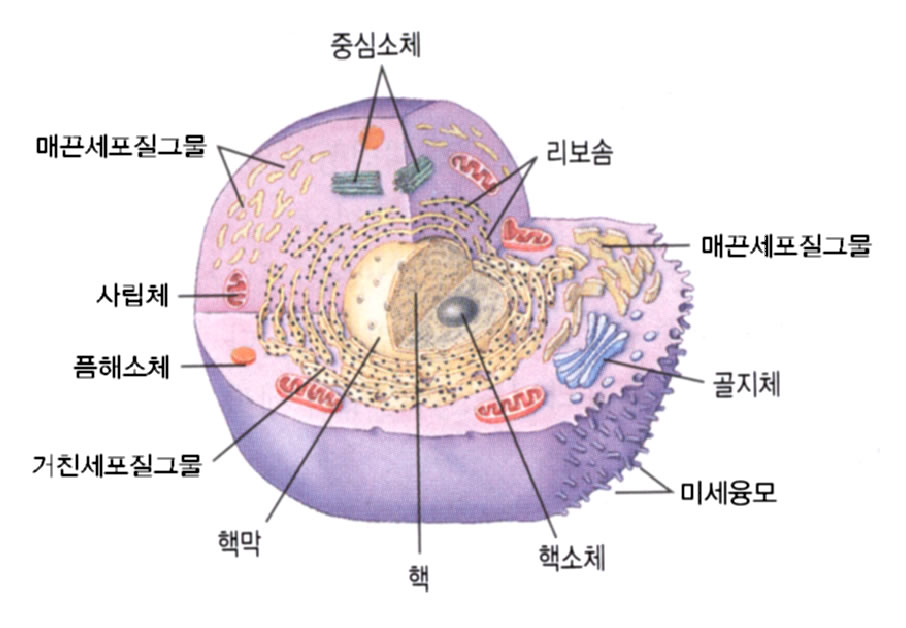 |
||
| 영문 | cell-mediated immunity | 한글 | 세포매개면역 |
|---|---|---|---|
| 설명 | 면역이란 신체를 외부의 물질로부터 보호하는 행위를 말한다. 여기에는 특이적 면역과 비특이적 면역의 두 가지가 있다. 비특이적 면역이라함은 특정한 물질에 관계하는 면역이 아니라 특정 대상이 없이 모든 외부 물체에 작용할 수 있는 면역을 말한다. 여기에는 소변의 흐름, 눈물의 흐름, 피부의 비투과성 등의 기계적인 것도 포함되고 피속에 돌아다니는 세포 중에서 비특이적으로 외부의 물질을 포식하는 세포들(예를 들면 큰포식세포(macrophage)의 활동도 포함이 된다. 세포매개면역이란 특이한 물질을 감지할 수 있는 세포를 생성하게 하여 그것으로 하여금 그 물질을 포식하게 하는 것을 말한다. |
||
| BM | Bachelor of Medicine; barium meal; basal medium; basal metabolism; basement membrane; basilar membra... |
|---|---|
| CCE | carboline carboxylic acid ester; chamois contagious ecthyma; clear-cell endothelioma; clubbing, cyan... |
| CCSK | clear cell sarcoma of the kidney |
| CL | capillary lumen; cardiolipin; cell line; centralis lateralis; chemiluminescence; chest and left arm ... |
| Cl | chloride; chlorine; clavicle; clear; clinic; Clostridium; closure; colistin |
| carcinoma, large cell | A tumour of undifferentiated (anaplastic) cells of large size. It is usually bronchogenic. (12 Dec 1998) |
|---|---|
| carcinoma, merkel cell | A carcinoma arising from merkel cells located in the basal layer of the epidermis and occurring most commonly as a primary neuroendocrine carcinoma of the skin. Merkel cells are tactile cells of neuroectodermal origin and histologically show neurosecretory granules. The skin of the head and neck are a common site of merkel cell carcinoma, occurring generally in elderly patients. (12 Dec 1998) |
| carcinoma, non-small-cell lung | A heterogeneous aggregate of at least three distinct histological types of lung cancer, including squamous cell carcinoma, adenocarcinoma, and large cell carcinoma. They are dealt with collectively because of the shared properties of poor response to conventional chemotherapy and the potential for cure with surgical resection in a fraction of patients. (12 Dec 1998) |
| carcinoma, renal cell | Carcinoma of the renal parenchyma usually occurring in middle age or later and composed of tubular cells in varying arrangements. It was first described in 1826. Possible causal factors are environmental, hormonal, cellular, and genetic. Smoking is a definite risk factor and obesity is associated with increased risk. Renal cell carcinoma accounts for approximately 3% of adult cancer; the male-female ratio is 2:1. It is more common among urban residents than rural. (12 Dec 1998) |
| carcinoma, signet ring cell | A highly malignant, mucus-secreting tumour in which the mucus-secreting cells are anaplastic and appear rounded, with the nucleus displaced to one side by a globule of mucus in the cytoplasm. (12 Dec 1998) |
| carcinoma, small cell | An anaplastic, highly malignant, and usually bronchogenic carcinoma composed of small ovoid cells with scanty neoplasm. It is characterised by a dominant, deeply basophilic nucleus, and absent or indistinct nucleoli. There are admixtures of small cell lung carcinoma with other types of lung cancer. Small cell carcinomas are distinguished by their distinctive biological features, response to chemotherapy and radiotherapy, and by their nearly universal tendency to develop overt or subclinical metastases, which frequently eliminates surgery in most patients. (12 Dec 1998) |
| carcinoma, squamous cell | A carcinoma derived from stratified squamous epithelium. It may also occur in sites where glandular or columnar epithelium is normally present. (12 Dec 1998) |
| carcinoma, transitional cell | A malignant neoplasm derived from transitional epithelium, occurring chiefly in the urinary bladder, ureters or renal pelves (especially if well differentiated), frequently papillary. Transitional cell carcinomas are graded 1 to 3 or 4 according to the degree of anaplasia, grade 1 appearing histologically benign but being liable to recurrence. (12 Dec 1998) |
| giant cell carcinoma | <tumour> A malignant epithelial neoplasm characterised by unusually large anaplastic cells. (05 Mar 2000) |
| giant cell carcinoma of thyroid gland | A rapidly progressive undifferentiated carcinoma observed in the thyroid gland, characterised by numerous, unusually large, anaplastic cells derived from glandular epithelium of the thyroid gland. (05 Mar 2000) |
| renal cell carcinoma | <oncology, tumour> The most common form of kidney cancer which occurs when the cells lining the renal tubule undergo cancerous changes. There are approximately 18,000 new cases of renal cell carcinoma (hypernephroma) per year in the U.S. With about 8,000 deaths annually. Smoking is considered a major risk factor. Kidney dialysis patients are at increased risk for the development of hypernephroma. Family history for renal cell carcinoma is also considered a risk factor. Symptoms include haematuria, flank pain, abdominal pain, back pain, weight loss and abdominal swelling. (27 Sep 1997) |
| Hurthle cell carcinoma | A neoplasm of the thyroid gland composed of polyhedral acidophilic cells, thought by some to be oncocytes; it may be benign or malignant, the behaviour of the latter depending on the general microscopic pattern, whether follicular, papillary, or undifferentiated. See: Hurthle cell adenoma. Synonym: Hurthle cell carcinoma. (05 Mar 2000) |
| signet-ring cell carcinoma | <tumour> A poorly differentiated adenocarcinoma composed of cells with a cytoplasmic droplet of mucus that compresses the nucleus to one side along the cell membrane; arises most frequently in the stomach, occasionally in the large bowel or elsewhere. (05 Mar 2000) |
| small cell carcinoma | <oncology, tumour> Common malignant neoplasm of bronchus. Cells of the tumour have endocrine like characteristics and may secrete one or more of a wide range of hormones, especially regulatory peptides like bombesin. (18 Nov 1997) |
| spindle cell carcinoma | <tumour> A carcinoma composed of elongated cells, frequently a poorly differentiated squamous cell carcinoma which may be difficult to distinguish from a sarcoma. Synonym: sarcomatoid carcinoma. (05 Mar 2000) |