
| 영문 | tumor | 한글 | 종양 |
|---|---|---|---|
| 설명 | 조절할 수 없이 계속 진행되는 세포분열에 의한 조직의 새로운 증식 및 증대. 신생물. (1) 분류 A. 침윤과 전이의 유무에 따라 i)양성종양: 침윤과 전이가 없고 역형성이 낮은 세포로 구성됨. 대개 치료에 반응이 높고, 생명에 크게 지장이 없으며, 재발하는 경우도 적다. 증상은 단지 주위조직에 대한 압박정도이다. ii)악성종양: 침윤과 전이가 있고 퇴화도가 높은 세포로 구성됨. 기원세포가 상피조직일 경우 암종, 비상피성일 경우 육종으로 나누기도 한다. 치료에 잘 반응하지 않고, 재발을 잘 하며, 생존율이 낮다. 흔히 말하는 “암”을 의미한다. B. 조직학적 특징에 따라 샘종, 지방종, 근종 등으로 나누기도 한다. (2) 병리조직학적 특징 A. 육안적 소견 덩어리를 형성하기도 하고 정상조직에 스며들듯이 판상구조를 이루기도 하는 등 다양한 형태를 보인다. 양성의 경우 피막을 가진 경우가 많고 악성의 경우 없는 경우가 많다. 육안소견에 따라 다음과 같이 나눈다. 낭성, 융기성, 괴사성, 폴립모양, 궤양형 등이 있다. 또는 세포의 크기와 모양이 비정상적인 형태로 변화한다. 핵의 극성이 사라지고 핵의 염색성이 짙어진다. 세포질의 염색성도 변화하며 세포들간의 세포주기가 매우 다양해져 많은 세포분열을 보인다. 이러한 일련의 변화를 역형성이라 한다. 역형성의 정도에 따라 조직학적 등급을 나눈다. 또한 각 종양에 따라 각기 다른 병리조직학적 명칭을 붙인다. |
||
| 영문 | muscle cell(=muscle fiber) | 한글 | 근육세포 |
|---|---|---|---|
| 설명 | 근육은 수의근(의식에 의해서 조절이 가능한 근육: 예를 들어 다리, 팔, 얼굴근육 등)과 불수의근(의식과 무관하게 조절하지 않아도 움직이는 근육: 예를 들어 심장근, 소화기관에 분포하는 근육 등)으로 나누어지며, 근육세포의 모양은 다음과 같다(수의근, 불수의근 외에 심장에 있는 심장근은 불수의근에 해당하지만 그 모양은 수의근과 같아 따로 분류한다).  |
||
| 영문 | white blood cell(WBC), leukocyte | 한글 | 백혈구 |
|---|---|---|---|
| 설명 | 혈액내에 골수구계세포와 림프계세포, 단핵구계세포를 모두 통틀어 말한다. 백혈구의 증가가 있으면 대개 감염이 있거나, 혹은 탈수현상이 있음을 의미한다. 또한 지나친 백혈구수의 감소는 인체내 면역기능이 떨어져 있음을 의미하며, 다른 질병에 의해 나타나는 이차적인 현상이 아닌지 꼭 진단을 받아보아야 한다. |
||
| 영문 | mast cell | 한글 | 비만 세포 |
|---|---|---|---|
| 설명 | 동물의 결합 조직 가운데 널리 분포하는 세포. 결합조직과 점막조직 내에 있는 호염기성 색소로 이염색성(metachromasia)을 나타내는 과립을 가진 방추형의 세포에 작은 둥근 핵을 가진다. 비만세포의 표면에는 IgE에 대한 수용체가 존재하며, 수용체에 결합한 IgE 분자들끼리 다가의 항원에 의해 서로 연결되면 비만세포 과립탈출 반응이 일어나, 히스타민, 세로토닌, 헤파린 등의 화학전달 물질이 방출되어, 즉시형 알레르기 반응 등의 증상을 일으킨다. 피부, 장막, 혈관 주위, 점막 주변에 있다. |
||
| 영문 | cell | 한글 | 세포 |
|---|---|---|---|
| 설명 | 생명체를 이루는 구조적, 기능적 단위. 핵의 유무에 따라서 유핵세포와 무핵세포로 나눌 수가 있다. 무핵세포란 핵이 없는 세포를 말한다. 핵이란 유전정보를 가지고 있는 염색체를 보관하는 곳인데 무핵세포에서는 염색체가 세포속에 그냥 노출되어 있다. 대개 세포 하나하나가 독립된 생명체의 역할을 하는 단세포생물로서 외부환경으로부터 자신을 보호할 수 있는 견고한 세포벽을 가지고 있다. 유핵세포란 핵을 가지고 있어서 유전정보가 있는 염색체가 세포의 다른 부분과 구분되어 핵속에 들어있다. 세포속에서 핵외의 부분(이를 세포질이라 한다)에는 여러 가지 세포의 소기관이 있어서 세포의 다양한 기능을 분담한다. ◈유핵세포의 기본 구조 1.세포막-세포를 둘러싸서 주위환경과 분리하여 세포의 내환경을 유지한다. 2.형질내세망(endoplasmic reticulum)-단위막으로 둘러쌓여 있는 불규칙한 망상구조이다. 이 망상구조의 내부를 소강, 소조라고 부른다. 여기에는 표면이 매끈한 무과립형질내세망과 표면이 불규칙한 과립형질내세망의 두 가지가 있다. 과립형질내세망의 경우는 표면에 단백질을 합성하는 리보솜이라는 것이 부착되어 있다. 이곳은 주로 세포밖으로 분비할 단백질을 합성하는 장소이다. 무과립형질내세망은 표면에 리보솜이 부착되어 있지 않은 것을 말하며, 이곳에서는 주로 해독작용, 글리코겐의 합성, 스테로이드호르몬의 합성 등이 일어난다. 3.리보솜-단백질을 합성하는 역할을 하는 곳이다.이것은 세포질에 존재하는 자유리보솜과 과립형질내세망에 부착이 되어 존재하는 부착리보솜의 두 가지로 나눈다. 자유리보솜은 주로 세포내에서 필요한 단백질을 만드는 역할을 하고 부착리보솜은 세포밖으로 분비할 단백질을 만드는 역할을 한다. 4.골지장치(Golgi apparatus)-핵주위에 분포하는 납작해진 주머니모양의 것이 중첩되어 형성된 층판 모양의 구조물로 과립형질내세망에서 생성되어 외부로 분비될 단백질을 모아서 농축, 포장하여 과립을 만드는 역할을 한다. 5.사립체(mitochondria)-구형, 난형의 긴 막대기 모양으로 크기가 다양한 구조물. 생물체의 에너지 저장물질인 ATP를 생산하는 역할을 한다. 또 세포와 다른 자신만의 유전정보를 가진 DNA, RNA를 가지고 있다. 모양, 크기가 세균과 비슷하며 자체증식성 등 독립된 생명체로서 필요한 요건을 갖추고 있어서 세포와 공생관계를 가진 독립된 세포로 생각하고 있다. 6.용해소체(lysosome)-작은 구형의 소체로 여러 가지 분해효소를 가진다. 세포외계에서 들어온 물질과 결합하여 그 물질들을 용해하는 역할을 하고, 오래된 세포소기관들을 제거하는 역할도 한다. 7.세포핵(nucleus)-구형, 난형으로 세포의 중심에 위치한다. 핵내에는 유전정보가 있는 물질인 염색체가 존재한다. 8.중심소체(centrosome)-핵주위에 존재하면서 핵의 분열시에 양쪽의 염색체를 당기는 작은 섬유를 만드는 역할을 하는 곳. 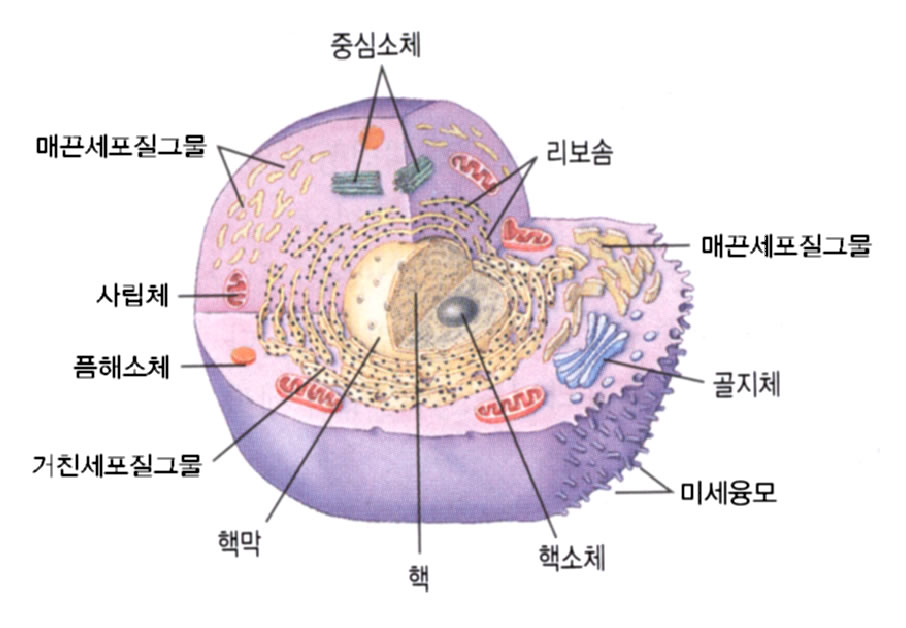 |
||
| BT | base of tongue; bedtime; bitemporal; bitrochanteric; bladder tumor; Blalock-Taussig [shunt]; bleedin... |
|---|---|
| TNM | primary tumor, regional nodes, metastasis [tumor staging]; thyroid node metastases; tumor node metas... |
| GPC | gastric parietal cell; gel permeation chromatography; giant papillary conjunctivitis; glycophorin C;... |
| RGC | radio-gas chromatography; remnant gastric cancer; retinal ganglion cell; right giant cell |
| ACC | accommodation; acetyl coenzyme A carboxylase; acinic cell carcinoma; acute care center; adenoid cyst... |
| foreign body giant cell | <pathology> Syncytium formed by the fusion of macrophages in response to an indigestible particle too large to be phagocytosed for example talc, silica or asbestos fibres). There may be as many as 100 nuclei randomly distributed: similar cells but with the nuclei more peripherally located (Langhans cells) are found at the centre of tuberculous lesions. (06 Mar 1998) |
|---|---|
| benign giant lymph node hyperplasia | Solitary masses of lymphoid tissue containing concentric perivascular aggregates of lymphocytes, occurring usually in the mediastinum or hilar region of young adults; similar changes have been reported outside the mediastinum and, if associated with interfollicular sheets of plasma cells, may progress to lymphoma or plasmacytoma. Synonym: angiofollicular mediastinal lymph node hyperplasia, Castleman's disease. (05 Mar 2000) |
| giant | 1. A man of extraordinari bulk and stature. "Giants of mighty bone and bold emprise." 2. A person of extraordinary strength or powers, bodily or intellectual. 3. Any animal, plant, or thing, of extraordinary size or power. Giant's Causeway, a vast collection of basaltic pillars, in the county of Antrim on the northern coast of Ireland. Origin: OE. Giant, geant, geaunt, OF. Jaiant, geant, F. Geant, L. Gigas, fr. Gr, from the root of E. Gender, genesis. See Gender, and cf. Gigantic. Like a giant; extraordinary in size, strength, or power; as, giant brothers; a giant son. Giant cell. <anatomy> A very large African heron (Ardeomega goliath). It is the largest heron known. Giant kettle, a pothole of very large dimensions, as found in Norway in connection with glaciers. See Pothole. Giant powder. See Nitroglycerin. <botany> Giant puffball, one of several species of very large squids, belonging to Architeuthis and allied genera. Some are over forty feet long. Source: Websters Dictionary (01 Mar 1998) |
| giant axon | <biology> Extraordinarily large unmyelinated axons found in invertebrates. Some, like the squid giant axon, can approach 1 mm diameter. Large axons have high conduction speeds, the giant axons are invariably involved in panic or escape responses and may (e.g. Crayfish) have electrical synapses to further increase speed. Vertebrate axons with high conduction velocites are much narrower: they are myelinated, allowing saltatory conduction. (17 Dec 1997) |
| giant axonal neuropathy | <paediatrics> A rare disorder beginning at or after the third year of life, and presenting clinically with kinky hair, progressive painless clumsiness, muscle weakness and atrophy, sensory loss, and areflexia. Pathologically, both myelinated and unmyelinated nerve fibres contain axonal spheroids packed with neurofilaments; sporadic in nature. (05 Mar 2000) |
| giant cells, foreign-body | Multinucleated cells (fused macrophages), characteristic of granulomatous inflammation, which form around exogenous material in the skin. They are similar in appearance to langhans giant cells (giant cells, langhans), but foreign-body giant cells have more abundant chromatin and their nuclei are scattered in an irregular pattern in the cytoplasm. (12 Dec 1998) |
| giant cells, langhans | Multinucleated cells (fused macrophages) seen in granulomatous inflammations such as tuberculosis, syphilis, sarcoidosis, and deep fungal infections. They resemble foreign-body giant cells (giant cells, foreign body) but langhans giant cells contain less chromatin and their nuclei are arranged peripherally in a horseshoe-shaped pattern. Langhans giant cells occur frequently in delayed hypersensitivity. (12 Dec 1998) |
| giant chromosome | <cell biology> Giant chromosomes produced by the successive replication of homologous pairs of chromosomes, joined together (synapsed) without chromosome separation or nuclear division. They thus consist of many up to 1000) identical chromosomes (strictly chromatids) running parallel and in strict register. The chromosomes remain visible during interphase and are found in some ciliates, ovule cells in angiosperms and in larval Dipteran tissue. The best known polytene chromosomes are those of the salivary gland of the larvae of Drosophila melanogaster which appear as a series of dense bands interspersed by light interbands, in a pattern characteristic for each chromosome. The bands, of which there are about 5,000 in Drosophila melanogaster, contain most of the DNA (ca 95%) of the chromosomes and each band roughly represents one gene. The banding pattern of polytene chromosomes provides a visible map to compare with the linkage map determined by genetic studies. Some segments of polytene chromosome show chromosome puffs, areas of high transcription. (18 Nov 1997) |
| giant colon | An abnormally large or dilated colon, the condition may be congenital or acquired, acute or chronic. (18 Nov 1997) |
| giant condyloma | A large type of condyloma acuminatum found in the anus, vulva, or preputial sac of the penis of middle-aged, uncircumcised men; it tends to extend deeply and recur. Synonym: Buschke-Lowenstein tumour. (05 Mar 2000) |
| giant drusen | An obsolete term for a glial hamartoma of the optic nerve head or the peripapillary retina, seen in tuberous sclerosis. (05 Mar 2000) |
| giant follicular lymphoblastoma | <tumour> A malignant lymphoma arising from lymphoid follicular B-cells which may be small or large, growing in a nodular pattern. Synonym: follicular lymphoma, giant follicular lymphoblastoma. (05 Mar 2000) |
| giant follicular thyroiditis | A variant of Hashimoto's thyroiditis in which lymphocytic infiltrate in thyroid has formed into giant follicles. (05 Mar 2000) |
| giant gastric folds | Enlarged gastric submucosal ridges covered by hyperplastic mucosa, as seen in Zollinger-Ellison syndrome, Menetrier's disease, and hypertrophic hypersecretory gastropathy. (05 Mar 2000) |
| giant hairy nevus | <dermatology> These large pigmented (often hairy) congenital nevi are important because of their increased risk (10 to 15%) of conversion into malignant melanoma. A biopsy can confirm if cells have turned malignant. Any change in a pre-existing nevus should prompt a physician evaluation. (17 Dec 1997) |