
| 영문 | mast cell | 한글 | 비만 세포 |
|---|---|---|---|
| 설명 | 동물의 결합 조직 가운데 널리 분포하는 세포. 결합조직과 점막조직 내에 있는 호염기성 색소로 이염색성(metachromasia)을 나타내는 과립을 가진 방추형의 세포에 작은 둥근 핵을 가진다. 비만세포의 표면에는 IgE에 대한 수용체가 존재하며, 수용체에 결합한 IgE 분자들끼리 다가의 항원에 의해 서로 연결되면 비만세포 과립탈출 반응이 일어나, 히스타민, 세로토닌, 헤파린 등의 화학전달 물질이 방출되어, 즉시형 알레르기 반응 등의 증상을 일으킨다. 피부, 장막, 혈관 주위, 점막 주변에 있다. |
||
| 영문 | cell | 한글 | 세포 |
|---|---|---|---|
| 설명 | 생명체를 이루는 구조적, 기능적 단위. 핵의 유무에 따라서 유핵세포와 무핵세포로 나눌 수가 있다. 무핵세포란 핵이 없는 세포를 말한다. 핵이란 유전정보를 가지고 있는 염색체를 보관하는 곳인데 무핵세포에서는 염색체가 세포속에 그냥 노출되어 있다. 대개 세포 하나하나가 독립된 생명체의 역할을 하는 단세포생물로서 외부환경으로부터 자신을 보호할 수 있는 견고한 세포벽을 가지고 있다. 유핵세포란 핵을 가지고 있어서 유전정보가 있는 염색체가 세포의 다른 부분과 구분되어 핵속에 들어있다. 세포속에서 핵외의 부분(이를 세포질이라 한다)에는 여러 가지 세포의 소기관이 있어서 세포의 다양한 기능을 분담한다. ◈유핵세포의 기본 구조 1.세포막-세포를 둘러싸서 주위환경과 분리하여 세포의 내환경을 유지한다. 2.형질내세망(endoplasmic reticulum)-단위막으로 둘러쌓여 있는 불규칙한 망상구조이다. 이 망상구조의 내부를 소강, 소조라고 부른다. 여기에는 표면이 매끈한 무과립형질내세망과 표면이 불규칙한 과립형질내세망의 두 가지가 있다. 과립형질내세망의 경우는 표면에 단백질을 합성하는 리보솜이라는 것이 부착되어 있다. 이곳은 주로 세포밖으로 분비할 단백질을 합성하는 장소이다. 무과립형질내세망은 표면에 리보솜이 부착되어 있지 않은 것을 말하며, 이곳에서는 주로 해독작용, 글리코겐의 합성, 스테로이드호르몬의 합성 등이 일어난다. 3.리보솜-단백질을 합성하는 역할을 하는 곳이다.이것은 세포질에 존재하는 자유리보솜과 과립형질내세망에 부착이 되어 존재하는 부착리보솜의 두 가지로 나눈다. 자유리보솜은 주로 세포내에서 필요한 단백질을 만드는 역할을 하고 부착리보솜은 세포밖으로 분비할 단백질을 만드는 역할을 한다. 4.골지장치(Golgi apparatus)-핵주위에 분포하는 납작해진 주머니모양의 것이 중첩되어 형성된 층판 모양의 구조물로 과립형질내세망에서 생성되어 외부로 분비될 단백질을 모아서 농축, 포장하여 과립을 만드는 역할을 한다. 5.사립체(mitochondria)-구형, 난형의 긴 막대기 모양으로 크기가 다양한 구조물. 생물체의 에너지 저장물질인 ATP를 생산하는 역할을 한다. 또 세포와 다른 자신만의 유전정보를 가진 DNA, RNA를 가지고 있다. 모양, 크기가 세균과 비슷하며 자체증식성 등 독립된 생명체로서 필요한 요건을 갖추고 있어서 세포와 공생관계를 가진 독립된 세포로 생각하고 있다. 6.용해소체(lysosome)-작은 구형의 소체로 여러 가지 분해효소를 가진다. 세포외계에서 들어온 물질과 결합하여 그 물질들을 용해하는 역할을 하고, 오래된 세포소기관들을 제거하는 역할도 한다. 7.세포핵(nucleus)-구형, 난형으로 세포의 중심에 위치한다. 핵내에는 유전정보가 있는 물질인 염색체가 존재한다. 8.중심소체(centrosome)-핵주위에 존재하면서 핵의 분열시에 양쪽의 염색체를 당기는 작은 섬유를 만드는 역할을 하는 곳. 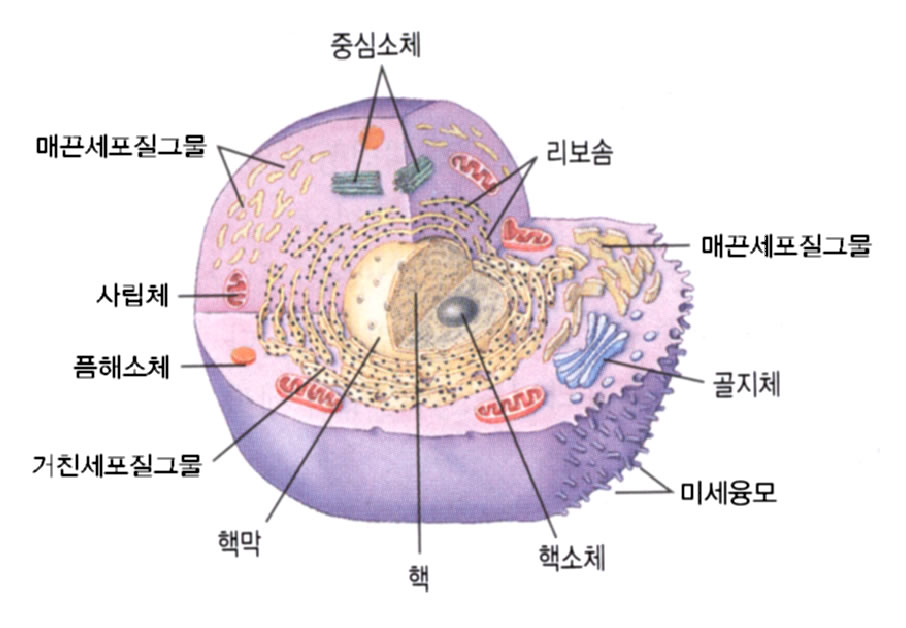 |
||
| 영문 | cell-mediated immunity | 한글 | 세포매개면역 |
|---|---|---|---|
| 설명 | 면역이란 신체를 외부의 물질로부터 보호하는 행위를 말한다. 여기에는 특이적 면역과 비특이적 면역의 두 가지가 있다. 비특이적 면역이라함은 특정한 물질에 관계하는 면역이 아니라 특정 대상이 없이 모든 외부 물체에 작용할 수 있는 면역을 말한다. 여기에는 소변의 흐름, 눈물의 흐름, 피부의 비투과성 등의 기계적인 것도 포함되고 피속에 돌아다니는 세포 중에서 비특이적으로 외부의 물질을 포식하는 세포들(예를 들면 큰포식세포(macrophage)의 활동도 포함이 된다. 세포매개면역이란 특이한 물질을 감지할 수 있는 세포를 생성하게 하여 그것으로 하여금 그 물질을 포식하게 하는 것을 말한다. |
||
| 영문 | nerve cell | 한글 | 신경세포 |
|---|---|---|---|
| 설명 | 신경세포는 올바른 신경전달을 위한 각 부분별로 나뉘어져 있다. 신경세포에서는 전해져오는 자극을 전기적인 신호로 바뀌어 보내거나 받게 된다. 이런 전기적인 현상은 각 신경세포내에 존재하는 각 이온채널(ion channel: ion이란 나트륨, 칼륨 등을 지칭하는 말들로써, 이들이 세포막에 의해 나뉘어질 때 생기는 전압차가 전기적 자극을 일으키고 유지하는데 결정적인 역할을 한다)들의 작용에 의해 이루어지게 된다. |
||
| 영문 | glia cell | 한글 | 아교세포 |
|---|---|---|---|
| 설명 | 신경세포 사이에서 그물구조를 이루며 이를 지지하는 조직. 신경아교세포는 신경모세포와 갈라진 아교모세포가 다시 여러 형태로 분화-성장한 것이다. 뇌실이나 척수중심관의 벽을 덮고 원주상 또는 입방형이며, 초기에는 유리면에 섬모가 있다. 대형세포는 별뇌실막세포는 아교세포라고 하며, 신경세포나 신경섬유 사이에 산재한다. 그 외에 희소돌기아교세포도 포함된다. |
||
| CHRONIC | chronic disease, rheumatoid arthritis, neoplasms, infections, cryoglobulinemia [conditions in which ... |
|---|---|
| MEN | Multiple Endocrine Neoplasia ; AD Trait 1. MEN Type I(= Wermer Syndro... |
| MC | mass casualties; mast cell; Master of Surgery [Lat. Magister Chirurgiae]; maximum concentration; Med... |
| MA | malignant arrhythmia; management and administration; mandelic acid; masseter; Master of Arts; matern... |
| MT | magnetization transfer; malaria therapy; malignant teratoma; mammary tumor; mammilothalamic tract; m... |
| plasma cell mastitis | A condition of the breasts characterised by tumourlike indurated masses containing numerous plasma cells, usually resulting from mammary duct ectasia; although clinically resembling malignant disease (attachment to skin and enlargement of axillary lymph nodes), it is not neoplastic. (05 Mar 2000) |
|---|---|
| interstitial plasma cell pneumonia | <chest medicine> A pneumonia caused by an infection with Pneumocystis carinii. Pneumocystis carinii grows rapidly in the lungs of patients with immunosuppression, particularly due to AIDS and is the leading AIDS-related cause of death. Pneumocystis carinii infection sometimes may occur elsewhere in the body (skin, eye, spleen, liver or heart). It is considered one of the diagnostic criteria for AIDS in an HIV positive individual. (10 Jan 1998) |
| neoplasms, basal cell | Neoplasms composed of cells from the deepest layer of the epidermis. The concept does not refer to neoplasms located in the stratum basale. (12 Dec 1998) |
| neoplasms, squamous cell | Neoplasms composed of squamous cells of the epithelium. The concept does not refer to neoplasms located in tissue composed of squamous elements. (12 Dec 1998) |
| b and t cell count | A test that measures the respective quantities of B lymphocytes and T lymphocytes. This test is often performed in the analysis of an immune deficiency disorder. Normal values include: 68 to 75% of total lymphocytes are T lymphocytes and 10 to 20% are B lymphocytes. Increased T-cell counts can indicate infectious mononucleosis, acute lymphocytic leukaemia or multiple myeloma. Increased B lymphocytes can indicate chronic lymphocytic leukaemia, multiple myeloma, Waldenstrom's macroglobulinaemia or Di George syndrome. Decreased T-cells may indicate congenital T-cell deficiency, Wiskott-Aldrich syndrome or AIDS. Decreased B-cells may indicate acute lymphocytic leukaemia or a congenital immunoglobulin deficiency disorder. (27 Sep 1997) |
| nevus, epithelioid and spindle cell | A benign compound nevus occurring most often in children before puberty, composed of spindle and epithelioid cells located mainly in the dermis, sometimes in association with large atypical cells and multinucleate cells, and having a close histopathological resemblance to malignant melanoma. The tumour presents as a smooth to slightly scaly, round to oval, raised, firm papule or nodule, ranging in colour from pink-tan to purplish red, often with surface telangiectasia. (12 Dec 1998) |
| cancer, malignant melanoma | A skin cancer that begins in cells called melanocytes that can grow together to form benign (not cancerous) moles. A change in size, shape, or colour of a mole can be a sign of melanoma. Melanoma can be cured if detected early, before spread (metastasis) to other areas of the body. Diagnosis is confirmed with a biopsy of the abnormal skin. Sun exposure can cause skin damage that can lead to melanoma. (12 Dec 1998) |
| canine malignant lymphoma | <tumour> A progressive fatal disease of dogs characterised by neoplastic transformation and proliferation of lymphoid cells, usually originating in solid lymphoid organs (lymphosarcoma) or bone marrow (lymphocytic leukaemia). (05 Mar 2000) |
| malignant | <oncology> Tending to become progressively worse and to result in death. Having the properties of anaplasia, invasion and metastasis, said of tumours. Origin: L. Malignans = acting maliciously (18 Nov 1997) |
| malignant anaemia | <haematology> A form of anaemia (low red blood cell counts) that results when the bone marrow fails to produce adequate numbers of red blood cells due to a deficiency in vitamin B12. Intrinsic factor, necessary for normal B12 absorption, may be the underlying cause for B12 deficiency if is not produced in the gastric glands (in the stomach). Origin: Gr. Haima = blood (27 Sep 1997) |
| malignant carcinoid syndrome | <syndrome> A symptom complex associated with carcinoid tumour and characterised by attacks of severe flushing of the skin, diarrhoeal watery stools, bronchoconstriction, sudden drops in blood pressure, oedema, and ascites. The carcinoid tumours are usually located in the gastrointestinal tract and metastasize to the liver. Symptoms are caused by tumour secretion of serotonin, prostaglandins, and other biologically active substances. Cardiac manifestations constitute carcinoid heart disease. (12 Dec 1998) |
| malignant catarrh | A herpes virus infection of cattle characterised by catarrhal inflammation of the upper respiratory and alimentary epithelia, keratoconjunctivitis, encephalitis and lymph node enlargement. Syn: bovine epitheliosis, snotsiekte. (12 Dec 1998) |
| malignant catarrhal fever | A highly fatal, sporadic disease of cattle caused by alcelaphine herpesvirus 1 (a member of the Herpesviridae family) and characterised by inflammation, ulceration, and exudation of the oral and upper respiratory mucous membranes, and sometimes eye lesions and nervous system disturbances. Synonym: malignant catarrh of cattle. (05 Mar 2000) |
| malignant catarrhal fever virus | A herpesvirus of wide distribution causing malignant catarrhal fever of cattle; sheep and wildebeests harbor inapparent infections and may transmit the virus to cattle. (05 Mar 2000) |
| malignant catarrh of cattle | A highly fatal, sporadic disease of cattle caused by alcelaphine herpesvirus 1 (a member of the Herpesviridae family) and characterised by inflammation, ulceration, and exudation of the oral and upper respiratory mucous membranes, and sometimes eye lesions and nervous system disturbances. Synonym: malignant catarrh of cattle. (05 Mar 2000) |