¼±Åà - È­»ìǥŰ/¿£ÅÍŰ ´Ý±â - ESC

 
"Cancer cell."¿¡ ´ëÇÑ °Ë»ö °á°úÀÔ´Ï´Ù. °Ë»ö °á°ú º¸´Â µµÁß¿¡ Tab ۸¦ ´©¸£½Ã¸é °Ë»ö âÀÌ ¼±Åõ˴ϴÙ.
À̰ÍÀ» ¿øÇϼ̽À´Ï±î?
¾Ë±â½¬¿î ÀÇÇпë¾îÇ®ÀÌÁý, ¼­¿ïÀÇ´ë ±³¼ö ÁöÁ¦±Ù, °í·ÁÀÇÇÐ ÃâÆÇ À¯»ç °Ë»ö °á°ú : 5 ÆäÀÌÁö: 3
¿µ¹® mast cell ÇÑ±Û ºñ¸¸ ¼¼Æ÷
¼³¸í   
  µ¿¹°ÀÇ °áÇÕ Á¶Á÷ °¡¿îµ¥ ³Î¸® ºÐÆ÷Çϴ ¼¼Æ÷. °áÇÕÁ¶Á÷°ú Á¡¸·Á¶Á÷ ³»¿¡ Àִ ȣ¿°±â¼º »ö¼Ò·Î ÀÌ¿°»ö¼º(metachromasia)À» ³ªÅ¸³»´Â °ú¸³À» °¡Áø ¹æÃßÇüÀÇ ¼¼Æ÷¿¡ ÀÛÀº µÕ±Ù ÇÙÀ» °¡Áø´Ù. ºñ¸¸¼¼Æ÷ÀǠǥ¸é¿¡´Â IgE¿¡ ´ëÇÑ ¼ö¿ëü°¡ Á¸ÀçÇϸç, ¼ö¿ëü¿¡ °áÇÕÇÑ IgE ºÐÀڵ鳢¸® ´Ù°¡ÀÇ Ç׿ø¿¡ ÀÇÇØ ¼­·Î ¿¬°áµÇ¸é ºñ¸¸¼¼Æ÷ °ú¸³Å»Ãâ ¹ÝÀÀÀÌ ÀϾ, È÷½ºÅ¸¹Î, ¼¼·ÎÅä´Ñ, ÇìÆÄ¸° µîÀÇ È­ÇÐÀü´Þ ¹°ÁúÀÌ ¹æÃâµÇ¾î, Áï½ÃÇü ¾Ë·¹¸£±â ¹ÝÀÀ µîÀÇ Áõ»óÀ» ÀÏÀ¸Å²´Ù. ÇǺÎ, À帷, Ç÷°ü ÁÖÀ§, Á¡¸· ÁÖº¯¿¡ ÀÖ´Ù.
¿µ¹® cell ÇÑ±Û ¼¼Æ÷
¼³¸í   
  »ý¸íü¸¦ ÀÌ·ç´Â ±¸Á¶Àû, ±â´ÉÀû ´ÜÀ§.
  
  ÇÙÀÇ À¯¹«¿¡ µû¶ó¼­ À¯ÇÙ¼¼Æ÷¿Í ¹«ÇÙ¼¼Æ÷·Î ³ª´­ ¼ö°¡ ÀÖ´Ù. ¹«ÇÙ¼¼Æ÷¶õ ÇÙÀÌ ¾ø´Â ¼¼Æ÷¸¦ ¸»ÇÑ´Ù. ÇÙÀ̶õ À¯ÀüÁ¤º¸¸¦ °¡Áö°í Àִ ¿°»öü¸¦ º¸°üÇϴ °÷Àε¥ ¹«ÇÙ¼¼Æ÷¿¡¼­´Â ¿°»öü°¡ ¼¼Æ÷¼Ó¿¡ ±×³É ³ëÃâµÇ¾î ÀÖ´Ù. ´ë°³ ¼¼Æ÷ ÇϳªÇϳª°¡ µ¶¸³µÈ »ý¸íüÀÇ ¿ªÇÒÀ» Çϴ ´Ü¼¼Æ÷»ý¹°·Î¼­ ¿ÜºÎȯ°æÀ¸·ÎºÎÅÍ ÀÚ½ÅÀ» º¸È£ÇÒ ¼ö Àִ °ß°íÇÑ ¼¼Æ÷º®À» °¡Áö°í ÀÖ´Ù. À¯ÇÙ¼¼Æ÷¶õ ÇÙÀ» °¡Áö°í À־ À¯ÀüÁ¤º¸°¡ Àִ ¿°»öü°¡ ¼¼Æ÷ÀÇ ´Ù¸¥ ºÎºÐ°ú ±¸ºÐµÇ¾î ÇÙ¼Ó¿¡ µé¾îÀÖ´Ù. ¼¼Æ÷¼Ó¿¡¼­ ÇÙ¿ÜÀÇ ºÎºÐ(À̸¦ ¼¼Æ÷ÁúÀ̶ó ÇÑ´Ù)¿¡´Â ¿©·¯ °¡Áö ¼¼Æ÷ÀÇ ¼Ò±â°üÀÌ À־ ¼¼Æ÷ÀÇ ´Ù¾çÇÑ ±â´ÉÀ» ºÐ´ãÇÑ´Ù.
  
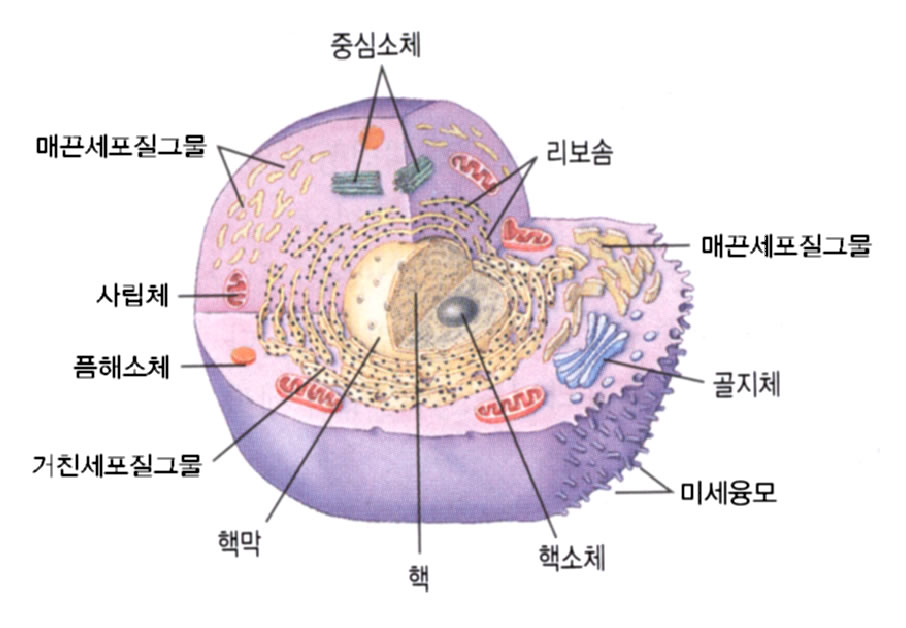
  ¢ÂÀ¯ÇÙ¼¼Æ÷ÀÇ ±âº» ±¸Á¶
  
  1.¼¼Æ÷¸·-¼¼Æ÷¸¦ µÑ·¯½Î¼­ ÁÖÀ§È¯°æ°ú ºÐ¸®ÇÏ¿© ¼¼Æ÷ÀÇ ³»È¯°æÀ» À¯ÁöÇÑ´Ù.
  
  2.ÇüÁú³»¼¼¸Á(endoplasmic reticulum)-´ÜÀ§¸·À¸·Î µÑ·¯½×¿© Àִ ºÒ±ÔÄ¢ÇÑ ¸Á»ó±¸Á¶ÀÌ´Ù. ÀÌ ¸Á»ó±¸Á¶ÀÇ ³»ºÎ¸¦ ¼Ò°­, ¼ÒÁ¶¶ó°í ºÎ¸¥´Ù. ¿©±â¿¡´Â Ç¥¸éÀÌ ¸Å²öÇÑ ¹«°ú¸³ÇüÁú³»¼¼¸Á°ú Ç¥¸éÀÌ ºÒ±ÔÄ¢ÇÑ °ú¸³ÇüÁú³»¼¼¸ÁÀÇ µÎ °¡Áö°¡ ÀÖ´Ù. °ú¸³ÇüÁú³»¼¼¸ÁÀÇ °æ¿ì´Â Ç¥¸é¿¡ ´Ü¹éÁúÀ» ÇÕ¼ºÇϴ ¸®º¸¼ØÀ̶ó´Â °ÍÀÌ ºÎÂøµÇ¾î ÀÖ´Ù. À̰÷Àº ÁַΠ¼¼Æ÷¹ÛÀ¸·Î ºÐºñÇÒ ´Ü¹éÁúÀ» ÇÕ¼ºÇϴ Àå¼ÒÀÌ´Ù. ¹«°ú¸³ÇüÁú³»¼¼¸ÁÀº Ç¥¸é¿¡ ¸®º¸¼ØÀÌ ºÎÂøµÇ¾î ÀÖÁö ¾ÊÀº °ÍÀ» ¸»Çϸç, À̰÷¿¡¼­´Â ÁÖ·Î ÇØµ¶ÀÛ¿ë, ±Û¸®ÄÚ°ÕÀÇ ÇÕ¼º, ½ºÅ×·ÎÀ̵åÈ£¸£¸óÀÇ ÇÕ¼º µîÀÌ ÀϾ´Ù.
  
  3.¸®º¸¼Ø-´Ü¹éÁúÀ» ÇÕ¼ºÇϴ ¿ªÇÒÀ» Çϴ °÷ÀÌ´Ù.À̰ÍÀº ¼¼Æ÷Áú¿¡ Á¸ÀçÇϴ ÀÚÀ¯¸®º¸¼Ø°ú °ú¸³ÇüÁú³»¼¼¸Á¿¡ ºÎÂøÀÌ µÇ¾î Á¸ÀçÇϴ ºÎÂø¸®º¸¼ØÀÇ µÎ °¡Áö·Î ³ª´«´Ù. ÀÚÀ¯¸®º¸¼ØÀº ÁַΠ¼¼Æ÷³»¿¡¼­ ÇÊ¿äÇÑ ´Ü¹éÁúÀ» ¸¸µå´Â ¿ªÇÒÀ» Ç졒ʼÎÂø¸®º¸¼ØÀº ¼¼Æ÷¹ÛÀ¸·Î ºÐºñÇÒ ´Ü¹éÁúÀ» ¸¸µå´Â ¿ªÇÒÀ» ÇÑ´Ù.
  
  4.°ñÁöÀåÄ¡(Golgi apparatus)-ÇÙÁÖÀ§¿¡ ºÐÆ÷Çϴ ³³ÀÛÇØÁø ÁָӴϸð¾çÀÇ °ÍÀÌ ÁßøµÇ¾î Çü¼ºµÈ ÃþÆÇ ¸ð¾çÀÇ ±¸Á¶¹°·Î °ú¸³ÇüÁú³»¼¼¸Á¿¡¼­ »ý¼ºµÇ¾î ¿ÜºÎ·Î ºÐºñµÉ ´Ü¹éÁúÀ» ¸ð¾Æ¼­ ³óÃà, Æ÷ÀåÇÏ¿© °ú¸³À» ¸¸µå´Â ¿ªÇÒÀ» ÇÑ´Ù.
  
  5.»ç¸³Ã¼(mitochondria)-±¸Çü, ³­ÇüÀÇ ±ä ¸·´ë±â ¸ð¾çÀ¸·Î Å©±â°¡ ´Ù¾çÇÑ ±¸Á¶¹°. »ý¹°Ã¼ÀÇ ¿¡³ÊÁö ÀúÀå¹°ÁúÀΠATP¸¦ »ý»êÇϴ ¿ªÇÒÀ» ÇÑ´Ù. ¶Ç ¼¼Æ÷¿Í ´Ù¸¥ ÀڽŸ¸ÀÇ À¯ÀüÁ¤º¸¸¦ °¡Áø DNA, RNA¸¦ °¡Áö°í ÀÖ´Ù. ¸ð¾ç, Å©±â°¡ ¼¼±Õ°ú ºñ½ÁÇϸç ÀÚüÁõ½Ä¼º µî µ¶¸³µÈ »ý¸íü·Î¼­ ÇÊ¿äÇÑ ¿ä°ÇÀ» °®Ãß°í À־ ¼¼Æ÷¿Í °ø»ý°ü°è¸¦ °¡Áø µ¶¸³µÈ ¼¼Æ÷·Î »ý°¢Çϰí ÀÖ´Ù.
  
  6.¿ëÇØ¼Òü(lysosome)-ÀÛÀº ±¸ÇüÀÇ ¼Òü·Î ¿©·¯ °¡Áö ºÐÇØÈ¿¼Ò¸¦ °¡Áø´Ù. ¼¼Æ÷¿Ü°è¿¡¼­ µé¾î¿Â ¹°Áú°ú °áÇÕÇÏ¿© ±× ¹°ÁúµéÀ» ¿ëÇØÇϴ ¿ªÇÒÀ» Çϰí, ¿À·¡µÈ ¼¼Æ÷¼Ò±â°üµéÀ» Á¦°ÅÇϴ ¿ªÇÒµµ ÇÑ´Ù.
  
  7.¼¼Æ÷ÇÙ(nucleus)-±¸Çü, ³­ÇüÀ¸·Î ¼¼Æ÷ÀÇ Á߽ɿ¡ À§Ä¡ÇÑ´Ù. ÇÙ³»¿¡´Â À¯ÀüÁ¤º¸°¡ Àִ ¹°ÁúÀΠ¿°»öü°¡ Á¸ÀçÇÑ´Ù.
  
  8.Á߽ɼÒü(centrosome)-ÇÙÁÖÀ§¿¡ Á¸ÀçÇϸ鼭 ÇÙÀÇ ºÐ¿­½Ã¿¡ ¾çÂÊÀÇ ¿°»öü¸¦ ´ç±â´Â ÀÛÀº ¼¶À¯¸¦ ¸¸µå´Â ¿ªÇÒÀ» Çϴ °÷.
  
  ¼¼Æ÷
¿µ¹® cell-mediated immunity ÇÑ±Û ¼¼Æ÷¸Å°³¸é¿ª
¼³¸í   
  ¸é¿ªÀ̶õ ½Åü¸¦ ¿ÜºÎÀÇ ¹°Áú·ÎºÎÅÍ º¸È£Çϴ ÇàÀ§¸¦ ¸»ÇÑ´Ù. ¿©±â¿¡´Â Æ¯ÀÌÀû ¸é¿ª°ú ºñƯÀÌÀû ¸é¿ªÀÇ µÎ °¡Áö°¡ ÀÖ´Ù.
  
  ºñƯÀÌÀû ¸é¿ªÀ̶óÇÔÀº Æ¯Á¤ÇÑ ¹°Áú¿¡ °ü°èÇϴ ¸é¿ªÀÌ ¾Æ´Ï¶ó Æ¯Á¤ ´ë»óÀÌ ¾øÀÌ ¸ðµç ¿ÜºÎ ¹°Ã¼¿¡ ÀÛ¿ëÇÒ ¼ö Àִ ¸é¿ªÀ» ¸»ÇÑ´Ù. ¿©±â¿¡´Â ¼Òº¯ÀÇ È帧, ´«¹°ÀÇ È帧, ÇǺÎÀÇ ºñÅõ°ú¼º µîÀÇ ±â°èÀûÀΠ°Íµµ Æ÷ÇԵǰí ÇǼӿ¡ µ¹¾Æ´Ù´Ï´Â ¼¼Æ÷ Áß¿¡¼­ ºñƯÀÌÀûÀ¸·Î ¿ÜºÎÀÇ ¹°ÁúÀ» Æ÷½ÄÇϴ ¼¼Æ÷µé(¿¹¸¦ µé¸é Å«Æ÷½Ä¼¼Æ÷(macrophage)ÀǠȰµ¿µµ Æ÷ÇÔÀÌ µÈ´Ù. ¼¼Æ÷¸Å°³¸é¿ªÀ̶õ Æ¯ÀÌÇÑ ¹°ÁúÀ» °¨ÁöÇÒ ¼ö Àִ ¼¼Æ÷¸¦ »ý¼ºÇϰԠÇÏ¿© ±×°ÍÀ¸·Î ÇÏ¿©±Ý ±× ¹°ÁúÀ» Æ÷½ÄÇϰԠÇϴ °ÍÀ» ¸»ÇÑ´Ù.
¿µ¹® nerve cell ÇÑ±Û ½Å°æ¼¼Æ÷
¼³¸í   
  ½Å°æ¼¼Æ÷´Â ¿Ã¹Ù¸¥ ½Å°æÀü´ÞÀ» À§ÇÑ °¢ ºÎºÐº°·Î ³ª´µ¾îÁ® ÀÖ´Ù. ½Å°æ¼¼Æ÷¿¡¼­´Â ÀüÇØÁ®¿À´Â ÀÚ±ØÀ» Àü±âÀûÀΠ½ÅÈ£·Î ¹Ù²î¾î º¸³»°Å³ª ¹Þ°Ô µÈ´Ù. ÀÌ·± Àü±âÀûÀΠÇö»óÀº °¢ ½Å°æ¼¼Æ÷³»¿¡ Á¸ÀçÇϴ °¢ ÀÌ¿Âä³Î(ion channel: ionÀ̶õ ³ªÆ®·ý, Ä®·ý µîÀ» ÁöĪÇϴ ¸»µé·Î½á, À̵éÀÌ ¼¼Æ÷¸·¿¡ ÀÇÇØ ³ª´µ¾îÁú ¶§ »ý±â´Â Àü¾ÐÂ÷°¡ Àü±âÀû ÀÚ±ØÀ» ÀÏÀ¸Å°°í À¯ÁöÇϴµ¥ °áÁ¤ÀûÀΠ¿ªÇÒÀ» ÇÑ´Ù)µéÀÇ ÀÛ¿ë¿¡ ÀÇÇØ ÀÌ·ç¾îÁö°Ô µÈ´Ù.
¿µ¹® glia cell ÇÑ±Û ¾Æ±³¼¼Æ÷
¼³¸í   
  ½Å°æ¼¼Æ÷ »çÀÌ¿¡¼­ ±×¹°±¸Á¶¸¦ ÀÌ·ç¸ç À̸¦ ÁöÁöÇϴ Á¶Á÷. ½Å°æ¾Æ±³¼¼Æ÷´Â ½Å°æ¸ð¼¼Æ÷¿Í °¥¶óÁø ¾Æ±³¸ð¼¼Æ÷°¡ ´Ù½Ã ¿©·¯ ÇüÅ·ΠºÐÈ­-¼ºÀåÇÑ °ÍÀÌ´Ù. ³ú½ÇÀ̳ª Ã´¼öÁ߽ɰüÀÇ º®À» µ¤°í ¿øÁÖ»ó ¶Ç´Â ÀÔ¹æÇüÀ̸ç, Ãʱ⿡´Â À¯¸®¸é¿¡ ¼¶¸ð°¡ ÀÖ´Ù. ´ëÇü¼¼Æ÷´Â º°³ú½Ç¸·¼¼Æ÷´Â ¾Æ±³¼¼Æ÷¶ó°í Çϸç, ½Å°æ¼¼Æ÷³ª ½Å°æ¼¶À¯ »çÀÌ¿¡ »êÀçÇÑ´Ù. ±× ¿Ü¿¡ Èñ¼Òµ¹±â¾Æ±³¼¼Æ÷µµ Æ÷ÇԵȴÙ.
´ëÇÑÀÇÇù ÀÇÇпë¾î »çÀü °Ë»ö À¯»ç °Ë»ö °á°ú : 15 ÆäÀÌÁö: 3
  • ¿µ¹®
    ÇѱÛ
  • retrograde cancer
    ÅðÇà¾Ï
  • soft cancer
    ¼ÓÁú¾Ï, ¼öÁú¾Ï
  • solid cancer
    °íÇü¾Ï
  • scrotal cancer
    À½³¶¾Ï
  • undifferentiated cancer
    ¹ÌºÐÈ­¾Ï
  • vaginal cancer
    Áú¾Ï
  • acantholytic cell
    °¡½Ã¼¼Æ÷ºÐ¸®¼¼Æ÷
  • angioimmunoblastic T-cell lymphoma
    Ç÷°ü¸é¿ª¸ð±¸T¼¼Æ÷¸²ÇÁÁ¾
  • annular elastotic giant cell granuloma
    °í¸®Åº·Â¼¶À¯°Å´ë¼¼Æ÷À°¾ÆÁ¾, ȯ»óź·Â¼¶À¯°Å´ë¼¼Æ÷À°¾ÆÁ¾
  • accessory cell
    º¸Á¶¼¼Æ÷, µ¡¼¼Æ÷
  • antibody-dependent cell-mediated cytotoxicity
    Ç×üÀÇÁ¸¼¼Æ÷¸Å°³¼¼Æ÷µ¶¼º
  • antibody-producing cell
    Ç×ü»ý»ê¼¼Æ÷
  • antibody-screening cell
    Ç×ü¼±º°Ç÷±¸
  • antigen-presenting cell
    Ç׿øÁ¦½Ã¼¼Æ÷
  • antigen-reactive cell
    Ç׿ø¹ÝÀÀ¼¼Æ÷
´ëÇÑÀÇÇù Çʼö ÀÇÇпë¾îÁý »çÀü °Ë»ö À¯»ç °Ë»ö °á°ú : 15 ÆäÀÌÁö: 3
  • ¿µ¹®
    ÇѱÛ
  • blood cell
    Ç÷¾×¼¼Æ÷, Ç÷±¸
  • ethmoidal cell
    ¹úÁý»À¹úÁý
  • eukaryotic cell
    ÁøÇÙ¼¼Æ÷
  • goblet cell
    ¼úÀܼ¼Æ÷
  • hair cell
    Åм¼Æ÷
  • inflammatory cell
    ¿°Áõ¼¼Æ÷
  • killer cell
    »ìÇØ¼¼Æ÷
  • Kupffer's cell
    º°Å«Æ÷½Ä¼¼Æ÷, ÄíÆÛ¼¼Æ÷
  • mast cell
    ºñ¸¸¼¼Æ÷
  • mesenchymal cell
    Áß°£¿±¼¼Æ÷
  • mesothelial cell
    ÁßÇǼ¼Æ÷
  • mother cell
    ¸ð¼¼Æ÷, ¾î¹Ì¼¼Æ÷
  • neuroendocrine cell
    ½Å°æ³»ºÐºñ¼¼Æ÷
  • packed red blood cell
    ³óÃàÀûÇ÷±¸
  • parietal cell
    º®¼¼Æ÷
¿¾ ´ëÇÑÀÇÇù ÀÇÇпë¾î »çÀü °Ë»ö À¯»ç °Ë»ö °á°ú : 15 ÆäÀÌÁö: 3
  • ¿µ¹®
    ÇѱÛ
  • annular elastotic giant cell granuloma
    °í¸®Åº·Â¼¶À¯°Å´ë¼¼Æ÷À°¾ÆÁ¾, ȯ»óź·Â¼¶À¯°Å´ë¼¼Æ÷À°¾ÆÁ¾
  • antibody-dependent cell-mediated cytotoxicity
    Ç×üÀÇÁ¸¼¼Æ÷¸Å°³¼¼Æ÷µ¶¼º
  • antibody-producing cell
    Ç×ü»ý»ê¼¼Æ÷
  • antibody-screening cell
    Ç×ü¼±º°Ç÷±¸
  • antigen-presenting cell
    Ç׿øÀü´Þ¼¼Æ÷
  • antigen-reactive cell
    Ç׿ø¹ÝÀÀ¼¼Æ÷
  • antigen-recognizing cell
    Ç׿øÀÎÁö¼¼Æ÷
  • argentaffin cell
    ģũ·ÒÀº¼¼Æ÷
  • argyrophilic cell
    ÀºÄ£È­¼¼Æ÷
  • asexual cell
    ¹«¼º¼¼Æ÷
  • basal cell adenoma
    ±âÀú¼¼Æ÷»ùÁ¾, ¹Ù´Ú¼¼Æ÷¾ÏÁ¾
  • basosqumaous cell acanthoma
    ±âÀúÆíÆò¼¼Æ÷°¡½Ã¼¼Æ÷Á¾
  • cell-associated antibody
    ¼¼Æ÷ºÎÂøÇ×ü
  • cell-bound antibody
    (¢¡cell-fixed antibody) ¼¼Æ÷°áÇÕÇ×ü
  • cell-fixed antibody
    ¼¼Æ÷°áÇÕÇ×ü
¿¾ ´ëÇÑÀÇÇù 2 ÀÇÇпë¾î »çÀü °Ë»ö À¯»ç °Ë»ö °á°ú : 15 ÆäÀÌÁö: 3
  • ¿µ¹®
    ÇѱÛ
  • C-cell
    C ¼¼Æ÷
  • CD4+ cell
    CD4+ ¼¼Æ÷
  • Cell adhesion molecules
    ¼¼Æ÷À¯ÂøºÐÀÚ
  • Chinese hamster ovary tumor cell
    Áß±¹ÇÔ½ºÅÍ ³­¼Ò¼¼Æ÷, CHO¼¼Æ÷
  • Graham cell
    ±×¶óÇÔ¼¼Æ÷
  • Granulosa cell
    °ú¸³¸·¼¼Æ÷(Î¨Ø£Ø¯á¬øà)
  • Granulosa cell tumor
    °ú¸³¸·¼¼Æ÷Á¾¾ç(Î¨Ø£Ø¯á¬øàðþåË)
  • H-9 cell line
    H-9 ¼¼Æ÷°è
  • HeLa cell
    Çï¶ó¼¼Æ÷.
  • HeLa cell
    Çï¶ó¼¼Æ÷
  • Heidenhain s cell
    ÇÏÀ̵§ÇÏÀμ¼Æ÷.
  • Henle s cell
    Çî·¯¼¼Æ÷.
  • Hfr cell
    °íºóµµÀçÁ¶ÇÕ¼¼Æ÷
  • Hulle cell
    ¿ÜÇǼ¼Æ÷
  • ICSH = interstitial cell stimulating hormone
    °£Áú¼¼Æ÷ÀÚ±Ø(Êàòõá¬øàí©Ð½)È£¸£¸ó.
¿¾ ´ëÇÑÀÇÇù 3 ÀÇÇпë¾î »çÀü °Ë»ö À¯»ç °Ë»ö °á°ú : 15 ÆäÀÌÁö: 3
  • ¿µ¹®
    ÇѱÛ
  • early gastric cancer
    Á¶±âÀ§¾Ï.
  • epidermal cancer
    Ç¥ÇǾÏ(øúù«äß)
  • epithelial ovarian cancer
    »óÇǼº ³­¼Ò¾Ï
  • esophageal cancer
    ½Äµµ¾Ï
  • gastric cancer
    À§¾Ï(êÖ ).
  • gastric cancer
    À§¾Ï(À§¾Ï).
  • glandular cancer
    ¼±¾Ï(¼±¾Ï).
  • glottic cancer
    ¼º¹®¾Ï
  • infiltrating cancer
    ħÀ±¼º ¾Ï.
  • integrated cancer management
    ÅëÇÕÀû¾ÏÄ¡·á
  • laryngeal cancer
    ÈĵξÏ(¡­ ).
  • laryngeal cancer
    ÈĵξÏ
  • liver cancer
    °£¾Ï(°£¾Ï).
  • liver cancer
    °£¾Ï(ÊÜäß).
  • lung cancer
    Æó¾Ï
´ëÇÑÇØºÎÇÐȸ ÀÇÇпë¾î »çÀü °Ë»ö À¯»ç °Ë»ö °á°ú : 15 ÆäÀÌÁö: 3
  • ¿µ¹®
    ÇѱÛ
  • Follicular cell
    ³­Æ÷¼¼Æ÷
    [¿¾ ¿ë¾î] ³­Æ÷¼¼Æ÷
  • Endothelial cell
    ³»ÇǼ¼Æ÷
    [¿¾ ¿ë¾î] ³»ÇǼ¼Æ÷
  • Ependymal cell
    ³ú½Ç¸·¼¼Æ÷
    [¿¾ ¿ë¾î] »óÀǼ¼Æ÷
  • Secretory cell of lacrimal gland
    ´«¹°¼¼Æ÷
    [¿¾ ¿ë¾î] ´©¼±¼¼Æ÷
  • Delta cell
    µ¨Å¸¼¼Æ÷
    [¿¾ ¿ë¾î] µ¨Å¸¼¼Æ÷
  • Fat-storing cell
    µ¿±¼ÁÖÀ§Áö¹æ¼¼Æ÷
    [¿¾ ¿ë¾î] µ¿¾çÇ÷°üÁÖÀ§Áö¹æ¼¼Æ÷
  • Bipolar cell
    µÎ±Ø¼¼Æ÷
    [¿¾ ¿ë¾î] ¾ç±Ø¼¼Æ÷
  • Spherical cell
    µÕ±Ù¼¼Æ÷
    [¿¾ ¿ë¾î] ±¸Çü¼¼Æ÷
  • Glial cell of peripheral nervous system
    ¸»ÃʾƱ³¼¼Æ÷
    [¿¾ ¿ë¾î] ¸»Ãʱ³¼¼Æ÷
  • Choroid ependymal cell
    ¸Æ¶ô³ú½Ç¸·¼¼Æ÷
    [¿¾ ¿ë¾î] ¸Æ¶ô»óÀǼ¼Æ÷
  • Dust cell
    ¸ÕÁö¼¼Æ÷
    [¿¾ ¿ë¾î] ¸ÕÁö¼¼Æ÷
  • Amacrine cell
    ¹«Ãà»è¼¼Æ÷
    [¿¾ ¿ë¾î] ¹«Ãà»è¼¼Æ÷
  • Polyhedral cell
    ¹µ¸éü¼¼Æ÷
    [¿¾ ¿ë¾î] ´Ù°¢Çü¼¼Æ÷
  • Polyhedral cell
    ¹µ¸éü¼¼Æ÷
    [¿¾ ¿ë¾î] ´Ù¸éü¼¼Æ÷
  • Multilocular fat cell
    ¹µÄ­Áö¹æ¼¼Æ÷
    [¿¾ ¿ë¾î] ´Ù¹æ¼ºÁö¹æ¼¼Æ÷
´ëÇÑ»ýÈ­ÇкÐÀÚ»ý¹°ÇÐȸ ¿ë¾î »çÀü °Ë»ö À¯»ç °Ë»ö °á°ú : 15 ÆäÀÌÁö: 3
  • ¿µ¹®
    ÇѱÛ
  • cell hybridization
    ¼¼Æ÷(á¬øà) Æ¢±âÇü¼º(û¡à÷)
  • cell line
    ¼¼Æ÷ÁÖ(á¬øàñ»)
  • cell-mediated immunity
    ¼¼Æ÷¸Å°³¸é¿ª(á¬øàØÚË¿Øóæ¹)
  • cell membrane
    ¼¼Æ÷¸· (á¬øàØ¯)
  • cell strain
    ¼¼Æ÷ÁÖ(á¬øàñ»)
  • cell wall
    ¼¼Æ÷º®(á¬øàÛú)
  • centrifuge cell
    ¿ø½ÉºÐ¸®½Ç(êÀãýÝÂ×îãø)
  • competent cell
    Àû°Ý¼¼Æ÷(îêÌ«á¬øà)
  • constitutive secretory cell
    ±¸¼º¼º ºÐºñ¼¼Æ÷(ϰà÷àõÝÂÝôá¬øà)
  • continuous cell line
    "Áö¼Ó¼¼Æ÷ÁÖ(ò¥áÙá¬øàñ»), (ÔÒ) established cell line"
  • COS cell
    COS ¼¼Æ÷(á¬øà)
  • cytotoxic T cell
    ¼¼Æ÷µ¶¼º(á¬øàÔ¸àõ) T ¼¼Æ÷(á¬øà)
  • double-sector cell
    ÀÌÁß±¸È¹½Ç(ì£ñìÏ¡üñãø)
  • effector cell
    È¿°ú±â ¼¼Æ÷(üùÍýÐïá¬øà)
  • enucleated cell
    Á¦ÇÙ ¼¼Æ÷ (ð¶ú·á¬øà)
KI ÀÇÇпë¾î »çÀü °Ë»ö À¯»ç °Ë»ö °á°ú : 15 ÆäÀÌÁö: 3
  • ¿µ¹®
    ÇѱÛ
  • germ cell
    »ý½Ä¼¼Æ÷, ¹è¼¼Æ÷
  • giant cell
    °Å¼¼Æ÷
  • giant cell tumor
    °Å¼¼Æ÷Á¾¾ç
  • goblet cell
    ¼úÀܼ¼Æ÷, ¹è³¶¼¼Æ÷
  • granular cell myoblastoma
    °ú¸³¼¼Æ÷±Ù¸ð¼¼Æ÷Á¾
  • granulosa cell
    °ú¸³¸·¼¼Æ÷
  • granulosa cell tumor
    °ú¸³¸·¼¼Æ÷Á¾¾ç
  • islet cell
    µµ¼¼Æ÷
  • islet cell adenoma
    Ãéµµ¼¼Æ÷¼±Á¾
  • islet cell carcinoma
    µµ¼¼Æ÷¾ÏÁ¾
  • Langerhans' cell
    ¶û°Ô¸£Çѽº¼¼Æ÷
  • Langhans' glant cell
    ¶û±×Çѽº°Å¼¼Æ÷
  • large cell
    ´ë¼¼Æ÷
  • lymphoid cell
    ¸²ÇÁ¾ç¼¼Æ÷, ¸²ÇÁ°è¼¼Æ÷, ¸²ÇÁ±¸¾ç¼¼Æ÷
  • mast cell
    ºñ¸¸¼¼Æ÷
KMLE ÀÇÇоà¾î »çÀü À¯»ç °Ë»ö °á°ú : 5 ÆäÀÌÁö: 3
MCC mean corpuscular hemoglobin concentration; medial cell column; Medical Council of Canada; metacerebr...
RGC radio-gas chromatography; remnant gastric cancer; retinal ganglion cell; right giant cell
GC ganglion cell; gas chromatography; general circulation; general closure; general condition; generali...
TCC Transitional Cell Cancer
CAR Canadian Association of Radiologists; cancer-associated retinopathy; cardiac ambulation routine; cel...
KMLE ÀÚµ¿ÃßÃâ ÀÇÇоà¾î »çÀü À¯»ç °Ë»ö °á°ú : 5 ÆäÀÌÁö: 3
AJCC American Joint Commission in Cancer
AJCC American Joint Committee on Cancer
BC Breast Cancer
BCDDP Breast Cancer Detection Demonstration Project
BCPT Breast Cancer PRevention TRial
°æºÏ´ë Ä¡°ú´ëÇÐ ±¸°­³»°ú ±³½Ç »çÀü À¯»ç °Ë»ö °á°ú : 15 ÆäÀÌÁö: 3
  • ¿µ¹®
    ÇѱÛ
    ¼³¸í
  • abnormality of cell interaction
    ¼¼Æ÷ »óÈ£ÀÛ¿ë ÀÌ»ó
    ¼¼Æ÷ »çÀÌ¿¡ ÀϾ´Â ÀÛ¿ëÀÌ ºñÁ¤»óÀûÀÎ °Í.
  • absolute cell increase
    Àý´ë ¼¼Æ÷ ¼ö Áõ°¡
  • absorptive cell
    Èí¼ö ¼¼Æ÷
  • accessory cell
    ºÎ¼¼Æ÷
    °ñÀú¼± Áß¿¡¼­ ÁÖ¼¼Æ÷, ¹æ¼¼Æ÷¿¡ ¼¯¿©¼­ Á¸ÀçÇÑ´Ù. ÀÔ¹æÇüÀ̸ç Á¡¾×¼ºÀÇ ¹°ÁúÀ» °£Á÷ÇÑ´Ù. ÇÙÀº ¼¼Æ÷Àú¿¡ Ä¡¿ìÃÄ ÀÖ¾î ÆíÆò¿¡ °¡±õ´Ù.
  • acinic cell carcinoma
    ¼±¹æ ¼¼Æ÷ ¾ÏÁ¾
    1. ¼±¹æ ¼¼Æ÷, ±Ù»óÇǼ¼Æ÷°¡ Áõ½ÄÇÏ¿© Çü¼ºµÇ°í ³·Àº ¾Ç¼ºµµ¸¦ º¸ÀδÙ. 2. Ÿ¾×¼± ¾à¼º Á¾¾ç Áß 5¹øÂ°ÀÇ ¹ß»ý ºñÀ²À» °®´Â Á¾¾çÀ¸·Î 90%¿¡¼­ ÀÌÇϼ±¿¡¼­ ¹ß»ýÇÏ¸ç ¾ÇÇϼ±°ú ¼ÒŸ¾×¼±¿¡¼­µµ µå¹°°Ô ¹ß»ýÇÑ´Ù. ¿©¼º¿¡¼­ ´Ù¼Ò È£¹ßÇϰí, ¾î´À ¿¬·É¿¡¼­³ª ¹ß»ýÇϳª ÁÖ·Î 30-70´ë¿¡ °ñ°í·ç ¹ß»ýÇÑ´Ù. ¿¹Àü¿¡´Â ¾ç¼ºÀ¸·Î »ý°¢ÇÏ¿© ¼±¹æ¼¼Æ÷Á¾À̶ó ºÎ¸¥ ÀûÀÌ ÀÖÀ¸³ª ºÐ¸íÇÑ ¾Ç¼ºÀ¸·Î ¼±¾ÏÁ¾À¸·Î ºÎ¸¥´Ù. Á¾¾ç ¼¼Æ÷´Â Àå¾×¼º ¼±¹æ¼¼Æ÷¿Í À¯»çÇÏÁö¸¸ ¿©·¯ °¡Áö ´Ù¸¥ ¼¼Æ÷µéÀÌ ³ªÅ¸³ª¸ç, °³Á¦°ü ¿¹ºñ¼¼Æ÷¿¡¼­ ±â¿øÇÑ´Ù°í º»´Ù.
  • adamantinoid basal cell carcinoma
    ¹ý¶û Á¾¾ç ±âÀú¼¼Æ÷¾Ï
  • adenoid basal cell carcinoma
    ¼±»ó ±âÀú¼¼Æ÷¾Ï
  • adenosquamous cell carcinoma
    ¼± ÆíÆò»óÇÇ ¼¼Æ÷¾Ï
    ¼± ¾Ï°ú ÆíÆò¼¼Æ÷ ¾ÏÀÌ È¥ÀçµÇ¾î ÀÖ´Â °Í. ÀÚ±Ã°æ ³»¸· »óÇÇÀÇ ±âÀú Ãþ¿¡ ÀÖ´Â ¿¹ºñ ¼¼Æ÷¿¡¼­ ¹ß»ý. ÀÌ´Â °°Àº º´±âÀÇ ÆíÆò¼¼Æ÷ ¾Ï°ú ºñ±³ÇÏ¿© ¿¹Èİ¡ ´õ ³ª»Ú´Ù.
  • adipose cell
    Áö¹æ ¼¼Æ÷
    Áö¹æÀ» °¡Áø ¼¼Æ÷·Î¼­ ¼¼Æ÷´Â ±¸ÇüÀ» ÀÌ·ç°í, ÇÙÀº ÇÑ ÂÊÀ¸·Î Ä¡¿ìÃÄ ÀÖ´Ù.
  • adrenal medullary chromaffin cell
    ºÎ½Å ¼öÁú Å©·Ò ģȭ ¼¼Æ÷
  • adult T cell leukemia
    ¼ºÀÎ T¼¼Æ÷ ¹éÇ÷º´
    ¹ßÁõ ¿¬·ÉÀº Æò±Õ 51¼¼, ÀϺ» Kyushu, Shikoku, Kii ¹Ýµµ Áö¹æ¿¡¼­ ´Ù¹ßÇϰí ÇǺΠħÀ± ¹× °£Àå, ºñÀå, ¸²ÇÁÀý Á¾´ë¸¦ ÈçÈ÷ º¼ ¼ö Àִµ¥ ºóÇ÷Àº ¾ø´ø°¡, À־ °æµµ, °ñ¼ö¿¡ÀÇ Ä§À±Àº º¸Åë ÇöÀúÇÏÁö ¾Ê´Ù. 50% »ýÁ¸Àº 4.4°³¿ù·Î ª´Ù. ¹éÇ÷º´ ¼¼Æ÷ÀÇ Æ¯Â¡Àº ÇÙÀÌ ÀÌÇüÀÌ¸ç ºÐ¿±»ó, È­ÆÇ»ó µîÀ¸·Î Áø´Ü¿¡ »ç¿ëµÈ´Ù.
  • aggressive basal cell carcinoma
    ħ½À ±âÀú¼¼Æ÷¾Ï
  • air cell
    ÇԱ⠼¼Æ÷
  • alveolar cell carcinoma
    ÆóÆ÷ ¼¼Æ÷ ¾ÏÁ¾
  • Alzheimer's cell
    ¾ËÂêÇÏÀÌ¸Ó ¼¼Æ÷
CancerWEB ¿µ¿µ ÀÇÇлçÀü À¯»ç °Ë»ö °á°ú : 15 ÆäÀÌÁö: 3
cancer en cuirasse A carcinoma that involves a considerable portion of the skin of one or both sides of the thorax.
Origin: Fr. Breastplate
(05 Mar 2000)
cancer family A group of blood relatives of whom several have had cancer; the mode of aggregation may be genetic and homogeneous, as in familial polyposis of the colon; diverse as in neurofibromatosis; or due to common exposure to a carcinogenic or oncogenic agent, such as a virus.
(05 Mar 2000)
cancer, gastric Cancer of the stomach, the major organ that holds food for digestion. Stomach cancer (gastric cancer) can develop in any part of the stomach and spread to other organs. Stomach ulcers do not appear to increase a person's risk of developing stomach cancer. Symptoms of stomach cancer are often vague, such as loss of appetite and weight. The cancer is diagnosed with a biopsy of stomach tissue during a procedure called an endoscopy.
(12 Dec 1998)
cancer, hodgkin's disease A type of lymphoma (cancer of the lymphatic system). The most common symptom of Hodgkin's disease is a painless swelling in the lymph nodes in the neck, underarm, or groin. Hodgkin's disease is diagnosed when abnormal tissue is detected by a pathologist after a biopsy of an enlarged lymph node. Treatment usually includes radiation therapy or chemotherapy. Regular follow-up examinations are important after treatment for Hodgkin's disease. Patients treated for Hodgkin's disease have an increased risk of developing other types of cancer later in life, especially leukaemia.
(12 Dec 1998)
cancer juice Turbid, white to yellow-white or gray-white fluid (chiefly plasma) that may be expressed from certain forms of malignant neoplastic tissue, and is likely to contain neoplastic cells and debris; formed especially in relatively large, degenerating, partly necrotic foci of rapidly growing neoplastic tissue.
(05 Mar 2000)
cancer, kidney Cancer of the major organ responsible for the removal from the blood of the toxins of body metabolism the kidney. Childhood kidney cancer is different from the adult kidney cancer. The most common symptom of kidney cancer is blood in the urine. The diagnosis of kidney cancer is supported by findings of the medical history and examination, blood, urine, and X-ray tests, and confirmed with a biopsy. Kidney cancer is treated with surgery, embolization, radiation therapy, hormone therapy, biological therapy, or chemotherapy.
(12 Dec 1998)
cancer, larynx Cancer of the voice box. The larynx is the voice box located at the top of the windpipe (trachea). Cancer of the larynx occurs most often in people over the age of 55 years. People who stop smoking can greatly reduce their risk of cancer of the larynx. Painless hoarseness can be a symptom of cancer of the larynx. The larynx can be examined with a viewing tube called a laryngoscope. Cancer of the larynx is usually treated with radiation therapy or surgery. Chemotherapy can also be used for cancers that have spread.
(12 Dec 1998)
cancer, leukaemia Leukaemia is a cancer of the white blood cells. Leukaemias are grouped by how quickly the disease develops (acute or chronic) as well as by the type of blood cell that is affected. People with leukaemia are at significantly increased risk for developing infections, anaemia, and bleeding. Diagnosis of leukaemia is supported by findings of the medical history and examination, and examining blood under a microscope. Leukaemia cells can be detected and further classified with a bone marrow aspiration and/or biopsy. most patients with leukaemia are treated with chemotherapy. Some patients also may have radiation therapy and/or bone marrow transplantation.
(12 Dec 1998)
cancer, lung Cancer of the major organ of respiration the lung. Lung cancer kills more men and women than any other form of cancer. Since the majority of lung cancer is diagnosed at a relatively late stage, only 10% of all lung cancer patients are ultimately cured. Eight out of 10 lung cancers are due to tobacco smoke. Lung cancers are classified as either small cell or non-small cell cancers. Persistent cough and bloody sputum can be symptoms of lung cancer. Lung cancer can be diagnosed based on examination of sputum, or tissue examination with biopsy using bronchoscopy, needle through the chest wall, or surgical excision.
(12 Dec 1998)
cancer, lymphoma, hodgkin's A type of lymphoma (cancer of the lymphatic system). The most common symptom of Hodgkin's disease is a painless swelling in the lymph nodes in the neck, underarm, or groin. Hodgkin's disease is diagnosed when abnormal tissue is detected by a pathologist after a biopsy of an enlarged lymph node. Treatment usually includes radiation therapy or chemotherapy. Regular follow-up examinations are important after treatment for Hodgkin's disease. Patients treated for Hodgkin's disease have an increased risk of developing other types of cancer later in life, especially leukaemia.
(12 Dec 1998)
cancer, lymphoma, non-hodgkin's A lymphoma is a cancer that develops in the lymphatic system. The most common symptom of non-Hodgkin's lymphomas is a painless swelling in the lymph nodes in the neck, underarm, or groin. Non-Hodgkin's lymphomas are diagnosed with a biopsy of an enlarged lymph node. Follow-up examinations are important after lymphoma treatment. Most relapses occur in the first 2 years after therapy.
(12 Dec 1998)
cancer, malignant melanoma A skin cancer that begins in cells called melanocytes that can grow together to form benign (not cancerous) moles. A change in size, shape, or colour of a mole can be a sign of melanoma. Melanoma can be cured if detected early, before spread (metastasis) to other areas of the body. Diagnosis is confirmed with a biopsy of the abnormal skin. Sun exposure can cause skin damage that can lead to melanoma.
(12 Dec 1998)
cancer, melanoma A skin cancer that begins in cells called melanocytes that can grow together to form benign (not cancerous) moles. A change in size, shape, or colour of a mole can be a sign of melanoma. It can be cured if detected early, before spread (metastasis) to other areas. Diagnosis is confirmed by a biopsy of the abnormal skin. Sun exposure can cause skin damage that can lead to melanoma.
(12 Dec 1998)
cancer, multiple myeloma A bone marrow cancer involving a type of white blood cell called a plasma (or myeloma) cell. The tumour cells can form a single collection (a plasmacytoma) or many tumours (multiple myeloma). Plasma cells are part of the immune system and make antibodies. Because patients have an excess of identical plasma cells, they have too much of one type of antibody. As myeloma cells increase in number, they damage and weaken the bones, causing pain and often fractures. When bones are damaged, calcium is released into the blood leading to hypercalcaemia (excess calcium in the blood) and that causes loss of appetite, nausea, thirst, fatigue, muscle weakness, restlessness, and confusion. Myeloma cells prevent the bone marrow from forming normal plasma cells and other white blood cells important to the immune system so patients may not be able to fight infections. The cancer cells can also prevent the growth of new red blood cells, causing anaemia. Excess antibody proteins and calcium may prevent the kidneys from filtering and cleaning the blood properly Cancer, non-Hodgkin's lymphoma: A lymphoma is a cancer that develops in the lymphatic system. The most common symptom of non-Hodgkin's lymphomas is a painless swelling in the lymph nodes in the neck, underarm, or groin. Non-Hodgkin's lymphomas are diagnosed with a biopsy of an enlarged lymph node. Follow-up examinations are important after lymphoma treatment. Most relapses occur in the first 2 years after therapy.
(12 Dec 1998)
cancer, myeloma A bone marrow cancer involving a type of white blood cell called a plasma (or myeloma) cell. The tumour cells can form a single collection (a plasmacytoma) or many tumours (multiple myeloma). Plasma cells are part of the immune system and make antibodies. Because patients have an excess of identical plasma cells, they have too much of one type of antibody. As myeloma cells increase in number, they damage and weaken the bones, causing pain and often fractures. When bones are damaged, calcium is released into the blood leading to hypercalcaemia (too much calcium in the blood) and that causes loss of appetite, nausea, thirst, fatigue, muscle weakness, restlessness, and confusion. Myeloma cells prevent the bone marrow from forming normal plasma cells and other white blood cells important to the immune system so patients may not be able to fight infections. The cancer cells can also prevent the growth of new red blood cells, causing anaemia. Excess antibody proteins and calcium may prevent the kidneys from filtering and cleaning the blood properly.
(12 Dec 1998)
ÇÑ¿µ/¿µÇÑ »çÀü À¯»ç °Ë»ö °á°ú : 15 ÆäÀÌÁö: 3
  • ¿µ¹®
    ÇѱÛ
  • germ cell
    »ý½Ä ¼¼Æ÷
  • guard cell
    °øº¯¼¼Æ÷
  • hair cell
    À¯¸ð ¼¼Æ÷(ƯÈ÷ ÄÚ¸£Æ¼ ±â°ü µî¿¡ Àִ û°¢ ¼¼Æ÷)
  • hot cell
    ¹æ»ç¼º ¹°Áú 󸮿ë Â÷Æó½Ç
  • interstitial cell stimulating hormone
    °£¼¼Æ÷ ÀÚ±Ø È£¸£¸ó(ICSH)
  • memory cell
    (ÄÄÇ»ÅÍ)±â¾ï¼ÒÀÚ
  • mercuer cell
    ¼öÀº ÀüÁö
  • micelle,-cell
    ±³Áú ÀÔÀÚ;¹Ì¼¿
  • microbial cell
    ¹Ì»ý¹°ÀÇ ±Õü
  • narrow bed(cell)
    NARROW HOUSE
  • nerve cell
    ½Å°æ¼¼Æ÷
  • padded cell
    (´ÙÄ¡Áö ¾Ê°Ô º®¿¡ ÆÐµå¸¦ ´í)Á¤½Å º´¿ø ȯÀÚ½Ç
  • photoelectric cell
    ±¤ÀüÁö;±¤Àü°ü 9
  • photoelectrochemical cell
    °í¾ÆÀü±â È­ÇÐ ÀüÁö
  • porous cell(cup)
    Ãʹú±¸ÀÌ Àڱ⠿ë±â
ÀÌ ¾Æ·¡ ºÎÅÍ´Â °á°ú°¡ ¾ø½À´Ï´Ù.
KMLE ¾àǰ/ÀǾàǰ ¸ÂÃã °Ë»ö °á°ú : 0 ÆäÀÌÁö: 3
  • Á¦Ç°¸í
    ¼ººÐ/ÇÔ·®
    ±¸ºÐ/º¸Çè±Þ¿©
KMLE ¾àǰ/ÀǾàǰ À¯»ç °Ë»ö °á°ú : 0 ÆäÀÌÁö: 3
  • Á¦Ç°¸í
    ¼ººÐ/ÇÔ·®
    ±¸ºÐ/º¸Çè±Þ¿©
¾Ë±â½¬¿î ÀÇÇпë¾îÇ®ÀÌÁý, ¼­¿ïÀÇ´ë ±³¼ö ÁöÁ¦±Ù, °í·ÁÀÇÇÐ ÃâÆÇ ¸ÂÃã °Ë»ö °á°ú : 0 ÆäÀÌÁö: 3
´ëÇÑÀÇÇù ÀÇÇпë¾î »çÀü °Ë»ö ¸ÂÃã °Ë»ö °á°ú : 0 ÆäÀÌÁö: 3
  • ¿µ¹®
    ÇѱÛ
´ëÇÑÀÇÇù Çʼö ÀÇÇпë¾îÁý »çÀü °Ë»ö ¸ÂÃã °Ë»ö °á°ú : 0 ÆäÀÌÁö: 3
  • ¿µ¹®
    ÇѱÛ
¿¾ ´ëÇÑÀÇÇù ÀÇÇпë¾î »çÀü °Ë»ö ¸ÂÃã °Ë»ö °á°ú : 0 ÆäÀÌÁö: 3
  • ¿µ¹®
    ÇѱÛ
¿¾ ´ëÇÑÀÇÇù 2 ÀÇÇпë¾î »çÀü °Ë»ö ¸ÂÃã °Ë»ö °á°ú : 0 ÆäÀÌÁö: 3
  • ¿µ¹®
    ÇѱÛ
¿¾ ´ëÇÑÀÇÇù 3 ÀÇÇпë¾î »çÀü °Ë»ö ¸ÂÃã °Ë»ö °á°ú : 0 ÆäÀÌÁö: 3
  • ¿µ¹®
    ÇѱÛ
´ëÇÑÇØºÎÇÐȸ ÀÇÇпë¾î »çÀü °Ë»ö ¸ÂÃã °Ë»ö °á°ú : 0 ÆäÀÌÁö: 3
  • ¿µ¹®
    ÇѱÛ
´ëÇѽŰæ¿Ü°úÇÐȸ ÀÇÇпë¾î »çÀü °Ë»ö ¸ÂÃã °Ë»ö °á°ú : 0 ÆäÀÌÁö: 3
  • ¿µ¹®
    ÇѱÛ
    ÇÑÀÚ
´ëÇѽŰæ¿Ü°úÇÐȸ ÀÇÇпë¾î »çÀü °Ë»ö À¯»ç °Ë»ö °á°ú : 0 ÆäÀÌÁö: 3
  • ¿µ¹®
    ÇѱÛ
    ÇÑÀÚ
´ëÇѱâ»ýÃæÇÐȸ ÀÇÇпë¾î »çÀü °Ë»ö ¸ÂÃã °Ë»ö °á°ú : 0 ÆäÀÌÁö: 3
  • ¿µ¹®
    ÇѱÛ
´ëÇѱâ»ýÃæÇÐȸ ÀÇÇпë¾î »çÀü °Ë»ö À¯»ç °Ë»ö °á°ú : 0 ÆäÀÌÁö: 3
  • ¿µ¹®
    ÇѱÛ
´ëÇÑ»ýÈ­ÇкÐÀÚ»ý¹°ÇÐȸ ¿ë¾î »çÀü °Ë»ö ¸ÂÃã °Ë»ö °á°ú : 0 ÆäÀÌÁö: 3
  • ¿µ¹®
    ÇѱÛ
KI ÀÇÇпë¾î »çÀü °Ë»ö ¸ÂÃã °Ë»ö °á°ú : 0 ÆäÀÌÁö: 3
  • ¿µ¹®
    ÇѱÛ
KMLE ÀÇÇоà¾î »çÀü ¸ÂÃã °Ë»ö °á°ú : 0 ÆäÀÌÁö: 3
KMLE ÀÚµ¿ÃßÃâ ÀÇÇоà¾î »çÀü ¸ÂÃã °Ë»ö °á°ú : 0 ÆäÀÌÁö: 3
ÀÇÇÐ³í¹® ¾àÀÚ(Pubmed/Entrez) °Ë»ö ¸ÂÃã °Ë»ö °á°ú : 0 ÆäÀÌÁö: 3
Çѱ¹Ç¥ÁØÁúº´»çÀκзù ¾àÀÚ ¸ÂÃã °Ë»ö °á°ú : 0 ÆäÀÌÁö: 3
  • ÄÚµå
    ¿µ¹®
    ÇѱÛ
Çѱ¹Ç¥ÁØÁúº´»çÀκзù ¾àÀÚ À¯»ç °Ë»ö °á°ú : 0 ÆäÀÌÁö: 3
  • ÄÚµå
    ¿µ¹®
    ÇѱÛ
°æºÏ´ë Ä¡°ú´ëÇÐ ±¸°­³»°ú ±³½Ç »çÀü ¸ÂÃã °Ë»ö °á°ú : 0 ÆäÀÌÁö: 3
  • ¿µ¹®
    ÇѱÛ
    ¼³¸í
CancerWEB ¿µ¿µ ÀÇÇлçÀü ¸ÂÃã °Ë»ö °á°ú : 0 ÆäÀÌÁö: 3
MeSH(Medical Subject Headings) ¸ÂÃã °Ë»ö (http://www.nlm.nih.gov) °á°ú : 0 ÆäÀÌÁö: 3
MeSH(Medical Subject Headings) À¯»ç °Ë»ö (http://www.nlm.nih.gov) °á°ú : 0 ÆäÀÌÁö: 3
¿ÜºÎ ¸µÅ© - Merriam-Webster's ÀÇÇлçÀü ¸ÂÃã °Ë»ö (https://www.merriam-webster.com) °á°ú: 0 ÆäÀÌÁö: 3
¿ÜºÎ ¸µÅ© - Merriam-Webster's ÀÇÇлçÀü À¯»ç °Ë»ö (https://www.merriam-webster.com) °á°ú: 0 ÆäÀÌÁö: 3
¿ÜºÎ ¸µÅ© - A.D.A.M. Medical Encyclopedia ¸ÂÃã °Ë»ö (http://www.nlm.nih.gov) °á°ú: 0 ÆäÀÌÁö: 3
¿ÜºÎ ¸µÅ© - A.D.A.M. Medical Encyclopedia À¯»ç °Ë»ö (http://www.nlm.nih.gov) °á°ú: 0 ÆäÀÌÁö: 3
¿ÜºÎ ¸µÅ© - MedlinePlus Health Topics ¸ÂÃã °Ë»ö (http://www.nlm.nih.gov) °á°ú: 0 ÆäÀÌÁö: 3
¿ÜºÎ ¸µÅ© - MedlinePlus Health Topics À¯»ç °Ë»ö (http://www.nlm.nih.gov) °á°ú: 0 ÆäÀÌÁö: 3
¿ÜºÎ ¸µÅ© - µå·¯±×ÀÎÆ÷ ¾àÇÐ Á¤º¸ ¸ÂÃã °Ë»ö (http://www.druginfo.co.kr) °á°ú: 0 ÆäÀÌÁö: 3
Á¦Ç°¸í
ÆÇ¸Å»ç
º¸ÇèÄÚµå ¼ººÐ/ÇÔ·®
±¸ºÐ/º¸Çè±Þ¿©
¿ÜºÎ ¸µÅ© - µå·¯±×ÀÎÆ÷ ¾àÇÐ Á¤º¸ À¯»ç °Ë»ö (http://www.druginfo.co.kr) °á°ú: 0 ÆäÀÌÁö: 3
Á¦Ç°¸í
ÆÇ¸Å»ç
º¸ÇèÄÚµå ¼ººÐ/ÇÔ·®
±¸ºÐ/º¸Çè±Þ¿©
¿ÜºÎ ¸µÅ© - WebMD.com Drug Reference ¸ÂÃã °Ë»ö (http://www.webmd.com) °á°ú: 0 ÆäÀÌÁö: 3
¿ÜºÎ ¸µÅ© - WebMD.com Drug Reference À¯»ç °Ë»ö (http://www.webmd.com) °á°ú: 0 ÆäÀÌÁö: 3
¿ÜºÎ ¸µÅ© - Drug.com Drugs by Medical Condition ¸ÂÃã °Ë»ö (http://www.drugs.com) °á°ú: 0 ÆäÀÌÁö: 3
¿ÜºÎ ¸µÅ© - Drug.com Drugs by Medical Condition À¯»ç °Ë»ö (http://www.drugs.com) °á°ú: 0 ÆäÀÌÁö: 3
KMLE À¥ ¿ë¾î ¸ÂÃã °Ë»ö °á°ú : 0 ÆäÀÌÁö: 3
KMLE À¥ ¿ë¾î À¯»ç °Ë»ö °á°ú : 0 ÆäÀÌÁö: 3
ÇÑ¿µ/¿µÇÑ »çÀü ¸ÂÃã °Ë»ö °á°ú : 0 ÆäÀÌÁö: 3
  • ¿µ¹®
    ÇѱÛ
WordNet ÀÏ¹Ý ¿µ¿µ »çÀü °Ë»ö °á°ú : 0 ÆäÀÌÁö: 3
¿ÜºÎ ¸µÅ© - American Heritage Dictionary ¿µ¿µ»çÀü ¸ÂÃã °Ë»ö (https://www.ahdictionary.com) °á°ú: 0 ÆäÀÌÁö: 3
¿ÜºÎ ¸µÅ© - American Heritage Dictionary ¿µ¿µ»çÀü À¯»ç °Ë»ö (https://www.ahdictionary.com) °á°ú: 0 ÆäÀÌÁö: 3
ÅëÇÕ°Ë»ö ¿Ï·á