
| 영문 | white blood cell(WBC), leukocyte | 한글 | 백혈구 |
|---|---|---|---|
| 설명 | 혈액내에 골수구계세포와 림프계세포, 단핵구계세포를 모두 통틀어 말한다. 백혈구의 증가가 있으면 대개 감염이 있거나, 혹은 탈수현상이 있음을 의미한다. 또한 지나친 백혈구수의 감소는 인체내 면역기능이 떨어져 있음을 의미하며, 다른 질병에 의해 나타나는 이차적인 현상이 아닌지 꼭 진단을 받아보아야 한다. |
||
| 영문 | mast cell | 한글 | 비만 세포 |
|---|---|---|---|
| 설명 | 동물의 결합 조직 가운데 널리 분포하는 세포. 결합조직과 점막조직 내에 있는 호염기성 색소로 이염색성(metachromasia)을 나타내는 과립을 가진 방추형의 세포에 작은 둥근 핵을 가진다. 비만세포의 표면에는 IgE에 대한 수용체가 존재하며, 수용체에 결합한 IgE 분자들끼리 다가의 항원에 의해 서로 연결되면 비만세포 과립탈출 반응이 일어나, 히스타민, 세로토닌, 헤파린 등의 화학전달 물질이 방출되어, 즉시형 알레르기 반응 등의 증상을 일으킨다. 피부, 장막, 혈관 주위, 점막 주변에 있다. |
||
| 영문 | cell | 한글 | 세포 |
|---|---|---|---|
| 설명 | 생명체를 이루는 구조적, 기능적 단위. 핵의 유무에 따라서 유핵세포와 무핵세포로 나눌 수가 있다. 무핵세포란 핵이 없는 세포를 말한다. 핵이란 유전정보를 가지고 있는 염색체를 보관하는 곳인데 무핵세포에서는 염색체가 세포속에 그냥 노출되어 있다. 대개 세포 하나하나가 독립된 생명체의 역할을 하는 단세포생물로서 외부환경으로부터 자신을 보호할 수 있는 견고한 세포벽을 가지고 있다. 유핵세포란 핵을 가지고 있어서 유전정보가 있는 염색체가 세포의 다른 부분과 구분되어 핵속에 들어있다. 세포속에서 핵외의 부분(이를 세포질이라 한다)에는 여러 가지 세포의 소기관이 있어서 세포의 다양한 기능을 분담한다. ◈유핵세포의 기본 구조 1.세포막-세포를 둘러싸서 주위환경과 분리하여 세포의 내환경을 유지한다. 2.형질내세망(endoplasmic reticulum)-단위막으로 둘러쌓여 있는 불규칙한 망상구조이다. 이 망상구조의 내부를 소강, 소조라고 부른다. 여기에는 표면이 매끈한 무과립형질내세망과 표면이 불규칙한 과립형질내세망의 두 가지가 있다. 과립형질내세망의 경우는 표면에 단백질을 합성하는 리보솜이라는 것이 부착되어 있다. 이곳은 주로 세포밖으로 분비할 단백질을 합성하는 장소이다. 무과립형질내세망은 표면에 리보솜이 부착되어 있지 않은 것을 말하며, 이곳에서는 주로 해독작용, 글리코겐의 합성, 스테로이드호르몬의 합성 등이 일어난다. 3.리보솜-단백질을 합성하는 역할을 하는 곳이다.이것은 세포질에 존재하는 자유리보솜과 과립형질내세망에 부착이 되어 존재하는 부착리보솜의 두 가지로 나눈다. 자유리보솜은 주로 세포내에서 필요한 단백질을 만드는 역할을 하고 부착리보솜은 세포밖으로 분비할 단백질을 만드는 역할을 한다. 4.골지장치(Golgi apparatus)-핵주위에 분포하는 납작해진 주머니모양의 것이 중첩되어 형성된 층판 모양의 구조물로 과립형질내세망에서 생성되어 외부로 분비될 단백질을 모아서 농축, 포장하여 과립을 만드는 역할을 한다. 5.사립체(mitochondria)-구형, 난형의 긴 막대기 모양으로 크기가 다양한 구조물. 생물체의 에너지 저장물질인 ATP를 생산하는 역할을 한다. 또 세포와 다른 자신만의 유전정보를 가진 DNA, RNA를 가지고 있다. 모양, 크기가 세균과 비슷하며 자체증식성 등 독립된 생명체로서 필요한 요건을 갖추고 있어서 세포와 공생관계를 가진 독립된 세포로 생각하고 있다. 6.용해소체(lysosome)-작은 구형의 소체로 여러 가지 분해효소를 가진다. 세포외계에서 들어온 물질과 결합하여 그 물질들을 용해하는 역할을 하고, 오래된 세포소기관들을 제거하는 역할도 한다. 7.세포핵(nucleus)-구형, 난형으로 세포의 중심에 위치한다. 핵내에는 유전정보가 있는 물질인 염색체가 존재한다. 8.중심소체(centrosome)-핵주위에 존재하면서 핵의 분열시에 양쪽의 염색체를 당기는 작은 섬유를 만드는 역할을 하는 곳. 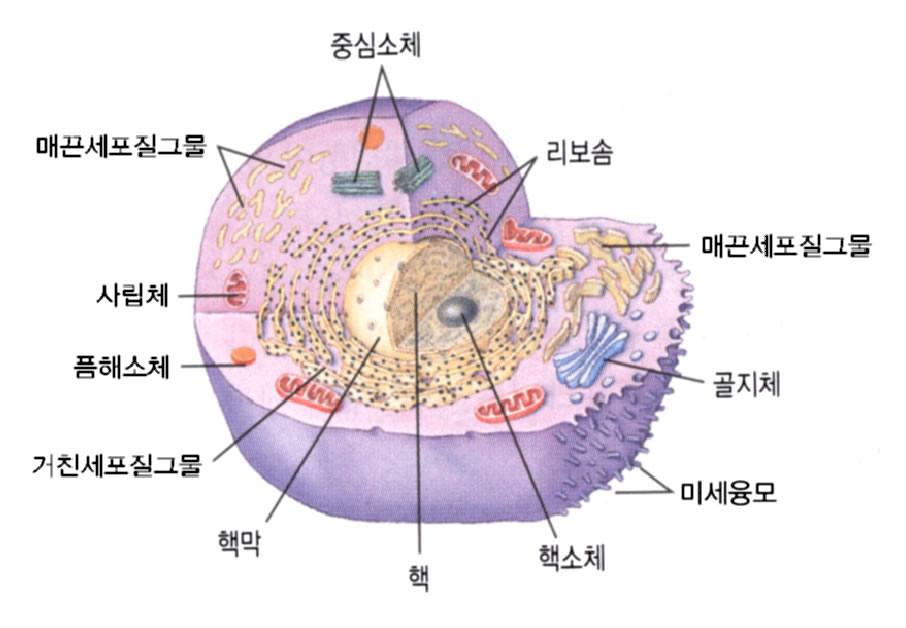 |
||
| 영문 | cell-mediated immunity | 한글 | 세포매개면역 |
|---|---|---|---|
| 설명 | 면역이란 신체를 외부의 물질로부터 보호하는 행위를 말한다. 여기에는 특이적 면역과 비특이적 면역의 두 가지가 있다. 비특이적 면역이라함은 특정한 물질에 관계하는 면역이 아니라 특정 대상이 없이 모든 외부 물체에 작용할 수 있는 면역을 말한다. 여기에는 소변의 흐름, 눈물의 흐름, 피부의 비투과성 등의 기계적인 것도 포함되고 피속에 돌아다니는 세포 중에서 비특이적으로 외부의 물질을 포식하는 세포들(예를 들면 큰포식세포(macrophage)의 활동도 포함이 된다. 세포매개면역이란 특이한 물질을 감지할 수 있는 세포를 생성하게 하여 그것으로 하여금 그 물질을 포식하게 하는 것을 말한다. |
||
| 영문 | nerve cell | 한글 | 신경세포 |
|---|---|---|---|
| 설명 | 신경세포는 올바른 신경전달을 위한 각 부분별로 나뉘어져 있다. 신경세포에서는 전해져오는 자극을 전기적인 신호로 바뀌어 보내거나 받게 된다. 이런 전기적인 현상은 각 신경세포내에 존재하는 각 이온채널(ion channel: ion이란 나트륨, 칼륨 등을 지칭하는 말들로써, 이들이 세포막에 의해 나뉘어질 때 생기는 전압차가 전기적 자극을 일으키고 유지하는데 결정적인 역할을 한다)들의 작용에 의해 이루어지게 된다. |
||
| RBC | red blood cell; red blood corpuscle; red blood count |
|---|---|
| RCC | radiological control center; rape crisis center; ratio of cost to charges; receptor-chemoeffector co... |
| MRBC | monkey red blood cell; mouse red blood cell |
| NRBC | National Rare Blood Club; normal red blood cell; nucleated red blood cell |
| RCF | red cell ferritin; red cell folate; relative centrifugal field/force; ristocetin cofactor |
| brain iron | <radiology> Normal, Infant: NONE, Adult: globus pallidum, substantia nigra, red nucleus, dentate nucleus, Aging: (adult) and putamen, Degenerative disease, Parkinson disease: putamen, SN compacta, Huntington disease: caudate, putamen, Alzheimer disease: cerebral cortex, Hallervorden-Spatz disease, MS: thalamus, putamen, Others, AVM: malformation and rim, Bleed: rim macrophages, Haemorrhagic CVA: gyral / basal ganglia MRI: low T1 and T2 signal (12 Dec 1998) |
|---|---|
| peptonised iron | A compound of iron oxide and peptone, rendered soluble by the presence of sodium citrate; used in the treatment of iron deficiency anaemia. (05 Mar 2000) |
| molybdenum-iron protein aldehyde oxidoreductase | <enzyme> Related to xanthine oxidase; isolated from desulfovibrio gigas Registry number: EC 1.2.7.- Synonym: mop protein (26 Jun 1999) |
| Weigert's iron haematoxylin stain | <technique> A nuclear staining solution containing haematoxylin, ferric chloride, and hydrochloric acid; useful in combination with von Gieson's stain, especially for demonstrating connective tissue elements or Entamoeba histolytica in sections. (05 Mar 2000) |
| Mowry's colloidal iron stain | <technique> A stain used for demonstrating acid mucopolysaccharides. (05 Mar 2000) |
| Hale's colloidal iron stain | <technique> A stain used to distinguish acid mucopolysaccharides such as hyaluronic acid; may be combined with PAS to also visualise carbohydrate-containing proteins and glycoproteins. (05 Mar 2000) |
| Heidenhain's iron haematoxylin stain | <technique> An iron alum haematoxylin stain used for staining muscle striations and mitotic structures blue-black. (05 Mar 2000) |
| serum iron level | A test that measures the amount of iron (Fe ++) in the blood. The test is performed when iron deficiency is suspected. Normal serum iron is 60 to 170 mcg/dl. Increased levels may be seen in the following: haemochromatosis, haemolysis, haemolytic anaemia, hepatitis, liver necrosis, haemosiderosis, iron poisoning and lead toxicity. Lower than normal levels are seen in chronic GI blood loss, iron deficiency anaemia, insufficient dietary iron, malabsorption, chronic heavy menstrual bleeding, nephrosis and late pregnancy. (27 Sep 1997) |
| spiegel iron | <chemistry> A fusible white cast iron containing a large amount of carbon (from three and a half to six per cent) and some manganese. When the manganese reaches twenty-five per cent and upwards it has a granular structure, and constitutes the alloy ferro manganese, largely used in the manufacture of Bessemer steel. Synonym: specular pig iron, spiegel, and spiegeleisen. Origin: G. Spiegel mirror + E. Iron. Source: Websters Dictionary (01 Mar 1998) |
| nickel-iron hydrogenase | <enzyme> From desulfovibrio multispirans Registry number: EC 1.12.- Synonym: nife hydrogenase, co-induced hydrogenase, co-tolerant hydrogenase (26 Jun 1999) |
| nickel-iron-selenium hydrogenase | <enzyme> From desulfovibrio baculatus Registry number: EC 1.12.- Synonym: nifese hydrogenase (26 Jun 1999) |
| non-haem iron protein | <biochemistry> Any protein containing iron but not any haem iron; e.g., NADH dehydrogenase. They are often found in oxidation-reduction reactions, and contain iron but no porphyrin groups. (17 Jul 2002) |
| deficiency, iron | Deficiency of iron results in anaemia because iron is necessary to make haemoglobin, the key molecule in red blood cells responsible for the transport of oxygen. In iron deficiency anaemia, the red cells are unusally small (microcytic) and pale (hypochromic). Characteristic features of iron deficiency anaemia in children include failure to thrive (grow) and increased infections. The treatment of iron deficiency anaemia , whether it be in children or adults, is with iron and iron-containing foods. Food sources of iron include meat, poultry, eggs, vegetables and cereals (especially those fortified with iron). According to the National Academy of Sciences, the Recommended Dietary Allowances of iron are 15 milligrams per day for women and 10 milligrams per day for men. (12 Dec 1998) |
| iron | 1. To smooth with an instrument of iron; especially, to smooth, as cloth, with a heated flatiron; sometimes used with out. 2. To shackle with irons; to fetter or handcuff. "Ironed like a malefactor." 3. To furnish or arm with iron; as, to iron a wagon. Origin: Ironed; Ironing. 1. Of, or made of iron; consisting of iron; as, an iron bar, dust. 2. Resembling iron in colour; as, iron blackness. 3. Like iron in hardness, strength, impenetrability, power of endurance, insensibility, etc.; as: Rude; hard; harsh; severe. "Iron years of wars and dangers." (Rowe) "Jove crushed the nations with an iron rod." (Pope) Firm; robust; enduring; as, an iron constitution. Inflexible; unrelenting; as, an iron will. Not to be broken; holding or binding fast; tenacious. "Him death's iron sleep oppressed." Iron is often used in composition, denoting made of iron, relating to iron, of or with iron; producing iron, etc.; resembling iron, literally or figuratively, in some of its properties or characteristics; as, iron-shod, iron-sheathed, iron-fisted, iron-framed, iron-handed, iron-hearted, iron foundry or iron-foundry. Iron age. Common pyrites, or pyrite. See Pyrites. Iron sand, an iron ore in grains, usually the magnetic iron ore, formerly used to sand paper after writing. Iron scale, the thin film which on the surface of wrought iron in the process of forging. It consists essentially of the magnetic oxide of iron, Fe3O4>. Iron works, a furnace where iron is smelted, or a forge, rolling mill, or foundry, where it is made into heavy work, such as shafting, rails, cannon, merchant bar, etc. Origin: AS. Iren, isen. See Iron. 1. <chemistry> The most common and most useful metallic element, being of almost universal occurrence, usually in the form of an oxide (as hematite, magnetite, etc), or a hydrous oxide (as limonite, turgite, etc). It is reduced on an enormous scale in three principal forms; viz, cast iron, steel, and wrought iron. Iron usually appears dark brown, from oxidation or impurity, but when pure, or an fresh surface, is a gray or white metal. It is easily oxidized (rusted) by moisture, and is attacked by many corrosive agents. Symbol Fe (Latin Ferrum). Atomic weight 55.9. Specific gravity, pure iron.86; cast iron.1. In magnetic properties, it is superior to all other substances. The value of iron is largely due to the facility with which it can be worked. Thus, when heated it is malleable and ductile, and can be easily welded and forged at a high temperature. As cast iron, it is easily fusible; as steel, is very tough, and (when tempered) very hard and elastic. Chemically, iron is grouped with cobalt and nickel. Steel is a variety of iron containing more carbon than wrought iron, but less that cast iron. It is made either from wrought iron, by roasting in a packing of carbon (cementation) or from cast iron, by burning off the impurities in a Bessemer converter (then called Bessemer steel), or directly from the iron ore (as in the Siemens rotatory and generating furnace). 2. An instrument or utensil made of iron; chiefly in composition; as, a flatiron, a smoothing iron, etc. "My young soldier, put up your iron." (Shak) 3. Fetters; chains; handcuffs; manacles. "Four of the sufferers were left to rot in irons." (Macaulay) 4. Strength; power; firmness; inflexibility; as, to rule with a rod of iron. Bar iron. See Wrought iron (below). Bog iron, bog ore; limonite. See Bog ore, under Bog. <chemistry> Cast iron, the purest form of iron commonly known in the arts, containing only about half of one per cent of carbon. It is made either directly from the ore, as in the Catalan forge or bloomery, or by purifying (puddling) cast iron in a reverberatory furnace or refinery. It is tough, malleable, and ductile. When formed into bars, it is called bar iron. Origin: OE. Iren, AS. Iren, isen, isern; akin to D. Ijzer, OS. Isarn, OHG. Isarn, isan, G. Eisen, Icel. Isarn, jarn, Sw. & Dan. Jern, and perh. To E. Ice; cf. Ir. Iarann, W. Haiarn, Armor. Houarn. Source: Websters Dictionary (01 Mar 1998) |
| iron-52 | A radioactive iron isotope; a cyclotron-produced positron emitter with a half-life of 8.28 hr, used to study iron metabolism. (05 Mar 2000) |