
| 영문 | heart | 한글 | 심장 |
|---|---|---|---|
| 설명 | 심장은 가슴의 중앙에 위치하며 오른쪽과 왼쪽반으로 나눌 수 있다. 각각은 정맥에서 피가 들어오는 방과 동맥으로 피를 내보내는 실이 있다. 심장은 정중앙선에서 왼쪽에 놓여 있다. 심장의 2개의 심방과 2개의 심실, 그리고 심방사이의 심방중격, 심실사이의 심실중격이 존재한다. 심실은 혈액을 주로 순환시키는 힘을 내는 곳으로 강한 근육층이 존재를 한다. 반면에 심방은 심실에 들어가기전에 일시적으로 피가 모이는 곳으로 근육층의 발달이 미약하다. 심방과 심실사이에 삼첨판과 승모판, 심실의 유출로에 대동맥판과 폐동맥판이 있다. 이것들은 혈액이 흐르는 방향에 거슬러 진행하는 것을 막는 기능을 한다. 그리고 심장에는 심장의 근육에 혈액을 공급하는 관상동맥이 있다. 이 심장동맥은 심장을 쌓듯이 존재한다. 심장박동의 신호는 특수한 장치에 의해서 발생이 되고 특수한 전도계를 통해서 전체의 심장으로 전도된다. 심장박동의 신호는 우선 우심방에 위치하는 동방결절(SA node)라는 곳에서 우선 생긴다. 여기에서 보내는 전기적 신호가 바로 심장을 뛰게하는 신호인 것이다. 이 신호로 말미암아 심방이 우선 수축을 한다. 그리고는 심방과 심실사이에 위치하는 방실결절(AV node)라는 곳에 일정하게 정해진 통로없이 전체의 심방을 통해서 전달이 되고 이 신호를 받은 방실결절(AV node)는 히스 다발(His bundle)과 심장전도근육섬유를 통해서 심실의 심장근육에게 이 신호를 보내주어 심실근육을 수축하게 한다. 히스다발과 심장전도근육섬유는 전체의 심실의 심근섬유에 동시에 전기적 신호를 보내어 줄 수 있게 하는 일종의 전기줄과 같은 역할을 한다. 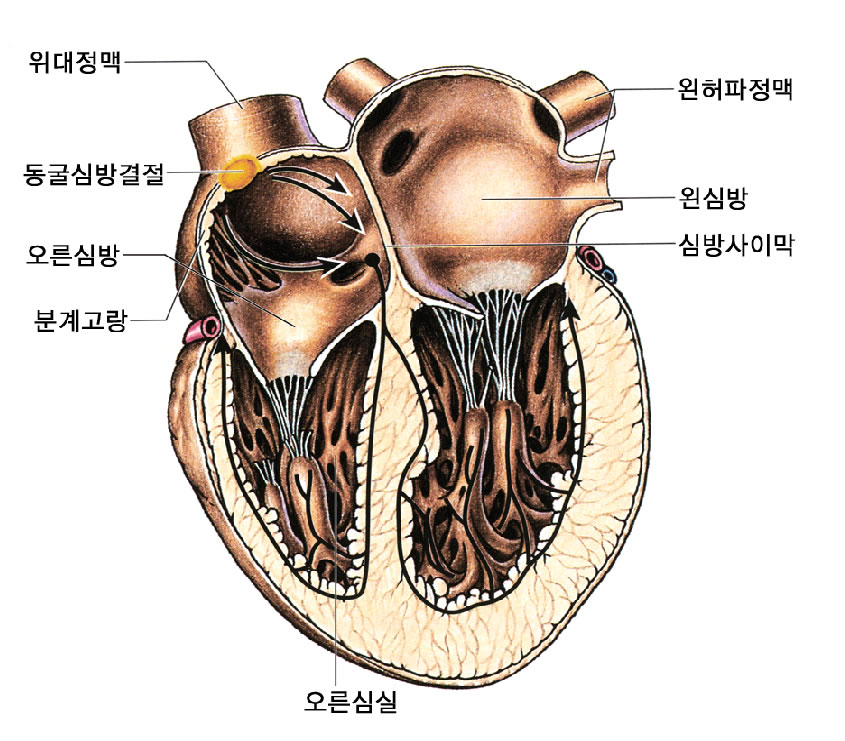 |
||
| 영문 | heart failure | 한글 | 심장기능상실 |
|---|---|---|---|
| 설명 | 몸의 조직이나 기관에서 대사에 필요한 만큼 충분한 양의 혈액을 공급할 수 없을 정도로 심장기능이 저하되어 있는 상태이다. 심장기능상실은 심근이 수축할 능력이 저하되었을 때나 심장에 심박출을 하기 위한 압력이 정상보다 증가되어 정상의 심장의 수축으로는 충분한 양의 혈액을 공급할 수 없는 경우, 그리고 심장근육, 심장에 걸리는 압력은 정상이나 심장박동의 이상에 의해서 정상적인 수축이 불가능할 경우에 생긴다. |
||
| 영문 | pacemaker(of heart) | 한글 | 심장박동기 |
|---|---|---|---|
| 설명 | 심장의 전기적 자극이 병적인 상태로 발생하지 않거나, 혹은 심실로 잘 전해지지 않을 때 사용한다. 일시적 심장박동기와 영구적 심장박동기가 있으며, 각기 쓰이는 용도는 병에 따라 다르다. 요즘에 나오는 심장 박동기는 건전지의 수명도 반영구적이며, 밖에서 조정할 수 있고, 운동이나 스트레스 상황에 대한 심장의 빠른 운동에도 잘 적응할 수 있도록 만들어져 있다. |
||
| 영문 | heart disease | 한글 | 심장병 |
|---|---|---|---|
| 설명 | 순환기 질환 중 심장의 병. 일반적으로 심장혈관이나 심장의 병도 포함된다. 병터의 부위에 의한 병리해부학적 분류와 병인에 의한 분류가 있다. 전자는 수 십 년 전부터 쓰여져 왔으나 근년에 와서 본질적인 원인요법이 가능하게 된 이후는 후자의 분류가 의의가 있어서 많이 쓰이게 되었다. 병터 부위로는 심내막(판막)-심장근-심장막, 그 밖의 것을 들 수 있으며, 각각 심내막염-심장판막증-심근염-심근경색-심장막염-선천성 심장병(심장기형) 등이포함된다. 병인별에서는 심장기형을 비롯하여 류마치스 심장병-매독성 심장병-고혈압성 심장병-심장동맥경화성 심장병-폐성심장-세균성 심내막염-심장신경증 등으로 나누어지며, 부정맥이나 방실차단 등의 자극전도계의 장애에 의한 것도 증세의 하나로 볼 수 있다. 심장병은 자각적으로는 무증세인 것에서부터 심장기능상실로 호흡곤란까지 있다. |
||
| 영문 | septal defects of heart | 한글 | 심장의 중격 결손 |
|---|---|---|---|
| 설명 | 선천적으로 심장 내의 심방사이중격(interatrial septum)이나 심실사이중격(interventricular septum)이 결손되어 혈류가 정상적으로 흐르지 않는 경우. 정상적인 경우 혈류는 정맥에서 우심방으로 모여 우심실을 거친뒤 폐로 가서 산소를 공급받고 다시 왼심방, 왼심실을 차례로 거쳐 대동맥으로 간다. 하지만, 이 경우는 혈류가 압력이 높은 왼심방이나 왼심실에서 압력이 낮은 우심방이나 우심실로 흐르게 된다. 따라서 동맥피와 정맥피가 섞이게 되고, 환자는 호흡곤란, 성장발육장애, 심잡음 등이 나타나고, 심한 경우 청색증으로 발전하기도 한다. 치료는 수술적으로 이 결손부위를 막아 주어야 한다. |
||
| IHD | Ischemic Heart Disease = Coronary Heart(Artery) Disease = Atheroscler... |
|---|---|
| AHD | acquired hepatocerebral degeneration; acute heart disease; antihyaluronidase; antihypertensive drug;... |
| CHD | Chediak-Higashi disease; childhood disease; chronic hemodialysis; congenital or congestive heart dis... |
| HT | Hashimoto thyroiditis; hearing test; hearing threshold; heart; heart transplantation, heart transpla... |
| HB | health board; heart block; heel to buttock; held back; hemoglobin; hepatitis B; His bundle; hold bre... |
| choroid tela of third ventricle | A double fold of pia mater, enclosing subarachnoid trabeculae, between the fornix above and the epithelial roof of the third ventricle and the thalami below; at each lateral margin is a vascular fringe projecting into the choroidal fissure of the lateral ventricle; on its undersurface are several small vascular projections filling the folds of the ependymal roof of the third ventricle. Synonym: tela choroidea ventriculi tertii, tela choroidea superior, triangular lamella, velum interpositum, velum triangulare. (05 Mar 2000) |
|---|---|
| molar, third | The aftermost permanent tooth on each side in the maxilla and mandible. (12 Dec 1998) |
| pregnancy trimester, third | Period of pregnancy from the beginning of the 29th through the 42nd completed week (197 to 294 days) of gestation. (12 Dec 1998) |
| healing by third intention | The slow filling of a wound cavity or ulcer by granulations, with subsequent cicatrization. (05 Mar 2000) |
| sphincter of third portion of duodenum | A physiological sphincter supposedly located at the horizontal (inferior) portion of the duodenum. (05 Mar 2000) |
| styloid process of third metacarpal bone | A pointed projection from the dorsolateral angle of the base of the third metacarpal bone; it sometimes exists as a separate ossicle. Synonym: processus styloideus ossis metacarpalis III. (05 Mar 2000) |
| syndrome, third and fourth pharyngeal pouch | See syndrome, digeorge. (12 Dec 1998) |
| third | 1. Next after the second; coming after two others; the ordinal of three; as, the thirdhour in the day. "The third night." 2. Constituting or being one of three equal parts into which anything is divided; as, the third part of a day. Third estate. In England, the commons, or the commonalty, who are represented in Parliament by the House of Commons. In France, the tiers etat. See Tiers etat. Third order See Third. Origin: OE. Thirde, AS. Ridda, fr. Ri, reo, three; akin to D. Derde third, G. Dritte, Icel. Rii, Goth. Ridja, L. Tertius, Gr, Skr. Ttiya. See Three, and cf. Riding a jurisdiction, Tierce. Source: Websters Dictionary (01 Mar 1998) |
| third and fourth pharyngeal pouch syndrome | <syndrome> Also called the digeorge syndrome (dgs), this disorder is characterised by (1) low blood calcium levels (hypocalcaemia) due to underdevelopment (hypoplasia) of the parathyroid glands which control calcium; (2) underdevelopment (hypoplasia) of the thymus, an organ behind the breastbone in which lymphocytes mature and multiply; and (3) defects of the heart involving the outflow tracts more than from the heart. most cases of dgs are due to a microdeletion in chromosome band 22q11.2. A small number of cases have defects in other chromosomes, notably 10p13. Named after the american paediatric endocrinologist angelo digeorge. Another name for dgs is hypoplasia of the thymus and parathyroids. (12 Dec 1998) |
| third corpuscle | <haematology> A discoid cell (3m diameter) found in large numbers in blood, important for blood coagulation and for haemostasis by repairing breaches (small breaks) in the walls of blood vessels. Platelet _ granules contain lysosomal enzymes, dense granules contain ADP (a potent platelet aggregating factor) and serotonin (a vasoactive amine). They also release platelet-derived growth factor which presumably contributes to later repair processes by stimulating fibroblast proliferation. Synonym: thrombocytes. (09 Oct 1997) |
| third cranial nerve | <anatomy, nerve> Responsible for motor enervation of upper eyelid muscle, extraocular muscle and pupillary muscle. Lesions of the oculomotor nerve results in ptosis (dropping eyelid), deviation of the eyeball outward, double vision and a dilated pupil. (27 Sep 1997) |
| third cuneiform bone | A bone of the distal row of the tarsus; it articulates with the intermediate cuneiform, cuboid, navicular, and second, third, and fourth metatarsal bones. Synonym: os cuneiforme laterale, third cuneiform bone, wedge bone. (05 Mar 2000) |
| third disease | <disease, virology> An acute, usually benign, infectious disease caused by a togavirus and most often affecting children and nonimmune young adults, in which the virus enters the respiratory tract via droplet nuclei and spreads to the lymphatic system. It is characterised by a slight cold, sore throat and fever, followed by enlargement of the postauricular, suboccipital and cervical lymph nodes and the appearances of a fine pink rash that begins on the head and spreads to become generalised. Synonym: German measles, rubeola. Origin: L. Rubellus = reddish, ruber = red (17 Dec 1997) |
| third eyelid | The semilunar fold formed by the palpebral conjunctiva at the medial angle of the eye, a fold of the conjunctival mucous membrane found in many animals; normally partially hidden in the medial canthus of the eye when at rest, it may be extended to cover part or all of the cornea in a winking-like action to clean the cornea, as in birds. Synonym: membrana nictitans, nictitating membrane, palpebra III, palpebra tertia, third eyelid. Synonym: plica lunata, plica semilunaris of eye, semilunar conjunctival fold. (05 Mar 2000) |
| third finger | Third finger. Synonym: digitus medius, digitus tertius, third finger. (05 Mar 2000) |