
| 영문 | heart | 한글 | 심장 |
|---|---|---|---|
| 설명 | 심장은 가슴의 중앙에 위치하며 오른쪽과 왼쪽반으로 나눌 수 있다. 각각은 정맥에서 피가 들어오는 방과 동맥으로 피를 내보내는 실이 있다. 심장은 정중앙선에서 왼쪽에 놓여 있다. 심장의 2개의 심방과 2개의 심실, 그리고 심방사이의 심방중격, 심실사이의 심실중격이 존재한다. 심실은 혈액을 주로 순환시키는 힘을 내는 곳으로 강한 근육층이 존재를 한다. 반면에 심방은 심실에 들어가기전에 일시적으로 피가 모이는 곳으로 근육층의 발달이 미약하다. 심방과 심실사이에 삼첨판과 승모판, 심실의 유출로에 대동맥판과 폐동맥판이 있다. 이것들은 혈액이 흐르는 방향에 거슬러 진행하는 것을 막는 기능을 한다. 그리고 심장에는 심장의 근육에 혈액을 공급하는 관상동맥이 있다. 이 심장동맥은 심장을 쌓듯이 존재한다. 심장박동의 신호는 특수한 장치에 의해서 발생이 되고 특수한 전도계를 통해서 전체의 심장으로 전도된다. 심장박동의 신호는 우선 우심방에 위치하는 동방결절(SA node)라는 곳에서 우선 생긴다. 여기에서 보내는 전기적 신호가 바로 심장을 뛰게하는 신호인 것이다. 이 신호로 말미암아 심방이 우선 수축을 한다. 그리고는 심방과 심실사이에 위치하는 방실결절(AV node)라는 곳에 일정하게 정해진 통로없이 전체의 심방을 통해서 전달이 되고 이 신호를 받은 방실결절(AV node)는 히스 다발(His bundle)과 심장전도근육섬유를 통해서 심실의 심장근육에게 이 신호를 보내주어 심실근육을 수축하게 한다. 히스다발과 심장전도근육섬유는 전체의 심실의 심근섬유에 동시에 전기적 신호를 보내어 줄 수 있게 하는 일종의 전기줄과 같은 역할을 한다. 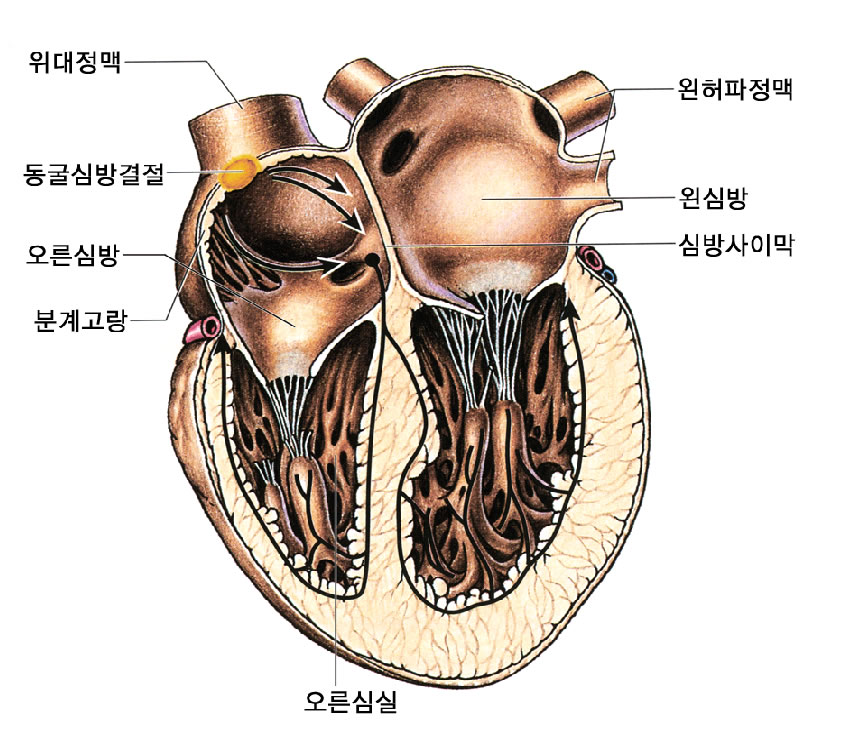 |
||
| 영문 | heart failure | 한글 | 심장기능상실 |
|---|---|---|---|
| 설명 | 몸의 조직이나 기관에서 대사에 필요한 만큼 충분한 양의 혈액을 공급할 수 없을 정도로 심장기능이 저하되어 있는 상태이다. 심장기능상실은 심근이 수축할 능력이 저하되었을 때나 심장에 심박출을 하기 위한 압력이 정상보다 증가되어 정상의 심장의 수축으로는 충분한 양의 혈액을 공급할 수 없는 경우, 그리고 심장근육, 심장에 걸리는 압력은 정상이나 심장박동의 이상에 의해서 정상적인 수축이 불가능할 경우에 생긴다. |
||
| 영문 | pacemaker(of heart) | 한글 | 심장박동기 |
|---|---|---|---|
| 설명 | 심장의 전기적 자극이 병적인 상태로 발생하지 않거나, 혹은 심실로 잘 전해지지 않을 때 사용한다. 일시적 심장박동기와 영구적 심장박동기가 있으며, 각기 쓰이는 용도는 병에 따라 다르다. 요즘에 나오는 심장 박동기는 건전지의 수명도 반영구적이며, 밖에서 조정할 수 있고, 운동이나 스트레스 상황에 대한 심장의 빠른 운동에도 잘 적응할 수 있도록 만들어져 있다. |
||
| 영문 | heart disease | 한글 | 심장병 |
|---|---|---|---|
| 설명 | 순환기 질환 중 심장의 병. 일반적으로 심장혈관이나 심장의 병도 포함된다. 병터의 부위에 의한 병리해부학적 분류와 병인에 의한 분류가 있다. 전자는 수 십 년 전부터 쓰여져 왔으나 근년에 와서 본질적인 원인요법이 가능하게 된 이후는 후자의 분류가 의의가 있어서 많이 쓰이게 되었다. 병터 부위로는 심내막(판막)-심장근-심장막, 그 밖의 것을 들 수 있으며, 각각 심내막염-심장판막증-심근염-심근경색-심장막염-선천성 심장병(심장기형) 등이포함된다. 병인별에서는 심장기형을 비롯하여 류마치스 심장병-매독성 심장병-고혈압성 심장병-심장동맥경화성 심장병-폐성심장-세균성 심내막염-심장신경증 등으로 나누어지며, 부정맥이나 방실차단 등의 자극전도계의 장애에 의한 것도 증세의 하나로 볼 수 있다. 심장병은 자각적으로는 무증세인 것에서부터 심장기능상실로 호흡곤란까지 있다. |
||
| 영문 | septal defects of heart | 한글 | 심장의 중격 결손 |
|---|---|---|---|
| 설명 | 선천적으로 심장 내의 심방사이중격(interatrial septum)이나 심실사이중격(interventricular septum)이 결손되어 혈류가 정상적으로 흐르지 않는 경우. 정상적인 경우 혈류는 정맥에서 우심방으로 모여 우심실을 거친뒤 폐로 가서 산소를 공급받고 다시 왼심방, 왼심실을 차례로 거쳐 대동맥으로 간다. 하지만, 이 경우는 혈류가 압력이 높은 왼심방이나 왼심실에서 압력이 낮은 우심방이나 우심실로 흐르게 된다. 따라서 동맥피와 정맥피가 섞이게 되고, 환자는 호흡곤란, 성장발육장애, 심잡음 등이 나타나고, 심한 경우 청색증으로 발전하기도 한다. 치료는 수술적으로 이 결손부위를 막아 주어야 한다. |
||
| JVP | [POMD P 49 - 52] 1) Jugular Vein Pressure 2) Jugular Venous Pulse ... |
|---|---|
| AHD | acquired hepatocerebral degeneration; acute heart disease; antihyaluronidase; antihypertensive drug;... |
| CHD | Chediak-Higashi disease; childhood disease; chronic hemodialysis; congenital or congestive heart dis... |
| HT | Hashimoto thyroiditis; hearing test; hearing threshold; heart; heart transplantation, heart transpla... |
| CAS | calcarine sulcus; calcific aortic stenosis; Cancer Attitude Survey; carbohydrate-active steroid; car... |
| C-terminal leucine protein methyltransferase | <enzyme> Reversibly modifies protein phosphatase 2a by methyl esterification at its c-terminal leucine residues Registry number: EC 2.1.1.- Synonym: tlp methyltransferase (26 Jun 1999) |
|---|---|
| protein NH2-terminal asparagine deamidase | <enzyme> Converts amino terminal asparagine to aspartic acid; from porcine liver; mw about 33 kD Registry number: EC 3.5.1.- Synonym: porcine pnad (26 Jun 1999) |
| protein N-terminal acetyltransferase | <enzyme> From saccharmyces cerevisiae; encodes a catalytic subunit of an n-terminal acetyltransferase; ard1 and nat1 proteins are subunits of this enzyme Registry number: EC 2.3.1.- Synonym: nat1 gene protein, saccharomyces, yeast protein n-terminal acetyltransferase, n-terminal protein acetyltransferase, ard1 protein (26 Jun 1999) |
| HIV long-terminal repeat | Regulatory sequences important for viral replication that are located on each end of the HIV genome. The ltr includes the HIV enhancer, promoter, and other sequences. Specific regions in the ltr include the negative regulatory element (nre), nf-kappa b binding sites , sp1 binding sites, tata box, and trans-acting responsive element (tar). The binding of both cellular and viral proteins to these regions regulates HIV transcription. (12 Dec 1998) |
| small bowel disease involving terminal ileum | <radiology> Crohn's, TB, Yersinia (12 Dec 1998) |
| NH2-terminal | <biochemistry> The end of a protein or polypeptide chain with the unattached amino group or the aminoacyl residue containing it. Each amino acid in the chain has an amino group on one side, which is attached to the carboxyl group (COOH group) of the previous amino acid, and a carboxyl group on the other side (which is attached to the amino group of the next amino acid). The other end of the polypeptide chain is called the carboxyl terminal. Synonym: NH2-terminal. (14 Aug 2000) |
| Deiters' terminal frames | Platelike structures in the organ of Corti uniting the outer phalangeal cells with Hensen's cells. (05 Mar 2000) |
| direct terminal repeat | A particular sequence of nucleotides which appears on both ends of a DNA or RNA molecule. (09 Oct 1997) |
| ileitis, terminal | Crohn's disease, a chronic inflammatory disease of the intestine involving only the end of the small intestine (the terminal ileum). Crohn's disease affects primarily the small and large intestines but which can occur anywhere in the digestive system between the mouth and the anus. Named after burrill crohn who described the disease in 1932. The disease often strikes persons in their teens or early twenties. It tends to be chronic, recurrent with periods of remission and exacerbation. In the early stages. It causes small scattered shallow crater-like areas (erosions) called apthous ulcers in the inner surface of the bowel. With time, deeper and larger ulcers develop, causing scarring and stiffness of the bowel and the bowel becomes increasingly narrowed, leading to obstruction. Deep ulcers can puncture holes in the bowel wall, leading to infection in the abdominal cavity (peritonitis) and in adjacent organs abdominal pain, diarrhoea, vomiting, fever, and weight loss can be symptoms. Crohn's disease can be associated with reddish tender skin nodules, and inflammation of the joints, spine, eyes, and liver. Diagnosis is by barium enema, barium X-ray of the small bowel, and colonoscopy. Treatment includes medications for inflammation, immune suppression, antibiotics, or surgery. (12 Dec 1998) |
| telomere terminal transferase | <enzyme> From oxytricha nova; adds two to seven tandem repeats of the sequence ggggtttt to the 3' end of oligonucleotide primers ending in repeats of g4t4 and always adds the repeats in the proper phase Registry number: EC 2.7.7.- (26 Jun 1999) |
| terminal | 1. Forming or pertaining to an end, placed at the end. 2. A termination, end or extremity. Origin: L. Terminalis (18 Nov 1997) |
| terminal addition enzyme | <enzyme> A non-template-directed DNA polymerase normally found in vertebrate thymus and bone marrow. It catalyses the elongation of oligo- or polydeoxynucleotide chains and is widely used as a tool in the differential diagnosis of acute leukaemias in man. Chemical name: Nucleoside-triphosphate:DNA deoxynucleotidylexotransferase Registry number: EC 2.7.7.31 (12 Dec 1998) |
| terminal artery | <anatomy, artery> An artery with insufficient anastomoses to maintain viability of the tissue supplied if occlusion of the artery occurs. Synonym: terminal artery. (05 Mar 2000) |
| terminal bar | Obsolete name for zonula occludens (tight junction). (18 Nov 1997) |
| terminal boutons | The somewhat enlarged, often club-shaped endings by which axons make synaptic contacts with other nerve cells or with effector cells (muscle or gland cells). As isolated, by homogenizing brain or spinal cord, they contain acetylcholine and the related enzymes. Terminals contain neurotransmitters of various kinds, sometimes more than one. These can be demonstrated by chemical analysis and immunocytochemical methods. See: synapse. Synonym: axonal terminal boutons, end-feet, neuropodia, pieds terminaux, synaptic boutons, synaptic endings, synaptic terminals, terminal boutons, bouton terminaux. (05 Mar 2000) |