
| 영문 | rheumatic heart disease | 한글 | 류마티스심장병 |
|---|---|---|---|
| 설명 | 사슬알균감염 후 생기는 심장판막병이다. 원인은 A군 -용혈사슬알에 의한 인두염후 일종의 면역반응으로 발병한다. 진단은 존의 기준에 의한다. (1) 주요기준은 관절염 심장염(심장비대, 심장잡음, 심장기능상실 등) 무도증: 무당이 춤을 추는 것 같은 행동의 발작증세. 연변홍반: 빨간 테두리를 가진 피부병변은 피하결절(subcutaneous nodule): 피부 밑에 생긴 결절, (2)참고 기준은 열, 관절통, EKG상 PR연장: 심전도 소견 급성기 반응물질(예: ESR, CRP)의 상승, 류마티스열 치료는 페니실린으로 치료하고 심장의 후유증 또한 페니실린으로 예방한다. |
||
| 영문 | congenital heart disease | 한글 | 선천심장병 |
|---|---|---|---|
| 설명 | 선천적으로 심장의 구조에 이상이 있는 병. |
||
| 영문 | heart | 한글 | 심장 |
|---|---|---|---|
| 설명 | 심장은 가슴의 중앙에 위치하며 오른쪽과 왼쪽반으로 나눌 수 있다. 각각은 정맥에서 피가 들어오는 방과 동맥으로 피를 내보내는 실이 있다. 심장은 정중앙선에서 왼쪽에 놓여 있다. 심장의 2개의 심방과 2개의 심실, 그리고 심방사이의 심방중격, 심실사이의 심실중격이 존재한다. 심실은 혈액을 주로 순환시키는 힘을 내는 곳으로 강한 근육층이 존재를 한다. 반면에 심방은 심실에 들어가기전에 일시적으로 피가 모이는 곳으로 근육층의 발달이 미약하다. 심방과 심실사이에 삼첨판과 승모판, 심실의 유출로에 대동맥판과 폐동맥판이 있다. 이것들은 혈액이 흐르는 방향에 거슬러 진행하는 것을 막는 기능을 한다. 그리고 심장에는 심장의 근육에 혈액을 공급하는 관상동맥이 있다. 이 심장동맥은 심장을 쌓듯이 존재한다. 심장박동의 신호는 특수한 장치에 의해서 발생이 되고 특수한 전도계를 통해서 전체의 심장으로 전도된다. 심장박동의 신호는 우선 우심방에 위치하는 동방결절(SA node)라는 곳에서 우선 생긴다. 여기에서 보내는 전기적 신호가 바로 심장을 뛰게하는 신호인 것이다. 이 신호로 말미암아 심방이 우선 수축을 한다. 그리고는 심방과 심실사이에 위치하는 방실결절(AV node)라는 곳에 일정하게 정해진 통로없이 전체의 심방을 통해서 전달이 되고 이 신호를 받은 방실결절(AV node)는 히스 다발(His bundle)과 심장전도근육섬유를 통해서 심실의 심장근육에게 이 신호를 보내주어 심실근육을 수축하게 한다. 히스다발과 심장전도근육섬유는 전체의 심실의 심근섬유에 동시에 전기적 신호를 보내어 줄 수 있게 하는 일종의 전기줄과 같은 역할을 한다. 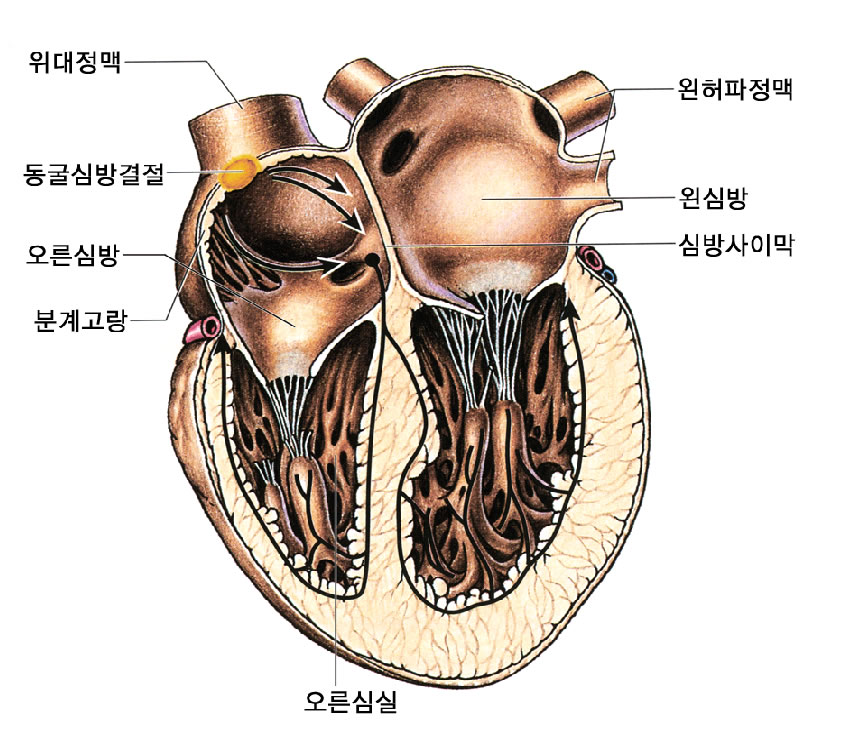 |
||
| 영문 | pacemaker(of heart) | 한글 | 심장박동기 |
|---|---|---|---|
| 설명 | 심장의 전기적 자극이 병적인 상태로 발생하지 않거나, 혹은 심실로 잘 전해지지 않을 때 사용한다. 일시적 심장박동기와 영구적 심장박동기가 있으며, 각기 쓰이는 용도는 병에 따라 다르다. 요즘에 나오는 심장 박동기는 건전지의 수명도 반영구적이며, 밖에서 조정할 수 있고, 운동이나 스트레스 상황에 대한 심장의 빠른 운동에도 잘 적응할 수 있도록 만들어져 있다. |
||
| 영문 | heart disease | 한글 | 심장병 |
|---|---|---|---|
| 설명 | 순환기 질환 중 심장의 병. 일반적으로 심장혈관이나 심장의 병도 포함된다. 병터의 부위에 의한 병리해부학적 분류와 병인에 의한 분류가 있다. 전자는 수 십 년 전부터 쓰여져 왔으나 근년에 와서 본질적인 원인요법이 가능하게 된 이후는 후자의 분류가 의의가 있어서 많이 쓰이게 되었다. 병터 부위로는 심내막(판막)-심장근-심장막, 그 밖의 것을 들 수 있으며, 각각 심내막염-심장판막증-심근염-심근경색-심장막염-선천성 심장병(심장기형) 등이포함된다. 병인별에서는 심장기형을 비롯하여 류마치스 심장병-매독성 심장병-고혈압성 심장병-심장동맥경화성 심장병-폐성심장-세균성 심내막염-심장신경증 등으로 나누어지며, 부정맥이나 방실차단 등의 자극전도계의 장애에 의한 것도 증세의 하나로 볼 수 있다. 심장병은 자각적으로는 무증세인 것에서부터 심장기능상실로 호흡곤란까지 있다. |
||
| AHD | acquired hepatocerebral degeneration; acute heart disease; antihyaluronidase; antihypertensive drug;... |
|---|---|
| CHD | Chediak-Higashi disease; childhood disease; chronic hemodialysis; congenital or congestive heart dis... |
| HT | Hashimoto thyroiditis; hearing test; hearing threshold; heart; heart transplantation, heart transpla... |
| ARF | acute renal failure; acute respiratory failure; acute rheumatic fever; Addiction Research Foundation... |
| CRF | case report form; chronic renal failure; chronic respiratory failure; coagulase-reacting factor; con... |
| systolic pressure | <cardiology, physiology> The pressure exerted on the walls of the arteries during the contraction phase of the heart. Considered abnormally elevated if consistently over 150 mmHg. Systolic blood pressure varies with age, sex, size and relative condition. (27 Sep 1997) |
|---|---|
| systolic shock | The abnormally palpable impact, appreciated by a hand on the chest wall, of an accentuated first heart sound. (05 Mar 2000) |
| systolic thrill | A thrill felt over the precordium or over a blood vessel during ventricular systole. (05 Mar 2000) |
| systolic time intervals | See: electromechanical systole, left ventricular ejection time, preejection period. (05 Mar 2000) |
| systolic whoop | systolic honk |
| total end-systolic diameter | Cross sectional diameter of the left ventricle including the septum and posterior wall thicknesses in systole. (05 Mar 2000) |
| end-systolic volume | The amount of blood in the ventricle at the end of the cardiac ejection period and immediately preceding the beginning of ventricular relaxation; a measurement of the adequacy of cardiac emptying, related to systolic function. (05 Mar 2000) |
| late apical systolic murmur | A murmur previously considered benign, or even extracardiac, with a possible relationship to pericardial disease; it often represents mitral insufficiency, often localised and of moderate severity but with propensity for developing bacterial endocarditis, and is frequently associated with systolic click and mitral prolapse (Barlow syndrome; a balloon or billowing mitral valve leaflet) often producing a click, murmur, or both, as it prolapses during systole into the left atrium. (05 Mar 2000) |
| acute kidney failure | <nephrology> A sudden decline in renal function may be triggered by a number of acute disease processes. Examples include sepsis (infection), shock, trauma, kidney stones, kidney infection, drug toxicity (aspirin or lithium), poisons or toxins (drug abuse) or after injection with an iodinated contrast dye (adverse effect). Chronic renal failure represents a slow decline in kidney function over time. Chronic renal failure may be caused by a number of disorders which include long-standing hypertension, diabetes, congestive heart failure, lupus or sickle cell anaemia. Both forms of renal failure result in a life-threatening metabolic derangement. (27 Sep 1997) |
| acute renal failure | <nephrology> A sudden decline in renal function may be triggered by a number of acute disease processes. Examples include sepsis (infection), shock, trauma, kidney stones, kidney infection, drug toxicity (aspirin or lithium), poisons or toxins (drug abuse) or after injection with an iodinated contrast dye (adverse effect). Chronic renal failure represents a slow decline in kidney function over time. Chronic renal failure may be caused by a number of disorders which include long-standing hypertension, diabetes, congestive heart failure, lupus or sickle cell anaemia. Both forms of renal failure result in a life-threatening metabolic derangement. (27 Sep 1997) |
| acute respiratory failure | Loss of pulmonary function either acute or chronic that results in hypoxaemia or hypercarbia. (05 Mar 2000) |
| cardiac failure | A condition where there is ineffective pumping of the heart leading to an accumulation of fluid in the lungs. Typical symptoms include shortness of breath with exertion, difficulty breathing when lying flat and leg or ankle swelling. Causes include chronic hypertension, cardiomyopathy and myocardial infarction. (27 Sep 1997) |
| pacemaker failure | Failure of an artificial pacemaker to generate or deliver effective stimuli to the myocardium. (05 Mar 2000) |
| renal failure | Chronic renal failure represents a slow decline in kidney function over time. Chronic renal failure may be caused by a number of disorders which include long-standing hypertension, diabetes, congestive heart failure, lupus or sickle cell anaemia. If renal function declines to a low enough level (end-stage renal disease) kidney dialysis may be necessary. A sudden decline in renal function may be triggered by a number of acute disease processes. Examples include sepsis (infection), shock, trauma, kidney stones, kidney infection, drug toxicity (aspirin or lithium), poisons or toxins (drug abuse) or after injection with an iodinated contrast dye (adverse effect). Both forms of renal failure result in a life-threatening metabolic derangement. (27 Sep 1997) |
| respiratory failure | A clinical syndrome that is defined either by the inability to rid the body of C02 or establish an adequate blood oxygen level (PAO2). See: arterial blood gas. (27 Sep 1997) |