
| 영문 | lacrimal duct | 한글 | 눈물관 |
|---|---|---|---|
| 설명 | 눈물이 흘러내리는 통로에 해당한다. 눈물은 대개 눈물샘에서 만들어져 눈을 적신 뒤에, 여기를 거쳐서 눈물주머니에 모인 뒤, 코눈물관으로 흘러 코 안쪽으로 내려가게 된다. 만약 여기가 막히면, 눈물이 계속 고이게 되어 계속 눈물을 흘리게 되며, 또한 병균의 서식처가 되어 감염의 위험성이 높아진다. 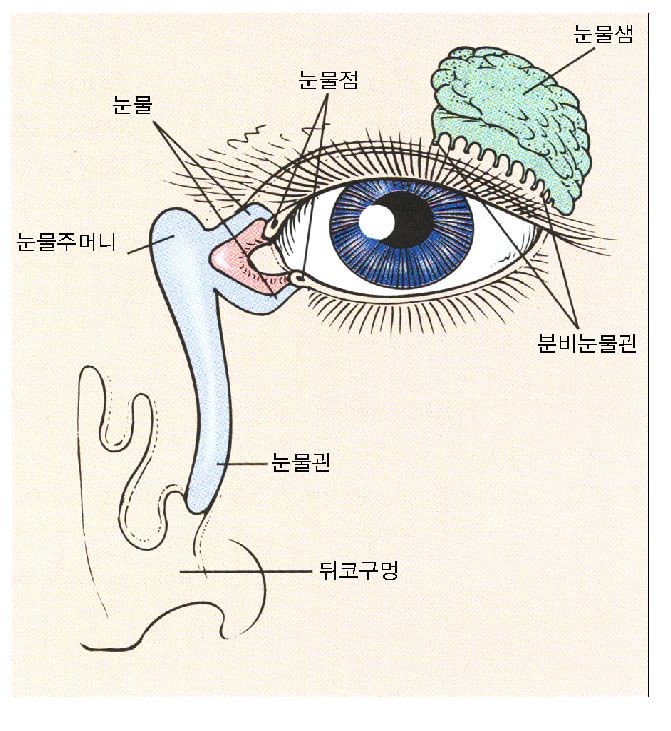 |
||
| 영문 | pancreatic duct | 한글 | 이자관, 췌장관 |
|---|---|---|---|
| 설명 | 이자에서 이자액을 분비하도록 샘창자로 이어진 관. 이자관은 샘창자의 중간부에서 온쓸개관과 같이 개구한다. |
||
| 영문 | nasolacrimal duct | 한글 | 코눈물관 |
|---|---|---|---|
| 설명 | 눈물은 대개 눈물샘에서 만들어져 눈을 적신 뒤에 누관을 거쳐서 눈물주머니에 모인 뒤에 이 코눈물관으로 흘러 코 안쪽으로 내려가게 된다. 만일 여기가 막히면, 눈물이 계속 고이게 되어 계속 눈물을 흘리게 되며, 또한 병균의 서식처가 되어 감염의 위험성이 높아진다. |
||
| 영문 | striated muscle | 한글 | 가로무늬근 |
|---|---|---|---|
| 설명 | 표면에 가로줄무늬가 보이는 근육. 뜻대로 움직일 수 있으므로 수의근이라고도 불린다. 인체의 가로무늬근의 대부분은 골격근이며, 얼굴의 피부를 움직이는 표정근, 혀나 후두를 움직이는 근육도 가로무늬근이다. 예를 들어 팔을 구부릴 때는 많은 근육의 복잡한 협조가 필요하여 전체적인 움직임을 통제하는 기구가 있다. 또 자세의 균형을 잡을 때 등 많은 운동을 무의식적-반사적으로 조절하는 기구도 있다. 심장근은 가로무늬근이지만 불수의근의 성질을 가졌다. |
||
| 영문 | skeletal muscle | 한글 | 골격근 |
|---|---|---|---|
| 설명 | 골격에 붙어 그 운동을 관장하는 근육계. 골격근-평활근-심장근 등 세 개 근조직의 하나. 굵기 10~100μ, 길이 5~12cm의 가늘고 긴 근육섬유의 집합체이며, 가로무늬가 있고, 수의운동을 한다. 한 개의 골격근은 다수의 근섬유와 결합조직으로 구성되고 각기 특유한 형태를 지닌다. 근육의 양끝은 가늘며 그 부분을 근육머리라고 한다. 근육머리는 힘줄로 이행하며 힘줄은 뼈막에 붙는데, 때로는 뼈막을 뚥고 뼈에 부착되어 있다. 근육의 중앙부는 굵고 두꺼우며 이부분을 근복이라 한다. 근육머리는 다시 두갈래근-세갈래근-네갈래근으로 나뉜다. 근육의 운동 자체는 항상 근섬유의 방향에 따르는 수축운동뿐이다. 그러나 골격근이 뼈에 붙은 위치에 따라 뼈대에 대한 여러 가지 운동을 하게 된다. 운동하는 형태로 골격근을 분류하면 폄근-굽힘근-내전근-외전근-회외근-회내근-올림근 등이 있다. 굽히고 폄-내외전-회내외의 운동은 관절축을 중심으로 행한다. 같은 골격에 대하여 펌근육과 굽힘근육이 각기 반대운동을 할 경우에는 양 근육을 서로 대항근이라 하고, 공동운동을 하는 경우에는 공동근이라 한다. |
||
| sphincter muscle of pylorus | A thickening of the circular layer of the gastric musculature encircling the gastroduodenal junction. Synonym: musculus sphincter pylori, sphincter muscle of pylorus. (05 Mar 2000) |
|---|---|
| sphincter muscle of urethra | Origin, ramus of pubis; insertion, with fellow in median raphe behind and in front of urethra; action, constricts membranous urethra; nerve supply, pudendal. Synonym: musculus sphincter urethrae, external urethral sphincter, Guthrie's muscle, musculus compressor urethrae, musculus constrictor urethrae, musculus sphincter urethrae membranaceae, sphincter muscle of urethra, Wilson's muscle. (05 Mar 2000) |
| sphincter muscle of urinary bladder | The complete collar of smooth muscle cells of the neck of the urinary bladder which extend distally to surround the preprostatic sportion of the male urethra. There is not a comparable structure in the neck of the femoral bladder; the internal urethral sphincter may exist to prevent reflux of semen into bladder. Synonym: annulus urethralis, internal urethral sphincter, musculus sphincter vesicae, preprostate urethral sphincter, proximal urethral sphincter, sphincter muscle of urinary bladder. (05 Mar 2000) |
| dilator muscle of ileocaecal sphincter | The longitudinal muscular fibres that open the ileal orifice at the level of the caecocolic junction. Synonym: musculus dilator pylori ilealis. (05 Mar 2000) |
| internal sphincter muscle of anus | <anatomy> A smooth muscle ring, formed by an increase of the circular fibres of the rectum, situated at the upper end of the anal canal, internal to the outer voluntary external anal sphincter. This sphincter is maximally-contracted when the rectal ampulla is at rest -empty or relaxed to accommodate a distending faecal mass. It is inhibited with filling of the ampulla, increased distension and peristalsis. Synonym: musculus sphincter ani internus, internal sphincter muscle of anus. (05 Mar 2000) |
| external sphincter muscle of anus | A fusiform ring of striated muscular fibres surrounding the anus, attached posteriorly to the coccyx and anteriorly to the central tendon of the perineum; it is subdivided, often indistinctly, into a subcutaneous part, a superficial part and a deep part for descriptive purposes. Synonym: musculus sphincter ani externus, external sphincter muscle of anus. (05 Mar 2000) |
| aberrant bile ducts | Small duct's occasionally present in the ligaments of the liver or originating from the surface of the liver. (05 Mar 2000) |
| bile | <gastroenterology> A greenish-yellow fluid secreted by the liver and stored in the gallbladder. Bile plays an important role in the intestinal absorption of fats. Bile is secreted by the liver and contains cholesterol, bile salts and waste products such as bilirubin. Bile salts aid in the digestion of fats. Bile passes out of the liver via the bile duct where it is stored in the gallbladder and released in response to a fat-containing meal. (27 Sep 1997) |
| bile acid 3alpha-sulfate sulfohydrolase | <enzyme> Used for determination of serum 3alpha-sulfated bile acids; converts 3alpha-sulfated bile acids into 3beta-hydroxy bile acids Registry number: EC 3.1.6.- Synonym: 3alpha-sulfated bile acid sulfohydrolase, ba-3s sulfohydrolase (26 Jun 1999) |
| bile acid 7alpha-dehydratase | <enzyme> Enzyme in the bacterial bile acid 7alpha-dehydroxylation pathway Registry number: EC 4.2.1.- Synonym: c24 bile acid 7alpha-dehydratase, ba7alphad, baie gene product (26 Jun 1999) |
| bile acid 7 alpha-dehydroxylase | <enzyme> Mechanism is questionable: cholic acid - deoxycholic acid - chenodeoxycholic acid - lithocholic acid Registry number: EC 1.14.- Synonym: 7 alpha-dehydroxylase, bile acid 7-dehydroxylase, bile acid 7-alpha-dehydroxylase, bai a1, bai a2, bai a3, cholic acid 7alpha-dehydroxylase (26 Jun 1999) |
| bile acid-CoA ligase | <enzyme> Catalyses the synthesis of all bile acid-coas; in order to measure the activity of all bile acids, the bile acid is coupled with c(14)-glycine and measured with bile acid-CoA glycine-taurine n-acetyltransferase Registry number: EC 6.2.1.- (26 Jun 1999) |
| bile acids | Steroid acids found in bile; e.g., taurocholic and glycocholic acid's, used when biliary secretion is inadequate and for biliary colic. Their physiological roles include fat emulsification. Their synthesis is reduced in disorders of the peroxisomes. (05 Mar 2000) |
| bile acids and salts | <chemical> Steroid acids and salts. The primary bile acids are derived from cholesterol in the liver and usually conjugated with glycine or taurine. The secondary bile acids are further modified by bacteria in the intestine. They play an important role in the digestion and absorption of fat. They have also been used pharmacologically, especially in the treatment of gallstones. Pharmacological action: cholagogues and choleretics, gastrointestinal agents. (12 Dec 1998) |
| bile acid tolerance test | A sensitive test of hepatic dysfunction; following oral administration of labelled or unlabelled bile acid, the measured fractional disappearance rate or 10-minute retention is measured. (05 Mar 2000) |