
| 영문 | white blood cell(WBC), leukocyte | 한글 | 백혈구 |
|---|---|---|---|
| 설명 | 혈액내에 골수구계세포와 림프계세포, 단핵구계세포를 모두 통틀어 말한다. 백혈구의 증가가 있으면 대개 감염이 있거나, 혹은 탈수현상이 있음을 의미한다. 또한 지나친 백혈구수의 감소는 인체내 면역기능이 떨어져 있음을 의미하며, 다른 질병에 의해 나타나는 이차적인 현상이 아닌지 꼭 진단을 받아보아야 한다. |
||
| 영문 | mast cell | 한글 | 비만 세포 |
|---|---|---|---|
| 설명 | 동물의 결합 조직 가운데 널리 분포하는 세포. 결합조직과 점막조직 내에 있는 호염기성 색소로 이염색성(metachromasia)을 나타내는 과립을 가진 방추형의 세포에 작은 둥근 핵을 가진다. 비만세포의 표면에는 IgE에 대한 수용체가 존재하며, 수용체에 결합한 IgE 분자들끼리 다가의 항원에 의해 서로 연결되면 비만세포 과립탈출 반응이 일어나, 히스타민, 세로토닌, 헤파린 등의 화학전달 물질이 방출되어, 즉시형 알레르기 반응 등의 증상을 일으킨다. 피부, 장막, 혈관 주위, 점막 주변에 있다. |
||
| 영문 | cell | 한글 | 세포 |
|---|---|---|---|
| 설명 | 생명체를 이루는 구조적, 기능적 단위. 핵의 유무에 따라서 유핵세포와 무핵세포로 나눌 수가 있다. 무핵세포란 핵이 없는 세포를 말한다. 핵이란 유전정보를 가지고 있는 염색체를 보관하는 곳인데 무핵세포에서는 염색체가 세포속에 그냥 노출되어 있다. 대개 세포 하나하나가 독립된 생명체의 역할을 하는 단세포생물로서 외부환경으로부터 자신을 보호할 수 있는 견고한 세포벽을 가지고 있다. 유핵세포란 핵을 가지고 있어서 유전정보가 있는 염색체가 세포의 다른 부분과 구분되어 핵속에 들어있다. 세포속에서 핵외의 부분(이를 세포질이라 한다)에는 여러 가지 세포의 소기관이 있어서 세포의 다양한 기능을 분담한다. ◈유핵세포의 기본 구조 1.세포막-세포를 둘러싸서 주위환경과 분리하여 세포의 내환경을 유지한다. 2.형질내세망(endoplasmic reticulum)-단위막으로 둘러쌓여 있는 불규칙한 망상구조이다. 이 망상구조의 내부를 소강, 소조라고 부른다. 여기에는 표면이 매끈한 무과립형질내세망과 표면이 불규칙한 과립형질내세망의 두 가지가 있다. 과립형질내세망의 경우는 표면에 단백질을 합성하는 리보솜이라는 것이 부착되어 있다. 이곳은 주로 세포밖으로 분비할 단백질을 합성하는 장소이다. 무과립형질내세망은 표면에 리보솜이 부착되어 있지 않은 것을 말하며, 이곳에서는 주로 해독작용, 글리코겐의 합성, 스테로이드호르몬의 합성 등이 일어난다. 3.리보솜-단백질을 합성하는 역할을 하는 곳이다.이것은 세포질에 존재하는 자유리보솜과 과립형질내세망에 부착이 되어 존재하는 부착리보솜의 두 가지로 나눈다. 자유리보솜은 주로 세포내에서 필요한 단백질을 만드는 역할을 하고 부착리보솜은 세포밖으로 분비할 단백질을 만드는 역할을 한다. 4.골지장치(Golgi apparatus)-핵주위에 분포하는 납작해진 주머니모양의 것이 중첩되어 형성된 층판 모양의 구조물로 과립형질내세망에서 생성되어 외부로 분비될 단백질을 모아서 농축, 포장하여 과립을 만드는 역할을 한다. 5.사립체(mitochondria)-구형, 난형의 긴 막대기 모양으로 크기가 다양한 구조물. 생물체의 에너지 저장물질인 ATP를 생산하는 역할을 한다. 또 세포와 다른 자신만의 유전정보를 가진 DNA, RNA를 가지고 있다. 모양, 크기가 세균과 비슷하며 자체증식성 등 독립된 생명체로서 필요한 요건을 갖추고 있어서 세포와 공생관계를 가진 독립된 세포로 생각하고 있다. 6.용해소체(lysosome)-작은 구형의 소체로 여러 가지 분해효소를 가진다. 세포외계에서 들어온 물질과 결합하여 그 물질들을 용해하는 역할을 하고, 오래된 세포소기관들을 제거하는 역할도 한다. 7.세포핵(nucleus)-구형, 난형으로 세포의 중심에 위치한다. 핵내에는 유전정보가 있는 물질인 염색체가 존재한다. 8.중심소체(centrosome)-핵주위에 존재하면서 핵의 분열시에 양쪽의 염색체를 당기는 작은 섬유를 만드는 역할을 하는 곳. 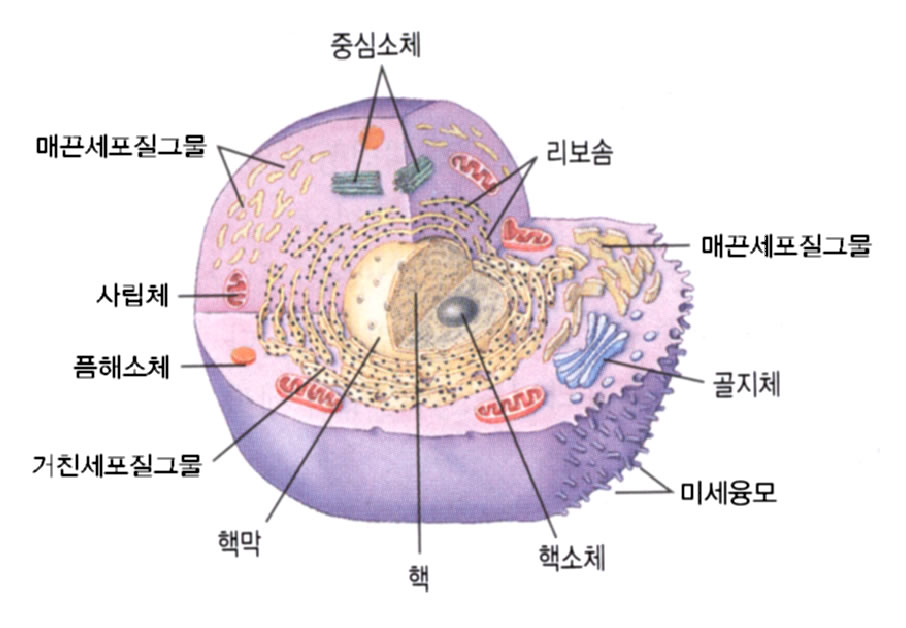 |
||
| 영문 | cell-mediated immunity | 한글 | 세포매개면역 |
|---|---|---|---|
| 설명 | 면역이란 신체를 외부의 물질로부터 보호하는 행위를 말한다. 여기에는 특이적 면역과 비특이적 면역의 두 가지가 있다. 비특이적 면역이라함은 특정한 물질에 관계하는 면역이 아니라 특정 대상이 없이 모든 외부 물체에 작용할 수 있는 면역을 말한다. 여기에는 소변의 흐름, 눈물의 흐름, 피부의 비투과성 등의 기계적인 것도 포함되고 피속에 돌아다니는 세포 중에서 비특이적으로 외부의 물질을 포식하는 세포들(예를 들면 큰포식세포(macrophage)의 활동도 포함이 된다. 세포매개면역이란 특이한 물질을 감지할 수 있는 세포를 생성하게 하여 그것으로 하여금 그 물질을 포식하게 하는 것을 말한다. |
||
| 영문 | nerve cell | 한글 | 신경세포 |
|---|---|---|---|
| 설명 | 신경세포는 올바른 신경전달을 위한 각 부분별로 나뉘어져 있다. 신경세포에서는 전해져오는 자극을 전기적인 신호로 바뀌어 보내거나 받게 된다. 이런 전기적인 현상은 각 신경세포내에 존재하는 각 이온채널(ion channel: ion이란 나트륨, 칼륨 등을 지칭하는 말들로써, 이들이 세포막에 의해 나뉘어질 때 생기는 전압차가 전기적 자극을 일으키고 유지하는데 결정적인 역할을 한다)들의 작용에 의해 이루어지게 된다. |
||
| TSA | technical surgical assistance; toluene sulfonic acid; total shoulder arthroplasty; total solute abso... |
|---|---|
| TSTA | toxoplasmin skin test antigen; tumor-specific tissue antigen; tumor-specific transplantation antigen... |
| NM | near-miss; neomycin; neuromedin; neuromuscular; neutrophil migration; nictitating membrane; nitrogen... |
| SCA | self-care agency; severe congenital anomaly; sickle-cell anemia; single-camera autostereoscopic [ima... |
| CCA | cephalin cholesterol antigen; chick cell agglutination; chimpanzee coryza agent; choriocarcinoma; ci... |
| receptors, antigen, T-cell, alpha-beta | T-cell receptors composed of CD3-associated alpha and beta polypeptide chains and expressed primarily in CD4+ or CD8+ T-cells. Unlike immunoglobulins, the alpha-beta T-cell receptors recognise antigens only when presented in association with major histocompatibility (MHC) molecules. (12 Dec 1998) |
|---|---|
| receptors, antigen, T-cell, gamma-delta | T-cell receptors composed of CD3-associated gamma and delta polypeptide chains and expressed primarily in CD4-/CD8- T-cells. The receptors appear to be preferentially located in epithelial sites and probably play a role in the recognition of bacterial antigens. The T-cell receptor gamma/delta chains are separate and not related to the gamma and delta chains which are subunits of CD3 (see antigens, CD3). (12 Dec 1998) |
| senescent cell antigen | <immunology> An antigen (62 kD) that appears on the surface of senescent erythrocytes and is immunologically cross reactive with isolated Band III protein. Seems to be recognised by an autoantibody and the immunoglobulin coated erythrocyte is then removed from circulation by cells such as Kuppfer cells of the liver that have Fc receptors. Intracellular cleavage of intact band III by a calcium activated protease, calpain, may reveal the antigen in situ. (18 Nov 1997) |
| islet cell antigen-related protein-tyrosine phosphatase | <enzyme> Receptor-like autoantigen found in insulin-dependent diabetes; genbank l76258 Registry number: EC 3.1.3.- Synonym: iar ptp (26 Jun 1999) |
| T-cell antigen receptors | Receptors present on T-cells that interact with both processed antigen and major histocompatibility antigens simultaneously. (05 Mar 2000) |
| receptors, cytoplasmic and nuclear | Proteins in the cytoplasm or nucleus that specifically bind signalling molecules and trigger changes which influence the behaviour of cells. The major groups are the steroid hormone receptors, which usually are found in the cytoplasm, and the thyroid hormone receptors, which usually are found in the nucleus. Receptors, unlike enzymes, generally do not catalyze chemical changes in their ligands. (12 Dec 1998) |
| Remak's nuclear division | <cell biology> An unusual form of nuclear division, in which the nucleus simply constricts, rather like a cell without chromosome condensation or spindle formation. Partitioning of daughter chromosomes is haphazard. Observed in some Protozoa. (18 Nov 1997) |
| Pelger-Huet nuclear anomaly | Congenital inhibition of lobulation in the nuclei of neutrophilic leukocytes; most cells present band or bilobulate appearance, and only an occasional cell is trilobed; it is not associated with disease, but may be confused with leukocyte "shift to left"; autosomal dominant inheritance. (05 Mar 2000) |
| ribonucleoproteins, small nuclear | Highly conserved nuclear RNA-protein complexes that function in RNA processing in the nucleus, including pre-mRNA splicing and pre-mRNA 3'-end processing in the nucleoplasm. The u3 snrnp is localised in the nucleolus, where it aligns into base pairs with the 28s rrna precursor in a still unidentified region and functions in pre-rrna processing. The u7 snrnp aligns into base pairs with a conserved sequence in the 3'-end of histone pre-mRNA and is an essential cofactor for the cleavage that creates the mature nonadenylated 3'-end. (12 Dec 1998) |
| RNA, heterogeneous nuclear | Nuclear nonribosomal RNA larger than about 1000 nucleotides, the mass of which is rapidly synthesised and degraded within the cell nucleus. Some heterogeneous nuclear RNA may be a precursor to mRNA. However, the great bulk of total hnrna hybridises with nuclear DNA rather than with mRNA. (12 Dec 1998) |
| RNA, nuclear | RNA molecules found in the nucleus either associated with chromosomes or in the nucleoplasm. (12 Dec 1998) |
| RNA, small nuclear | Short chains of RNA found in the nucleus. Their function is to remove the introns (nontranslated intervening sequences) from mRNA precursors, thereby bringing the two exons (coding segments) together into correct juxtaposition for enzymatic splicing at the correct point. The resulting mRNA is now ready to leave the nucleus. (12 Dec 1998) |
| cistern of nuclear envelope | The space between the internal and external membranes of the nuclear envelope; may be continuous in places with cisterns of the endoplasmic reticulum. Synonym: cistern of nuclear envelope, perinuclear space. (05 Mar 2000) |
| heterogeneous nuclear RNA | An ill-defined form of RNA, of high molecular weight, that never leaves the nucleus and is thought to be the precursor of messenger RNA. (05 Mar 2000) |
| heterogenous nuclear RNA | <molecular biology> Originally identified as a class of RNA, found in the nucleus but not the nucleolus, which is rapidly labelled and with a very wide range of sizes, 2-40 kilobases. It represents the primary transcripts of RNA polymerase II and includes precursors of all messenger RNAs from which introns are removed by splicing. (18 Nov 1997) |