
| 영문 | fulminant hepatitis | 한글 | 전격간염 |
|---|---|---|---|
| 설명 | 바이러스 간염의 한 형으로 급성 황색위축증이라고도 부른다. 간세포의 대부분이 괴사상태로 되며 환자는 보통 사망한다. 황달이 나타나기 전부터 이미 증상은 현저히 진행하여 황달의 출현도 빠르고, 급성 발열을 수반하며 점막이나 피하출혈을 볼 수 있다. 간의 압통을 수반하는 수도 있다. 위축에 의하여 간은 자주 작아진다. 최후에는 의식장애를 초래하여 졸음이 오고 혼미상태로 되며 간성혼수로 진행하여 사망하게 된다. 증상이 시작되어 2~3주 내에 간뇌병증까지 진행하는 간기능 상실을 전격성 간기능상실이라고 부르며, 진행 속도가 빠르지 않아서 3개월에 이르러 간기능상실에 빠지는 것은 아급성 간기능상실이라고 부른다. 모든 간염 바이러스가 모두 일으키지는 않는다. 간염A바이러스와 간염E바이러스는 보유자 상태나 만성 간염을 거의 일으키지 않는다. 기타 다른 감염 또는 비감염성 원인, 특히 약물과 독소도 본질적으로 동일한 증후를 일으킬 수 있다. 그러므로 바이러스성 간염의 진단과 각 간염 바이러스를 구별하는데는 혈청학적 검사가 필수적이다. |
||
| 영문 | muscle cell(=muscle fiber) | 한글 | 근육세포 |
|---|---|---|---|
| 설명 | 근육은 수의근(의식에 의해서 조절이 가능한 근육: 예를 들어 다리, 팔, 얼굴근육 등)과 불수의근(의식과 무관하게 조절하지 않아도 움직이는 근육: 예를 들어 심장근, 소화기관에 분포하는 근육 등)으로 나누어지며, 근육세포의 모양은 다음과 같다(수의근, 불수의근 외에 심장에 있는 심장근은 불수의근에 해당하지만 그 모양은 수의근과 같아 따로 분류한다).  |
||
| 영문 | white blood cell(WBC), leukocyte | 한글 | 백혈구 |
|---|---|---|---|
| 설명 | 혈액내에 골수구계세포와 림프계세포, 단핵구계세포를 모두 통틀어 말한다. 백혈구의 증가가 있으면 대개 감염이 있거나, 혹은 탈수현상이 있음을 의미한다. 또한 지나친 백혈구수의 감소는 인체내 면역기능이 떨어져 있음을 의미하며, 다른 질병에 의해 나타나는 이차적인 현상이 아닌지 꼭 진단을 받아보아야 한다. |
||
| 영문 | mast cell | 한글 | 비만 세포 |
|---|---|---|---|
| 설명 | 동물의 결합 조직 가운데 널리 분포하는 세포. 결합조직과 점막조직 내에 있는 호염기성 색소로 이염색성(metachromasia)을 나타내는 과립을 가진 방추형의 세포에 작은 둥근 핵을 가진다. 비만세포의 표면에는 IgE에 대한 수용체가 존재하며, 수용체에 결합한 IgE 분자들끼리 다가의 항원에 의해 서로 연결되면 비만세포 과립탈출 반응이 일어나, 히스타민, 세로토닌, 헤파린 등의 화학전달 물질이 방출되어, 즉시형 알레르기 반응 등의 증상을 일으킨다. 피부, 장막, 혈관 주위, 점막 주변에 있다. |
||
| 영문 | cell | 한글 | 세포 |
|---|---|---|---|
| 설명 | 생명체를 이루는 구조적, 기능적 단위. 핵의 유무에 따라서 유핵세포와 무핵세포로 나눌 수가 있다. 무핵세포란 핵이 없는 세포를 말한다. 핵이란 유전정보를 가지고 있는 염색체를 보관하는 곳인데 무핵세포에서는 염색체가 세포속에 그냥 노출되어 있다. 대개 세포 하나하나가 독립된 생명체의 역할을 하는 단세포생물로서 외부환경으로부터 자신을 보호할 수 있는 견고한 세포벽을 가지고 있다. 유핵세포란 핵을 가지고 있어서 유전정보가 있는 염색체가 세포의 다른 부분과 구분되어 핵속에 들어있다. 세포속에서 핵외의 부분(이를 세포질이라 한다)에는 여러 가지 세포의 소기관이 있어서 세포의 다양한 기능을 분담한다. ◈유핵세포의 기본 구조 1.세포막-세포를 둘러싸서 주위환경과 분리하여 세포의 내환경을 유지한다. 2.형질내세망(endoplasmic reticulum)-단위막으로 둘러쌓여 있는 불규칙한 망상구조이다. 이 망상구조의 내부를 소강, 소조라고 부른다. 여기에는 표면이 매끈한 무과립형질내세망과 표면이 불규칙한 과립형질내세망의 두 가지가 있다. 과립형질내세망의 경우는 표면에 단백질을 합성하는 리보솜이라는 것이 부착되어 있다. 이곳은 주로 세포밖으로 분비할 단백질을 합성하는 장소이다. 무과립형질내세망은 표면에 리보솜이 부착되어 있지 않은 것을 말하며, 이곳에서는 주로 해독작용, 글리코겐의 합성, 스테로이드호르몬의 합성 등이 일어난다. 3.리보솜-단백질을 합성하는 역할을 하는 곳이다.이것은 세포질에 존재하는 자유리보솜과 과립형질내세망에 부착이 되어 존재하는 부착리보솜의 두 가지로 나눈다. 자유리보솜은 주로 세포내에서 필요한 단백질을 만드는 역할을 하고 부착리보솜은 세포밖으로 분비할 단백질을 만드는 역할을 한다. 4.골지장치(Golgi apparatus)-핵주위에 분포하는 납작해진 주머니모양의 것이 중첩되어 형성된 층판 모양의 구조물로 과립형질내세망에서 생성되어 외부로 분비될 단백질을 모아서 농축, 포장하여 과립을 만드는 역할을 한다. 5.사립체(mitochondria)-구형, 난형의 긴 막대기 모양으로 크기가 다양한 구조물. 생물체의 에너지 저장물질인 ATP를 생산하는 역할을 한다. 또 세포와 다른 자신만의 유전정보를 가진 DNA, RNA를 가지고 있다. 모양, 크기가 세균과 비슷하며 자체증식성 등 독립된 생명체로서 필요한 요건을 갖추고 있어서 세포와 공생관계를 가진 독립된 세포로 생각하고 있다. 6.용해소체(lysosome)-작은 구형의 소체로 여러 가지 분해효소를 가진다. 세포외계에서 들어온 물질과 결합하여 그 물질들을 용해하는 역할을 하고, 오래된 세포소기관들을 제거하는 역할도 한다. 7.세포핵(nucleus)-구형, 난형으로 세포의 중심에 위치한다. 핵내에는 유전정보가 있는 물질인 염색체가 존재한다. 8.중심소체(centrosome)-핵주위에 존재하면서 핵의 분열시에 양쪽의 염색체를 당기는 작은 섬유를 만드는 역할을 하는 곳. 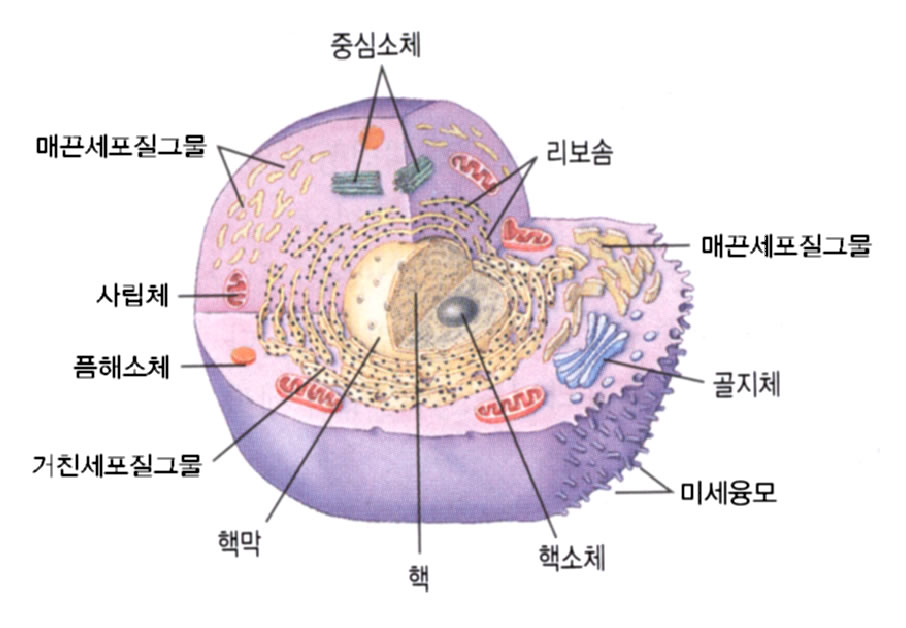 |
||
| ACC | accommodation; acetyl coenzyme A carboxylase; acinic cell carcinoma; acute care center; adenoid cyst... |
|---|---|
| CAH | chronic active hepatitis; chronic aggressive hepatitis; combined atrial hypertrophy; congenital adre... |
| HA | H antigen; Hakim-Adams [syndrome]; halothane anesthesia; Hartley [guinea pig]; headache; health alli... |
| HBV | hepatitis B vaccine; hepatitis B virus |
| HDV | hepatitis D virus; hepatitis delta virus |
| beam-plasma reaction | <radiobiology> Fusion reaction which occurs from the collision of a fast beam ion with a thermal plasma ion. (09 Oct 1997) |
|---|---|
| bean-shaped plasma | <radiobiology> A toroidal plasma indented on the inboard side (the side with the donut hole), that results in additional stability to ballooning modes. Moderate indentation may provide access to the second-stability region (high beta). (13 Nov 1997) |
| blood plasma | <haematology> Acellular fluid in which blood cells are suspended. Serum obtained by defibrinating plasma (plasma derived serum) lacks platelet released factors and is less suitable to support the growth of cells in culture. (13 Oct 1997) |
| blood plasma fractions | Portions of the blood plasma as separated by electrophoresis or other technique. (05 Mar 2000) |
| rapid plasma reagin | <investigation> The rapid plasma reagin test is similar to the VDRL test for diagnosing syphilis. This blood test is designed to detect an antibody substance in the bloodstream when syphilis infection is present. Early syphilis infections may be RPR negative. See: VDRL (17 Dec 1997) |
| rapid plasma reagin test | A group of serologic test's for syphilis in which unheated serum or plasma is reacted with a standard test antigen containing charcoal particles; positive test's yield a flocculation. A modification, called the RPR (circle) card test, is widely used as a screening test. Synonym: RPR test. (05 Mar 2000) |
| renal plasma flow | <physiology> The amount of plasma that perfuses the kidneys per unit time, approximately 10% greater than effective renal plasma flow. It should be differentiated from the renal blood flow which refers to the total volume of blood flowing through the renal vasculature, while the renal plasma flow refers to the rate of plasma flow. (12 Dec 1998) |
| peak plasma drug concentration | <pharmacology> The highest level of drug that can be obtained in the blood usually following multiple doses. (09 Oct 1997) |
| collisionless plasma model | <radiobiology> Model of a plasma in which the density is so low, or the temperature so high, that close binary (two-body) collisions have practically no significance (on certain timescales) because the time scales of interest are shorter than the collision time. Yields valid physical results for timescales much shorter than the average collision time in a real plasma. (09 Oct 1997) |
| plasma | <haematology> Acellular fluid in which blood cells are suspended. Serum obtained by defibrinating plasma (plasma derived serum) lacks platelet released factors and is less suitable to support the growth of cells in culture. (13 Oct 1997) |
| plasma accelerator globulin | <chemical> Heat- and storage-labile plasma glycoprotein which accelerates the conversion of prothrombin to thrombin in blood coagulation. Factor v accomplishes this by forming a complex with factor xa, phospholipid, and calcium (prothrombinase complex). Deficiency of factor v leads to owren's disease. Chemical name: Blood-coagulation factor V (12 Dec 1998) |
| plasma albumin | <protein> The serum level of the low molecular protein albumin. Albumin, produced by the liver, plays an important role in maintaining plasma oncotic pressure. Normal serum albumin should be 3.5-5.0 grams per decilitre. Low serum albumin can be found in cases of liver disease and malnutrition. (27 Sep 1997) |
| plasma cells | Special white blood cells that produce antibodies. (12 Dec 1998) |
| plasma containment | <physics> In physics experiments or nuclear fusion experiments, operation is intended to prevent, in an effective and sufficiently prolonged manner, the particles of a plasma from striking the walls of the container in which this plasma is produced. Plasma confinement is a fundamental requirement for obtaining net energy from a fusion plasma. The reason is that scattering (hence diffusion) is at least an order of magnitude more probable than fusion reactions. Hence, without confinement, the plasma fuel would disperse before enough fusion reactions could take place. (31 Dec 1997) |
| plasma exchange | Removal of plasma and replacement with various fluids, e.g., fresh frozen plasma, plasma protein fractions (ppf), albumin preparations, dextran solutions, saline. Used in treatment of autoimmune diseases, immune complex diseases, diseases of excess plasma factors, and other conditions. (12 Dec 1998) |