
| 영문 | congenital heart disease | 한글 | 선천심장병 |
|---|---|---|---|
| 설명 | 선천적으로 심장의 구조에 이상이 있는 병. |
||
| 영문 | heart | 한글 | 심장 |
|---|---|---|---|
| 설명 | 심장은 가슴의 중앙에 위치하며 오른쪽과 왼쪽반으로 나눌 수 있다. 각각은 정맥에서 피가 들어오는 방과 동맥으로 피를 내보내는 실이 있다. 심장은 정중앙선에서 왼쪽에 놓여 있다. 심장의 2개의 심방과 2개의 심실, 그리고 심방사이의 심방중격, 심실사이의 심실중격이 존재한다. 심실은 혈액을 주로 순환시키는 힘을 내는 곳으로 강한 근육층이 존재를 한다. 반면에 심방은 심실에 들어가기전에 일시적으로 피가 모이는 곳으로 근육층의 발달이 미약하다. 심방과 심실사이에 삼첨판과 승모판, 심실의 유출로에 대동맥판과 폐동맥판이 있다. 이것들은 혈액이 흐르는 방향에 거슬러 진행하는 것을 막는 기능을 한다. 그리고 심장에는 심장의 근육에 혈액을 공급하는 관상동맥이 있다. 이 심장동맥은 심장을 쌓듯이 존재한다. 심장박동의 신호는 특수한 장치에 의해서 발생이 되고 특수한 전도계를 통해서 전체의 심장으로 전도된다. 심장박동의 신호는 우선 우심방에 위치하는 동방결절(SA node)라는 곳에서 우선 생긴다. 여기에서 보내는 전기적 신호가 바로 심장을 뛰게하는 신호인 것이다. 이 신호로 말미암아 심방이 우선 수축을 한다. 그리고는 심방과 심실사이에 위치하는 방실결절(AV node)라는 곳에 일정하게 정해진 통로없이 전체의 심방을 통해서 전달이 되고 이 신호를 받은 방실결절(AV node)는 히스 다발(His bundle)과 심장전도근육섬유를 통해서 심실의 심장근육에게 이 신호를 보내주어 심실근육을 수축하게 한다. 히스다발과 심장전도근육섬유는 전체의 심실의 심근섬유에 동시에 전기적 신호를 보내어 줄 수 있게 하는 일종의 전기줄과 같은 역할을 한다. 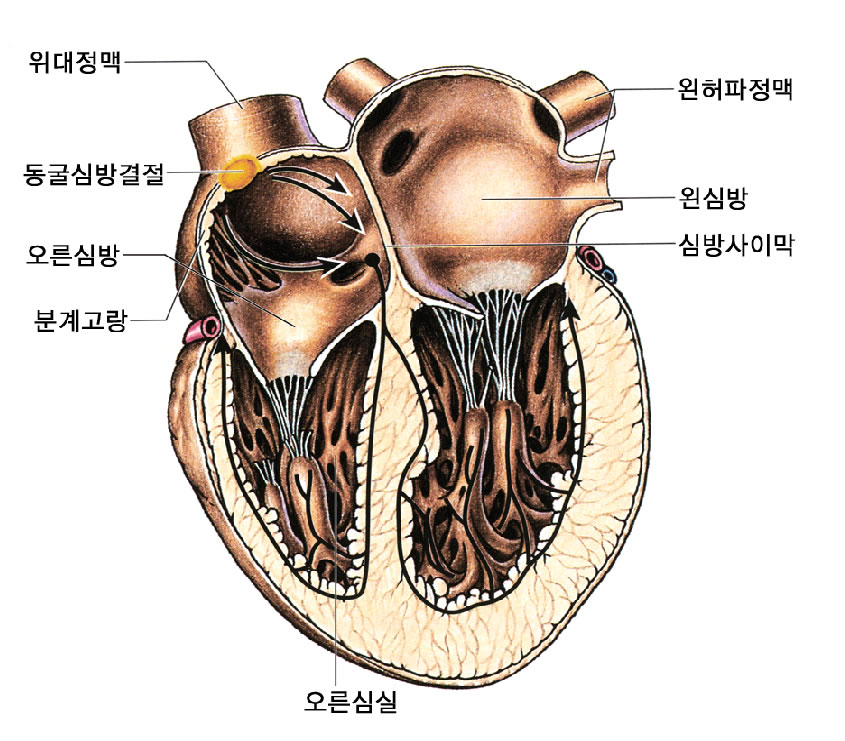 |
||
| 영문 | heart failure | 한글 | 심장기능상실 |
|---|---|---|---|
| 설명 | 몸의 조직이나 기관에서 대사에 필요한 만큼 충분한 양의 혈액을 공급할 수 없을 정도로 심장기능이 저하되어 있는 상태이다. 심장기능상실은 심근이 수축할 능력이 저하되었을 때나 심장에 심박출을 하기 위한 압력이 정상보다 증가되어 정상의 심장의 수축으로는 충분한 양의 혈액을 공급할 수 없는 경우, 그리고 심장근육, 심장에 걸리는 압력은 정상이나 심장박동의 이상에 의해서 정상적인 수축이 불가능할 경우에 생긴다. |
||
| 영문 | pacemaker(of heart) | 한글 | 심장박동기 |
|---|---|---|---|
| 설명 | 심장의 전기적 자극이 병적인 상태로 발생하지 않거나, 혹은 심실로 잘 전해지지 않을 때 사용한다. 일시적 심장박동기와 영구적 심장박동기가 있으며, 각기 쓰이는 용도는 병에 따라 다르다. 요즘에 나오는 심장 박동기는 건전지의 수명도 반영구적이며, 밖에서 조정할 수 있고, 운동이나 스트레스 상황에 대한 심장의 빠른 운동에도 잘 적응할 수 있도록 만들어져 있다. |
||
| 영문 | heart disease | 한글 | 심장병 |
|---|---|---|---|
| 설명 | 순환기 질환 중 심장의 병. 일반적으로 심장혈관이나 심장의 병도 포함된다. 병터의 부위에 의한 병리해부학적 분류와 병인에 의한 분류가 있다. 전자는 수 십 년 전부터 쓰여져 왔으나 근년에 와서 본질적인 원인요법이 가능하게 된 이후는 후자의 분류가 의의가 있어서 많이 쓰이게 되었다. 병터 부위로는 심내막(판막)-심장근-심장막, 그 밖의 것을 들 수 있으며, 각각 심내막염-심장판막증-심근염-심근경색-심장막염-선천성 심장병(심장기형) 등이포함된다. 병인별에서는 심장기형을 비롯하여 류마치스 심장병-매독성 심장병-고혈압성 심장병-심장동맥경화성 심장병-폐성심장-세균성 심내막염-심장신경증 등으로 나누어지며, 부정맥이나 방실차단 등의 자극전도계의 장애에 의한 것도 증세의 하나로 볼 수 있다. 심장병은 자각적으로는 무증세인 것에서부터 심장기능상실로 호흡곤란까지 있다. |
||
| AHD | acquired hepatocerebral degeneration; acute heart disease; antihyaluronidase; antihypertensive drug;... |
|---|---|
| CHD | Chediak-Higashi disease; childhood disease; chronic hemodialysis; congenital or congestive heart dis... |
| HT | Hashimoto thyroiditis; hearing test; hearing threshold; heart; heart transplantation, heart transpla... |
| LVS | left ventricular strain |
| LA | lactic acid; large amount; laser angioplasty; late abortion; late antigen; latex agglutination; left... |
| crippled strain | <microbiology> A strain of bacteria, typically highly pathogenic, that has been genetically engineered so that it cannot survive on anything but a veryspecialised medium of nutrients, this is done so that geneticists can experiment on certain pathogens without the risk that they will escape fromthe lab. (09 Oct 1997) |
|---|---|
| HFR strain | A strain, or clone, in which a conjugative plasmid (such as an F'), integrated in the bacterial genome, is instrumental in the transfer (along with plasmid DNA) of integrated bacterial DNA in a sequential manner to a suitable recipient. Origin: high freguency of recombination (05 Mar 2000) |
| pseudolysogenic strain | A bacterial strain that is contaminated with a bacteriophage of low infectivity. Synonym: pseudolysogenic strain. (05 Mar 2000) |
| high frequency recombination strain | A type of bacterial strain which is able to pass on genetic information to neighboring bacteria at a high rate. The high-frequency recombination strain (Hfr) is able to do this because it possesses the f plasmid and can therefore initiate bacterial conjugation. (09 Oct 1997) |
| hypothetical mean strain | A hypothetical strain that possesses the characteristics of a calculated mean organism. (05 Mar 2000) |
| smooth strain | <microbiology> Bacterial strains that have altered outer cell wall carbohydrate chains causing colonies on agar to change their appearance from smooth to dull. In Streptococci the smooth strains are virulent whereas the rough strains are not. This is partly because the rough strains are much more readily phagocytosed. (17 Dec 1997) |
| neotype strain | A strain accepted by international agreement to replace a type strain which is no longer in existence or to serve as the type strain if a type strain was not designated and if no strain exists which can be designated as the type. Synonym: neotype culture. (05 Mar 2000) |
| stock strain | A bacterial or other microbial strain that has been maintained under laboratory conditions as representative of its type. (05 Mar 2000) |
| strain | A tearing injury to muscle. Usually causes some degree of bleeding within the muscle tissue (haematoma). (27 Sep 1997) |
| strain birefringence | <chemistry> Optical property of a material in which the refractive index is different for light polarized in one plane compared to the orthogonal plane. May arise from molecular organisation of the material (form birefringence.), alignment of molecules due to tension (stress birefringence.) or alignment of rod like particles in flow (flow birefringence). With crossed Nicoll prisms a birefringent material appears bright against a dark background. (19 Jan 1998) |
| strain development | Improving the genetics of an organism so that it carries out a biotechnological process more effectively. (14 Nov 1997) |
| strain fracture | The tearing off, by a sudden force, of a piece of bone attached to a tendon, ligament, or capsule; the force may be exogenous or endogenous. (05 Mar 2000) |
| strain gauge | A device, employing the Wheatstone bridge principle, used for accurate measurement of forces such as strain, stress, or pressure. (05 Mar 2000) |
| stress-strain curve | A curve showing the ratio of deformation to load during the testing of a material in tension. (05 Mar 2000) |
| inbred strain | Any strain of animal or plant obtained by a breeding strategy that tends to lead to homozygosity. Such breeding strategies include brother sister mating and back crossing of offspring with parents. See: congenic. (18 Nov 1997) |