
| 영문 | umbilical cord | 한글 | 탯줄, 제대 |
|---|---|---|---|
| 설명 | 태아의 배꼽을 태반과 연결시키는 유일한 구조로 2개의 탯줄동맥과 1개의 탯줄정맥이 지나간다. 신생아때에는 길이가 약 50cm이다. 태생기 발생 약 5주경에 요막경(allantoic diverticulum, body stalk)으로부터 형성되며 배꼽창자관(vitello- intestinal duct) 및 요막(allantoic membrane)을 포함하고 있다. 약 1%에서 제대동맥이 하나뿐인 경우가 있는데 이때에는 선천성기형의 동반률이 증가한다. |
||
| 영문 | muscle cell(=muscle fiber) | 한글 | 근육세포 |
|---|---|---|---|
| 설명 | 근육은 수의근(의식에 의해서 조절이 가능한 근육: 예를 들어 다리, 팔, 얼굴근육 등)과 불수의근(의식과 무관하게 조절하지 않아도 움직이는 근육: 예를 들어 심장근, 소화기관에 분포하는 근육 등)으로 나누어지며, 근육세포의 모양은 다음과 같다(수의근, 불수의근 외에 심장에 있는 심장근은 불수의근에 해당하지만 그 모양은 수의근과 같아 따로 분류한다).  |
||
| 영문 | white blood cell(WBC), leukocyte | 한글 | 백혈구 |
|---|---|---|---|
| 설명 | 혈액내에 골수구계세포와 림프계세포, 단핵구계세포를 모두 통틀어 말한다. 백혈구의 증가가 있으면 대개 감염이 있거나, 혹은 탈수현상이 있음을 의미한다. 또한 지나친 백혈구수의 감소는 인체내 면역기능이 떨어져 있음을 의미하며, 다른 질병에 의해 나타나는 이차적인 현상이 아닌지 꼭 진단을 받아보아야 한다. |
||
| 영문 | mast cell | 한글 | 비만 세포 |
|---|---|---|---|
| 설명 | 동물의 결합 조직 가운데 널리 분포하는 세포. 결합조직과 점막조직 내에 있는 호염기성 색소로 이염색성(metachromasia)을 나타내는 과립을 가진 방추형의 세포에 작은 둥근 핵을 가진다. 비만세포의 표면에는 IgE에 대한 수용체가 존재하며, 수용체에 결합한 IgE 분자들끼리 다가의 항원에 의해 서로 연결되면 비만세포 과립탈출 반응이 일어나, 히스타민, 세로토닌, 헤파린 등의 화학전달 물질이 방출되어, 즉시형 알레르기 반응 등의 증상을 일으킨다. 피부, 장막, 혈관 주위, 점막 주변에 있다. |
||
| 영문 | cell | 한글 | 세포 |
|---|---|---|---|
| 설명 | 생명체를 이루는 구조적, 기능적 단위. 핵의 유무에 따라서 유핵세포와 무핵세포로 나눌 수가 있다. 무핵세포란 핵이 없는 세포를 말한다. 핵이란 유전정보를 가지고 있는 염색체를 보관하는 곳인데 무핵세포에서는 염색체가 세포속에 그냥 노출되어 있다. 대개 세포 하나하나가 독립된 생명체의 역할을 하는 단세포생물로서 외부환경으로부터 자신을 보호할 수 있는 견고한 세포벽을 가지고 있다. 유핵세포란 핵을 가지고 있어서 유전정보가 있는 염색체가 세포의 다른 부분과 구분되어 핵속에 들어있다. 세포속에서 핵외의 부분(이를 세포질이라 한다)에는 여러 가지 세포의 소기관이 있어서 세포의 다양한 기능을 분담한다. ◈유핵세포의 기본 구조 1.세포막-세포를 둘러싸서 주위환경과 분리하여 세포의 내환경을 유지한다. 2.형질내세망(endoplasmic reticulum)-단위막으로 둘러쌓여 있는 불규칙한 망상구조이다. 이 망상구조의 내부를 소강, 소조라고 부른다. 여기에는 표면이 매끈한 무과립형질내세망과 표면이 불규칙한 과립형질내세망의 두 가지가 있다. 과립형질내세망의 경우는 표면에 단백질을 합성하는 리보솜이라는 것이 부착되어 있다. 이곳은 주로 세포밖으로 분비할 단백질을 합성하는 장소이다. 무과립형질내세망은 표면에 리보솜이 부착되어 있지 않은 것을 말하며, 이곳에서는 주로 해독작용, 글리코겐의 합성, 스테로이드호르몬의 합성 등이 일어난다. 3.리보솜-단백질을 합성하는 역할을 하는 곳이다.이것은 세포질에 존재하는 자유리보솜과 과립형질내세망에 부착이 되어 존재하는 부착리보솜의 두 가지로 나눈다. 자유리보솜은 주로 세포내에서 필요한 단백질을 만드는 역할을 하고 부착리보솜은 세포밖으로 분비할 단백질을 만드는 역할을 한다. 4.골지장치(Golgi apparatus)-핵주위에 분포하는 납작해진 주머니모양의 것이 중첩되어 형성된 층판 모양의 구조물로 과립형질내세망에서 생성되어 외부로 분비될 단백질을 모아서 농축, 포장하여 과립을 만드는 역할을 한다. 5.사립체(mitochondria)-구형, 난형의 긴 막대기 모양으로 크기가 다양한 구조물. 생물체의 에너지 저장물질인 ATP를 생산하는 역할을 한다. 또 세포와 다른 자신만의 유전정보를 가진 DNA, RNA를 가지고 있다. 모양, 크기가 세균과 비슷하며 자체증식성 등 독립된 생명체로서 필요한 요건을 갖추고 있어서 세포와 공생관계를 가진 독립된 세포로 생각하고 있다. 6.용해소체(lysosome)-작은 구형의 소체로 여러 가지 분해효소를 가진다. 세포외계에서 들어온 물질과 결합하여 그 물질들을 용해하는 역할을 하고, 오래된 세포소기관들을 제거하는 역할도 한다. 7.세포핵(nucleus)-구형, 난형으로 세포의 중심에 위치한다. 핵내에는 유전정보가 있는 물질인 염색체가 존재한다. 8.중심소체(centrosome)-핵주위에 존재하면서 핵의 분열시에 양쪽의 염색체를 당기는 작은 섬유를 만드는 역할을 하는 곳. 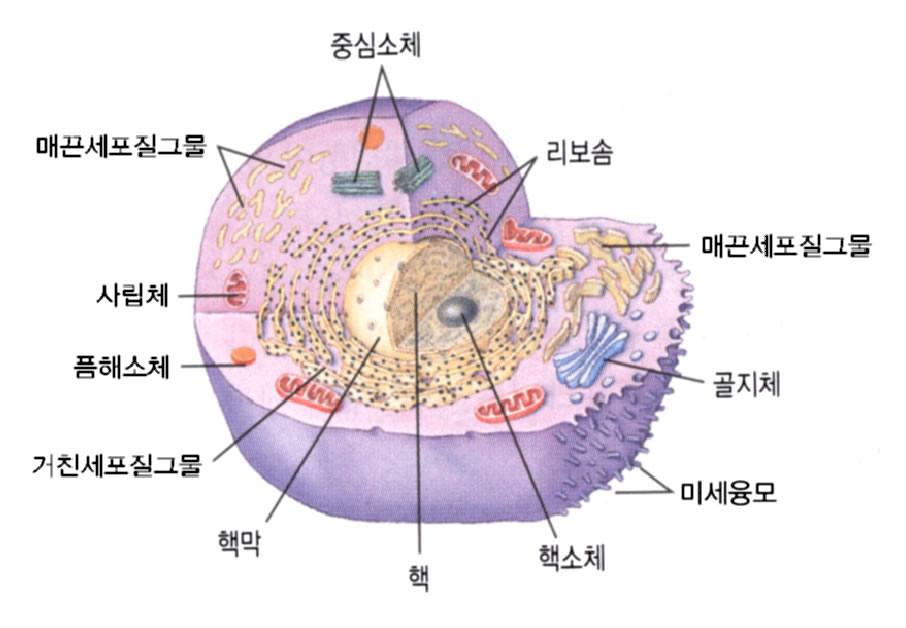 |
||
| MC | mass casualties; mast cell; Master of Surgery [Lat. Magister Chirurgiae]; maximum concentration; Med... |
|---|---|
| SCM | Schwann cell membrane; sensation, circulation, and motion; Society of Computer Medicine; soluble cyt... |
| ASCI | acute spinal cord injury; American Society for Clinical Investigation |
| BSCP | bovine spinal cord protein |
| CCSCS | central cervical spinal cord syndrome |
| cervical segments of spinal cord | The eight cervical segments [C1-C8] of the spinal cord which give rise to the eight pairs of cervical spinal nerves and constitute the cervical part of the spinal cord. Synonym: segmenta medullae spinalis cervicalia. (05 Mar 2000) |
|---|---|
| coccygeal part of spinal cord | The terminal part of the spinal cord consisting of the three coccygeal segments of the spinal cord from which the three pairs of coccygeal nerves originate. Synonym: pars coccygea medullae spinalis, segmenta medullae spinalis coccygea. (05 Mar 2000) |
| coccygeal segments of spinal cord | The three coccygeal segments [Co1-Co3] of the spinal cord which give rise to the three pairs of coccygeal spinal nerves and constitute the coccygeal part of the spinal cord. (05 Mar 2000) |
| cornua of spinal cord | The posterior or occipital division of the lateral ventricle of the brain, extending backward into the occipital lobe; the posterior gray column of the spinal cord as appearing in cross section. Synonym: cornu posterius ventriculi lateralis, cornu posterius, cornua of spinal cord, occipital horn. (05 Mar 2000) |
| posterior median fissure of spinal cord | A shallow furrow in the median line of the posterior surface of the spinal cord. Synonym: sulcus medianus posterior medullae spinalis, posterior median fissure of spinal cord. (05 Mar 2000) |
| posterior median sulcus of spinal cord | A shallow furrow in the median line of the posterior surface of the spinal cord. Synonym: sulcus medianus posterior medullae spinalis, posterior median fissure of spinal cord. (05 Mar 2000) |
| sacral part of spinal cord | The part of the cord from which consists of the five sacral segments of the spinal cord (S1-S5) and from which five pairs of sacral nerves originate. Synonym: pars sacralis medullae spinalis, segmenta medullae spinalis sacralia. (05 Mar 2000) |
| segments of spinal cord | Portions of the spinal cord corresponding to the line of attachment of the roots of the individual spinal nerves. These are the cervical spinal cord segments [C1-C8]; the thoracic spinal cord segments [T1-T12]; the lumbar spinal cord segments Origin: L1-L5]; the sacral spinal cord segments [S1-S5]; and the coccygeal spinal cord segments [Co1-Co3]. Synonym: segmenta medullae spinalis. (05 Mar 2000) |
| spinal cord | <anatomy> Elongated, approximately cylindrical part of the central nervous system of vertebrates that lies in the vertebral canal and from which the spinal nerves emerge. (18 Nov 1997) |
| spinal cord compression | A condition in which pressure is exerted on the spinal cord, as by a tumour, spinal fracture, etc. Its manifestations, which vary with location and degree of pressure, may include pain, paresthesias, and sensory and motor disturbances. (12 Dec 1998) |
| spinal cord concussion | Injury to the spinal cord due to a blow to the vertebral column with transient or prolonged dysfunction below the level of the lesion. Synonym: spinal concussion. (05 Mar 2000) |
| spinal cord injuries | Injuries to the spinal cord, that is, the part of the central nervous system that is situated within the vertebral column. (12 Dec 1998) |
| spinal cord injury | Any injury to the spinal cord via blunt or penetrating trauma. Extreme flexion or extension (particularly in the neck) of the spine can result in traction on the spinal cord with subsequent injury and the development of neurologic symptoms. See: neurologic symptoms. (27 Sep 1997) |
| spinal cord neoplasms | Neoplasms located in the spinal cord. They include neoplasms in the inner core or the outer layer of the cord, but not those in the protective membranes, or meninges ( = meningeal neoplasms). (12 Dec 1998) |
| spinal cord tumour | A spinal cord tumour is a aggregate if cells that form a mass that can compress the spinal cord. Spinal cord tumours may arise from local structures (for example meninges) or from a cancer from a distant site (i.e. Metastasis). Regardless of the aetiology, all spinal cord tumours cause symptoms from compression on the spinal cord, surrounding nerve roots or blood vessels that supply the cord. Symptoms are variable with the extent and the level of the spinal cord tumour. Common symptoms include back pain that may radiate, numbness and tingling to the lower extremities, muscle weakness in the legs, difficulty walking and loss of bowel and bladder control (incontinence). (27 Sep 1997) |