
| 영문 | rheumatic heart disease | 한글 | 류마티스심장병 |
|---|---|---|---|
| 설명 | 사슬알균감염 후 생기는 심장판막병이다. 원인은 A군 -용혈사슬알에 의한 인두염후 일종의 면역반응으로 발병한다. 진단은 존의 기준에 의한다. (1) 주요기준은 관절염 심장염(심장비대, 심장잡음, 심장기능상실 등) 무도증: 무당이 춤을 추는 것 같은 행동의 발작증세. 연변홍반: 빨간 테두리를 가진 피부병변은 피하결절(subcutaneous nodule): 피부 밑에 생긴 결절, (2)참고 기준은 열, 관절통, EKG상 PR연장: 심전도 소견 급성기 반응물질(예: ESR, CRP)의 상승, 류마티스열 치료는 페니실린으로 치료하고 심장의 후유증 또한 페니실린으로 예방한다. |
||
| 영문 | congenital heart disease | 한글 | 선천심장병 |
|---|---|---|---|
| 설명 | 선천적으로 심장의 구조에 이상이 있는 병. |
||
| 영문 | heart | 한글 | 심장 |
|---|---|---|---|
| 설명 | 심장은 가슴의 중앙에 위치하며 오른쪽과 왼쪽반으로 나눌 수 있다. 각각은 정맥에서 피가 들어오는 방과 동맥으로 피를 내보내는 실이 있다. 심장은 정중앙선에서 왼쪽에 놓여 있다. 심장의 2개의 심방과 2개의 심실, 그리고 심방사이의 심방중격, 심실사이의 심실중격이 존재한다. 심실은 혈액을 주로 순환시키는 힘을 내는 곳으로 강한 근육층이 존재를 한다. 반면에 심방은 심실에 들어가기전에 일시적으로 피가 모이는 곳으로 근육층의 발달이 미약하다. 심방과 심실사이에 삼첨판과 승모판, 심실의 유출로에 대동맥판과 폐동맥판이 있다. 이것들은 혈액이 흐르는 방향에 거슬러 진행하는 것을 막는 기능을 한다. 그리고 심장에는 심장의 근육에 혈액을 공급하는 관상동맥이 있다. 이 심장동맥은 심장을 쌓듯이 존재한다. 심장박동의 신호는 특수한 장치에 의해서 발생이 되고 특수한 전도계를 통해서 전체의 심장으로 전도된다. 심장박동의 신호는 우선 우심방에 위치하는 동방결절(SA node)라는 곳에서 우선 생긴다. 여기에서 보내는 전기적 신호가 바로 심장을 뛰게하는 신호인 것이다. 이 신호로 말미암아 심방이 우선 수축을 한다. 그리고는 심방과 심실사이에 위치하는 방실결절(AV node)라는 곳에 일정하게 정해진 통로없이 전체의 심방을 통해서 전달이 되고 이 신호를 받은 방실결절(AV node)는 히스 다발(His bundle)과 심장전도근육섬유를 통해서 심실의 심장근육에게 이 신호를 보내주어 심실근육을 수축하게 한다. 히스다발과 심장전도근육섬유는 전체의 심실의 심근섬유에 동시에 전기적 신호를 보내어 줄 수 있게 하는 일종의 전기줄과 같은 역할을 한다. 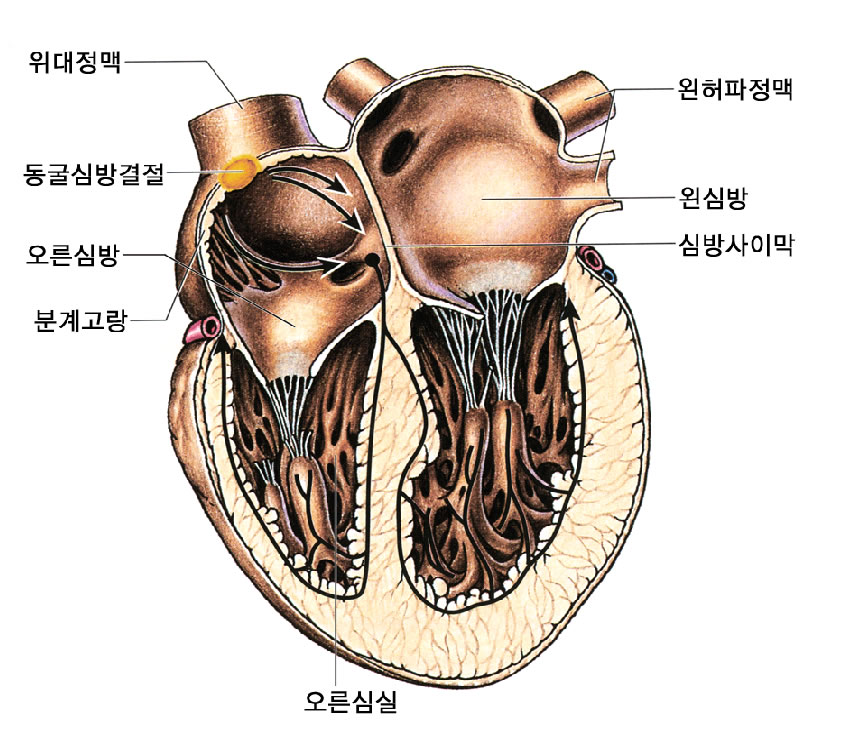 |
||
| 영문 | heart failure | 한글 | 심장기능상실 |
|---|---|---|---|
| 설명 | 몸의 조직이나 기관에서 대사에 필요한 만큼 충분한 양의 혈액을 공급할 수 없을 정도로 심장기능이 저하되어 있는 상태이다. 심장기능상실은 심근이 수축할 능력이 저하되었을 때나 심장에 심박출을 하기 위한 압력이 정상보다 증가되어 정상의 심장의 수축으로는 충분한 양의 혈액을 공급할 수 없는 경우, 그리고 심장근육, 심장에 걸리는 압력은 정상이나 심장박동의 이상에 의해서 정상적인 수축이 불가능할 경우에 생긴다. |
||
| 영문 | pacemaker(of heart) | 한글 | 심장박동기 |
|---|---|---|---|
| 설명 | 심장의 전기적 자극이 병적인 상태로 발생하지 않거나, 혹은 심실로 잘 전해지지 않을 때 사용한다. 일시적 심장박동기와 영구적 심장박동기가 있으며, 각기 쓰이는 용도는 병에 따라 다르다. 요즘에 나오는 심장 박동기는 건전지의 수명도 반영구적이며, 밖에서 조정할 수 있고, 운동이나 스트레스 상황에 대한 심장의 빠른 운동에도 잘 적응할 수 있도록 만들어져 있다. |
||
| mm | millimeter; 1/1000 Meter, 10-3 Meter |
|---|---|
| IHD | Ischemic Heart Disease = Coronary Heart(Artery) Disease = Atheroscler... |
| JVP | [POMD P 49 - 52] 1) Jugular Vein Pressure 2) Jugular Venous Pulse ... |
| AHD | acquired hepatocerebral degeneration; acute heart disease; antihyaluronidase; antihypertensive drug;... |
| CHD | Chediak-Higashi disease; childhood disease; chronic hemodialysis; congenital or congestive heart dis... |
| meter-kilogram-second system | An absolute system based on the meter, kilogram, and second; the basis of the International System of Units. (05 Mar 2000) |
|---|---|
| meter-kilogram-second unit | An absolute unit of the meter-kilogram-second system. (05 Mar 2000) |
| stethogonio meter | An apparatus for measuring the curvatures of the thorax. Origin: stetho-+ G. Gonia, angle, + metron, measure (05 Mar 2000) |
| newton-meter | A unit of the MKS system, expressed as energy expended, or work done, by a force of 1 newton acting through a distance of 1 meter; equal to 1 joule = 107 ergs. (05 Mar 2000) |
| kilogram-meter | <unit> A measure of energy or work done, being the amount expended in raising one kilogram through the height of one meter, in the latitude of Paris. Source: Websters Dictionary (01 Mar 1998) |
| abortion rate | The number of abortions per 1000 terminated pregnancies during a given period of time. (05 Mar 2000) |
| age-specific rate | A rate for a specified age group, in which the numerator and denominator refer to the same age group. (05 Mar 2000) |
| attack rate | A cumulative incidence rate used for particular groups observed for limited periods under special circumstances, such as during an epidemic. (05 Mar 2000) |
| average flow rate | <physiology> The flow rate determined by dividing the total volume passed in a time period divided by the time period, usually quoted in mls per minute. (05 Mar 2000) |
| backup rate | A utility charge for providing occasional electricity service to replace on-site generation. (05 Dec 1998) |
| basal metabolic rate | <biochemistry, biology> The metabolic rate as measured under basal conditions: 12 hours after eating, after a restful sleep, no exercise or activity preceding test, elimination of emotional excitement and occurring in a comfortable temperature. Acronym: BMR (15 Nov 1997) |
| basic reproductive rate, ratio | <epidemiology> See Reproductive Ratio. (05 Dec 1998) |
| birth rate | The birth rate is usually given as the number of live births divided by the average population (or the population at midyear). This is termed the crude birth rate. In 1995, for example, the crude birth rate per 1,000 population was 14 in the United States, 16.9 in Australia, etc. (12 Dec 1998) |
| breathing rate | <chest medicine, clinical sign> Also referred to as the respiratory rate. Measured as the number of breaths taken every minute. Normal resting adult respiratory rates are from 16-20 breaths per minute. The normal 1 year old infant can have a respiratory rate of 30 breaths per minute. Count the breaths taken in 30 seconds observing the rise and fall of the chest and then multiply this number by 2. (27 Sep 1997) |
| rate | The number of occurrences in one minute (for example respiratory rate, heart rate) (27 Sep 1997) |