
| 영문 | rheumatic heart disease | 한글 | 류마티스심장병 |
|---|---|---|---|
| 설명 | 사슬알균감염 후 생기는 심장판막병이다. 원인은 A군 -용혈사슬알에 의한 인두염후 일종의 면역반응으로 발병한다. 진단은 존의 기준에 의한다. (1) 주요기준은 관절염 심장염(심장비대, 심장잡음, 심장기능상실 등) 무도증: 무당이 춤을 추는 것 같은 행동의 발작증세. 연변홍반: 빨간 테두리를 가진 피부병변은 피하결절(subcutaneous nodule): 피부 밑에 생긴 결절, (2)참고 기준은 열, 관절통, EKG상 PR연장: 심전도 소견 급성기 반응물질(예: ESR, CRP)의 상승, 류마티스열 치료는 페니실린으로 치료하고 심장의 후유증 또한 페니실린으로 예방한다. |
||
| 영문 | congenital heart disease | 한글 | 선천심장병 |
|---|---|---|---|
| 설명 | 선천적으로 심장의 구조에 이상이 있는 병. |
||
| 영문 | heart | 한글 | 심장 |
|---|---|---|---|
| 설명 | 심장은 가슴의 중앙에 위치하며 오른쪽과 왼쪽반으로 나눌 수 있다. 각각은 정맥에서 피가 들어오는 방과 동맥으로 피를 내보내는 실이 있다. 심장은 정중앙선에서 왼쪽에 놓여 있다. 심장의 2개의 심방과 2개의 심실, 그리고 심방사이의 심방중격, 심실사이의 심실중격이 존재한다. 심실은 혈액을 주로 순환시키는 힘을 내는 곳으로 강한 근육층이 존재를 한다. 반면에 심방은 심실에 들어가기전에 일시적으로 피가 모이는 곳으로 근육층의 발달이 미약하다. 심방과 심실사이에 삼첨판과 승모판, 심실의 유출로에 대동맥판과 폐동맥판이 있다. 이것들은 혈액이 흐르는 방향에 거슬러 진행하는 것을 막는 기능을 한다. 그리고 심장에는 심장의 근육에 혈액을 공급하는 관상동맥이 있다. 이 심장동맥은 심장을 쌓듯이 존재한다. 심장박동의 신호는 특수한 장치에 의해서 발생이 되고 특수한 전도계를 통해서 전체의 심장으로 전도된다. 심장박동의 신호는 우선 우심방에 위치하는 동방결절(SA node)라는 곳에서 우선 생긴다. 여기에서 보내는 전기적 신호가 바로 심장을 뛰게하는 신호인 것이다. 이 신호로 말미암아 심방이 우선 수축을 한다. 그리고는 심방과 심실사이에 위치하는 방실결절(AV node)라는 곳에 일정하게 정해진 통로없이 전체의 심방을 통해서 전달이 되고 이 신호를 받은 방실결절(AV node)는 히스 다발(His bundle)과 심장전도근육섬유를 통해서 심실의 심장근육에게 이 신호를 보내주어 심실근육을 수축하게 한다. 히스다발과 심장전도근육섬유는 전체의 심실의 심근섬유에 동시에 전기적 신호를 보내어 줄 수 있게 하는 일종의 전기줄과 같은 역할을 한다. 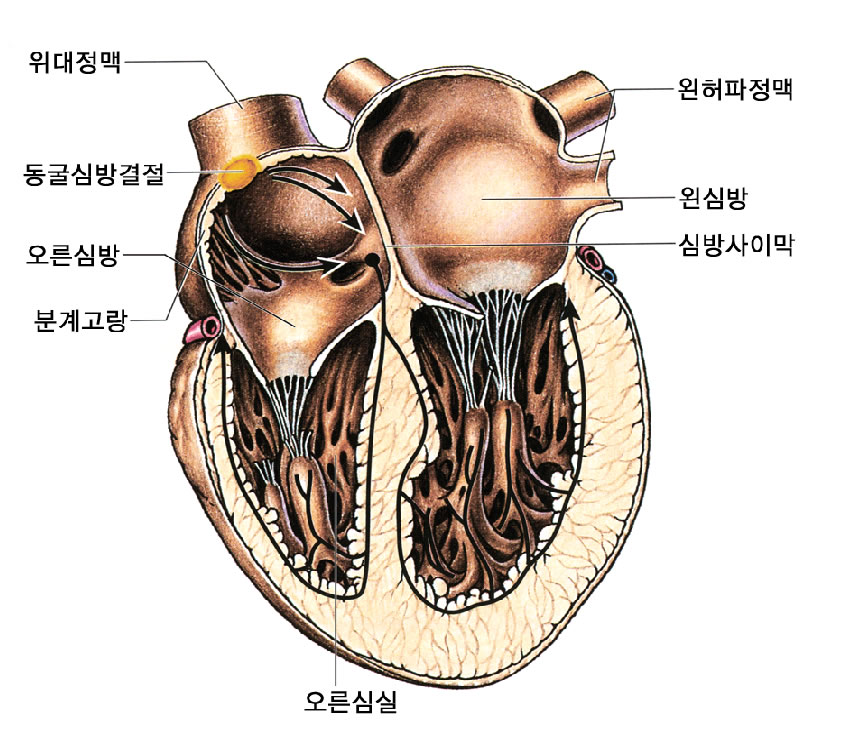 |
||
| 영문 | heart failure | 한글 | 심장기능상실 |
|---|---|---|---|
| 설명 | 몸의 조직이나 기관에서 대사에 필요한 만큼 충분한 양의 혈액을 공급할 수 없을 정도로 심장기능이 저하되어 있는 상태이다. 심장기능상실은 심근이 수축할 능력이 저하되었을 때나 심장에 심박출을 하기 위한 압력이 정상보다 증가되어 정상의 심장의 수축으로는 충분한 양의 혈액을 공급할 수 없는 경우, 그리고 심장근육, 심장에 걸리는 압력은 정상이나 심장박동의 이상에 의해서 정상적인 수축이 불가능할 경우에 생긴다. |
||
| 영문 | pacemaker(of heart) | 한글 | 심장박동기 |
|---|---|---|---|
| 설명 | 심장의 전기적 자극이 병적인 상태로 발생하지 않거나, 혹은 심실로 잘 전해지지 않을 때 사용한다. 일시적 심장박동기와 영구적 심장박동기가 있으며, 각기 쓰이는 용도는 병에 따라 다르다. 요즘에 나오는 심장 박동기는 건전지의 수명도 반영구적이며, 밖에서 조정할 수 있고, 운동이나 스트레스 상황에 대한 심장의 빠른 운동에도 잘 적응할 수 있도록 만들어져 있다. |
||
| IHD | Ischemic Heart Disease = Coronary Heart(Artery) Disease = Atheroscler... |
|---|---|
| JVP | [POMD P 49 - 52] 1) Jugular Vein Pressure 2) Jugular Venous Pulse ... |
| AHD | acquired hepatocerebral degeneration; acute heart disease; antihyaluronidase; antihypertensive drug;... |
| CHD | Chediak-Higashi disease; childhood disease; chronic hemodialysis; congenital or congestive heart dis... |
| HT | Hashimoto thyroiditis; hearing test; hearing threshold; heart; heart transplantation, heart transpla... |
| rate, birth | The birth rate is usually given as the number of live births divided by the average population (or the population at midyear). This is termed the crude birth rate. In 1995, for example, the crude birth rate per 1,000 population was 14 in the united states, 16.9 in Australia, etc. (12 Dec 1998) |
|---|---|
| rate constants | Proportionality constants equal to the initial rate of a reaction divided by the concentration of the reactant(s); e.g., in the reaction A → B + C, the rate of the reaction equals -d[A]/dt = k1[A]. The rate constant k1 is a unimolecular rate constant since there is only one molecular species reacting and has units of reciprocal time (e.g., sec-1). For the reverse reaction, B + C → A, the rate equals -d[B]/dt = d[A]/dt = k2[B][C]. The rate constant k2 is a bimolecular rate constant and has units of reciprocal concentration-time (e.g., m-1 sec-1). Synonym: velocity constants. (05 Mar 2000) |
| rate, death | The number of deaths in the population divided by the average population (or the population at midyear) is the crude death rate. In 1994, for example, the crude death rate per 1,000 population was 8.8 in the united states, 7.1 in Australia, etc. A death rate can also be tabulated according to age or cause. (12 Dec 1998) |
| rate equation | A mathematical expression for a chemical, radiochemical, or enzyme-catalyzed reaction. (05 Mar 2000) |
| rate, erythrocyte sedimentation | A sedimentation rate, or sed rate , is a blood test that detects and is used to monitor inflammation activity. It is measured by recording the rate at which red blood cells (rbcs) sediment in a tube over time. It increases (the rbcs sediment faster) with more inflammation. (12 Dec 1998) |
| rate, foetal mortality | The ratio of foetal deaths divided by the sum of the births (the live births + the foetal deaths) in that year. In the united states, the foetal mortality rate plummeted from 19.2 per 1,000 births in 1950 to 9.2 per 1,000 births in 1980. (12 Dec 1998) |
| rate, infant mortality | The number of children dying under a year of age divided by the number of live births that year. The infant mortality rate in the united states, which was 12.5 per 1,000 live births in 1980, fell to 9.2 per 1,000 live births in 1990. (12 Dec 1998) |
| rate-limiting step | <biochemistry> The slowest step in a metabolic pathway, or the step in an enzymatic reaction that requires the greatest amount of energy to initiate. (17 Dec 1997) |
| rate, maternal mortality | The number of maternal deaths related to childbearing divided by the number of live births (or by the number of live births + foetal deaths) in that year. The maternal mortality rate in the united states in 1993 (and 1994) was 0.1 per 1,000 live births, or 1 mother dying per 10,000 live births. (12 Dec 1998) |
| rate meter | A device that continuously displays the magnitude of events averaged over varying time intervals. (05 Mar 2000) |
| rate, neonatal mortality | The number of children dying under 28 days of age divided by the number of live births that year. The neonatal mortality rate in the united states, which was 8.4 per 1,000 live births in 1980, declined to 5.8 per 1,000 live births in 1990. (12 Dec 1998) |
| rate, pulse | The pulse rate is most often taken at the wrist. It measures the number of pulsations in the radial artery each minute. (12 Dec 1998) |
| rate, respiratory | The number of breaths per minute (or, more formally, the number of movements indicative of inspiration and expiration per unit time). In practice, the respiratory rate is usually determined by counting the number of times the chest rises (or falls) per minute. By whatever means, the aim is to determine if the respirations are normal, abnormally fast (tachypnea), abnormally slow (technically termed bradypnea), or nonexistent (apnea). (12 Dec 1998) |
| rate schedule | A price list showing how the electric bill of a particular type of customer will be calculated by an electric utility company. (05 Dec 1998) |
| rate, sed | A sedimentation rate, or sed rate , is a blood test that detects and is used to monitor inflammation activity. It is measured by recording the rate at which red blood cells (rbcs) sediment in a tube over time. It increases (the rbcs sediment faster) with more inflammation. (12 Dec 1998) |
| heart rate |
Number of beats of the heart per minute.
출처: www.iacpr.net/services/glossary_terms.php
|
|---|---|
| heart rate |
The number of times the heart beats in one minute. Normal heart rate for a child is in the range of 80 to 120 beats per minute.
출처: www.howardnations.com/burns/burns_glossary.html
|
| heart rate variability |
ABBR: HRV. Spontaneous fluctuations above and below the mean heart rate. A reduced HRV is associated with an increased incidence of total mortality and cardiac events in post-myocardial infarction patients, as well as in
출처:
|
| heart rate, target zone |
A heart rate that is 50% to 75% of an individual's maximum heart rate. Persons who exercise to attain or maintain physical fitness should attempt to exercise vigorously enough to produce a heart rate that is both safe and
출처:
|
| heart rate |
number of beats per minute of the heart, reflected in the patient's pulse and potentially reflective of increased stress on the patient's system.
출처: www.asha.org/about/publications/leader-online/arch...
|