
| 영문 | hypertensive heart disease | 한글 | 고혈압심장병 |
|---|---|---|---|
| 설명 | 고혈압에 의해서 생기는 심장병. 고혈압심장병이라는 진단을 붙이기 위해서는 최소한 다음과 같은 조건이 부합되어야 하는데, 첫째 심장혈관계에 심장병을 유발할 수 있을 만한 다른 병변이 없이 좌심실 비대가 있어야 하며, 둘째 고혈압을 앓았다는 병력이 있어야 한다. 주로 고혈압에 의한 심장병은 초기에는 좌심실이 비후라는 것으로 특징되어진다. 즉 혈압이 높으므로 혈액을 순환시키기 위해서는 그만큼 심장의 혈액을 보내는 힘이 좋아야 한다. 그 힘을 얻기위해서는 심근의 비후가 필요로 하여 좌심실 근육의 비후가 생긴다. 그리고 고혈압이 지속이 될 경우에는 결국 심장이 제 구실을 하지 못하고 펌프로서의 기능을 잃어버리게 되어 심장기능상실에 빠지게 된다. |
||
| 영문 | rheumatic heart disease | 한글 | 류마티스심장병 |
|---|---|---|---|
| 설명 | 사슬알균감염 후 생기는 심장판막병이다. 원인은 A군 -용혈사슬알에 의한 인두염후 일종의 면역반응으로 발병한다. 진단은 존의 기준에 의한다. (1) 주요기준은 관절염 심장염(심장비대, 심장잡음, 심장기능상실 등) 무도증: 무당이 춤을 추는 것 같은 행동의 발작증세. 연변홍반: 빨간 테두리를 가진 피부병변은 피하결절(subcutaneous nodule): 피부 밑에 생긴 결절, (2)참고 기준은 열, 관절통, EKG상 PR연장: 심전도 소견 급성기 반응물질(예: ESR, CRP)의 상승, 류마티스열 치료는 페니실린으로 치료하고 심장의 후유증 또한 페니실린으로 예방한다. |
||
| 영문 | heart | 한글 | 심장 |
|---|---|---|---|
| 설명 | 심장은 가슴의 중앙에 위치하며 오른쪽과 왼쪽반으로 나눌 수 있다. 각각은 정맥에서 피가 들어오는 방과 동맥으로 피를 내보내는 실이 있다. 심장은 정중앙선에서 왼쪽에 놓여 있다. 심장의 2개의 심방과 2개의 심실, 그리고 심방사이의 심방중격, 심실사이의 심실중격이 존재한다. 심실은 혈액을 주로 순환시키는 힘을 내는 곳으로 강한 근육층이 존재를 한다. 반면에 심방은 심실에 들어가기전에 일시적으로 피가 모이는 곳으로 근육층의 발달이 미약하다. 심방과 심실사이에 삼첨판과 승모판, 심실의 유출로에 대동맥판과 폐동맥판이 있다. 이것들은 혈액이 흐르는 방향에 거슬러 진행하는 것을 막는 기능을 한다. 그리고 심장에는 심장의 근육에 혈액을 공급하는 관상동맥이 있다. 이 심장동맥은 심장을 쌓듯이 존재한다. 심장박동의 신호는 특수한 장치에 의해서 발생이 되고 특수한 전도계를 통해서 전체의 심장으로 전도된다. 심장박동의 신호는 우선 우심방에 위치하는 동방결절(SA node)라는 곳에서 우선 생긴다. 여기에서 보내는 전기적 신호가 바로 심장을 뛰게하는 신호인 것이다. 이 신호로 말미암아 심방이 우선 수축을 한다. 그리고는 심방과 심실사이에 위치하는 방실결절(AV node)라는 곳에 일정하게 정해진 통로없이 전체의 심방을 통해서 전달이 되고 이 신호를 받은 방실결절(AV node)는 히스 다발(His bundle)과 심장전도근육섬유를 통해서 심실의 심장근육에게 이 신호를 보내주어 심실근육을 수축하게 한다. 히스다발과 심장전도근육섬유는 전체의 심실의 심근섬유에 동시에 전기적 신호를 보내어 줄 수 있게 하는 일종의 전기줄과 같은 역할을 한다. 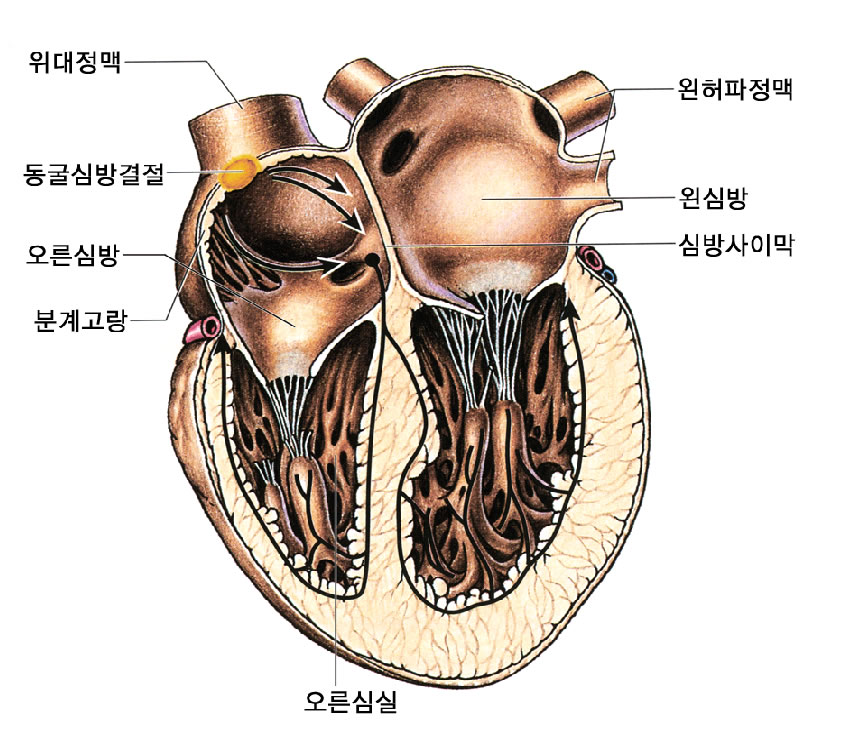 |
||
| 영문 | heart failure | 한글 | 심장기능상실 |
|---|---|---|---|
| 설명 | 몸의 조직이나 기관에서 대사에 필요한 만큼 충분한 양의 혈액을 공급할 수 없을 정도로 심장기능이 저하되어 있는 상태이다. 심장기능상실은 심근이 수축할 능력이 저하되었을 때나 심장에 심박출을 하기 위한 압력이 정상보다 증가되어 정상의 심장의 수축으로는 충분한 양의 혈액을 공급할 수 없는 경우, 그리고 심장근육, 심장에 걸리는 압력은 정상이나 심장박동의 이상에 의해서 정상적인 수축이 불가능할 경우에 생긴다. |
||
| 영문 | pacemaker(of heart) | 한글 | 심장박동기 |
|---|---|---|---|
| 설명 | 심장의 전기적 자극이 병적인 상태로 발생하지 않거나, 혹은 심실로 잘 전해지지 않을 때 사용한다. 일시적 심장박동기와 영구적 심장박동기가 있으며, 각기 쓰이는 용도는 병에 따라 다르다. 요즘에 나오는 심장 박동기는 건전지의 수명도 반영구적이며, 밖에서 조정할 수 있고, 운동이나 스트레스 상황에 대한 심장의 빠른 운동에도 잘 적응할 수 있도록 만들어져 있다. |
||
| MACDP | Metropolitan Atlanta Congenital Defects Program |
|---|---|
| CHB | chronic hepatitis B; complete heart block; congenital heart block |
| CHF | chick embryo fibroblast; chronic heart failure; congenital hepatic fibrosis; congestive heart failur... |
| IHD | Ischemic Heart Disease = Coronary Heart(Artery) Disease = Atheroscler... |
| JVP | [POMD P 49 - 52] 1) Jugular Vein Pressure 2) Jugular Venous Pulse ... |
| bovine congenital ataxia | An autosomal recessive ataxia seen in several European breeds of cattle. (05 Mar 2000) |
|---|---|
| bullous congenital ichthyosiform erythroderma | Diffusely red, eroded skin at birth, with subsequent scaling, tending to improve in later life, characterised by generalised epidermolytic hyperkeratosis and autosomal dominant inheritance. See: epidermolytic hyperkeratosis. Synonym: generalised epidermolytic hyperkeratosis, ichthyismus hystrix, ichthyosis hystrix. (05 Mar 2000) |
| pain insensitivity, congenital | Absence of sensibility to pain or inability to feel pain. The condition is present at birth. (12 Dec 1998) |
| rubella syndrome, congenital | Transplacental infection of the foetus with rubella usually in the first trimester of pregnancy, as a consequence of maternal infection, resulting in various developmental abnormalities in the newborn infant. They include cardiac and ocular lesions, deafness, microcephaly, mental retardation, and generalised growth retardation. (12 Dec 1998) |
| congenital | <embryology> Existing at and usually before, birth, referring to conditions that are present at birth, regardless of their causation. Origin: L. Congenitus = born together (18 Nov 1997) |
| congenital absence of pulmonary valve | <radiology> BIG central pulmonary arteries, big RV (12 Dec 1998) |
| congenital adrenal hyperplasia | <endocrinology> A genetic disorder present at birth characterised by a deficiency of the hormones aldosterone and cortisol and an overproduction of male sex hormones (androgens). In males this may manifest as enlarged penis, small testes and early development of masculine characteristics. In females features include ambiguous genitalia, failure to menstruate, deep voice and excessive hair. Origin: Gr. Plassein = to form (27 Sep 1997) |
| congenital afibrinogenaemia | <biochemistry> A below normal level of fibrinogen in the plasma. Fibrinogen (factor II) is one of the proteins involved in the formation of a blood clot. This condition may be congenital or acquired (for example disseminated intravascular coagulation, multiple blood transfusions). Origin: Gr. Haima = blood (27 Sep 1997) |
| congenital amputation | Amputation produced in utero; attributed to the pressure of constricting bands (amniotic); autosomal recessive inheritance. Synonym: amniotic amputation, amputation, birth amputation, intrauterine amputation, spontaneous amputation. (05 Mar 2000) |
| congenital anaemia | <haematology> A condition which develops in the foetus due to an incompatibility between the mother's blood type (RH factor) and the baby's. Maternal antibodies, which enter the foetal circulation during delivery attack the baby's red blood cells leading to haemolysis (rupture of the cells). Symptoms include an infant with an enlarged liver and spleen, swelling, jaundice and anaemia. (27 Sep 1997) |
| congenital ankyloblepharon | Congenital adhesion of the upper and lower eyelid by bands of tissue. Synonym: filiform adnatum. Origin: ankylo-+ G. Blepharon, eyelid (05 Mar 2000) |
| congenital antithrombin III deficiency | Antithrombin III is a protein which stimulates the removal of blood clots in the bloodstream. Small blood clots form normally within the bloodstream, but are normally dissolved via the bodys antithrombin III. The deficiency of antithrombin III will result in an increased risk for blood clot formation causing organ damage. This is an inherited as a autosomal dominant trait. Inheritance: autosomal dominant. (27 Sep 1997) |
| congenital aplasia of thymus | diGeorge syndrome |
| congenital aplastic anaemia | <haematology> A rare inherited type of aplastic anaemia which carries an increased risk to the patient of developing leukaemia. May be treated by bone marrow transplant. Origin: Gr. Haima = blood (13 Nov 1997) |
| congenital atonic pseudoparalysis | Atonic pseudoparalysis of congenital origin (neither familial nor hereditary), observed especially in infants and characterised by absences of muscular tone only in muscles innervated by the spinal nerves. Synonym: congenital atonic pseudoparalysis, myatonia congenita, Oppenheim's disease, Oppenheim's syndrome. An indefinite term for a number of congenital neuromuscular disorders that cause generalised myotonia in young children, and that have a benign course (static or regressive). (05 Mar 2000) |