
| 영문 | rheumatic heart disease | 한글 | 류마티스심장병 |
|---|---|---|---|
| 설명 | 사슬알균감염 후 생기는 심장판막병이다. 원인은 A군 -용혈사슬알에 의한 인두염후 일종의 면역반응으로 발병한다. 진단은 존의 기준에 의한다. (1) 주요기준은 관절염 심장염(심장비대, 심장잡음, 심장기능상실 등) 무도증: 무당이 춤을 추는 것 같은 행동의 발작증세. 연변홍반: 빨간 테두리를 가진 피부병변은 피하결절(subcutaneous nodule): 피부 밑에 생긴 결절, (2)참고 기준은 열, 관절통, EKG상 PR연장: 심전도 소견 급성기 반응물질(예: ESR, CRP)의 상승, 류마티스열 치료는 페니실린으로 치료하고 심장의 후유증 또한 페니실린으로 예방한다. |
||
| 영문 | congenital heart disease | 한글 | 선천심장병 |
|---|---|---|---|
| 설명 | 선천적으로 심장의 구조에 이상이 있는 병. |
||
| 영문 | heart | 한글 | 심장 |
|---|---|---|---|
| 설명 | 심장은 가슴의 중앙에 위치하며 오른쪽과 왼쪽반으로 나눌 수 있다. 각각은 정맥에서 피가 들어오는 방과 동맥으로 피를 내보내는 실이 있다. 심장은 정중앙선에서 왼쪽에 놓여 있다. 심장의 2개의 심방과 2개의 심실, 그리고 심방사이의 심방중격, 심실사이의 심실중격이 존재한다. 심실은 혈액을 주로 순환시키는 힘을 내는 곳으로 강한 근육층이 존재를 한다. 반면에 심방은 심실에 들어가기전에 일시적으로 피가 모이는 곳으로 근육층의 발달이 미약하다. 심방과 심실사이에 삼첨판과 승모판, 심실의 유출로에 대동맥판과 폐동맥판이 있다. 이것들은 혈액이 흐르는 방향에 거슬러 진행하는 것을 막는 기능을 한다. 그리고 심장에는 심장의 근육에 혈액을 공급하는 관상동맥이 있다. 이 심장동맥은 심장을 쌓듯이 존재한다. 심장박동의 신호는 특수한 장치에 의해서 발생이 되고 특수한 전도계를 통해서 전체의 심장으로 전도된다. 심장박동의 신호는 우선 우심방에 위치하는 동방결절(SA node)라는 곳에서 우선 생긴다. 여기에서 보내는 전기적 신호가 바로 심장을 뛰게하는 신호인 것이다. 이 신호로 말미암아 심방이 우선 수축을 한다. 그리고는 심방과 심실사이에 위치하는 방실결절(AV node)라는 곳에 일정하게 정해진 통로없이 전체의 심방을 통해서 전달이 되고 이 신호를 받은 방실결절(AV node)는 히스 다발(His bundle)과 심장전도근육섬유를 통해서 심실의 심장근육에게 이 신호를 보내주어 심실근육을 수축하게 한다. 히스다발과 심장전도근육섬유는 전체의 심실의 심근섬유에 동시에 전기적 신호를 보내어 줄 수 있게 하는 일종의 전기줄과 같은 역할을 한다. 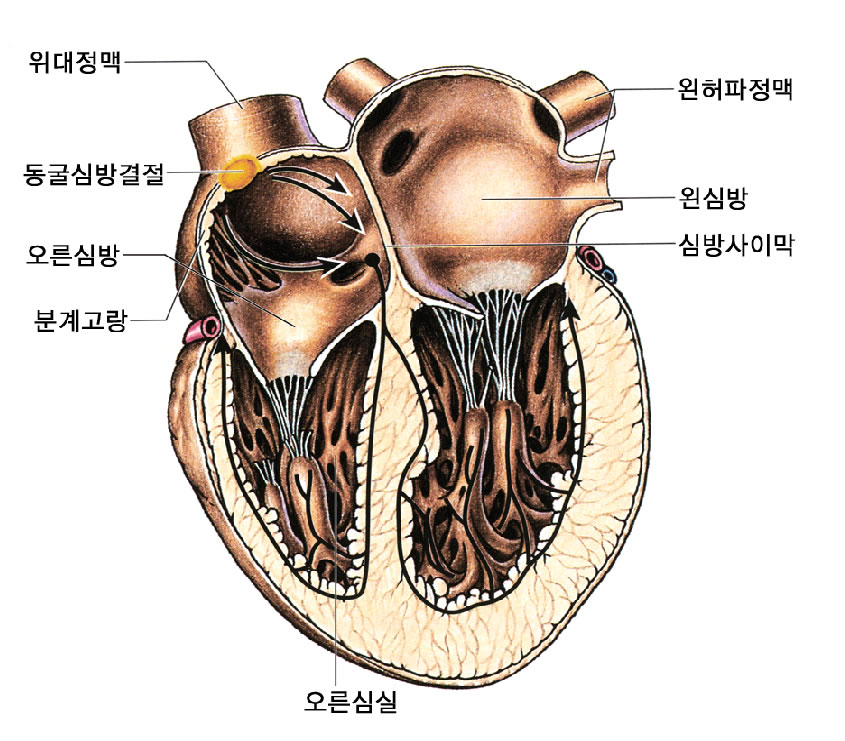 |
||
| 영문 | heart failure | 한글 | 심장기능상실 |
|---|---|---|---|
| 설명 | 몸의 조직이나 기관에서 대사에 필요한 만큼 충분한 양의 혈액을 공급할 수 없을 정도로 심장기능이 저하되어 있는 상태이다. 심장기능상실은 심근이 수축할 능력이 저하되었을 때나 심장에 심박출을 하기 위한 압력이 정상보다 증가되어 정상의 심장의 수축으로는 충분한 양의 혈액을 공급할 수 없는 경우, 그리고 심장근육, 심장에 걸리는 압력은 정상이나 심장박동의 이상에 의해서 정상적인 수축이 불가능할 경우에 생긴다. |
||
| 영문 | pacemaker(of heart) | 한글 | 심장박동기 |
|---|---|---|---|
| 설명 | 심장의 전기적 자극이 병적인 상태로 발생하지 않거나, 혹은 심실로 잘 전해지지 않을 때 사용한다. 일시적 심장박동기와 영구적 심장박동기가 있으며, 각기 쓰이는 용도는 병에 따라 다르다. 요즘에 나오는 심장 박동기는 건전지의 수명도 반영구적이며, 밖에서 조정할 수 있고, 운동이나 스트레스 상황에 대한 심장의 빠른 운동에도 잘 적응할 수 있도록 만들어져 있다. |
||
| SIDS | Sudden Infant Death Syndrome; 영아 돌연사 증후군 = Crib Death |
|---|---|
| BD | barbital-dependent; barbiturate dependence; base deficit; base of prism down; basophilic degeneratio... |
| ND | Doctor of Naturopathy; nasal deformity; natural death; Naval Dispensary; neonatal death; neoplastic ... |
| SID | single intradermal [test]; Society for Investigative Dermatology; sucrase-isomaltase deficiency; sud... |
| SDHD | sudden death heart disease |
| programmed cell death | <cell biology, molecular biology> The concept that certain cells are determined to die at specific stages and specific sites during development, for example cells in the spaces between the developing digits of vertebrates, thus dividing them. Programmed cell death occurs by apopotosis. (18 Nov 1997) |
|---|---|
| somatic death | Death of the entire body, as distinguished from local death. (05 Mar 2000) |
| neonatal death | Death of a young, liveborn infant; classified as: (05 Mar 2000) |
| sudden death | An arrhythmogenic death in aortic stenosis, coronary disease, mesothelioma of the AV node, or single coronary artery. (05 Mar 2000) |
| sudden infant death | The abrupt and unexplained death of an apparently healthy infant under one year of age, remaining unexplained after a thorough case investigation, including performance of a complete autopsy, examination of the death scene, and review of the clinical history. (expert panel of the national institute of child health and human development in paediatric pathology, v.11, no.5, sept-oct 1991, p681) (12 Dec 1998) |
| sudden infant death syndrome | <syndrome> May affect infants of any age, but some risk factors have been identified: term infants who have had a life-threatening period of apnoea (not breathing), premature infants of low birth weight, siblings of infants who have succumbed to sudden infant death syndrome and infants of substance abusing mothers. Peak age is at 2.5 months and 4 months, but can range from 1 month to 1 year. High risk infants should have home monitoring done. It is recommended that the less than 4 month old infant should sleep on their back. Synonym: cot death syndrome. Incidence: 2 per 1,000 live births. Acronym: SIDS (27 Sep 1997) |
| death | 1. The cessation of all vital phenomena without capability of resuscitation, either in animals or plants. Local death is going on at times and in all parts of the living body, in which individual cells and elements are being cast off and replaced by new; a process essential to life. General death is of two kinds; death of the body as a whole (somatic or systemic death), and death of the tissues. By the former is implied the absolute cessation of the functions of the brain, the circulatory and the respiratory organs; by the latter the entire disappearance of the vital actions of the ultimate structural constituents of the body. When death takes place, the body as a whole dies first, the death of the tissues sometimes not occurring until after a considerable interval. Death is much used adjectively and as the first part of a compound, meaning, in general, of or pertaining to death, causing or presaging death; as, deathbed or death bed; deathblow or death blow, etc. Black death. Civil death, the separation of a man from civil society, or the debarring him from the enjoyment of civil rights, as by banishment, attainder, abjuration of the realm, entering a monastery, etc. Death adder. <zoology> A kind of viper found in South Africa (Acanthophis tortor); so called from the virulence of its venom. A venomous Australian snake of the family Elapidae, of several species, as the Hoplocephalus superbus and Acanthopis antarctica. Death applies to the termination of every form of existence, both animal and vegetable; the other words only to the human race. Decease is the term used in law for the removal of a human being out of life in the ordinary course of nature. Demise was formerly confined to decease of princes, but is now sometimes used of distinguished men in general; as, the demise of Mr. Pitt. Departure and release are peculiarly terms of Christian affection and hope. A violent death is not usually called a decease. Departure implies a friendly taking leave of life. Release implies a deliverance from a life of suffering or sorrow. Origin: OE. Deth, dea, AS. Dea; akin to OS. D, D. Dood, G. Tod, Icel. Daui, Sw. & Dan. Dod, Goth. Daupus; from a verb meaning to die. See Die, and cf. Dead. (04 Mar 1998) |
| death, black | The black plague or the plague. In 14th century Europe, the victims of the black plague had bleeding below the skin (subcutaneous haemorrhage) which made darkened ( blackened ) their bodies. The black death swept recurrently through Europe, killing half its population in the middle of the 14th century. (12 Dec 1998) |
| death certificate | Official, legal document and vital record, signed by a licensed physician or other designated authority, that includes cause of death, decedent's name, sex, place of residence, date of death; other information, e.g., birth date, birth place, occupation may be included; the immediate cause of death is recorded on the first line of the certificate, followed by the condition(s) giving rise to this, with the underlying cause on the last line; the underlying cause is coded and tabulated in official publications of mortality. (05 Mar 2000) |
| death certificates | Official records of individual deaths including the cause of death certified by a physician, and any other required identifying information. (12 Dec 1998) |
| death instinct | The instinct of all living creatures toward self-destruction, death, or a return to the inorganic lifelessness from which they arose. Synonym: aggressive instinct. (05 Mar 2000) |
| death phase | <cell culture> The final growth phase in a culture, during which nutrients have been depleted and cell number decreases. (09 Oct 1997) |
| death rate | The number of deaths in the population divided by the average population (or the population at midyear) is the crude death rate. In 1994, for example, the crude death rate per 1,000 population was 8.8 in the United States, 7.1 in Australia, etc. A death rate can also be tabulated according to age or cause. (12 Dec 1998) |
| death-rattle | A respiratory gurgling or rattling in the throat of a dying person, caused by the loss of the cough reflex and accumulation of mucus. (05 Mar 2000) |
| death's-head | A naked human skull as the emblem of death; the head of the conventional personification of death. "I had rather be married to a death's-head with a bone in his mouth. <zoology> " (Shak) Death's-head moth, a very large European moth (Acherontia atropos), so called from a figure resembling a human skull on the back of the thorax. Synonym: death's-head sphinx. Source: Websters Dictionary (01 Mar 1998) |