¼±Åà - È­»ìǥŰ/¿£ÅÍŰ ´Ý±â - ESC

 
"flow tract of the heart"¿¡ ´ëÇÑ °Ë»ö °á°úÀÔ´Ï´Ù. °Ë»ö °á°ú º¸´Â µµÁß¿¡ Tab ۸¦ ´©¸£½Ã¸é °Ë»ö âÀÌ ¼±Åõ˴ϴÙ.
¾Ë±â½¬¿î ÀÇÇпë¾îÇ®ÀÌÁý, ¼­¿ïÀÇ´ë ±³¼ö ÁöÁ¦±Ù, °í·ÁÀÇÇÐ ÃâÆÇ À¯»ç °Ë»ö °á°ú : 5 ÆäÀÌÁö: 2
¿µ¹® hypertensive heart disease ÇÑ±Û °íÇ÷¾Ð½ÉÀ庴
¼³¸í   
  °íÇ÷¾Ð¿¡ ÀÇÇØ¼­ »ý±â´Â ½ÉÀ庴. °íÇ÷¾Ð½ÉÀ庴À̶ó´Â Áø´ÜÀ» ºÙÀ̱â À§Çؼ­´Â ÃÖ¼ÒÇÑ ´ÙÀ½°ú °°Àº Á¶°ÇÀÌ ºÎÇյǾî¾ß Çϴµ¥, Ã¹Â° ½ÉÀåÇ÷°ü°è¿¡ ½ÉÀ庴À» À¯¹ßÇÒ ¼ö ÀÖÀ» ¸¸ÇÑ ´Ù¸¥ º´º¯ÀÌ ¾øÀÌ Á½ɽǠºñ´ë°¡ ÀÖ¾î¾ß Çϸç, µÑ° °íÇ÷¾ÐÀ» ¾Î¾Ò´Ù´Â º´·ÂÀÌ ÀÖ¾î¾ß ÇÑ´Ù. ÁַΠ°íÇ÷¾Ð¿¡ ÀÇÇÑ ½ÉÀ庴Àº Ãʱ⿡´Â Á½ɽÇÀÌ ºñÈĶó´Â °ÍÀ¸·Î Æ¯Â¡µÇ¾îÁø´Ù. Áï Ç÷¾ÐÀÌ ³ôÀ¸¹Ç·Î Ç÷¾×À» ¼øÈ¯½Ã۱â À§Çؼ­´Â ±×¸¸Å­ ½ÉÀåÀÇ Ç÷¾×À» º¸³»´Â ÈûÀÌ ÁÁ¾Æ¾ß ÇÑ´Ù. ±× ÈûÀ» ¾ò±âÀ§Çؼ­´Â ½É±ÙÀÇ ºñÈİ¡ ÇÊ¿ä·Î ÇÏ¿© Á½ɽǠ±ÙÀ°ÀÇ ºñÈİ¡ »ý±ä´Ù. ±×¸®°í °íÇ÷¾ÐÀÌ Áö¼ÓÀÌ µÉ °æ¿ì¿¡´Â °á±¹ ½ÉÀåÀÌ Á¦ ±¸½ÇÀ» ÇÏÁö ¸øÇ졒ʮßÇÁ·Î¼­ÀÇ ±â´ÉÀ» ÀÒ¾î¹ö¸®°Ô µÇ¾î ½ÉÀå±â´É»ó½Ç¿¡ ºüÁö°Ô µÈ´Ù.
¿µ¹® rheumatic heart disease ÇÑ±Û ·ù¸¶Æ¼½º½ÉÀ庴
¼³¸í   
  »ç½½¾Ë±Õ°¨¿° ÈÄ »ý±â´Â ½ÉÀåÆÇ¸·º´ÀÌ´Ù. ¿øÀÎÀº A±º -¿ëÇ÷»ç½½¾Ë¿¡ ÀÇÇÑ Àεο°ÈÄ ÀÏÁ¾ÀÇ ¸é¿ª¹ÝÀÀÀ¸·Î ¹ßº´ÇÑ´Ù.
  
  Áø´ÜÀº Á¸ÀÇ ±âÁØ¿¡ ÀÇÇÑ´Ù.
  
  (1) ÁÖ¿ä±âÁØÀº °üÀý¿° ½ÉÀå¿°(½ÉÀåºñ´ë, ½ÉÀåÀâÀ½, ½ÉÀå±â´É»ó½Ç µî) ¹«µµÁõ: ¹«´çÀÌ ÃãÀ» Ãߴ °Í °°Àº ÇൿÀÇ ¹ßÀÛÁõ¼¼. ¿¬º¯È«¹Ý: »¡°£ Å׵θ®¸¦ °¡Áø ÇǺκ´º¯Àº ÇÇÇϰáÀý(subcutaneous nodule): ÇǺΠ¹Ø¿¡ »ý±ä °áÀý,
  
  (2)Âü°í ±âÁØÀº ¿­, °üÀýÅë, EKG»ó PR¿¬Àå: ½ÉÀüµµ ¼Ò°ß ±Þ¼º±â ¹ÝÀÀ¹°Áú(¿¹: ESR, CRP)ÀÇ »ó½Â, ·ù¸¶Æ¼½º¿­
  
  Ä¡·á´Â Æä´Ï½Ç¸°À¸·Î Ä¡·áÇÏ°í ½ÉÀåÀÇ ÈÄÀ¯Áõ ¶ÇÇÑ Æä´Ï½Ç¸°À¸·Î ¿¹¹æÇÑ´Ù.
¿µ¹® congenital heart disease ÇÑ±Û ¼±Ãµ½ÉÀ庴
¼³¸í   
  ¼±ÃµÀûÀ¸·Î ½ÉÀåÀÇ ±¸Á¶¿¡ ÀÌ»óÀÌ Àִ º´.
¿µ¹® heart ÇÑ±Û ½ÉÀå
¼³¸í   
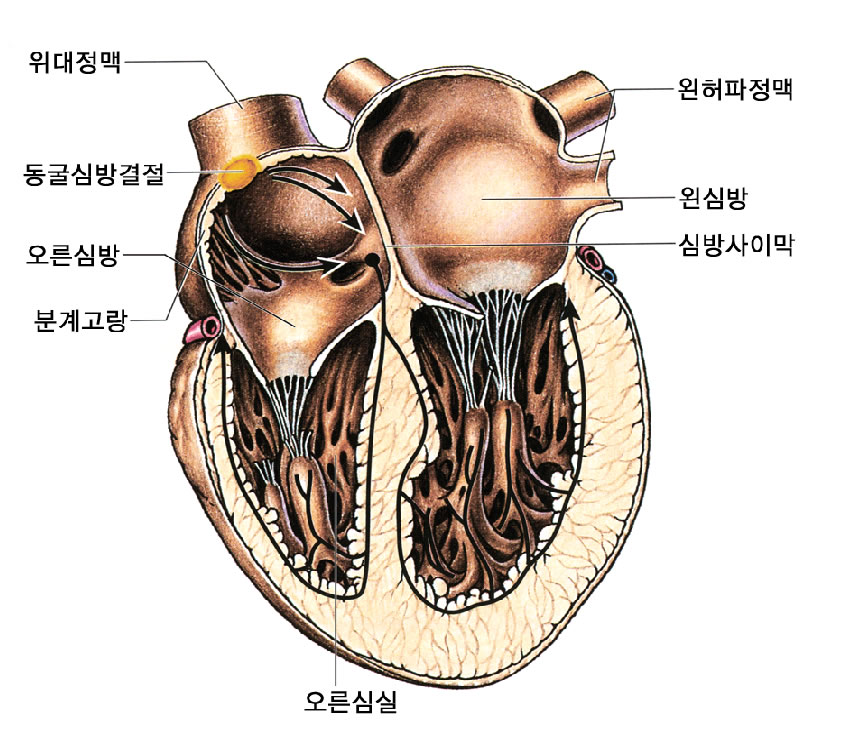
  ½ÉÀåÀº °¡½¿ÀÇ Áß¾Ó¿¡ À§Ä¡Çϸ砿À¸¥Âʰú ¿ÞÂʹÝÀ¸·Î ³ª´­ ¼ö ÀÖ´Ù. °¢°¢Àº Á¤¸Æ¿¡¼­ Çǰ¡ µé¾î¿À´Â ¹æ°ú µ¿¸ÆÀ¸·Î ÇǸ¦ ³»º¸³»´Â ½ÇÀÌ ÀÖ´Ù. ½ÉÀåÀº Á¤Áß¾Ó¼±¿¡¼­ ¿ÞÂÊ¿¡ ³õ¿© ÀÖ´Ù.
  
  ½ÉÀåÀÇ 2°³ÀÇ ½É¹æ°ú 2°³ÀÇ ½É½Ç, ±×¸®°í ½É¹æ»çÀÌÀÇ ½É¹æÁß°Ý, ½É½Ç»çÀÌÀÇ ½É½ÇÁß°ÝÀÌ Á¸ÀçÇÑ´Ù. ½É½ÇÀº Ç÷¾×À» ÁַΠ¼øÈ¯½Ã۴ ÈûÀ» ³»´Â °÷À¸·Î °­ÇÑ ±ÙÀ°ÃþÀÌ Á¸À縦 ÇÑ´Ù. ¹Ý¸é¿¡ ½É¹æÀº ½É½Ç¿¡ µé¾î°¡±âÀü¿¡ ÀϽÃÀûÀ¸·Î Çǰ¡ ¸ðÀ̴ °÷À¸·Î ±ÙÀ°ÃþÀÇ ¹ß´ÞÀÌ ¹Ì¾àÇÏ´Ù. ½É¹æ°ú ½É½Ç»çÀÌ¿¡ »ï÷ÆÇ°ú ½Â¸ðÆÇ, ½É½ÇÀÇ À¯Ãâ·Î¿¡ ´ëµ¿¸ÆÆÇ°ú Æóµ¿¸ÆÆÇÀÌ ÀÖ´Ù. À̰͵éÀº Ç÷¾×ÀÌ È帣´Â ¹æÇâ¿¡ °Å½½·¯ ÁøÇàÇϴ °ÍÀ» ¸·´Â ±â´ÉÀ» ÇÑ´Ù. ±×¸®°í ½ÉÀå¿¡´Â ½ÉÀåÀÇ ±ÙÀ°¿¡ Ç÷¾×À» °ø±ÞÇϴ °ü»óµ¿¸ÆÀÌ ÀÖ´Ù. ÀÌ ½ÉÀ嵿¸ÆÀº ½ÉÀåÀ» ½×µíÀÌ Á¸ÀçÇÑ´Ù.
  
  ½ÉÀå¹Úµ¿ÀÇ ½ÅÈ£´Â Æ¯¼öÇÑ ÀåÄ¡¿¡ ÀÇÇØ¼­ ¹ß»ýÀÌ µÇ°í Æ¯¼öÇÑ Àüµµ°è¸¦ ÅëÇØ¼­ ÀüüÀÇ ½ÉÀåÀ¸·Î ÀüµµµÈ´Ù. ½ÉÀå¹Úµ¿ÀÇ ½ÅÈ£´Â ¿ì¼± ¿ì½É¹æ¿¡ À§Ä¡Çϴ µ¿¹æ°áÀý(SA node)¶ó´Â °÷¿¡¼­ ¿ì¼± »ý±ä´Ù. ¿©±â¿¡¼­ º¸³»´Â Àü±âÀû ½ÅÈ£°¡ ¹Ù·Î ½ÉÀåÀ» ¶Ù°ÔÇϴ ½ÅÈ£ÀΠ°ÍÀÌ´Ù. ÀÌ ½ÅÈ£·Î ¸»¹Ì¾Ï¾Æ ½É¹æÀÌ ¿ì¼± ¼öÃàÀ» ÇÑ´Ù. ±×¸®°í´Â ½É¹æ°ú ½É½Ç»çÀÌ¿¡ À§Ä¡Çϴ ¹æ½Ç°áÀý(AV node)¶ó´Â °÷¿¡ ÀÏÁ¤ÇϰԠÁ¤ÇØÁø Åë·Î¾øÀÌ ÀüüÀÇ ½É¹æÀ» ÅëÇØ¼­ Àü´ÞÀÌ µÇ°í ÀÌ ½ÅÈ£¸¦ ¹ÞÀº ¹æ½Ç°áÀý(AV node)´Â È÷½º ´Ù¹ß(His bundle)°ú ½ÉÀåÀüµµ±ÙÀ°¼¶À¯¸¦ ÅëÇØ¼­ ½É½ÇÀÇ ½ÉÀå±ÙÀ°¿¡°Ô ÀÌ ½ÅÈ£¸¦ º¸³»Á־ɽDZÙÀ°À» ¼öÃàÇϰԠÇÑ´Ù. È÷½º´Ù¹ß°ú ½ÉÀåÀüµµ±ÙÀ°¼¶À¯´Â ÀüüÀÇ ½É½ÇÀÇ ½É±Ù¼¶À¯¿¡ µ¿½Ã¿¡ Àü±âÀû ½ÅÈ£¸¦ º¸³»¾î ÁÙ ¼ö ÀÖ°Ô Çϴ ÀÏÁ¾ÀÇ Àü±âÁÙ°ú °°Àº ¿ªÇÒÀ» ÇÑ´Ù.
  
  ½ÉÀå
¿µ¹® heart failure ÇÑ±Û ½ÉÀå±â´É»ó½Ç
¼³¸í   
  ¸öÀÇ Á¶Á÷À̳ª ±â°ü¿¡¼­ ´ë»ç¿¡ ÇÊ¿äÇÑ ¸¸Å­ ÃæºÐÇÑ ¾çÀÇ Ç÷¾×À» °ø±ÞÇÒ ¼ö ¾øÀ» Á¤µµ·Î ½ÉÀå±â´ÉÀÌ ÀúÇϵǾî Àִ »óÅÂÀÌ´Ù. ½ÉÀå±â´É»ó½ÇÀº ½É±ÙÀÌ ¼öÃàÇÒ ´É·ÂÀÌ ÀúÇϵǾúÀ» ¶§³ª ½ÉÀå¿¡ ½É¹ÚÃâÀ» Çϱâ À§ÇÑ ¾Ð·ÂÀÌ Á¤»óº¸´Ù Áõ°¡µÇ¾î Á¤»óÀÇ ½ÉÀåÀÇ ¼öÃàÀ¸·Î´Â ÃæºÐÇÑ ¾çÀÇ Ç÷¾×À» °ø±ÞÇÒ ¼ö ¾ø´Â °æ¿ì, ±×¸®°í ½ÉÀå±ÙÀ°, ½ÉÀå¿¡ °É¸®´Â ¾Ð·ÂÀº Á¤»óÀ̳ª ½ÉÀå¹Úµ¿ÀÇ À̻󿡠ÀÇÇØ¼­ Á¤»óÀûÀΠ¼öÃàÀÌ ºÒ°¡´ÉÇÒ °æ¿ì¿¡ »ý±ä´Ù.
´ëÇÑÀÇÇù ÀÇÇпë¾î »çÀü °Ë»ö À¯»ç °Ë»ö °á°ú : 15 ÆäÀÌÁö: 2
  • ¿µ¹®
    ÇѱÛ
  • inflow tract
    À¯ÀÔ·Î
  • lateral corticospinal tract
    °¡ÂʰÑÁúô¼ö·Î, ¿ÜÃøÇÇÁúô¼ö·Î
  • lateral spinothalamic tract
    °¡ÂÊô¼ö½Ã»ó·Î, ¿Ü̫̿¼ö½Ã»ó·Î
  • long tract sign
    ±ä½Å°æ·Î¡ÈÄ
  • olfactory tract
    Èİ¢·Î, ÈÄ»è
  • olivocerebellar tract
    ¿Ã¸®ºê¼Ò³ú·Î
  • optic tract
    ½Ã°¢·Î, ½Ã»è(ãÊÞþ)
  • outflow tract defect
    À¯Ãâ·Î°á¼Õ
  • posterior spinocerebellar tract
    µÚô¼ö¼Ò³ú·Î, ÈÄô¼ö¼Ò³ú·Î
  • posterolateral tract
    µÚ°¡ÂÊ·Î, ÈÄ¿ÜÃø·Î
  • pyramidal tract
    ÇǶó¹Ìµå·Î, Ãßü·Î
  • pyramidal tract response
    ÇǶó¹Ìµå·Î¹ÝÀÀ, Ãßü·Î¹ÝÀÀ
  • paraventriculohypophyseal tract
    ³ú½Ç°çÇÙ³úÇϼöü·Î
  • respiratory tract
    ±âµµ, ¼û±æ
  • respiratory tract infection
    ±âµµ°¨¿°
´ëÇÑÀÇÇù Çʼö ÀÇÇпë¾îÁý »çÀü °Ë»ö À¯»ç °Ë»ö °á°ú : 15 ÆäÀÌÁö: 2
  • ¿µ¹®
    ÇѱÛ
  • biliary tract
    ´ãµµ, ´ã°ü, ¾µ°³±æ
  • bypass tract
    ¹æ½Ç¿ìȸ·Î
  • corticospinal tract
    °ÑÁúô¼ö·Î, ÇÇÁúô¼ö·Î
  • descending tract
    ³»¸²±æ, ÇÏÇà·Î
  • digestive tract
    ¼ÒÈ­°ü
  • fistulous tract
    »û±æ
  • gastrointestinal tract
    À§Ã¢ÀÚ±æ, À§Àå°ü
  • genital tract
    »ý½Ä°ü, »ý½Ä±æ
  • genitourinary tract
    ºñ´¢»ý½Ä°ü
  • lateral corticospinal tract
    °¡ÂʰÑÁúô¼ö·Î, °¡ÂÊÇǶó¹Ìµå·Î
  • lateral spinothalamic tract
    °¡ÂÊô¼ö½Ã»ó·Î
  • optic tract
    ½Ã°¢·Î
  • pyramidal tract
    ÇǶó¹Ìµå·Î, Ãßü·Î
  • respiratory tract
    ±âµµ, ¼û±æ
  • solitary tract
    °í¸³·Î
¿¾ ´ëÇÑÀÇÇù ÀÇÇпë¾î »çÀü °Ë»ö À¯»ç °Ë»ö °á°ú : 15 ÆäÀÌÁö: 2
  • ¿µ¹®
    ÇѱÛ
  • iliotibial tract
    ¾ûµ¢Á¤°­±Ù¸·¶ì
  • inflow tract
    À¯ÀÔ·Î
  • lateral corticospinal tract
    °¡ÂʰÑÁúô¼ö·Î, °¡ÂÊÇǶó¹Ô·Î
  • lateral spinothalamic tract
    °¡ÂÊô¼ö½Ã»ó·Î
  • motor tract
    ¿îµ¿·Î
  • olfactory tract
    Èİ¢·Î, ÈÄ»è
  • olivocerebellar tract
    ¿Ã¸®ºê¼Ò³ú·Î
  • optic tract
    ½Ã°¢·Î
  • paraventriculohypophyseal tract
    ³ú½Ç°çÇÙ³úÇϼöü·Î
  • posterolateral tract
    µÚ°¡ÂÊ·Î
  • projection tract
    Åõ»ç·Î
  • pyramidal tract
    ÇǶó¹Ô·Î
  • pyramidal tract response
    ÇǶó¹Ô·Î¹ÝÀÀ, Ãßü·Î¹ÝÀÀ
  • respiratory tract
    ±âµµ, ¼û±æ
  • reticulospinal tract
    ±×¹°Ã¼Ã´¼ö·Î
¿¾ ´ëÇÑÀÇÇù 2 ÀÇÇпë¾î »çÀü °Ë»ö À¯»ç °Ë»ö °á°ú : 15 ÆäÀÌÁö: 2
  • ¿µ¹®
    ÇѱÛ
  • hepatic blood flow
    °£Ç÷·ù(·®)(ÊÜúì×µ).
  • hepatic blood flow
    °£Ç÷·ù(·®).
  • high flow method
    °íÀ¯·®¹ý(ÍÔêüåÖÛö).
  • in-flow effect
    À¯ÀÔ È¿°ú
  • in-plane flow misregistration
    Æò¸é³» À¯µ¿ ¿Àµî·Ï
  • inspiratory triggering flow
    Èí±âÀ¯¹ß±â·ù.
  • pressure flow study
    ¾Ð·ù·® Á¶»ç
  • pulmonary blood flow
    ÆóÇ÷·ù·®(øËúìêüåÖ).
  • pulmonary flow resistance
    Æó±â·ùÀúÇ×(øËѨêüî½ù÷).
  • pyelointerstitial back flow
    ½Å¿ì°£Áú¼º¿ª·ù
  • pyelotubular back flow
    ½Å¿ì¼¼¿ä°ü¼º¿ª·ù
  • quantitative flow measurement
    Á¤·®Àû À¯·® ÃøÁ¤
  • rate of flow
    ¹æ¼ö·ù·®, ¹æ¼ö»ý»ê·®
  • renal blood flow
    ½ÅÇ÷·ù·®
  • renal blood flow =RBF
    ½ÅÇ÷·ù(·®)(ãìúìêüåÖ).
¿¾ ´ëÇÑÀÇÇù 3 ÀÇÇпë¾î »çÀü °Ë»ö À¯»ç °Ë»ö °á°ú : 15 ÆäÀÌÁö: 2
  • ¿µ¹®
    ÇѱÛ
  • blood flow velocity
    Ç÷·ù¼Óµµ(úì×µáÜÓô).
  • blood flow velocity
    Ç÷·ù¼Óµµ.
  • blood flow volume
    Ç÷·ù·®(úìêüåÖ).
  • bulk flow
    ¿ëÀûÀ̵¿(é»îÝì¹ÔÑ)
  • bulk flow
    ¿ëÀûÀ̵¿(¡­ì¹ÔÑ).
  • bulk flow
    µ¢¾î¸® È帧
  • cerebral blood flow
    ³úÇ÷·ù(·®)(ÒàúìêüåÖ).
  • cerebrospinal fluid flow void sign
    ³úô¼ö¾× È帧 ¼Ò½Ç ¡ÈÄ
  • co-current flow
    ¹Ù¸¥ È帧, Á¤È帧
  • color Doppler flow mapping
    »ö µµÇ÷¯ Ç÷·ù ÁöµµÈ­
  • color doppler flow mapping
    »ö (ßä) µµÇ÷¯ Ç÷·ùÇ¥½Ã (úì×µøúãÆ)
  • color flow imaging
    »ö Ç÷·ù ¿µ»ó
  • color flow imaging
    »öÇ÷·ù ¿µ»ó (ßäúì×µ ç±ßÀ)
  • color flow mapping
    »ö Ç÷·ù ÁöµµÈ­
  • continuous flow analyzer
    Áö¼Ó¼º À¯µ¿ºÐ¼®±â
´ëÇÑÇØºÎÇÐȸ ÀÇÇпë¾î »çÀü °Ë»ö À¯»ç °Ë»ö °á°ú : 15 ÆäÀÌÁö: 2
  • ¿µ¹®
    ÇѱÛ
  • Total heart defect
    Àüü½ÉÀå°áÇÔ
    [¿¾ ¿ë¾î] ½ÉÀåÀü°áÇÔ
  • Corticonuclear tract
    °ÑÁúÇÙ·Î
    [¿¾ ¿ë¾î] ÇÇÁúÇÙ·Î
  • Solitary tract
    °í¸³·Î
    [¿¾ ¿ë¾î] °í¼Ó
  • Habenulointerpeduncular tract
    °í»ß´Ù¸®»çÀÌ·Î
    [¿¾ ¿ë¾î] °í»ß°¢°£·Î
  • Foraminous spiral tract
    ±¸¸Ûº®³ª¼±±æ
    [¿¾ ¿ë¾î] ³ª¼±°ø·Ä
  • Reticulospinal tract
    ±×¹°Ã´¼ö·Î
    [¿¾ ¿ë¾î] ¸Á»óüô¼ö·Î
  • Paraventriculohypophyseal tract
    ³ú½Ç°ç³úÇϼöü·Î
    [¿¾ ¿ë¾î] ½Ç¹æÇϼöü·Î
  • Pontine reticulospinal tract
    ´Ù¸®³ú±×¹°Ã´¼ö·Î
    [¿¾ ¿ë¾î] ±³³ú¸Á»óüô¼ö·Î
  • Tectobulbar tract
    µ¤°³¼û³ú·Î
    [¿¾ ¿ë¾î] ½Ã°³¿¬¼ö·Î
  • Tectospinal tract
    µ¤°³Ã´¼ö·Î
    [¿¾ ¿ë¾î] ½Ã°³Ã´¼ö·Î
  • Posterolateral tract
    µÚ°¡ÂÊ·Î
    [¿¾ ¿ë¾î] ÈÄ¿ÜÃø·Î
  • Posterior spinocerebellar tract
    µÚô¼ö¼Ò³ú·Î
    [¿¾ ¿ë¾î] ÈÄô¼ö¼Ò³ú·Î
  • Muscles of urinary tract
    ºñ´¢°ü±ÙÀ°
    [¿¾ ¿ë¾î] ºñ´¢°ü±Ù
  • Trigeminal lemniscus [Trigeminothalamic tract]
    »ïÂ÷¼¶À¯¶ì 3[»ïÂ÷½Å°æ½Ã»ó·Î]
    [¿¾ ¿ë¾î] »ïÂ÷½Å°æ¸ð´ë
  • Trigeminal mesencephalic tract
    »ïÂ÷½Å°æÁß°£³ú·Î
    [¿¾ ¿ë¾î] »ïÂ÷½Å°æÁß³ú·Î
´ëÇÑ»ýÈ­ÇкÐÀÚ»ý¹°ÇÐȸ ¿ë¾î »çÀü °Ë»ö À¯»ç °Ë»ö °á°ú : 10 ÆäÀÌÁö: 2
  • ¿µ¹®
    ÇѱÛ
  • gas-flow counter
    °³½º È긲 °èÃø±â(ͪö´Ðï)
  • gradient-flow method
    ±¸¹è(ÎþÛÕ)-È帧¹ý(Ûö)
  • laminar flow
    Ãþ·ù(öµ×µ)
  • pulsatile flow
    ¸Æ·ù(Øæ×µ)
  • rapid flow kinetics
    ±Þ·ù¿ªµ¿ÇÐ(Ðá×µæ³ÔÑùÊ)
  • rapid flow technique
    ±Þ·ù¼ú(Ðá×µâú)
  • sedimentation field flow fractionation
    ħ°­Àå(öØË½íÞ) È帧ºÐȹ¹ý(ÝÂüñÛö)
  • stopped flow technique
    È帧Á¤Áö ¼ú(ïÎò­âú)
  • upward flow
    »óÇâ(ß¾ú¾) È帧
  • windowless gas flow counter
    ¹«Ã¢(Ùíóë) °¡½º È帧 °èÃø±â(ͪö´Ðï)
KI ÀÇÇпë¾î »çÀü °Ë»ö À¯»ç °Ë»ö °á°ú : 15 ÆäÀÌÁö: 2
  • ¿µ¹®
    ÇѱÛ
  • apex of heart
    ½É÷
  • base of heart
    ½ÉÀúºÎ
  • coronary heart disease
    °ü»óµ¿¸Æ½ÉÁúȯ
  • cyanotic heart disease
    û»ö¼º½ÉÀåÁúȯ
  • heart
    ½ÉÀå
  • heart beat
    ½É¹Úµ¿
  • heart block
    ½ÉÂ÷´Ü
  • heart catheterization
    ½ÉÀåÄ«Å×Å׸£¹ý
  • heart failure
    ½ÉºÎÀü
  • heart lung machine
    ½ÉÆó±â, Àΰø½ÉÆóÀåÄ¡±â
  • heart lung ratio
    ½ÉÆó°è¼ö
  • heart scan
    ½ÉÁÖ»ç
  • heart shadow
    ½ÉÀåÀ½¿µ
  • high output heart failure
    °í¹ÚÃ⼺½ÉºÎÀü
  • hypoplastic left heart syndrome
    Á½ɽÇÇü¼ººÎÀüÁõÈıº
KMLE ÀÇÇоà¾î »çÀü À¯»ç °Ë»ö °á°ú : 5 ÆäÀÌÁö: 2
LRTI lower respiratory tract illness; lower respiratory tract infection
IHD Ischemic Heart Disease
  = Coronary Heart(Artery) Disease
  = Atheroscler...
AHD acquired hepatocerebral degeneration; acute heart disease; antihyaluronidase; antihypertensive drug;...
CHD Chediak-Higashi disease; childhood disease; chronic hemodialysis; congenital or congestive heart dis...
HT Hashimoto thyroiditis; hearing test; hearing threshold; heart; heart transplantation, heart transpla...
KMLE ÀÚµ¿ÃßÃâ ÀÇÇоà¾î »çÀü À¯»ç °Ë»ö °á°ú : 5 ÆäÀÌÁö: 2
DSCT Dorsal Spinocerebellar Tract
GIT Gastro-Intestinal Tract
LVOT Left ventricular outflow tract
LVOTO Left ventricular outflow tract obstruction
LT Lissauer Tract
°æºÏ´ë Ä¡°ú´ëÇÐ ±¸°­³»°ú ±³½Ç »çÀü À¯»ç °Ë»ö °á°ú : 15 ÆäÀÌÁö: 2
  • ¿µ¹®
    ÇѱÛ
    ¼³¸í
  • Lissauer's tract
    Lissauer °æ·Î
  • long tract syndrome
    Àå°æ·Î ÁõÈıº
  • motor tract
    ¿îµ¿·Î
  • neospinothalamic tract
    ½Åô¼ö ½Ã»ó·Î
  • nociceptive spinothalamic tract
    Ä§ÇØ ¼ö¿ë¼º ô¼ö ½Ã»ó·Î, À¯ ¼ö¿ë¼º ô¼ö ½Ã»ó·Î
  • nucleus of spinal tract
    ô¼ö·Î ÇÙ
  • olivospinal tract
    ¿Ã¸®ºê ô¼ö·Î
  • paleospinothalamic tract
    ±¸Ã´¼ö ½Ã»ó·Î
  • paraventriculohypophyseal tract
    ³ú½Ç °ç ³úÇϼöü·Î
  • pontine reticulospinal tract
    ´Ù¸® ³ú ±×¹° ô¼ö·Î
  • pyramidal tract
    Ãßü·Î, ÇǶó¹Ô·Î
  • respiratory tract
    ±âµµ, È£Èí ±âµµ, È£Èí°ü
  • reticulospinal tract
    ¸Á»óü ô¼ö·Î
  • solitary tract
    °í¼Ó, À¯ÀÏÇÑ Åë·Î
  • spinoreticularthalamic tract
    ô¼ö ¸Á»ó ½Ã»ó·Î
CancerWEB ¿µ¿µ ÀÇÇлçÀü À¯»ç °Ë»ö °á°ú : 15 ÆäÀÌÁö: 2
pulsatile flow Rhythmic, intermittent propagation of a fluid through a vessel or piping system, in contrast to constant, smooth propagation, which produces laminar flow. The quality of blood flow, whether smooth (laminar) or pulsatile, is important to the integrity of the tissues being artificially perfused by various heart assist devices or in regional perfusion.
(12 Dec 1998)
sheared flow <radiobiology> Fluid flow where the magnitude of the fluid velocity changes along a direction perpedicular to the direction of the fluid flow. (Freeway traffic often exhibits sheared flow in that traffic in the fast lane moves more rapidly than traffic in the slow lane with the exits.) Sheared flow typically correlates with reduced transport and enhanced confinement. (This definition is rather informal and may not be fully technically correct - R.F. Heeter)
(09 Oct 1997)
shear flow A flow of a material in which parallel planes in the material are displaced in a direction parallel to each other.
(05 Mar 2000)
shuttle flow <cell biology> Bulk flow of the cytoplasm of cells. most conspicuous in large cells such as amoebae and the internodal cells of Chara where the rate of movement may be as high as 100 m/sec.
See: cyclosis.
(18 Nov 1997)
newtonian flow The type of flow characteristic of a newtonian fluid.
(05 Mar 2000)
Doppler colour flow A computer-generated colour image produced by Doppler ultrasonography in which different directions of flow are represented by different hues.
This technique is typically used to examine blood flow when evaluating heart disease. Where obstructions (for instance, arterial plaques) exist, blood flow will alter according to the principles of fluid mechanics. Eddies and reversals are readily apparent on the colour image.
See: Doppler ultrasonography.
(05 Mar 2000)
instream flow incremental methodology Technique to predict the biomass of a fish species or life stage that a stream reach can support at a given flow, given knowledge of the fishes' physical habitat preferences.
(09 Oct 1997)
isovolume pressure-flow curve The relationship between transpulmonary pressure and respiratory air flow, expressed as a function of lung volume.
(05 Mar 2000)
effective renal blood flow The amount of blood flowing to the parts of the kidney that are involved with production of constituents of urine.
(05 Mar 2000)
effective renal plasma flow <physiology> The amount of plasma flowing to the parts of the kidney that have a function in the production of constituents of urine; the clearance of substances such as iodopyracet and p-aminohippuric acid, assuming that the extraction ratio in the peritubular capillaries is 100%.
It is the amount of plasma perfusing the kidney tubules per unit time, generally measured by p-aminohippurate clearance. It should be differentiated from renal plasma flow which is approximately 10% greater than the effective renal plasma flow.
(07 Mar 2000)
karyotyping, flow Use of flow cytometry to analyze and/or separate chromosomes on the basis of their DNA content. Flow cytometry detects the light- absorbing or fluorescing properties of chromosomes passing in a narrow stream through a laser beam and with automated sorting devices can sort successive droplets of the stream into different fractions depending on the fluorescence emitted by each droplet.
(12 Dec 1998)
flow 1. To move with a continual change of place among the particles or parts, as a fluid; to change place or circulate, as a liquid; as, rivers flow from springs and lakes; tears flow from the eyes.
2. To become liquid; to melt. "The mountains flowed down at thy presence." (Is. Lxiv. 3)
3. To pproceed; to issue forth; as, wealth flows from industry and economy. "Those thousand decencies that daily flow From all her words and actions." (Milton)
4. To glide along smoothly, without harshness or asperties; as, a flowing period; flowing numbers; to sound smoothly to the ear; to be uttered easily. "Virgil is sweet and flowingin his hexameters." (Dryden)
5. To have or be in abundance; to abound; to full, so as to run or flow over; to be copious. "In that day . . . The hills shall flow with milk." (Joel III. 18) "The exhilaration of a night that needed not the influence of the flowing bowl." (Prof. Wilson)
6. To hang loose and waving; as, a flowing mantle; flowing locks. "The imperial purple flowing in his train." (A. Hamilton)
7. To rise, as the tide; opposed to ebb; as, the tide flows twice in twenty-four hours. "The river hath thrice flowed, no ebb between." (Shak)
8. To discharge blood in excess from the uterus.
Origin: AS. Flowan; akin to D. Vloeijen, OHG. Flawen to wash, Icel. Floa to deluge, Gr. To float, sail, and prob. Ultimately to E. Float, fleet. 80. Cf. Flood.
1. A stream of water or other fluid; a current; as, a flow of water; a flow of blood.
2. A continuous movement of something abundant; as, a flow of words.
3. Any gentle, gradual movement or procedure of thought, diction, music, or the like, resembling the quiet, steady movement of a river; a stream. "The feast of reason and the flow of soul." (Pope)
4. The tidal setting in of the water from the ocean to the shore. See Ebb and flow, under Ebb.
5. A low-lying piece of watery land; called also flow moss and flow bog.
Source: Websters Dictionary
(01 Mar 1998)
flow cytoenzymology A technique for for separating and sorting cells based on the presence ofspecific enzymes that create acoloured material when they bind to a substrate.
(09 Oct 1997)
flow cytometry <technique> Flow cytometry is an emerging technique which holds great promise for the separation, classification and quantitation of blood cells and antibodies which affect blood cells.
Complex computerised instruments are used to pass a monocellular stream of cells, platelets or other microscopic particulate elements through a beam of laser light. The cells are categorised first by size and then computer analysed to sort the mixture of cellular elements into cell type by size.
Cells are labelled with fluorescent dye and then passed, in suspending medium, through a narrow dropping nozzle so that each cell is in a small droplet. A laser based detector system is used to excite fluorescence and droplets with positively fluorescent cells are given an electric charge. Charged and uncharged droplets are separated as they fall between charged plates and so collect in different tubes. The machine can be used either as an analytical tool, counting the number of labelled cells in a population or to separate the cells for subsequent growth of the selected population. Further sophistication can be built into the system by using a second laser system at right angles to the first to look at a second fluorescent label or to gauge cell size on the basis of light scatter. The great strength of the system is that it looks at large numbers of individual cells and makes possible the separation of populations with, for example: particular surface properties.
Tabulation of counted data in conjunction with size analysis enables determination of relative percentages of each specific cellular subset for which monoclonal antibody conjugates are utilised, even when the size of the cell is identical to other subset species.
Flow cytometry is a slightly imprecise but common term for the use of the Fluorescence-activated Cell Sorter (FACS).
(01 Dec 1998)
flow cytophotometry <technique> Flow cytometry is an emerging technique which holds great promise for the separation, classification and quantitation of blood cells and antibodies which affect blood cells.
Complex computerised instruments are used to pass a monocellular stream of cells, platelets or other microscopic particulate elements through a beam of laser light. The cells are categorised first by size and then computer analysed to sort the mixture of cellular elements into cell type by size.
Cells are labelled with fluorescent dye and then passed, in suspending medium, through a narrow dropping nozzle so that each cell is in a small droplet. A laser based detector system is used to excite fluorescence and droplets with positively fluorescent cells are given an electric charge. Charged and uncharged droplets are separated as they fall between charged plates and so collect in different tubes. The machine can be used either as an analytical tool, counting the number of labelled cells in a population or to separate the cells for subsequent growth of the selected population. Further sophistication can be built into the system by using a second laser system at right angles to the first to look at a second fluorescent label or to gauge cell size on the basis of light scatter. The great strength of the system is that it looks at large numbers of individual cells and makes possible the separation of populations with, for example: particular surface properties.
Tabulation of counted data in conjunction with size analysis enables determination of relative percentages of each specific cellular subset for which monoclonal antibody conjugates are utilised, even when the size of the cell is identical to other subset species.
Flow cytometry is a slightly imprecise but common term for the use of the Fluorescence-activated Cell Sorter (FACS).
(01 Dec 1998)
ÇÑ¿µ/¿µÇÑ »çÀü À¯»ç °Ë»ö °á°ú : 15 ÆäÀÌÁö: 2
  • ¿µ¹®
    ÇѱÛ
  • heart-stricken
    ½½ÇÄ¿¡ Á¥¾î ¹ö¸°
  • heart-struck
    ½½ÇÄ¿¡ Á¥¾î ¹ö¸°
  • learn by heart
    ¾Ï±âÇÏ´Ù
  • lose heart
    ³«´ãÇÏ´Ù
  • take heart
    Èñ¸ÁÀ» °®´Ù
  • take to heart
    ÁøÁöÇÏ°Ô ¹Þ¾ÆµéÀÌ´Ù
  • Purple Heart
    ¸í¿¹ »óÀ̱âÀå;(ÇÏÆ®Çü)ÈïºÐÁ¦
  • bleeding heart
    ±Ý³¶È­
  • heart
    ½ÉÀå;°¡½¿(¼Ó);¸¶À½;¸¶À½¼Ó;º»½É;¾ÖÁ¤;¿ë±â;±â·Â;¿ø±â;Áß½É;Áß¾Ó;ÇÙ½É
  • heart attack
    =HEART FAILURE
  • heart cherry
    ¾ÞµÎÀÇ ÀÏÁ¾(½ÉÀå ¸ð¾çÀÇ)
  • heart disease
    ½ÉÀ庴
  • heart disease
    ½ÉÀ庴
  • heart failure
    ½ÉÀ帶ºñ;½ÉÀå¹ßÀÛ
  • heart murmur
    ½ÉÀå ÀâÀ½
ÀÌ ¾Æ·¡ ºÎÅÍ´Â °á°ú°¡ ¾ø½À´Ï´Ù.
KMLE ¾àǰ/ÀǾàǰ ¸ÂÃã °Ë»ö °á°ú : 0 ÆäÀÌÁö: 2
  • Á¦Ç°¸í
    ¼ººÐ/ÇÔ·®
    ±¸ºÐ/º¸Çè±Þ¿©
KMLE ¾àǰ/ÀǾàǰ À¯»ç °Ë»ö °á°ú : 0 ÆäÀÌÁö: 2
  • Á¦Ç°¸í
    ¼ººÐ/ÇÔ·®
    ±¸ºÐ/º¸Çè±Þ¿©
¾Ë±â½¬¿î ÀÇÇпë¾îÇ®ÀÌÁý, ¼­¿ïÀÇ´ë ±³¼ö ÁöÁ¦±Ù, °í·ÁÀÇÇÐ ÃâÆÇ ¸ÂÃã °Ë»ö °á°ú : 0 ÆäÀÌÁö: 2
´ëÇÑÀÇÇù ÀÇÇпë¾î »çÀü °Ë»ö ¸ÂÃã °Ë»ö °á°ú : 0 ÆäÀÌÁö: 2
  • ¿µ¹®
    ÇѱÛ
´ëÇÑÀÇÇù Çʼö ÀÇÇпë¾îÁý »çÀü °Ë»ö ¸ÂÃã °Ë»ö °á°ú : 0 ÆäÀÌÁö: 2
  • ¿µ¹®
    ÇѱÛ
¿¾ ´ëÇÑÀÇÇù ÀÇÇпë¾î »çÀü °Ë»ö ¸ÂÃã °Ë»ö °á°ú : 0 ÆäÀÌÁö: 2
  • ¿µ¹®
    ÇѱÛ
¿¾ ´ëÇÑÀÇÇù 2 ÀÇÇпë¾î »çÀü °Ë»ö ¸ÂÃã °Ë»ö °á°ú : 0 ÆäÀÌÁö: 2
  • ¿µ¹®
    ÇѱÛ
¿¾ ´ëÇÑÀÇÇù 3 ÀÇÇпë¾î »çÀü °Ë»ö ¸ÂÃã °Ë»ö °á°ú : 0 ÆäÀÌÁö: 2
  • ¿µ¹®
    ÇѱÛ
´ëÇÑÇØºÎÇÐȸ ÀÇÇпë¾î »çÀü °Ë»ö ¸ÂÃã °Ë»ö °á°ú : 0 ÆäÀÌÁö: 2
  • ¿µ¹®
    ÇѱÛ
´ëÇѽŰæ¿Ü°úÇÐȸ ÀÇÇпë¾î »çÀü °Ë»ö ¸ÂÃã °Ë»ö °á°ú : 0 ÆäÀÌÁö: 2
  • ¿µ¹®
    ÇѱÛ
    ÇÑÀÚ
´ëÇѽŰæ¿Ü°úÇÐȸ ÀÇÇпë¾î »çÀü °Ë»ö À¯»ç °Ë»ö °á°ú : 0 ÆäÀÌÁö: 2
  • ¿µ¹®
    ÇѱÛ
    ÇÑÀÚ
´ëÇѱâ»ýÃæÇÐȸ ÀÇÇпë¾î »çÀü °Ë»ö ¸ÂÃã °Ë»ö °á°ú : 0 ÆäÀÌÁö: 2
  • ¿µ¹®
    ÇѱÛ
´ëÇѱâ»ýÃæÇÐȸ ÀÇÇпë¾î »çÀü °Ë»ö À¯»ç °Ë»ö °á°ú : 0 ÆäÀÌÁö: 2
  • ¿µ¹®
    ÇѱÛ
´ëÇÑ»ýÈ­ÇкÐÀÚ»ý¹°ÇÐȸ ¿ë¾î »çÀü °Ë»ö ¸ÂÃã °Ë»ö °á°ú : 0 ÆäÀÌÁö: 2
  • ¿µ¹®
    ÇѱÛ
KI ÀÇÇпë¾î »çÀü °Ë»ö ¸ÂÃã °Ë»ö °á°ú : 0 ÆäÀÌÁö: 2
  • ¿µ¹®
    ÇѱÛ
KMLE ÀÇÇоà¾î »çÀü ¸ÂÃã °Ë»ö °á°ú : 0 ÆäÀÌÁö: 2
KMLE ÀÚµ¿ÃßÃâ ÀÇÇоà¾î »çÀü ¸ÂÃã °Ë»ö °á°ú : 0 ÆäÀÌÁö: 2
ÀÇÇÐ³í¹® ¾àÀÚ(Pubmed/Entrez) °Ë»ö ¸ÂÃã °Ë»ö °á°ú : 0 ÆäÀÌÁö: 2
Çѱ¹Ç¥ÁØÁúº´»çÀκзù ¾àÀÚ ¸ÂÃã °Ë»ö °á°ú : 0 ÆäÀÌÁö: 2
  • ÄÚµå
    ¿µ¹®
    ÇѱÛ
Çѱ¹Ç¥ÁØÁúº´»çÀκзù ¾àÀÚ À¯»ç °Ë»ö °á°ú : 0 ÆäÀÌÁö: 2
  • ÄÚµå
    ¿µ¹®
    ÇѱÛ
°æºÏ´ë Ä¡°ú´ëÇÐ ±¸°­³»°ú ±³½Ç »çÀü ¸ÂÃã °Ë»ö °á°ú : 0 ÆäÀÌÁö: 2
  • ¿µ¹®
    ÇѱÛ
    ¼³¸í
CancerWEB ¿µ¿µ ÀÇÇлçÀü ¸ÂÃã °Ë»ö °á°ú : 0 ÆäÀÌÁö: 2
MeSH(Medical Subject Headings) ¸ÂÃã °Ë»ö (http://www.nlm.nih.gov) °á°ú : 0 ÆäÀÌÁö: 2
MeSH(Medical Subject Headings) À¯»ç °Ë»ö (http://www.nlm.nih.gov) °á°ú : 0 ÆäÀÌÁö: 2
¿ÜºÎ ¸µÅ© - Merriam-Webster's ÀÇÇлçÀü ¸ÂÃã °Ë»ö (https://www.merriam-webster.com) °á°ú: 0 ÆäÀÌÁö: 2
¿ÜºÎ ¸µÅ© - Merriam-Webster's ÀÇÇлçÀü À¯»ç °Ë»ö (https://www.merriam-webster.com) °á°ú: 0 ÆäÀÌÁö: 2
¿ÜºÎ ¸µÅ© - A.D.A.M. Medical Encyclopedia ¸ÂÃã °Ë»ö (http://www.nlm.nih.gov) °á°ú: 0 ÆäÀÌÁö: 2
¿ÜºÎ ¸µÅ© - A.D.A.M. Medical Encyclopedia À¯»ç °Ë»ö (http://www.nlm.nih.gov) °á°ú: 0 ÆäÀÌÁö: 2
¿ÜºÎ ¸µÅ© - MedlinePlus Health Topics ¸ÂÃã °Ë»ö (http://www.nlm.nih.gov) °á°ú: 0 ÆäÀÌÁö: 2
¿ÜºÎ ¸µÅ© - MedlinePlus Health Topics À¯»ç °Ë»ö (http://www.nlm.nih.gov) °á°ú: 0 ÆäÀÌÁö: 2
¿ÜºÎ ¸µÅ© - µå·¯±×ÀÎÆ÷ ¾àÇÐ Á¤º¸ ¸ÂÃã °Ë»ö (http://www.druginfo.co.kr) °á°ú: 0 ÆäÀÌÁö: 2
Á¦Ç°¸í
ÆÇ¸Å»ç
º¸ÇèÄÚµå ¼ººÐ/ÇÔ·®
±¸ºÐ/º¸Çè±Þ¿©
¿ÜºÎ ¸µÅ© - µå·¯±×ÀÎÆ÷ ¾àÇÐ Á¤º¸ À¯»ç °Ë»ö (http://www.druginfo.co.kr) °á°ú: 0 ÆäÀÌÁö: 2
Á¦Ç°¸í
ÆÇ¸Å»ç
º¸ÇèÄÚµå ¼ººÐ/ÇÔ·®
±¸ºÐ/º¸Çè±Þ¿©
¿ÜºÎ ¸µÅ© - WebMD.com Drug Reference ¸ÂÃã °Ë»ö (http://www.webmd.com) °á°ú: 0 ÆäÀÌÁö: 2
¿ÜºÎ ¸µÅ© - WebMD.com Drug Reference À¯»ç °Ë»ö (http://www.webmd.com) °á°ú: 0 ÆäÀÌÁö: 2
¿ÜºÎ ¸µÅ© - Drug.com Drugs by Medical Condition ¸ÂÃã °Ë»ö (http://www.drugs.com) °á°ú: 0 ÆäÀÌÁö: 2
¿ÜºÎ ¸µÅ© - Drug.com Drugs by Medical Condition À¯»ç °Ë»ö (http://www.drugs.com) °á°ú: 0 ÆäÀÌÁö: 2
KMLE À¥ ¿ë¾î ¸ÂÃã °Ë»ö °á°ú : 0 ÆäÀÌÁö: 2
KMLE À¥ ¿ë¾î À¯»ç °Ë»ö °á°ú : 0 ÆäÀÌÁö: 2
ÇÑ¿µ/¿µÇÑ »çÀü ¸ÂÃã °Ë»ö °á°ú : 0 ÆäÀÌÁö: 2
  • ¿µ¹®
    ÇѱÛ
WordNet ÀÏ¹Ý ¿µ¿µ »çÀü °Ë»ö °á°ú : 0 ÆäÀÌÁö: 2
¿ÜºÎ ¸µÅ© - American Heritage Dictionary ¿µ¿µ»çÀü ¸ÂÃã °Ë»ö (https://www.ahdictionary.com) °á°ú: 0 ÆäÀÌÁö: 2
¿ÜºÎ ¸µÅ© - American Heritage Dictionary ¿µ¿µ»çÀü À¯»ç °Ë»ö (https://www.ahdictionary.com) °á°ú: 0 ÆäÀÌÁö: 2
ÅëÇÕ°Ë»ö ¿Ï·á