
| 영문 | heart | 한글 | 심장 |
|---|---|---|---|
| 설명 | 심장은 가슴의 중앙에 위치하며 오른쪽과 왼쪽반으로 나눌 수 있다. 각각은 정맥에서 피가 들어오는 방과 동맥으로 피를 내보내는 실이 있다. 심장은 정중앙선에서 왼쪽에 놓여 있다. 심장의 2개의 심방과 2개의 심실, 그리고 심방사이의 심방중격, 심실사이의 심실중격이 존재한다. 심실은 혈액을 주로 순환시키는 힘을 내는 곳으로 강한 근육층이 존재를 한다. 반면에 심방은 심실에 들어가기전에 일시적으로 피가 모이는 곳으로 근육층의 발달이 미약하다. 심방과 심실사이에 삼첨판과 승모판, 심실의 유출로에 대동맥판과 폐동맥판이 있다. 이것들은 혈액이 흐르는 방향에 거슬러 진행하는 것을 막는 기능을 한다. 그리고 심장에는 심장의 근육에 혈액을 공급하는 관상동맥이 있다. 이 심장동맥은 심장을 쌓듯이 존재한다. 심장박동의 신호는 특수한 장치에 의해서 발생이 되고 특수한 전도계를 통해서 전체의 심장으로 전도된다. 심장박동의 신호는 우선 우심방에 위치하는 동방결절(SA node)라는 곳에서 우선 생긴다. 여기에서 보내는 전기적 신호가 바로 심장을 뛰게하는 신호인 것이다. 이 신호로 말미암아 심방이 우선 수축을 한다. 그리고는 심방과 심실사이에 위치하는 방실결절(AV node)라는 곳에 일정하게 정해진 통로없이 전체의 심방을 통해서 전달이 되고 이 신호를 받은 방실결절(AV node)는 히스 다발(His bundle)과 심장전도근육섬유를 통해서 심실의 심장근육에게 이 신호를 보내주어 심실근육을 수축하게 한다. 히스다발과 심장전도근육섬유는 전체의 심실의 심근섬유에 동시에 전기적 신호를 보내어 줄 수 있게 하는 일종의 전기줄과 같은 역할을 한다. 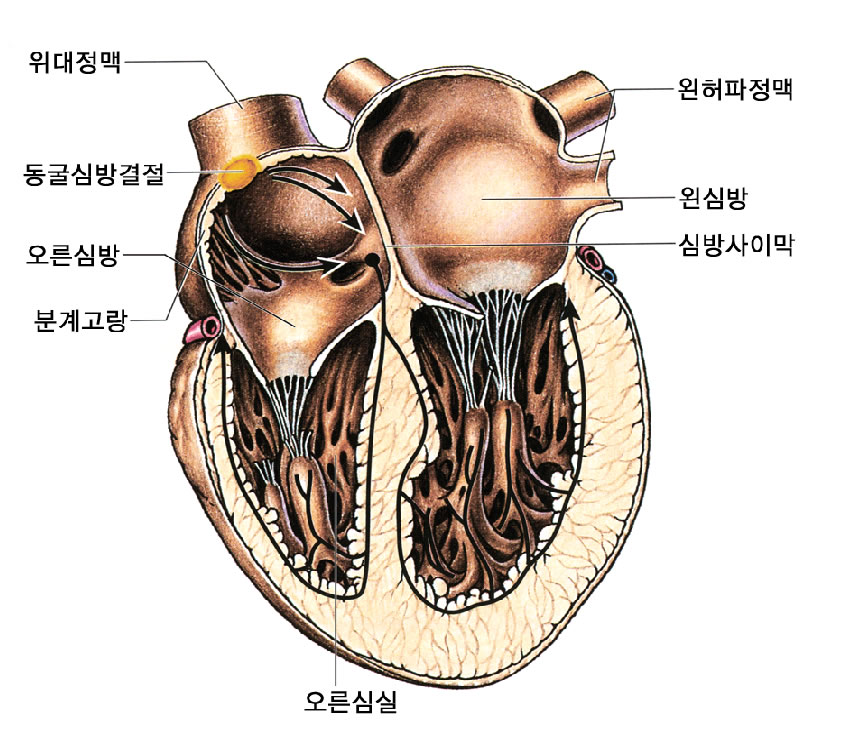 |
||
| 영문 | heart failure | 한글 | 심장기능상실 |
|---|---|---|---|
| 설명 | 몸의 조직이나 기관에서 대사에 필요한 만큼 충분한 양의 혈액을 공급할 수 없을 정도로 심장기능이 저하되어 있는 상태이다. 심장기능상실은 심근이 수축할 능력이 저하되었을 때나 심장에 심박출을 하기 위한 압력이 정상보다 증가되어 정상의 심장의 수축으로는 충분한 양의 혈액을 공급할 수 없는 경우, 그리고 심장근육, 심장에 걸리는 압력은 정상이나 심장박동의 이상에 의해서 정상적인 수축이 불가능할 경우에 생긴다. |
||
| 영문 | pacemaker(of heart) | 한글 | 심장박동기 |
|---|---|---|---|
| 설명 | 심장의 전기적 자극이 병적인 상태로 발생하지 않거나, 혹은 심실로 잘 전해지지 않을 때 사용한다. 일시적 심장박동기와 영구적 심장박동기가 있으며, 각기 쓰이는 용도는 병에 따라 다르다. 요즘에 나오는 심장 박동기는 건전지의 수명도 반영구적이며, 밖에서 조정할 수 있고, 운동이나 스트레스 상황에 대한 심장의 빠른 운동에도 잘 적응할 수 있도록 만들어져 있다. |
||
| 영문 | heart disease | 한글 | 심장병 |
|---|---|---|---|
| 설명 | 순환기 질환 중 심장의 병. 일반적으로 심장혈관이나 심장의 병도 포함된다. 병터의 부위에 의한 병리해부학적 분류와 병인에 의한 분류가 있다. 전자는 수 십 년 전부터 쓰여져 왔으나 근년에 와서 본질적인 원인요법이 가능하게 된 이후는 후자의 분류가 의의가 있어서 많이 쓰이게 되었다. 병터 부위로는 심내막(판막)-심장근-심장막, 그 밖의 것을 들 수 있으며, 각각 심내막염-심장판막증-심근염-심근경색-심장막염-선천성 심장병(심장기형) 등이포함된다. 병인별에서는 심장기형을 비롯하여 류마치스 심장병-매독성 심장병-고혈압성 심장병-심장동맥경화성 심장병-폐성심장-세균성 심내막염-심장신경증 등으로 나누어지며, 부정맥이나 방실차단 등의 자극전도계의 장애에 의한 것도 증세의 하나로 볼 수 있다. 심장병은 자각적으로는 무증세인 것에서부터 심장기능상실로 호흡곤란까지 있다. |
||
| 영문 | septal defects of heart | 한글 | 심장의 중격 결손 |
|---|---|---|---|
| 설명 | 선천적으로 심장 내의 심방사이중격(interatrial septum)이나 심실사이중격(interventricular septum)이 결손되어 혈류가 정상적으로 흐르지 않는 경우. 정상적인 경우 혈류는 정맥에서 우심방으로 모여 우심실을 거친뒤 폐로 가서 산소를 공급받고 다시 왼심방, 왼심실을 차례로 거쳐 대동맥으로 간다. 하지만, 이 경우는 혈류가 압력이 높은 왼심방이나 왼심실에서 압력이 낮은 우심방이나 우심실로 흐르게 된다. 따라서 동맥피와 정맥피가 섞이게 되고, 환자는 호흡곤란, 성장발육장애, 심잡음 등이 나타나고, 심한 경우 청색증으로 발전하기도 한다. 치료는 수술적으로 이 결손부위를 막아 주어야 한다. |
||
| ESWL | Extracorporeal Shock-Wave Lithotripsy - Ix for Gall Stone ... |
|---|---|
| EC | effective concentration; ejection click; electrochemical; electron capture; embryonal carcinoma; eme... |
| ECC | electrocorticogram, electrocorticography; electronic claim capture; embryonal cell carcinoma; emerge... |
| ECCO2R | extracorporeal carbon dioxide removal |
| ECI | electrocerebral inactivity; eosinophilic cytoplasmic inclusions; extracorporeal irradiation |
| atrium of heart | The upper chamber of each half of the heart. Synonym: atrium cordis, atrium. Left atrium of heart, atrium of the left side of the heart which receives the blood from the pulmonary veins. Synonym: atrium sinistrum cordis, atrium pulmonale. (05 Mar 2000) |
|---|---|
| backward heart failure | A concept (formerly considered mutually exclusive of forward heart failure) that maintains that the phenomena of congestive heart failure result from passive engorgement of the veins caused by a "backward" rise in pressure proximal to the failing cardiac chambers. Compare: forward heart failure. (05 Mar 2000) |
| baseline foetal heart rate | <paediatrics> The average heart rate for a particular foetus during the diastolic phase of uterine contractions. (05 Mar 2000) |
| baseline variability of foetal heart rate | The beat-to-beat changes in foetal heart rate as recorded on a graph. (05 Mar 2000) |
| base of heart | That part of the heart that lies opposite the apex, formed mainly by the left atrium but to a small extent by the posterior part of the right atrium; it is directed backward and to the right and is separated from the vertebral column by the oesophagus and aorta. Synonym: basis cordis. (05 Mar 2000) |
| beer heart | <cardiology, pathology> A weakness of the cardiac muscle which is seen in some chronic alcoholics, may be related to a thiamin deficiency or occur for unknown reasons. Origin: Gr. Pathos = disease (27 Sep 1997) |
| beriberi heart | Heart disease due to thiamine deficiency that may be epidemic or sporadic as characterised by cardiac metabolic damage and myocardial failure, often of the "high output" type, with oedema (except in "dry" beri) and polyneuritis. The term is derived from Singhalese, "I am unable." (05 Mar 2000) |
| biopsy, heart | <investigation, procedure, surgery> A procedure which involves the removal of a small specimen of cardiac muscle tissue for microscopic analysis. This is generally performed at the same time as a cardiac catheterisation or as a very similar, yet separate, procedure. A small piece of heart tissue is taken via a small forceps inserted into the cardiac catheter site (usually threaded through a vein in the neck). This test may reveal the cause of a cardiomyopathy, myocarditis, amyloidosis or a heart transplant rejection. (21 Mar 1998) |
| bony heart | The presence of extensive calcareous patches in the pericardium and walls of the heart, some of which chronically develop bony changes. (05 Mar 2000) |
| box-like heart | <radiology> Ebstein's anomaly, massive cardiomegaly, primarily RA enlargement (12 Dec 1998) |
| brain-heart infusion agar | A medium used for the isolation of fastidious microorganisms, especially fungi. (05 Mar 2000) |
| carcinoid heart disease | Cardiac manifestation of malignant carcinoid syndrome. It is a unique form of fibrosis involving the endocardium, primarily of the right heart. The fibrous deposits tend to cause constriction of the tricuspid and pulmonary valves. (12 Dec 1998) |
| machine, heart-lung | A machine that does the work both of the heart (pump blood) and the lungs (oxygenate the blood). Used, for example, in open heart surgery. Blood returning to the heart is diverted through the machine before returning it to the arterial circulation. Also called a pump-oxygenator. (12 Dec 1998) |
| valvular heart disease | A general term that applies to any abnormality of one of the heart valves, tricuspid, mitral, aortic or pulmonic valves. (27 Sep 1997) |
| rate, heart | Number of heart beats per minute. The normal resting adult heart beats regularly at an average rate of 60 times per minute. (young children's hearts beat faster). The speed of the heartbeat (heart rate) is governed by the speed of electrical signals from the pacemaker of the heart, the sa node, located in the right atrium (upper chamber of the heart). The electrical signals from the sa node travel across the atria and cause these two upper heart chambers to contract, delivering blood into the lower heart chambers, the ventricles. The electrical signals then pass through the av node to reach the ventricles. Electrical signals reaching the ventricles cause these chambers to contract, pumping blood to the rest of the body, generating the pulse. During rest, the speed of electrical signals originating from the sa node is slow, so the heart beats slowly. During exercise or excitement, the speed of signals from the sa node increases, and the heartbeat quickens. (12 Dec 1998) |