
| 영문 | rheumatic heart disease | 한글 | 류마티스심장병 |
|---|---|---|---|
| 설명 | 사슬알균감염 후 생기는 심장판막병이다. 원인은 A군 -용혈사슬알에 의한 인두염후 일종의 면역반응으로 발병한다. 진단은 존의 기준에 의한다. (1) 주요기준은 관절염 심장염(심장비대, 심장잡음, 심장기능상실 등) 무도증: 무당이 춤을 추는 것 같은 행동의 발작증세. 연변홍반: 빨간 테두리를 가진 피부병변은 피하결절(subcutaneous nodule): 피부 밑에 생긴 결절, (2)참고 기준은 열, 관절통, EKG상 PR연장: 심전도 소견 급성기 반응물질(예: ESR, CRP)의 상승, 류마티스열 치료는 페니실린으로 치료하고 심장의 후유증 또한 페니실린으로 예방한다. |
||
| 영문 | congenital heart disease | 한글 | 선천심장병 |
|---|---|---|---|
| 설명 | 선천적으로 심장의 구조에 이상이 있는 병. |
||
| 영문 | heart | 한글 | 심장 |
|---|---|---|---|
| 설명 | 심장은 가슴의 중앙에 위치하며 오른쪽과 왼쪽반으로 나눌 수 있다. 각각은 정맥에서 피가 들어오는 방과 동맥으로 피를 내보내는 실이 있다. 심장은 정중앙선에서 왼쪽에 놓여 있다. 심장의 2개의 심방과 2개의 심실, 그리고 심방사이의 심방중격, 심실사이의 심실중격이 존재한다. 심실은 혈액을 주로 순환시키는 힘을 내는 곳으로 강한 근육층이 존재를 한다. 반면에 심방은 심실에 들어가기전에 일시적으로 피가 모이는 곳으로 근육층의 발달이 미약하다. 심방과 심실사이에 삼첨판과 승모판, 심실의 유출로에 대동맥판과 폐동맥판이 있다. 이것들은 혈액이 흐르는 방향에 거슬러 진행하는 것을 막는 기능을 한다. 그리고 심장에는 심장의 근육에 혈액을 공급하는 관상동맥이 있다. 이 심장동맥은 심장을 쌓듯이 존재한다. 심장박동의 신호는 특수한 장치에 의해서 발생이 되고 특수한 전도계를 통해서 전체의 심장으로 전도된다. 심장박동의 신호는 우선 우심방에 위치하는 동방결절(SA node)라는 곳에서 우선 생긴다. 여기에서 보내는 전기적 신호가 바로 심장을 뛰게하는 신호인 것이다. 이 신호로 말미암아 심방이 우선 수축을 한다. 그리고는 심방과 심실사이에 위치하는 방실결절(AV node)라는 곳에 일정하게 정해진 통로없이 전체의 심방을 통해서 전달이 되고 이 신호를 받은 방실결절(AV node)는 히스 다발(His bundle)과 심장전도근육섬유를 통해서 심실의 심장근육에게 이 신호를 보내주어 심실근육을 수축하게 한다. 히스다발과 심장전도근육섬유는 전체의 심실의 심근섬유에 동시에 전기적 신호를 보내어 줄 수 있게 하는 일종의 전기줄과 같은 역할을 한다. 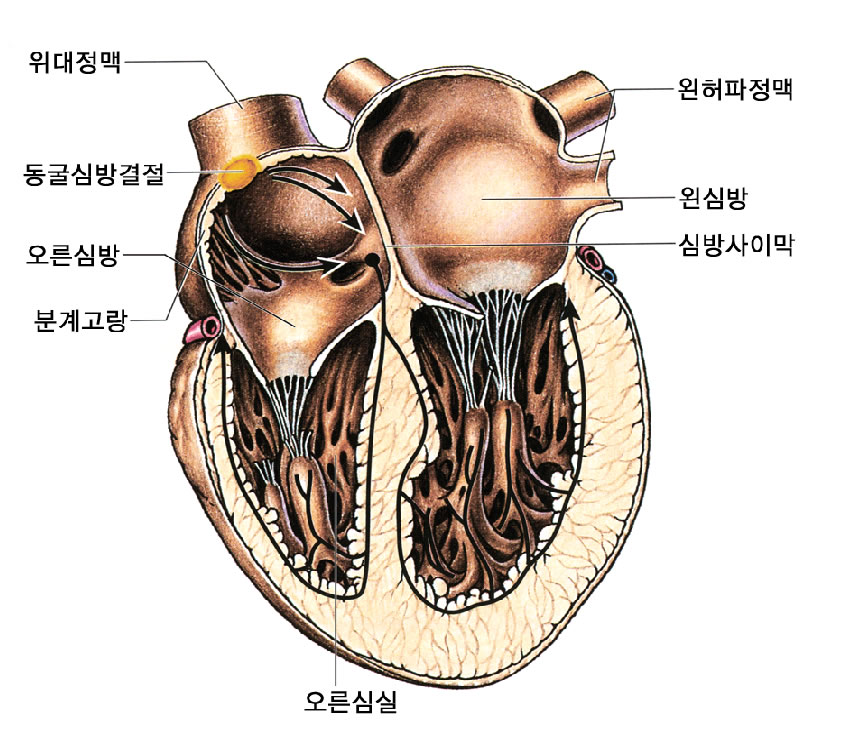 |
||
| 영문 | heart failure | 한글 | 심장기능상실 |
|---|---|---|---|
| 설명 | 몸의 조직이나 기관에서 대사에 필요한 만큼 충분한 양의 혈액을 공급할 수 없을 정도로 심장기능이 저하되어 있는 상태이다. 심장기능상실은 심근이 수축할 능력이 저하되었을 때나 심장에 심박출을 하기 위한 압력이 정상보다 증가되어 정상의 심장의 수축으로는 충분한 양의 혈액을 공급할 수 없는 경우, 그리고 심장근육, 심장에 걸리는 압력은 정상이나 심장박동의 이상에 의해서 정상적인 수축이 불가능할 경우에 생긴다. |
||
| 영문 | pacemaker(of heart) | 한글 | 심장박동기 |
|---|---|---|---|
| 설명 | 심장의 전기적 자극이 병적인 상태로 발생하지 않거나, 혹은 심실로 잘 전해지지 않을 때 사용한다. 일시적 심장박동기와 영구적 심장박동기가 있으며, 각기 쓰이는 용도는 병에 따라 다르다. 요즘에 나오는 심장 박동기는 건전지의 수명도 반영구적이며, 밖에서 조정할 수 있고, 운동이나 스트레스 상황에 대한 심장의 빠른 운동에도 잘 적응할 수 있도록 만들어져 있다. |
||
| EM | early memory; ejection murmur; electromagnetic; electron micrograph; electron microscopy, electron m... |
|---|---|
| ECG | Electro-Cardio-Graphy(-Gram); 심전도 = EKG 1. Conducting System Structu... |
| ESM | ejection systolic murmur; endoscopic specular microscope; ethosuximide |
| LSM | late systolic murmur; lymphocyte separation medium; lysergic acid morpholide |
| SEM | sample evaluation method; scanning electron microscopy; secondary enrichment medium; standard error ... |
| total end-systolic diameter | Cross sectional diameter of the left ventricle including the septum and posterior wall thicknesses in systole. (05 Mar 2000) |
|---|---|
| end-systolic volume | The amount of blood in the ventricle at the end of the cardiac ejection period and immediately preceding the beginning of ventricular relaxation; a measurement of the adequacy of cardiac emptying, related to systolic function. (05 Mar 2000) |
| adenovirus early proteins | <molecular biology, protein, virology> Proteins encoded by adenoviruses that are synthesised prior to, and in the absence of, viral DNA replication. The proteins are involved in both positive and negative regulation of expression in viral and cellular genes, and also affect the stability of viral mRNA. Some are also involved in oncogenic transformation. (12 Dec 1998) |
| genes, immediate-early | Genes that show rapid and transient expression in the absence of de novo protein synthesis. The term was originally used exclusively for viral genes where immediate-early referred to transcription immediately following virus integration into the host cell. It is also used to describe cellular genes which are expressed immediately after resting cells are stimulated by extracellular signals such as growth factors and neurotransmitters. (12 Dec 1998) |
| history of medicine, early modern | The period of the history of medicine from 1451 through 1600 a.d. History of medicine, 15th cent. And history of medicine, 16th cent. Are also available. (12 Dec 1998) |
| immediate early gene | Class of genes whose expression is low or undetectable in quiescent cells, but whose transcription is activated within minutes after extracellular stimulation such as addition of a growth factor. C fos and c myc proto-oncogenes were among the first IEG's to be identified. Many IEG's encode transcription factors and therefore have a regulatory function. (18 Nov 1997) |
| immediate-early proteins | Proteins that are coded by immediate-early genes, in the absence of de novo protein synthesis. The term was originally used exclusively for viral regulatory proteins that were synthesised just after viral integration into the host cell. It is also used to describe cellular proteins which are synthesised immediately after the resting cell is stimulated by extracellular signals. (12 Dec 1998) |
| early | 1. In advance of the usual or appointed time; in good season; prior in time; among or near the first; opposed to late; as, the early bird; an early spring; early fruit. "Early and provident fear is the mother of safety." (Burke) "The doorsteps and threshold with the early grass springing up about them." (Hawthorne) 2. Coming in the first part of a period of time, or among the first of successive acts, events, etc. "Seen in life's early morning sky." (Keble) "The forms of its earlier manhood." (Longfellow) "The earliest poem he composed was in his seventeenth summer." (J. C. <philosophy> Shairp) Early English See the Note under English. Early English architecture, the first of the pointed or Gothic styles used in England, succeeding the Norman style in the 12th and 13th centuries. Synonym: Forward, timely, not late, seasonable. Origin: OE. Earlich. See Early. Source: Websters Dictionary (01 Mar 1998) |
| early ambulation | Procedure characterised by a shorter period of hospitalization or recumbency or by more rapid mobilization than is normally practiced. (12 Dec 1998) |
| early deceleration | Slowing of the foetal heart rate early in the uterine contraction phase, denoting compression of the foetal head. (05 Mar 2000) |
| early development | An early stage in the life cycle of a bacteriophage (a virus which infects bacteria) that occurs after infection but before replication of the bacteriophage genome. (09 Oct 1997) |
| early gene | <genetics, molecular biology> Genes that are expressed soon after viral infection of a host cell. (18 Nov 1997) |
| early infantile autism | A severe emotional disturbance of childhood characterised by qualitative impairment in reciprocal social interaction and in communication, language, and social development. Synonym: autistic disorder, childhood schizophrenia, early infantile autism, Kanner's syndrome. (05 Mar 2000) |
| early labour | <obstetrics> The onset of uterine (labour) contractions after 32 weeks gestation but before 38 weeks gestation. (27 Sep 1997) |
| early latent syphilis | Infection with Treponema pallidum, the organism of syphilis, after the primary and secondary phases have subsided, during the first year after infection, before any manifestations of tertiary syphilis have appeared. (05 Mar 2000) |