
| 영문 | heart | 한글 | 심장 |
|---|---|---|---|
| 설명 | 심장은 가슴의 중앙에 위치하며 오른쪽과 왼쪽반으로 나눌 수 있다. 각각은 정맥에서 피가 들어오는 방과 동맥으로 피를 내보내는 실이 있다. 심장은 정중앙선에서 왼쪽에 놓여 있다. 심장의 2개의 심방과 2개의 심실, 그리고 심방사이의 심방중격, 심실사이의 심실중격이 존재한다. 심실은 혈액을 주로 순환시키는 힘을 내는 곳으로 강한 근육층이 존재를 한다. 반면에 심방은 심실에 들어가기전에 일시적으로 피가 모이는 곳으로 근육층의 발달이 미약하다. 심방과 심실사이에 삼첨판과 승모판, 심실의 유출로에 대동맥판과 폐동맥판이 있다. 이것들은 혈액이 흐르는 방향에 거슬러 진행하는 것을 막는 기능을 한다. 그리고 심장에는 심장의 근육에 혈액을 공급하는 관상동맥이 있다. 이 심장동맥은 심장을 쌓듯이 존재한다. 심장박동의 신호는 특수한 장치에 의해서 발생이 되고 특수한 전도계를 통해서 전체의 심장으로 전도된다. 심장박동의 신호는 우선 우심방에 위치하는 동방결절(SA node)라는 곳에서 우선 생긴다. 여기에서 보내는 전기적 신호가 바로 심장을 뛰게하는 신호인 것이다. 이 신호로 말미암아 심방이 우선 수축을 한다. 그리고는 심방과 심실사이에 위치하는 방실결절(AV node)라는 곳에 일정하게 정해진 통로없이 전체의 심방을 통해서 전달이 되고 이 신호를 받은 방실결절(AV node)는 히스 다발(His bundle)과 심장전도근육섬유를 통해서 심실의 심장근육에게 이 신호를 보내주어 심실근육을 수축하게 한다. 히스다발과 심장전도근육섬유는 전체의 심실의 심근섬유에 동시에 전기적 신호를 보내어 줄 수 있게 하는 일종의 전기줄과 같은 역할을 한다. 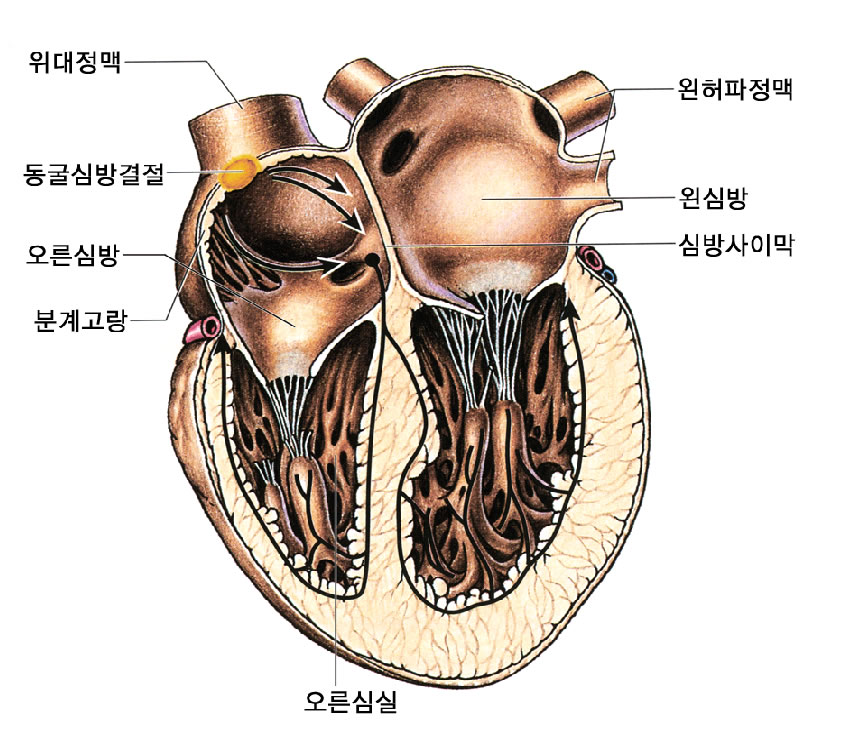 |
||
| 영문 | heart failure | 한글 | 심장기능상실 |
|---|---|---|---|
| 설명 | 몸의 조직이나 기관에서 대사에 필요한 만큼 충분한 양의 혈액을 공급할 수 없을 정도로 심장기능이 저하되어 있는 상태이다. 심장기능상실은 심근이 수축할 능력이 저하되었을 때나 심장에 심박출을 하기 위한 압력이 정상보다 증가되어 정상의 심장의 수축으로는 충분한 양의 혈액을 공급할 수 없는 경우, 그리고 심장근육, 심장에 걸리는 압력은 정상이나 심장박동의 이상에 의해서 정상적인 수축이 불가능할 경우에 생긴다. |
||
| 영문 | pacemaker(of heart) | 한글 | 심장박동기 |
|---|---|---|---|
| 설명 | 심장의 전기적 자극이 병적인 상태로 발생하지 않거나, 혹은 심실로 잘 전해지지 않을 때 사용한다. 일시적 심장박동기와 영구적 심장박동기가 있으며, 각기 쓰이는 용도는 병에 따라 다르다. 요즘에 나오는 심장 박동기는 건전지의 수명도 반영구적이며, 밖에서 조정할 수 있고, 운동이나 스트레스 상황에 대한 심장의 빠른 운동에도 잘 적응할 수 있도록 만들어져 있다. |
||
| 영문 | heart disease | 한글 | 심장병 |
|---|---|---|---|
| 설명 | 순환기 질환 중 심장의 병. 일반적으로 심장혈관이나 심장의 병도 포함된다. 병터의 부위에 의한 병리해부학적 분류와 병인에 의한 분류가 있다. 전자는 수 십 년 전부터 쓰여져 왔으나 근년에 와서 본질적인 원인요법이 가능하게 된 이후는 후자의 분류가 의의가 있어서 많이 쓰이게 되었다. 병터 부위로는 심내막(판막)-심장근-심장막, 그 밖의 것을 들 수 있으며, 각각 심내막염-심장판막증-심근염-심근경색-심장막염-선천성 심장병(심장기형) 등이포함된다. 병인별에서는 심장기형을 비롯하여 류마치스 심장병-매독성 심장병-고혈압성 심장병-심장동맥경화성 심장병-폐성심장-세균성 심내막염-심장신경증 등으로 나누어지며, 부정맥이나 방실차단 등의 자극전도계의 장애에 의한 것도 증세의 하나로 볼 수 있다. 심장병은 자각적으로는 무증세인 것에서부터 심장기능상실로 호흡곤란까지 있다. |
||
| 영문 | septal defects of heart | 한글 | 심장의 중격 결손 |
|---|---|---|---|
| 설명 | 선천적으로 심장 내의 심방사이중격(interatrial septum)이나 심실사이중격(interventricular septum)이 결손되어 혈류가 정상적으로 흐르지 않는 경우. 정상적인 경우 혈류는 정맥에서 우심방으로 모여 우심실을 거친뒤 폐로 가서 산소를 공급받고 다시 왼심방, 왼심실을 차례로 거쳐 대동맥으로 간다. 하지만, 이 경우는 혈류가 압력이 높은 왼심방이나 왼심실에서 압력이 낮은 우심방이나 우심실로 흐르게 된다. 따라서 동맥피와 정맥피가 섞이게 되고, 환자는 호흡곤란, 성장발육장애, 심잡음 등이 나타나고, 심한 경우 청색증으로 발전하기도 한다. 치료는 수술적으로 이 결손부위를 막아 주어야 한다. |
||
| HT | Hashimoto thyroiditis; hearing test; hearing threshold; heart; heart transplantation, heart transpla... |
|---|---|
| NYHA | New York Heart Association Heart Disease에 대한 Functional Classification &nbs... |
| AHA | acetohydroxamic acid; acquired hemolytic anemia; acute hemolytic anemia; American Heart Association;... |
| ASHD | arteriosclerotic heart disease; atrioseptal heart disease |
| CHB | chronic hepatitis B; complete heart block; congenital heart block |
| haemangiectatic hypertrophy | <syndrome> A congenital malformation syndrome characterised by the triad of asymmetric limb hypertrophy, haemangiomata, and nevi. Asymmetric limb hypertrophy is enlargement of one limb and not the corresponding limb on the other side, the enlarged limb being 3 times more likely to be a leg than an arm in ktw; and the limb enlargement is of bone as well as soft tissue. The haemangiomas, abnormal nests of blood vessels that proliferate inappropriately and excessively, cover a remarkable range from small innocuous capillary haemangiomas ( strawberry marks ) to huge cavernous haemangiomas. The nevi are pigmented moles on the skin; in ktw there are often also dark linear streaks on the skin, streaks due to too much pigment. There can be other abnormalities but the triad is the consistent clinical centrepiece of the disease. most persons with ktw have an enlarged leg and do relatively well without treatment or, for example, with only compression from an elastic stocking. Skin ulcers and other skin problems can occur over the swollen leg. Usually, the treatment is conservative. Surgery is almost never needed. The only possible exceptions are the very rare situations in which the leg reaches gigantic proportions or secondary clotting difficulties arise (due to trapping and destruction of blood platelets in a huge haemangioma). Then, amputation may become necessary. The cause of ktw syndrome is unknown. (12 Dec 1998) |
|---|---|
| simple hypertrophy | Increase in size of cells. (05 Mar 2000) |
| simulated hypertrophy | Increased size of a part due to continued growth unrestrained by attritions, as is seen in the case of the teeth of certain animals when the opposing teeth have been destroyed. (05 Mar 2000) |
| hypertrophy | The enlargement or overgrowth of an organ or part due to an increase in size of its constituent cells. Compare: hyperplasia. Origin: Gr. Troph = nutrition (18 Nov 1997) |
| hypertrophy, left ventricular | Enlargement of the left ventricle of the heart. This increase in ventricular mass is attributed to sustained abnormal pressure or volume loads and is a contributor to cardiovascular morbidity and mortality. (12 Dec 1998) |
| hypertrophy, right ventricular | Enlargement of the right ventricle of the heart. This increase in ventricular mass is often attributed to pulmonary hypertension and is a contributor to cardiovascular morbidity and mortality. (12 Dec 1998) |
| numerical hypertrophy | <pathology> The abnormal multiplication or increase in the number of normal cells in normal arrangement in a tissue. Compare: hypertrophy. Origin: Gr. Plasis = formation (18 Nov 1997) |
| quantitative hypertrophy | <pathology> The abnormal multiplication or increase in the number of normal cells in normal arrangement in a tissue. Compare: hypertrophy. Origin: Gr. Plasis = formation (18 Nov 1997) |
| eccentric hypertrophy | Thickening of the wall of the heart or other cavity, with dilation. (05 Mar 2000) |
| endemic hypertrophy | Enlargement of the calcaneus preceded by fever and pain in the heel, reported from the Gold Coast (now Ghana) and in Taiwan among the indigenous population. (05 Mar 2000) |
| true hypertrophy | An increase in size involving all the different tissues composing the part. (05 Mar 2000) |
| false hypertrophy | Increase in size of an organ or a part, due not to increase in size or number of the specific functional elements but to that of some other tissue, fatty or fibrous. Synonym: false hypertrophy. (05 Mar 2000) |
| left ventricular hypertrophy | <radiology> Coarctation, aortic stenosis (12 Dec 1998) |
| functional hypertrophy | Temporary increase in size of an organ or part to provide for a natural increase of function, such as the kind that occurs in the walls of the uterus and in the mammae during pregnancy. Synonym: functional hypertrophy. (05 Mar 2000) |
| lipomatous hypertrophy | Nonencapsulated adipose tissue forming a lipoma-like mass, usually in the cardiac interatrial septum where it may cause arrhythmia and sudden death. Synonym: lipomatous hypertrophy. (05 Mar 2000) |