¼±Åà - È­»ìǥŰ/¿£ÅÍŰ ´Ý±â - ESC

 
"cell organ"¿¡ ´ëÇÑ °Ë»ö °á°úÀÔ´Ï´Ù. °Ë»ö °á°ú º¸´Â µµÁß¿¡ Tab ۸¦ ´©¸£½Ã¸é °Ë»ö âÀÌ ¼±Åõ˴ϴÙ.
¾Ë±â½¬¿î ÀÇÇпë¾îÇ®ÀÌÁý, ¼­¿ïÀÇ´ë ±³¼ö ÁöÁ¦±Ù, °í·ÁÀÇÇÐ ÃâÆÇ À¯»ç °Ë»ö °á°ú : 5 ÆäÀÌÁö: 2
¿µ¹® mast cell ÇÑ±Û ºñ¸¸ ¼¼Æ÷
¼³¸í   
  µ¿¹°ÀÇ °áÇÕ Á¶Á÷ °¡¿îµ¥ ³Î¸® ºÐÆ÷Çϴ ¼¼Æ÷. °áÇÕÁ¶Á÷°ú Á¡¸·Á¶Á÷ ³»¿¡ Àִ ȣ¿°±â¼º »ö¼Ò·Î ÀÌ¿°»ö¼º(metachromasia)À» ³ªÅ¸³»´Â °ú¸³À» °¡Áø ¹æÃßÇüÀÇ ¼¼Æ÷¿¡ ÀÛÀº µÕ±Ù ÇÙÀ» °¡Áø´Ù. ºñ¸¸¼¼Æ÷ÀǠǥ¸é¿¡´Â IgE¿¡ ´ëÇÑ ¼ö¿ëü°¡ Á¸ÀçÇϸç, ¼ö¿ëü¿¡ °áÇÕÇÑ IgE ºÐÀڵ鳢¸® ´Ù°¡ÀÇ Ç׿ø¿¡ ÀÇÇØ ¼­·Î ¿¬°áµÇ¸é ºñ¸¸¼¼Æ÷ °ú¸³Å»Ãâ ¹ÝÀÀÀÌ ÀϾ, È÷½ºÅ¸¹Î, ¼¼·ÎÅä´Ñ, ÇìÆÄ¸° µîÀÇ È­ÇÐÀü´Þ ¹°ÁúÀÌ ¹æÃâµÇ¾î, Áï½ÃÇü ¾Ë·¹¸£±â ¹ÝÀÀ µîÀÇ Áõ»óÀ» ÀÏÀ¸Å²´Ù. ÇǺÎ, À帷, Ç÷°ü ÁÖÀ§, Á¡¸· ÁÖº¯¿¡ ÀÖ´Ù.
¿µ¹® cell ÇÑ±Û ¼¼Æ÷
¼³¸í   
  »ý¸íü¸¦ ÀÌ·ç´Â ±¸Á¶Àû, ±â´ÉÀû ´ÜÀ§.
  
  ÇÙÀÇ À¯¹«¿¡ µû¶ó¼­ À¯ÇÙ¼¼Æ÷¿Í ¹«ÇÙ¼¼Æ÷·Î ³ª´­ ¼ö°¡ ÀÖ´Ù. ¹«ÇÙ¼¼Æ÷¶õ ÇÙÀÌ ¾ø´Â ¼¼Æ÷¸¦ ¸»ÇÑ´Ù. ÇÙÀ̶õ À¯ÀüÁ¤º¸¸¦ °¡Áö°í Àִ ¿°»öü¸¦ º¸°üÇϴ °÷Àε¥ ¹«ÇÙ¼¼Æ÷¿¡¼­´Â ¿°»öü°¡ ¼¼Æ÷¼Ó¿¡ ±×³É ³ëÃâµÇ¾î ÀÖ´Ù. ´ë°³ ¼¼Æ÷ ÇϳªÇϳª°¡ µ¶¸³µÈ »ý¸íüÀÇ ¿ªÇÒÀ» Çϴ ´Ü¼¼Æ÷»ý¹°·Î¼­ ¿ÜºÎȯ°æÀ¸·ÎºÎÅÍ ÀÚ½ÅÀ» º¸È£ÇÒ ¼ö Àִ °ß°íÇÑ ¼¼Æ÷º®À» °¡Áö°í ÀÖ´Ù. À¯ÇÙ¼¼Æ÷¶õ ÇÙÀ» °¡Áö°í À־ À¯ÀüÁ¤º¸°¡ Àִ ¿°»öü°¡ ¼¼Æ÷ÀÇ ´Ù¸¥ ºÎºÐ°ú ±¸ºÐµÇ¾î ÇÙ¼Ó¿¡ µé¾îÀÖ´Ù. ¼¼Æ÷¼Ó¿¡¼­ ÇÙ¿ÜÀÇ ºÎºÐ(À̸¦ ¼¼Æ÷ÁúÀ̶ó ÇÑ´Ù)¿¡´Â ¿©·¯ °¡Áö ¼¼Æ÷ÀÇ ¼Ò±â°üÀÌ À־ ¼¼Æ÷ÀÇ ´Ù¾çÇÑ ±â´ÉÀ» ºÐ´ãÇÑ´Ù.
  
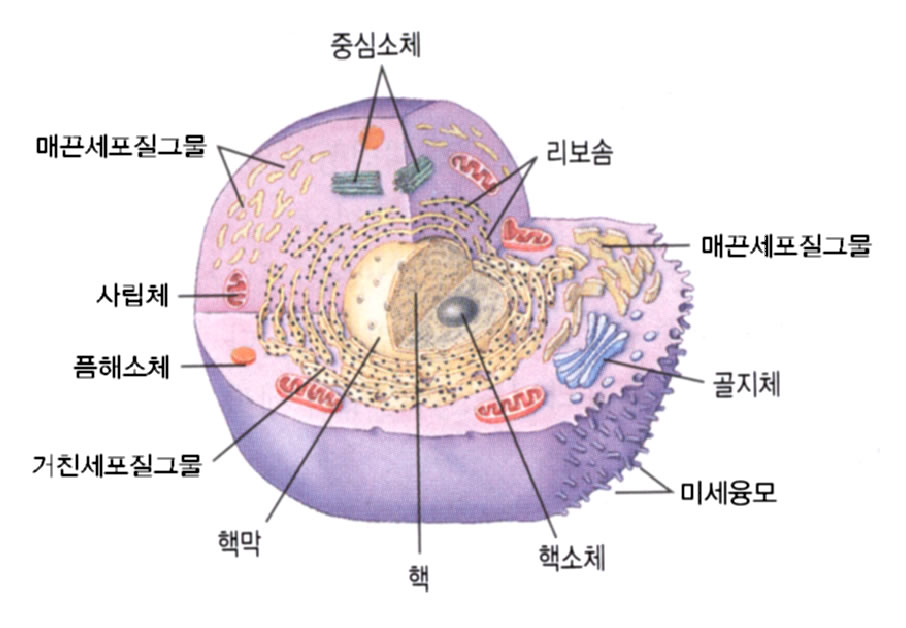
  ¢ÂÀ¯ÇÙ¼¼Æ÷ÀÇ ±âº» ±¸Á¶
  
  1.¼¼Æ÷¸·-¼¼Æ÷¸¦ µÑ·¯½Î¼­ ÁÖÀ§È¯°æ°ú ºÐ¸®ÇÏ¿© ¼¼Æ÷ÀÇ ³»È¯°æÀ» À¯ÁöÇÑ´Ù.
  
  2.ÇüÁú³»¼¼¸Á(endoplasmic reticulum)-´ÜÀ§¸·À¸·Î µÑ·¯½×¿© Àִ ºÒ±ÔÄ¢ÇÑ ¸Á»ó±¸Á¶ÀÌ´Ù. ÀÌ ¸Á»ó±¸Á¶ÀÇ ³»ºÎ¸¦ ¼Ò°­, ¼ÒÁ¶¶ó°í ºÎ¸¥´Ù. ¿©±â¿¡´Â Ç¥¸éÀÌ ¸Å²öÇÑ ¹«°ú¸³ÇüÁú³»¼¼¸Á°ú Ç¥¸éÀÌ ºÒ±ÔÄ¢ÇÑ °ú¸³ÇüÁú³»¼¼¸ÁÀÇ µÎ °¡Áö°¡ ÀÖ´Ù. °ú¸³ÇüÁú³»¼¼¸ÁÀÇ °æ¿ì´Â Ç¥¸é¿¡ ´Ü¹éÁúÀ» ÇÕ¼ºÇϴ ¸®º¸¼ØÀ̶ó´Â °ÍÀÌ ºÎÂøµÇ¾î ÀÖ´Ù. À̰÷Àº ÁַΠ¼¼Æ÷¹ÛÀ¸·Î ºÐºñÇÒ ´Ü¹éÁúÀ» ÇÕ¼ºÇϴ Àå¼ÒÀÌ´Ù. ¹«°ú¸³ÇüÁú³»¼¼¸ÁÀº Ç¥¸é¿¡ ¸®º¸¼ØÀÌ ºÎÂøµÇ¾î ÀÖÁö ¾ÊÀº °ÍÀ» ¸»Çϸç, À̰÷¿¡¼­´Â ÁÖ·Î ÇØµ¶ÀÛ¿ë, ±Û¸®ÄÚ°ÕÀÇ ÇÕ¼º, ½ºÅ×·ÎÀ̵åÈ£¸£¸óÀÇ ÇÕ¼º µîÀÌ ÀϾ´Ù.
  
  3.¸®º¸¼Ø-´Ü¹éÁúÀ» ÇÕ¼ºÇϴ ¿ªÇÒÀ» Çϴ °÷ÀÌ´Ù.À̰ÍÀº ¼¼Æ÷Áú¿¡ Á¸ÀçÇϴ ÀÚÀ¯¸®º¸¼Ø°ú °ú¸³ÇüÁú³»¼¼¸Á¿¡ ºÎÂøÀÌ µÇ¾î Á¸ÀçÇϴ ºÎÂø¸®º¸¼ØÀÇ µÎ °¡Áö·Î ³ª´«´Ù. ÀÚÀ¯¸®º¸¼ØÀº ÁַΠ¼¼Æ÷³»¿¡¼­ ÇÊ¿äÇÑ ´Ü¹éÁúÀ» ¸¸µå´Â ¿ªÇÒÀ» Ç졒ʼÎÂø¸®º¸¼ØÀº ¼¼Æ÷¹ÛÀ¸·Î ºÐºñÇÒ ´Ü¹éÁúÀ» ¸¸µå´Â ¿ªÇÒÀ» ÇÑ´Ù.
  
  4.°ñÁöÀåÄ¡(Golgi apparatus)-ÇÙÁÖÀ§¿¡ ºÐÆ÷Çϴ ³³ÀÛÇØÁø ÁָӴϸð¾çÀÇ °ÍÀÌ ÁßøµÇ¾î Çü¼ºµÈ ÃþÆÇ ¸ð¾çÀÇ ±¸Á¶¹°·Î °ú¸³ÇüÁú³»¼¼¸Á¿¡¼­ »ý¼ºµÇ¾î ¿ÜºÎ·Î ºÐºñµÉ ´Ü¹éÁúÀ» ¸ð¾Æ¼­ ³óÃà, Æ÷ÀåÇÏ¿© °ú¸³À» ¸¸µå´Â ¿ªÇÒÀ» ÇÑ´Ù.
  
  5.»ç¸³Ã¼(mitochondria)-±¸Çü, ³­ÇüÀÇ ±ä ¸·´ë±â ¸ð¾çÀ¸·Î Å©±â°¡ ´Ù¾çÇÑ ±¸Á¶¹°. »ý¹°Ã¼ÀÇ ¿¡³ÊÁö ÀúÀå¹°ÁúÀΠATP¸¦ »ý»êÇϴ ¿ªÇÒÀ» ÇÑ´Ù. ¶Ç ¼¼Æ÷¿Í ´Ù¸¥ ÀڽŸ¸ÀÇ À¯ÀüÁ¤º¸¸¦ °¡Áø DNA, RNA¸¦ °¡Áö°í ÀÖ´Ù. ¸ð¾ç, Å©±â°¡ ¼¼±Õ°ú ºñ½ÁÇϸç ÀÚüÁõ½Ä¼º µî µ¶¸³µÈ »ý¸íü·Î¼­ ÇÊ¿äÇÑ ¿ä°ÇÀ» °®Ãß°í À־ ¼¼Æ÷¿Í °ø»ý°ü°è¸¦ °¡Áø µ¶¸³µÈ ¼¼Æ÷·Î »ý°¢Çϰí ÀÖ´Ù.
  
  6.¿ëÇØ¼Òü(lysosome)-ÀÛÀº ±¸ÇüÀÇ ¼Òü·Î ¿©·¯ °¡Áö ºÐÇØÈ¿¼Ò¸¦ °¡Áø´Ù. ¼¼Æ÷¿Ü°è¿¡¼­ µé¾î¿Â ¹°Áú°ú °áÇÕÇÏ¿© ±× ¹°ÁúµéÀ» ¿ëÇØÇϴ ¿ªÇÒÀ» Çϰí, ¿À·¡µÈ ¼¼Æ÷¼Ò±â°üµéÀ» Á¦°ÅÇϴ ¿ªÇÒµµ ÇÑ´Ù.
  
  7.¼¼Æ÷ÇÙ(nucleus)-±¸Çü, ³­ÇüÀ¸·Î ¼¼Æ÷ÀÇ Á߽ɿ¡ À§Ä¡ÇÑ´Ù. ÇÙ³»¿¡´Â À¯ÀüÁ¤º¸°¡ Àִ ¹°ÁúÀΠ¿°»öü°¡ Á¸ÀçÇÑ´Ù.
  
  8.Á߽ɼÒü(centrosome)-ÇÙÁÖÀ§¿¡ Á¸ÀçÇϸ鼭 ÇÙÀÇ ºÐ¿­½Ã¿¡ ¾çÂÊÀÇ ¿°»öü¸¦ ´ç±â´Â ÀÛÀº ¼¶À¯¸¦ ¸¸µå´Â ¿ªÇÒÀ» Çϴ °÷.
  
  ¼¼Æ÷
¿µ¹® cell-mediated immunity ÇÑ±Û ¼¼Æ÷¸Å°³¸é¿ª
¼³¸í   
  ¸é¿ªÀ̶õ ½Åü¸¦ ¿ÜºÎÀÇ ¹°Áú·ÎºÎÅÍ º¸È£Çϴ ÇàÀ§¸¦ ¸»ÇÑ´Ù. ¿©±â¿¡´Â Æ¯ÀÌÀû ¸é¿ª°ú ºñƯÀÌÀû ¸é¿ªÀÇ µÎ °¡Áö°¡ ÀÖ´Ù.
  
  ºñƯÀÌÀû ¸é¿ªÀ̶óÇÔÀº Æ¯Á¤ÇÑ ¹°Áú¿¡ °ü°èÇϴ ¸é¿ªÀÌ ¾Æ´Ï¶ó Æ¯Á¤ ´ë»óÀÌ ¾øÀÌ ¸ðµç ¿ÜºÎ ¹°Ã¼¿¡ ÀÛ¿ëÇÒ ¼ö Àִ ¸é¿ªÀ» ¸»ÇÑ´Ù. ¿©±â¿¡´Â ¼Òº¯ÀÇ È帧, ´«¹°ÀÇ È帧, ÇǺÎÀÇ ºñÅõ°ú¼º µîÀÇ ±â°èÀûÀΠ°Íµµ Æ÷ÇԵǰí ÇǼӿ¡ µ¹¾Æ´Ù´Ï´Â ¼¼Æ÷ Áß¿¡¼­ ºñƯÀÌÀûÀ¸·Î ¿ÜºÎÀÇ ¹°ÁúÀ» Æ÷½ÄÇϴ ¼¼Æ÷µé(¿¹¸¦ µé¸é Å«Æ÷½Ä¼¼Æ÷(macrophage)ÀǠȰµ¿µµ Æ÷ÇÔÀÌ µÈ´Ù. ¼¼Æ÷¸Å°³¸é¿ªÀ̶õ Æ¯ÀÌÇÑ ¹°ÁúÀ» °¨ÁöÇÒ ¼ö Àִ ¼¼Æ÷¸¦ »ý¼ºÇϰԠÇÏ¿© ±×°ÍÀ¸·Î ÇÏ¿©±Ý ±× ¹°ÁúÀ» Æ÷½ÄÇϰԠÇϴ °ÍÀ» ¸»ÇÑ´Ù.
¿µ¹® nerve cell ÇÑ±Û ½Å°æ¼¼Æ÷
¼³¸í   
  ½Å°æ¼¼Æ÷´Â ¿Ã¹Ù¸¥ ½Å°æÀü´ÞÀ» À§ÇÑ °¢ ºÎºÐº°·Î ³ª´µ¾îÁ® ÀÖ´Ù. ½Å°æ¼¼Æ÷¿¡¼­´Â ÀüÇØÁ®¿À´Â ÀÚ±ØÀ» Àü±âÀûÀΠ½ÅÈ£·Î ¹Ù²î¾î º¸³»°Å³ª ¹Þ°Ô µÈ´Ù. ÀÌ·± Àü±âÀûÀΠÇö»óÀº °¢ ½Å°æ¼¼Æ÷³»¿¡ Á¸ÀçÇϴ °¢ ÀÌ¿Âä³Î(ion channel: ionÀ̶õ ³ªÆ®·ý, Ä®·ý µîÀ» ÁöĪÇϴ ¸»µé·Î½á, À̵éÀÌ ¼¼Æ÷¸·¿¡ ÀÇÇØ ³ª´µ¾îÁú ¶§ »ý±â´Â Àü¾ÐÂ÷°¡ Àü±âÀû ÀÚ±ØÀ» ÀÏÀ¸Å°°í À¯ÁöÇϴµ¥ °áÁ¤ÀûÀΠ¿ªÇÒÀ» ÇÑ´Ù)µéÀÇ ÀÛ¿ë¿¡ ÀÇÇØ ÀÌ·ç¾îÁö°Ô µÈ´Ù.
¿µ¹® glia cell ÇÑ±Û ¾Æ±³¼¼Æ÷
¼³¸í   
  ½Å°æ¼¼Æ÷ »çÀÌ¿¡¼­ ±×¹°±¸Á¶¸¦ ÀÌ·ç¸ç À̸¦ ÁöÁöÇϴ Á¶Á÷. ½Å°æ¾Æ±³¼¼Æ÷´Â ½Å°æ¸ð¼¼Æ÷¿Í °¥¶óÁø ¾Æ±³¸ð¼¼Æ÷°¡ ´Ù½Ã ¿©·¯ ÇüÅ·ΠºÐÈ­-¼ºÀåÇÑ °ÍÀÌ´Ù. ³ú½ÇÀ̳ª Ã´¼öÁ߽ɰüÀÇ º®À» µ¤°í ¿øÁÖ»ó ¶Ç´Â ÀÔ¹æÇüÀ̸ç, Ãʱ⿡´Â À¯¸®¸é¿¡ ¼¶¸ð°¡ ÀÖ´Ù. ´ëÇü¼¼Æ÷´Â º°³ú½Ç¸·¼¼Æ÷´Â ¾Æ±³¼¼Æ÷¶ó°í Çϸç, ½Å°æ¼¼Æ÷³ª ½Å°æ¼¶À¯ »çÀÌ¿¡ »êÀçÇÑ´Ù. ±× ¿Ü¿¡ Èñ¼Òµ¹±â¾Æ±³¼¼Æ÷µµ Æ÷ÇԵȴÙ.
´ëÇÑÀÇÇù ÀÇÇпë¾î »çÀü °Ë»ö À¯»ç °Ë»ö °á°ú : 15 ÆäÀÌÁö: 2
  • ¿µ¹®
    ÇѱÛ
  • female genital organ
    ¿©¼º»ý½Ä±â°ü
  • genital organ
    »ý½Ä±â°ü
  • Golgi tendon organ
    °ñÁöÈûÁÙ±â°ü
  • gustatory organ
    ¹Ì°¢±â°ü
  • hemopoietic organ
    Á¶Ç÷±â°ü, Ç÷±¸Çü¼º±â°ü
  • holdfast organ
    ÈíÂø±â°ü
  • insectivorous organ
    ½ÄÃæ±â°ü
  • leukopoietic organ
    ¹éÇ÷±¸Çü¼º±â°ü
  • male genital organ
    ³²¼º»ý½Ä±â°ü
  • motor end organ
    ¿îµ¿Á¾¸»±â°ü
  • nerve ending organ
    ½Å°æÁ¾¸»±â°ü
  • olfactory organ
    Èİ¢±â°ü
  • organ
    1. ±â°ü 2. Àå±â
  • organ culture
    Àå±â¹è¾ç
  • organ donor
    Àå±âÁ¦°øÀÚ
´ëÇÑÀÇÇù Çʼö ÀÇÇпë¾îÁý »çÀü °Ë»ö À¯»ç °Ë»ö °á°ú : 15 ÆäÀÌÁö: 2
  • ¿µ¹®
    ÇѱÛ
  • vestibular organ
    ¾È¶ã±â°ü, ÀüÁ¤±â°ü
  • vestigial organ
    ÈçÀû±â°ü
  • pelvic organ prolapse
    °ñ¹ÝÀå±âÅ»Ãâ(Áõ)
  • organ specificity
    ±â°üƯÀ̼º, Àå±âƯÀ̼º
  • organ transplantation
    Àå±âÀ̽Ä(¼ú)
  • sickle cell anemia
    ³´ÀûÇ÷±¸ºóÇ÷
  • cell
    ¼¼Æ÷
  • accessory cell
    º¸Á¶¼¼Æ÷, µ¡¼¼Æ÷
  • acinar cell
    »ù²Ê¸®¼¼Æ÷
  • amacrine cell
    ¹«Ãà»è¼¼Æ÷
  • balloon cell
    dz¼±¼¼Æ÷
  • basal cell
    ¹Ù´Ú¼¼Æ÷, ±âÀú¼¼Æ÷
  • basal cell carcinoma
    ¹Ù´Ú¼¼Æ÷¾ÏÁ¾, ±âÀú¼¼Æ÷¾ÏÁ¾
  • basket cell
    ¹Ù±¸´Ï¼¼Æ÷
  • basophilic cell
    È£¿°±â¼¼Æ÷
¿¾ ´ëÇÑÀÇÇù ÀÇÇпë¾î »çÀü °Ë»ö À¯»ç °Ë»ö °á°ú : 15 ÆäÀÌÁö: 2
  • ¿µ¹®
    ÇѱÛ
  • excretory organ
    ¹è¼³±â°ü
  • external genital organ
    ¹Ù±ù»ý½Ä±â°ü
  • extraperitoneal organ
    º¹¸·¹Ù±ù±â°ü, ¹è¸·¹Ù±ù±â°ü
  • female genital organ
    ¿©¼º»ý½Ä±â°ü
  • genital organ
    »ý½Ä±â°ü
  • Golgi tendon organ
    °ñÁöÈûÁÙ±â°ü
  • gustatory organ
    ¹Ì°¢±â°ü
  • hemopoietic organ
    Ç÷¾×Çü¼º±â°ü, Á¶Ç÷±â°ü
  • holdfast organ
    ÈíÂø±â°ü
  • hollow organ
    ¼ÓºóÀå±â
  • insectivorous organ
    ½ÄÃæ±â°ü
  • leukopoietic organ
    ¹éÇ÷±¸»ý¼º±â°ü
  • male genital organ
    ³²¼º»ý½Ä±â°ü
  • mechanical organ
    ÀΰøÀå±â
  • motor end organ
    ¿îµ¿Á¾¸»±â°ü
¿¾ ´ëÇÑÀÇÇù 2 ÀÇÇпë¾î »çÀü °Ë»ö À¯»ç °Ë»ö °á°ú : 15 ÆäÀÌÁö: 2
  • ¿µ¹®
    ÇѱÛ
  • hearing organ
    û°¢±â°ü(ôéÊÆÐïί).
  • hearing organ
    û°¢±â°ü
  • hemopoietic organ
    Ç÷__ü¼º±â°__ Á¶Ç÷±â°ü.
  • hemopoietic organ
    Ç÷±¸Çü¼º±â°ü, Á¶Ç÷±â°ü.
  • hollow organ
    ¼ÓºóÀå±â, Áß°ø±â°ü(ñéÍöÐïί), Áß°øÀå±â(ñéÍöíôÐï).
  • phonatory organ
    ¹ß¼º±â(Û¡á¢Ðï).
  • phonatory organ
    ¹ß¼º±â
  • receptor organ
    ¼ö¿ë±â°ü(áôé»Ðïί).
  • NK cell [=natural killer cell]
    ÀÚ¿¬»ì»ó¼¼Æ÷
  • alpha cell glucagon cell
    ¾ËÆÄ¼¼Æ÷ ±Û·çÄ«°ï¼¼Æ÷
  • quiescent cell, Q cell
    Á¤Áö¼¼Æ÷
  • A cell
    A ¼¼Æ÷
  • B cell
    B¼¼Æ÷(~ á¬øà)
  • B cell
    B ¼¼Æ÷
  • B cell
    B ¼¼Æ÷.
¿¾ ´ëÇÑÀÇÇù 3 ÀÇÇпë¾î »çÀü °Ë»ö À¯»ç °Ë»ö °á°ú : 15 ÆäÀÌÁö: 2
  • ¿µ¹®
    ÇѱÛ
  • central lymphoid organ
    ÁßÃ߸²ÇÁ±â°ü
  • chordotonal organ
    ÇöÀ½±â°ü
  • chordotonal organ
    ÇöÀ½±â°ü(ú×ëåÐïί)
  • circumventricular organ
    ³ú½ÇÁÖÀ§ ±â°ü(Òàãøñ²êÌÐïί)
  • critical organ
    Ç¥ÀûÀå±â, À§ÇØÀå±â
  • critical organ
    °áÁ¤Àå±â, ¹æ»ç¼±·®À» °áÁ¤Çϴµ¥ ¿µÇâ
  • culture, organ
    Àå±â¹è¾ç
  • death, organ
    Àå±â»ç¸Á
  • defect of urogenital organ
    ºñ´¢»ý½Ä±â°ü°áÇÔ
  • digestive organ
    ¼ÒÈ­±â°ü.
  • effector organ
    È¿°ú±â(üùÍýÐï)
  • effector organ
    È¿°ú±â°ü.
  • embryonic organ
    ¹è¾Æ±â°ü(ÛÏä´Ðïη).
  • enamel organ
    ¹ý³¶±â(¡­Ðï).
  • enamel organ
    »ç±âÁú±â°ü
´ëÇÑÇØºÎÇÐȸ ÀÇÇпë¾î »çÀü °Ë»ö À¯»ç °Ë»ö °á°ú : 15 ÆäÀÌÁö: 2
  • ¿µ¹®
    ÇѱÛ
  • Enamel organ
    »ç±âÁú±â°ü
    [¿¾ ¿ë¾î] ¿¡³ª¸á±â
  • Enamel organ
    »ç±âÁú±â°ü
    [¿¾ ¿ë¾î] ¿¡³ª¸á±â°ü
  • VISUAL ORGAN
    ½Ã°¢±â°ü
    [¿¾ ¿ë¾î] ½Ã°¢±â
  • Neurotendinal spindle [Golgi tendon organ]
    ½Å°æÈûÁÙ¹æÃß
    [¿¾ ¿ë¾î] ½Å°æ°Ç¹æÃß
  • EXTERNAL GENITAL ORGAN OF FEMALE
    ¿©¼º¹Ù±ù»ý½Ä±â°ü
    [¿¾ ¿ë¾î] ¿©¼º¿Ü»ý½Ä±â
  • Total organ duplication (Double ureter)
    Àüü±â°üÁߺ¹ (°ã¿ä°ü)
    [¿¾ ¿ë¾î] Àüü±â°üÁߺ¹ (°ã¿ä°ü)
  • VESTIBULOCOCHLEAR ORGAN
    ÆòÇüû°¢±â°ü
    [¿¾ ¿ë¾î] ÆòÇüû°¢±â
  • OLFACTORY ORGAN
    Èİ¢±â°ü
    [¿¾ ¿ë¾î] Èİ¢±â
  • Chief cell [Type I glomus cell]
    °ú¸³¼¼Æ÷
    [¿¾ ¿ë¾î] ÁÖ¼¼Æ÷(Á¦1Çü»ç±¸¼¼Æ÷)
  • Clear cell [Epinephrine cell]
    ¹àÀº¼¼Æ÷ [¿¡Çdz×ÇÁ¸°¼¼Æ÷]
    [¿¾ ¿ë¾î] ¸í¼¼Æ÷(¿¡Çdz×ÇÁ¸°ºÐºñ¼¼Æ÷)
  • Sustentacular cell [Sertoli cell]
    ¹öÆÀ¼¼Æ÷
    [¿¾ ¿ë¾î] ÁöÁÖ¼¼Æ÷
  • Beta cell [Insulin cell]
    º£Å¸¼¼Æ÷ [Àν´¸°¼¼Æ÷]
    [¿¾ ¿ë¾î] º£Å¸¼¼Æ÷
  • Secretory epithelial cell [Glandular cell]
    ºÐºñ»óÇǼ¼Æ÷ [»ù¼¼Æ÷]
    [¿¾ ¿ë¾î] ºÐºñ»óÇǼ¼Æ÷
  • Interstitial cell [Dark cell]
    »çÀÌÁú¼¼Æ÷
    [¿¾ ¿ë¾î] °£Áú¼¼Æ÷
  • Interstitial cell [Leydig`s cell]
    »çÀÌÁú¼¼Æ÷
    [¿¾ ¿ë¾î] °£Áú¼¼Æ÷
´ëÇÑ»ýÈ­ÇкÐÀÚ»ý¹°ÇÐȸ ¿ë¾î »çÀü °Ë»ö À¯»ç °Ë»ö °á°ú : 15 ÆäÀÌÁö: 2
  • ¿µ¹®
    ÇѱÛ
  • cell cloning
    ¼¼Æ÷(á¬øà) Ŭ·Î´×
  • cell coat
    ¼¼Æ÷(á¬øà)²®Áú
  • cell cycle
    ¼¼Æ÷ÁÖ±â(á¬øàñÎÑ¢)
  • cell differentiation
    ¼¼Æ÷ºÐÈ­(á¬øàÝÂûù)
  • cell envelope
    ¼¼Æ÷(á¬øà)½Î°³
  • cell factor
    ¼¼Æ÷ÀÎÀÚ(á¬øàì×í­)
  • cell fractionation
    ¼¼Æ÷ºÐȹȭ(á¬øàÝÂüñûù)
  • cell-free amino acid incorporating system
    ¹«¼¼Æ÷(Ùíá¬øà) ¾Æ¹Ì³ë»ê ÆíÀÔ(øºìý)¾¾½ºÅÛ
  • cell-free extract
    ¹«¼¼Æ÷ÃßÃâ¹°(Ùíá¬øàõÎõóÚª)
  • cell-free protein synthesis
    ¹«¼¼Æ÷´Ü¹éÁúÇÕ¼º(Ùíá¬øàÓ±ÛÜòõùêà÷)
  • cell-free system
    ¹«¼¼Æ÷(Ùíá¬øà)½Ã½ºÅÛ
  • cell fusion
    ¼¼Æ÷À¶ÇÕ(á¬øàë×ùê)
  • cell hybridization
    ¼¼Æ÷(á¬øà) Æ¢±âÇü¼º(û¡à÷)
  • cell line
    ¼¼Æ÷ÁÖ(á¬øàñ»)
  • cell-mediated immunity
    ¼¼Æ÷¸Å°³¸é¿ª(á¬øàØÚË¿Øóæ¹)
KI ÀÇÇпë¾î »çÀü °Ë»ö À¯»ç °Ë»ö °á°ú : 15 ÆäÀÌÁö: 2
  • ¿µ¹®
    ÇѱÛ
  • sensory organ
    °¨°¢(Áö°¢)±â
  • sexual organ
    »ý½Ä±â(°ü)
  • solid organ
    ½ÇÁú±â°ü, ½ÇÁúÀå±â
  • target organ
    Ç¥Àû±â°ü
  • urogenital organ
    ºñ´¢»ý½Ä±â°ü
  • vestibular organ
    ÀüÁ¤±â
  • visual organ
    ½Ã°¢±â
  • acinar cell
    Æ÷»ó¼¼Æ÷
  • air cell
    ÇԱ⵿
  • alveolar cell carcinoma
    ÆóÆ÷¼¼Æ÷¾ÏÁ¾
  • basal cell carcinoma
    ±âÀú¼¼Æ÷¾ÏÁ¾
  • blast cell
    ¸ð¼¼Æ÷
  • blood cell
    Ç÷±¸
  • cell
    ¼¼Æ÷, ¹úÁý, ºÀ¼Ò, °ÇÀüÁö
  • chromaffin cell
    Å©·Òģȭ¼¼Æ÷
KMLE ÀÇÇоà¾î »çÀü À¯»ç °Ë»ö °á°ú : 5 ÆäÀÌÁö: 2
GTO Golgi tendon organ
IVOTTS Irvine viable organ-tissue transport system
MODS medically oriented data system; multiple-organ dysfunction syndrome
MOF marine oxidation/fermentation; methotrexate, Oncovin, and fluorouracil; multiple organ failure
MOFS multiple organ failure syndrome
KMLE ÀÚµ¿ÃßÃâ ÀÇÇоà¾î »çÀü À¯»ç °Ë»ö °á°ú : 5 ÆäÀÌÁö: 2
MSOF Multi System Organ Failure
MOF Multi-Organ Failure
MOD Multiple Organ Dysfunction
MODS Multiple Organ Dysfunction Syndrome
MOF Multiple Organ Failure
°æºÏ´ë Ä¡°ú´ëÇÐ ±¸°­³»°ú ±³½Ç »çÀü À¯»ç °Ë»ö °á°ú : 15 ÆäÀÌÁö: 2
  • ¿µ¹®
    ÇѱÛ
    ¼³¸í
  • male genital organ
    ³²ÀÚÀÇ »ý½Ä±â, ³²¼º ¼º±â
  • male organ
    ³²¼º ±â°ü, ¼ö±â°ü, ¿õ¼º±â
  • mandibular affected organ
    ±â°ü¿¡ ¿µÇâÀ» ÁÖ´Â ÇϾÇ
  • mechanical organ
    Àΰø Àå±â
  • olfactory organ
    ÈÄ ±â°ü
  • organ blood barrier
    Àå±â-Ç÷¾×°£ °ü¹®
  • organ death
    Àå±â »ç¸Á
  • organ gain access
    ±âÁú À̵æ Á¢±Ù
  • organ of respiration
    È£Èí±â
  • organ of speech
    ¾ð¾î ±â°ü
  • organ of vision
    ½Ã°¢±â
  • organ tolerance dose
    ±â°ü Çã¿ë·®, Àå±â Çã¿ë·®
  • organ transplantation
    Àå±â À̽Ä
  • pelvic organ
    °ñ¹Ý³»Àå±â
    °ñ¹Ý°­¿¡ ³õ¿©ÀÖ´Â Àå±â.
  • reproductive organ
    »ý½Ä ±â°ü
CancerWEB ¿µ¿µ ÀÇÇлçÀü À¯»ç °Ë»ö °á°ú : 15 ÆäÀÌÁö: 2
Corti's organ A prominent ridge of highly specialised epithelium in the floor of the cochlear duct overlying the basilar membrane of cochlea, containing one inner row and three outer rows of hair cells, or cells of Corti (the auditory receptor cells innervated by the cochlear nerve) supported by various columnar cells: the pillars of Corti, cells of Hensen, and cells of Claudius; the spiral organ is partly overhung by an awning-like shelf, the tectorial membrane, the free marginal zone of which is covered by a gelatinous substance in which the stereocilia of the outer hair cells are embedded.
Synonym: organum spirale, acoustic papilla, Corti's organ.
(05 Mar 2000)
critical organ The organ or physiologic system that for a given source of radiation would first reach its legally defined maximum permissible radiation exposure as the dose of radiopharmaceutical is increased; e.g., the kidney is the critical organ when 197Hg-chlormerodrin is given.
(05 Mar 2000)
ptotic organ An organ with loose attachments, permitting its displacement.
Synonym: floating organ, ptotic organ.
(05 Mar 2000)
spiral organ A prominent ridge of highly specialised epithelium in the floor of the cochlear duct overlying the basilar membrane of cochlea, containing one inner row and three outer rows of hair cells, or cells of Corti (the auditory receptor cells innervated by the cochlear nerve) supported by various columnar cells: the pillars of Corti, cells of Hensen, and cells of Claudius; the spiral organ is partly overhung by an awning-like shelf, the tectorial membrane, the free marginal zone of which is covered by a gelatinous substance in which the stereocilia of the outer hair cells are embedded.
Synonym: organum spirale, acoustic papilla, Corti's organ.
(05 Mar 2000)
neuromast organ A structure in fish consisting of a long groove or canal extending along each side of the trunk and tail and branching in the head region; the groove or tube is lined with neuroepithelial cells, some of which are in groups known as neuromasts; its function appears to be the detection of vibrations of low frequency.
Synonym: neuromast organ.
(05 Mar 2000)
neurotendinous organ <cell biology, physiology> A proprioceptive sensory nerve ending embedded among the fibres of a tendon, often near the musculotendinous junction; it is compressed and activated by any increase of the tendon's tension, caused either by active contraction or passive stretch of the corresponding muscle.
Synonym: neurotendinous organ, neurotendinous spindle.
(05 Mar 2000)
subcommissural organ An ependymal derivative located at the junction of the third ventricle and the cerebral aqueduct, secreting somatostatin.
(12 Dec 1998)
subfornical organ A structure, situated close to the intraventricular foramen, which induces drinking behaviour after stimulation with angiotensin II.
(12 Dec 1998)
intromittent organ <anatomy> The male organ of copulation and of urinary excretion, comprising a root, body and extremity or glans penis. The root is attached to the descending portions of the pubic bone by the crura, the latter being the extremities of the corpora cavernosa and beneath them the corpus spongiosum, through which the urethra passes. The glans is covered with mucous membrane and ensheathed by the prepuce or foreskin. The penis is homologous with the clitoris in the female.
(18 Nov 1997)
olfactory organ The olfactory region in the superior portion of the nasal cavity.
Synonym: organum olfactus, organ of smell.
(05 Mar 2000)
organ 1. An instrument or medium by which some important action is performed, or an important end accomplished; as, legislatures, courts, armies, taxgatherers, etc, are organs of government.
2. <biology> A natural part or structure in an animal or a plant, capable of performing some special action (termed its function), which is essential to the life or well-being of the whole; as, the heart, lungs, etc, are organs of animals; the root, stem, foliage, etc, are organs of plants.
In animals the organs are generally made up of several tissues, one of which usually predominates, and determines the principal function of the organ. Groups of organs constitute a system. See System.
3. A component part performing an essential office in the working of any complex machine; as, the cylinder, valves, crank, etc, are organs of the steam engine.
4. A medium of communication between one person or body and another; as, the secretary of state is the organ of communication between the government and a foreign power; a newspaper is the organ of its editor, or of a party, sect, etc.
5. [Cf. AS. Organ, fr. L. Organum.
A wind instrument containing numerous pipes of various dimensions and kinds, which are filled with wind from a bellows, and played upon by means of keys similar to those of a piano, and sometimes by foot keys or pedals; formerly used in the plural, each pipe being considired an organ. "The deep, majestic, solemn organs blow." (Pope)
Chaucer used the form orgon as a plural. "The merry orgon . . . That in the church goon [go]" Barrel organ, Choir organ, Great organ, etc. See Barrel, Choir, etc.
<anatomy> Cabinet organ, a passage in which the tonic or dominant is sustained continuously by one part, while the other parts move.
Origin: L. Organum, Gr.; akin to work, and E. Work: cf. F. Organe. See Work, and cf. Orgue, Orgy.
Source: Websters Dictionary
(01 Mar 1998)
organ culture <cell biology> Culture in vitro of pieces of tissue (as opposed to single cells) in such a way as to maintain some normal spatial relationships between cells and some normal function. Contrast with tissue culture.
(18 Nov 1997)
organ of corti The organ that contains the special sensory receptors for hearing. It is composed of a series of epithelial structures placed upon the inner part of the basilar membrane.
(12 Dec 1998)
organ of hearing The content of the cochlea including the portion of the membranous labyrinth containing the spiral organ (cochlear duct) and the perilymphatic channels (scalae) which lie on either side.
Synonym: labyrinthus cochlearis, organ of hearing.
(05 Mar 2000)
organ of Rosenmuller <anatomy> See Parovarium.
Origin: NL, from Gr. Upon + egg + to bear.
Source: Websters Dictionary
(01 Mar 1998)
ÇÑ¿µ/¿µÇÑ »çÀü À¯»ç °Ë»ö °á°ú : 15 ÆäÀÌÁö: 2
  • ¿µ¹®
    ÇѱÛ
  • pipe organ
    ÆÄÀÌÇÁ ¿À¸£°£
  • positive organ
    ½Ç³» ¿À¸£°£
  • reed organ
    ¸®µå ¿À¸£°£(ÆÄÀÌÇÁ¸¦ »ç¿ëÇÏÁö ¾Ê°í ¸®µå¸¦ »ç¿ëÇÑ ¼ÒÇü ¿À¸£°£)
  • tactile organ
    Ã˰¢ ±â°ü
  • cell
    ¼¼Æ÷
  • HeLa cell
    Èú·¯ ¼¼Æ÷(¿¬±¸¿ëÀ¸·Î ¹è¾çµÇ°í ÀÖ´Â ¾Ï¼¼Æ÷ÀÇ ÀÏÁ¾)
  • blood cell
    Ç÷±¸
  • brain cell
    ³ú½Å°æ¼¼Æ÷
  • cadmium cell
    Ä«µå¹Å ÀüÁö
  • cell
    ÀÛÀº¹æ;¾ÏÀÚ(¼öµµ¿ø ºÎ¼ÓÀÇ);»ç½Ç;¿ÀµÎ¸·Áý;¹«´ý;(±³µµ¼ÒÀÇ)µ¶¹æ;(¹úÁýÀÇ)±¸¸Û;²É°¡·çÁÖ¸Ó´Ï;ÀüÁö;¼¼Æ÷;(Á¶Á÷³»ÀÇ)ÀÛÀº °øµ¿;¼¼Æ÷(°ø»ê´ç µîÀÇ);°¡½ºÅë(±â±¸ÀÇ);ºñÆ®ÀÇ ±â¾ï¼ÒÀÚ;µ¶¹æ»ìÀÌÇÏ´Ù;ÀÛÀº ¹æ¿¡ Ʋ¾î¹ÚÈ÷´Ù
  • cell body
    ¼¼Æ÷ÀÇ
  • cell cycle
    ¼¼Æ÷ÁÖ±â;ºÐ¿­ÁÖ±â
  • cell division
    ¼¼Æ÷ºÐ¿­
  • cell fusion
    ¼¼Æ÷À¶ÇÕ
  • cell lysis
    ¼¼Æ÷¿ëÇØ
ÀÌ ¾Æ·¡ ºÎÅÍ´Â °á°ú°¡ ¾ø½À´Ï´Ù.
KMLE ¾àǰ/ÀǾàǰ ¸ÂÃã °Ë»ö °á°ú : 0 ÆäÀÌÁö: 2
  • Á¦Ç°¸í
    ¼ººÐ/ÇÔ·®
    ±¸ºÐ/º¸Çè±Þ¿©
KMLE ¾àǰ/ÀǾàǰ À¯»ç °Ë»ö °á°ú : 0 ÆäÀÌÁö: 2
  • Á¦Ç°¸í
    ¼ººÐ/ÇÔ·®
    ±¸ºÐ/º¸Çè±Þ¿©
¾Ë±â½¬¿î ÀÇÇпë¾îÇ®ÀÌÁý, ¼­¿ïÀÇ´ë ±³¼ö ÁöÁ¦±Ù, °í·ÁÀÇÇÐ ÃâÆÇ ¸ÂÃã °Ë»ö °á°ú : 0 ÆäÀÌÁö: 2
´ëÇÑÀÇÇù ÀÇÇпë¾î »çÀü °Ë»ö ¸ÂÃã °Ë»ö °á°ú : 0 ÆäÀÌÁö: 2
  • ¿µ¹®
    ÇѱÛ
´ëÇÑÀÇÇù Çʼö ÀÇÇпë¾îÁý »çÀü °Ë»ö ¸ÂÃã °Ë»ö °á°ú : 0 ÆäÀÌÁö: 2
  • ¿µ¹®
    ÇѱÛ
¿¾ ´ëÇÑÀÇÇù ÀÇÇпë¾î »çÀü °Ë»ö ¸ÂÃã °Ë»ö °á°ú : 0 ÆäÀÌÁö: 2
  • ¿µ¹®
    ÇѱÛ
¿¾ ´ëÇÑÀÇÇù 2 ÀÇÇпë¾î »çÀü °Ë»ö ¸ÂÃã °Ë»ö °á°ú : 0 ÆäÀÌÁö: 2
  • ¿µ¹®
    ÇѱÛ
¿¾ ´ëÇÑÀÇÇù 3 ÀÇÇпë¾î »çÀü °Ë»ö ¸ÂÃã °Ë»ö °á°ú : 0 ÆäÀÌÁö: 2
  • ¿µ¹®
    ÇѱÛ
´ëÇÑÇØºÎÇÐȸ ÀÇÇпë¾î »çÀü °Ë»ö ¸ÂÃã °Ë»ö °á°ú : 0 ÆäÀÌÁö: 2
  • ¿µ¹®
    ÇѱÛ
´ëÇѽŰæ¿Ü°úÇÐȸ ÀÇÇпë¾î »çÀü °Ë»ö ¸ÂÃã °Ë»ö °á°ú : 0 ÆäÀÌÁö: 2
  • ¿µ¹®
    ÇѱÛ
    ÇÑÀÚ
´ëÇѽŰæ¿Ü°úÇÐȸ ÀÇÇпë¾î »çÀü °Ë»ö À¯»ç °Ë»ö °á°ú : 0 ÆäÀÌÁö: 2
  • ¿µ¹®
    ÇѱÛ
    ÇÑÀÚ
´ëÇѱâ»ýÃæÇÐȸ ÀÇÇпë¾î »çÀü °Ë»ö ¸ÂÃã °Ë»ö °á°ú : 0 ÆäÀÌÁö: 2
  • ¿µ¹®
    ÇѱÛ
´ëÇѱâ»ýÃæÇÐȸ ÀÇÇпë¾î »çÀü °Ë»ö À¯»ç °Ë»ö °á°ú : 0 ÆäÀÌÁö: 2
  • ¿µ¹®
    ÇѱÛ
´ëÇÑ»ýÈ­ÇкÐÀÚ»ý¹°ÇÐȸ ¿ë¾î »çÀü °Ë»ö ¸ÂÃã °Ë»ö °á°ú : 0 ÆäÀÌÁö: 2
  • ¿µ¹®
    ÇѱÛ
KI ÀÇÇпë¾î »çÀü °Ë»ö ¸ÂÃã °Ë»ö °á°ú : 0 ÆäÀÌÁö: 2
  • ¿µ¹®
    ÇѱÛ
KMLE ÀÇÇоà¾î »çÀü ¸ÂÃã °Ë»ö °á°ú : 0 ÆäÀÌÁö: 2
KMLE ÀÚµ¿ÃßÃâ ÀÇÇоà¾î »çÀü ¸ÂÃã °Ë»ö °á°ú : 0 ÆäÀÌÁö: 2
ÀÇÇÐ³í¹® ¾àÀÚ(Pubmed/Entrez) °Ë»ö ¸ÂÃã °Ë»ö °á°ú : 0 ÆäÀÌÁö: 2
Çѱ¹Ç¥ÁØÁúº´»çÀκзù ¾àÀÚ ¸ÂÃã °Ë»ö °á°ú : 0 ÆäÀÌÁö: 2
  • ÄÚµå
    ¿µ¹®
    ÇѱÛ
Çѱ¹Ç¥ÁØÁúº´»çÀκзù ¾àÀÚ À¯»ç °Ë»ö °á°ú : 0 ÆäÀÌÁö: 2
  • ÄÚµå
    ¿µ¹®
    ÇѱÛ
°æºÏ´ë Ä¡°ú´ëÇÐ ±¸°­³»°ú ±³½Ç »çÀü ¸ÂÃã °Ë»ö °á°ú : 0 ÆäÀÌÁö: 2
  • ¿µ¹®
    ÇѱÛ
    ¼³¸í
CancerWEB ¿µ¿µ ÀÇÇлçÀü ¸ÂÃã °Ë»ö °á°ú : 0 ÆäÀÌÁö: 2
MeSH(Medical Subject Headings) ¸ÂÃã °Ë»ö (http://www.nlm.nih.gov) °á°ú : 0 ÆäÀÌÁö: 2
MeSH(Medical Subject Headings) À¯»ç °Ë»ö (http://www.nlm.nih.gov) °á°ú : 0 ÆäÀÌÁö: 2
¿ÜºÎ ¸µÅ© - Merriam-Webster's ÀÇÇлçÀü ¸ÂÃã °Ë»ö (https://www.merriam-webster.com) °á°ú: 0 ÆäÀÌÁö: 2
¿ÜºÎ ¸µÅ© - Merriam-Webster's ÀÇÇлçÀü À¯»ç °Ë»ö (https://www.merriam-webster.com) °á°ú: 0 ÆäÀÌÁö: 2
¿ÜºÎ ¸µÅ© - A.D.A.M. Medical Encyclopedia ¸ÂÃã °Ë»ö (http://www.nlm.nih.gov) °á°ú: 0 ÆäÀÌÁö: 2
¿ÜºÎ ¸µÅ© - A.D.A.M. Medical Encyclopedia À¯»ç °Ë»ö (http://www.nlm.nih.gov) °á°ú: 0 ÆäÀÌÁö: 2
¿ÜºÎ ¸µÅ© - MedlinePlus Health Topics ¸ÂÃã °Ë»ö (http://www.nlm.nih.gov) °á°ú: 0 ÆäÀÌÁö: 2
¿ÜºÎ ¸µÅ© - MedlinePlus Health Topics À¯»ç °Ë»ö (http://www.nlm.nih.gov) °á°ú: 0 ÆäÀÌÁö: 2
¿ÜºÎ ¸µÅ© - µå·¯±×ÀÎÆ÷ ¾àÇÐ Á¤º¸ ¸ÂÃã °Ë»ö (http://www.druginfo.co.kr) °á°ú: 0 ÆäÀÌÁö: 2
Á¦Ç°¸í
ÆÇ¸Å»ç
º¸ÇèÄÚµå ¼ººÐ/ÇÔ·®
±¸ºÐ/º¸Çè±Þ¿©
¿ÜºÎ ¸µÅ© - µå·¯±×ÀÎÆ÷ ¾àÇÐ Á¤º¸ À¯»ç °Ë»ö (http://www.druginfo.co.kr) °á°ú: 0 ÆäÀÌÁö: 2
Á¦Ç°¸í
ÆÇ¸Å»ç
º¸ÇèÄÚµå ¼ººÐ/ÇÔ·®
±¸ºÐ/º¸Çè±Þ¿©
¿ÜºÎ ¸µÅ© - WebMD.com Drug Reference ¸ÂÃã °Ë»ö (http://www.webmd.com) °á°ú: 0 ÆäÀÌÁö: 2
¿ÜºÎ ¸µÅ© - WebMD.com Drug Reference À¯»ç °Ë»ö (http://www.webmd.com) °á°ú: 0 ÆäÀÌÁö: 2
¿ÜºÎ ¸µÅ© - Drug.com Drugs by Medical Condition ¸ÂÃã °Ë»ö (http://www.drugs.com) °á°ú: 0 ÆäÀÌÁö: 2
¿ÜºÎ ¸µÅ© - Drug.com Drugs by Medical Condition À¯»ç °Ë»ö (http://www.drugs.com) °á°ú: 0 ÆäÀÌÁö: 2
KMLE À¥ ¿ë¾î ¸ÂÃã °Ë»ö °á°ú : 0 ÆäÀÌÁö: 2
KMLE À¥ ¿ë¾î À¯»ç °Ë»ö °á°ú : 0 ÆäÀÌÁö: 2
ÇÑ¿µ/¿µÇÑ »çÀü ¸ÂÃã °Ë»ö °á°ú : 0 ÆäÀÌÁö: 2
  • ¿µ¹®
    ÇѱÛ
WordNet ÀÏ¹Ý ¿µ¿µ »çÀü °Ë»ö °á°ú : 0 ÆäÀÌÁö: 2
¿ÜºÎ ¸µÅ© - American Heritage Dictionary ¿µ¿µ»çÀü ¸ÂÃã °Ë»ö (https://www.ahdictionary.com) °á°ú: 0 ÆäÀÌÁö: 2
¿ÜºÎ ¸µÅ© - American Heritage Dictionary ¿µ¿µ»çÀü À¯»ç °Ë»ö (https://www.ahdictionary.com) °á°ú: 0 ÆäÀÌÁö: 2
ÅëÇÕ°Ë»ö ¿Ï·á