
| 영문 | mast cell | 한글 | 비만 세포 |
|---|---|---|---|
| 설명 | 동물의 결합 조직 가운데 널리 분포하는 세포. 결합조직과 점막조직 내에 있는 호염기성 색소로 이염색성(metachromasia)을 나타내는 과립을 가진 방추형의 세포에 작은 둥근 핵을 가진다. 비만세포의 표면에는 IgE에 대한 수용체가 존재하며, 수용체에 결합한 IgE 분자들끼리 다가의 항원에 의해 서로 연결되면 비만세포 과립탈출 반응이 일어나, 히스타민, 세로토닌, 헤파린 등의 화학전달 물질이 방출되어, 즉시형 알레르기 반응 등의 증상을 일으킨다. 피부, 장막, 혈관 주위, 점막 주변에 있다. |
||
| 영문 | cell | 한글 | 세포 |
|---|---|---|---|
| 설명 | 생명체를 이루는 구조적, 기능적 단위. 핵의 유무에 따라서 유핵세포와 무핵세포로 나눌 수가 있다. 무핵세포란 핵이 없는 세포를 말한다. 핵이란 유전정보를 가지고 있는 염색체를 보관하는 곳인데 무핵세포에서는 염색체가 세포속에 그냥 노출되어 있다. 대개 세포 하나하나가 독립된 생명체의 역할을 하는 단세포생물로서 외부환경으로부터 자신을 보호할 수 있는 견고한 세포벽을 가지고 있다. 유핵세포란 핵을 가지고 있어서 유전정보가 있는 염색체가 세포의 다른 부분과 구분되어 핵속에 들어있다. 세포속에서 핵외의 부분(이를 세포질이라 한다)에는 여러 가지 세포의 소기관이 있어서 세포의 다양한 기능을 분담한다. ◈유핵세포의 기본 구조 1.세포막-세포를 둘러싸서 주위환경과 분리하여 세포의 내환경을 유지한다. 2.형질내세망(endoplasmic reticulum)-단위막으로 둘러쌓여 있는 불규칙한 망상구조이다. 이 망상구조의 내부를 소강, 소조라고 부른다. 여기에는 표면이 매끈한 무과립형질내세망과 표면이 불규칙한 과립형질내세망의 두 가지가 있다. 과립형질내세망의 경우는 표면에 단백질을 합성하는 리보솜이라는 것이 부착되어 있다. 이곳은 주로 세포밖으로 분비할 단백질을 합성하는 장소이다. 무과립형질내세망은 표면에 리보솜이 부착되어 있지 않은 것을 말하며, 이곳에서는 주로 해독작용, 글리코겐의 합성, 스테로이드호르몬의 합성 등이 일어난다. 3.리보솜-단백질을 합성하는 역할을 하는 곳이다.이것은 세포질에 존재하는 자유리보솜과 과립형질내세망에 부착이 되어 존재하는 부착리보솜의 두 가지로 나눈다. 자유리보솜은 주로 세포내에서 필요한 단백질을 만드는 역할을 하고 부착리보솜은 세포밖으로 분비할 단백질을 만드는 역할을 한다. 4.골지장치(Golgi apparatus)-핵주위에 분포하는 납작해진 주머니모양의 것이 중첩되어 형성된 층판 모양의 구조물로 과립형질내세망에서 생성되어 외부로 분비될 단백질을 모아서 농축, 포장하여 과립을 만드는 역할을 한다. 5.사립체(mitochondria)-구형, 난형의 긴 막대기 모양으로 크기가 다양한 구조물. 생물체의 에너지 저장물질인 ATP를 생산하는 역할을 한다. 또 세포와 다른 자신만의 유전정보를 가진 DNA, RNA를 가지고 있다. 모양, 크기가 세균과 비슷하며 자체증식성 등 독립된 생명체로서 필요한 요건을 갖추고 있어서 세포와 공생관계를 가진 독립된 세포로 생각하고 있다. 6.용해소체(lysosome)-작은 구형의 소체로 여러 가지 분해효소를 가진다. 세포외계에서 들어온 물질과 결합하여 그 물질들을 용해하는 역할을 하고, 오래된 세포소기관들을 제거하는 역할도 한다. 7.세포핵(nucleus)-구형, 난형으로 세포의 중심에 위치한다. 핵내에는 유전정보가 있는 물질인 염색체가 존재한다. 8.중심소체(centrosome)-핵주위에 존재하면서 핵의 분열시에 양쪽의 염색체를 당기는 작은 섬유를 만드는 역할을 하는 곳. 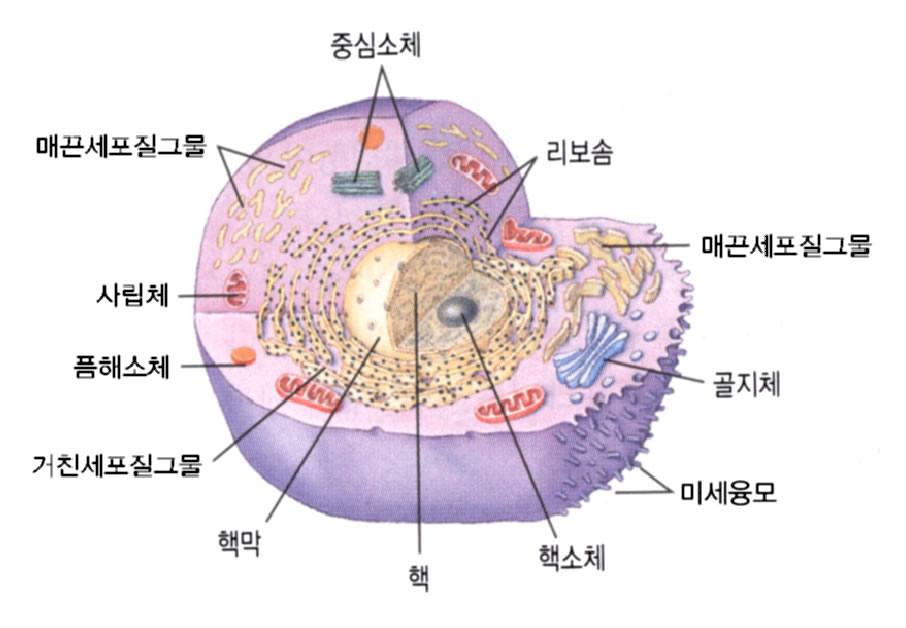 |
||
| 영문 | cell-mediated immunity | 한글 | 세포매개면역 |
|---|---|---|---|
| 설명 | 면역이란 신체를 외부의 물질로부터 보호하는 행위를 말한다. 여기에는 특이적 면역과 비특이적 면역의 두 가지가 있다. 비특이적 면역이라함은 특정한 물질에 관계하는 면역이 아니라 특정 대상이 없이 모든 외부 물체에 작용할 수 있는 면역을 말한다. 여기에는 소변의 흐름, 눈물의 흐름, 피부의 비투과성 등의 기계적인 것도 포함되고 피속에 돌아다니는 세포 중에서 비특이적으로 외부의 물질을 포식하는 세포들(예를 들면 큰포식세포(macrophage)의 활동도 포함이 된다. 세포매개면역이란 특이한 물질을 감지할 수 있는 세포를 생성하게 하여 그것으로 하여금 그 물질을 포식하게 하는 것을 말한다. |
||
| 영문 | nerve cell | 한글 | 신경세포 |
|---|---|---|---|
| 설명 | 신경세포는 올바른 신경전달을 위한 각 부분별로 나뉘어져 있다. 신경세포에서는 전해져오는 자극을 전기적인 신호로 바뀌어 보내거나 받게 된다. 이런 전기적인 현상은 각 신경세포내에 존재하는 각 이온채널(ion channel: ion이란 나트륨, 칼륨 등을 지칭하는 말들로써, 이들이 세포막에 의해 나뉘어질 때 생기는 전압차가 전기적 자극을 일으키고 유지하는데 결정적인 역할을 한다)들의 작용에 의해 이루어지게 된다. |
||
| 영문 | glia cell | 한글 | 아교세포 |
|---|---|---|---|
| 설명 | 신경세포 사이에서 그물구조를 이루며 이를 지지하는 조직. 신경아교세포는 신경모세포와 갈라진 아교모세포가 다시 여러 형태로 분화-성장한 것이다. 뇌실이나 척수중심관의 벽을 덮고 원주상 또는 입방형이며, 초기에는 유리면에 섬모가 있다. 대형세포는 별뇌실막세포는 아교세포라고 하며, 신경세포나 신경섬유 사이에 산재한다. 그 외에 희소돌기아교세포도 포함된다. |
||
| JP drain | The original suction drain. The drain itself is inside the body. It is made of Teflon and has multip... |
|---|---|
| ACC | accommodation; acetyl coenzyme A carboxylase; acinic cell carcinoma; acute care center; adenoid cyst... |
| GC | ganglion cell; gas chromatography; general circulation; general closure; general condition; generali... |
| LCL | Levinthal-Coles-Lillie [body]; lower confidence limit; lower control limit; lymphoblastoid cell line... |
| BW | bacteriological warfare; bed wetting; below waist; biological warfare; biological weapon; birth weig... |
| Barr chromatin body | Condensed chromatin of the inactivated X chromosome in female mammals (Barr body). (18 Nov 1997) |
|---|---|
| basal body | <cell biology> Structure found at the base of eukaryotic cilia and flagella consisting of a continuation of the nine outer sets of axonemal microtubules but with the addition of a C tubule to form a triplet (like the centriole). May be self replicating and serves as a nucleating centre for axonemal assembly. Anchored in the cytoplasm by rootlets. Synonymous with kinetosome. (18 Nov 1997) |
| basal body temperature | <biology> The temperature taken at its lowest point in the day, usually in the morning before getting out of bed. (09 Oct 1997) |
| basal lamina of ciliary body | The inner layer of the ciliary body, continuous with the basal layer of the choroid and supporting the pigment epithelium of the ciliary retina. Synonym: lamina basalis corporis ciliaris, basal layer of ciliary body. (05 Mar 2000) |
| basal layer of ciliary body | The inner layer of the ciliary body, continuous with the basal layer of the choroid and supporting the pigment epithelium of the ciliary retina. Synonym: lamina basalis corporis ciliaris, basal layer of ciliary body. (05 Mar 2000) |
| body | Origin: OE. Bodi, AS. Bodig; akin to OHG. Botah. Cf. Bodice. 1. The material organised substance of an animal, whether living or dead, as distinguished from the spirit, or vital principle; the physical person. "Absent in body, but present in spirit." (1 Cor. V. 3) "For of the soul the body form doth take. For soul is form, and doth the body make." (Spenser) 2. The trunk, or main part, of a person or animal, as distinguished from the limbs and head; the main, central, or principal part, as of a tree, army, country, etc. "Who set the body and the limbs Of this great sport together?" (Shak) "The van of the king's army was led by the general; . . . In the body was the king and the prince." (Clarendon) "Rivers that run up into the body of Italy." (Addison) 3. The real, as opposed to the symbolical; the substance, as opposed to the shadow. "Which are a shadow of things to come; but the body is of Christ." (Col. Ii. 17) 4. A person; a human being; frequently in composition; as, anybody, nobody. "A dry, shrewd kind of a body." (W. Irving) 5. A number of individuals spoken of collectively, usually as united by some common tie, or as organised for some purpose; a collective whole or totality; a corporation; as, a legislative body; a clerical body. "A numerous body led unresistingly to the slaughter." (Prescott) 6. A number of things or particulars embodied in a system; a general collection; as, a great body of facts; a body of laws or of divinity. 7. Any mass or portion of matter; any substance distinct from others; as, a metallic body; a moving body; an aeriform body. "A body of cold air." "By collision of two bodies, grind The air attrite to fire." (Milton) 8. Amount; quantity; extent. 9. That part of a garment covering the body, as distinguished from the parts covering the limbs. 10. The bed or box of a vehicle, on or in which the load is placed; as, a wagon body; a cart body. 11. The shank of a type, or the depth of the shank (by which the size is indicated); as, a nonpareil face on an agate body. 12. <geometry> A figure that has length, breadth, and thickness; any solid figure. 13. Consistency; thickness; substance; strength; as, this colour has body; wine of a good body. Colours bear a body when they are capable of being ground so fine, and of being mixed so entirely with oil, as to seem only a very thick oil of the same colour. After body, an end elevation, showing the conbour of the sides of a ship at certain points of her length. Body politic, the collective body of a nation or state as politically organised, or as exercising political functions; also, a corporation. "As to the persons who compose the body politic or associate themselves, they take collectively the name of "people", or "nation"." (Bouvier) Body servant, a valet. <chemistry> The bodies seven, the metals corresponding to the planets. "Sol gold is, and Luna silver we threpe (=call), Mars yren (=iron), Mercurie quicksilver we clepe, Saturnus lead, and Jupiter is tin, and Venus coper." (Chaucer) Body snatcher, one who secretly removes without right or authority a dead body from a grave, vault, etc.; a resurrectionist. Body snatching, the unauthorised removal of a dead body from the grave; usually for the purpose of dissection. Source: Websters Dictionary (01 Mar 1998) |
| body burden | The total amount of a chemical, metal or radioactive substance present at any time after absorption in the body of man or animal. (12 Dec 1998) |
| body cavity | The collective visceral cavity of the trunk (thoracic cavity plus abdominopelvic cavity), bounded by the superior thoracic aperture above, the pelvic floor below, and the body walls (parietes) in between. Synonym: celom, celoma, coelom. (05 Mar 2000) |
| body-centreed cubic | A molecular structure in which a cube-shaped lattice is formed with one atom in the middle and four other atoms arranged around it as the corners of the cube. (09 Oct 1997) |
| body constitution | The make-up of the body, determined by the genetic, biochemical, and physiologic endowment of the individual and modified in great measure by environmental factors. (12 Dec 1998) |
| body dysmorphic disorder | A psychosomatic (somatoform) disorder characterised by preoccupation with some imagined defect in appearance in a normal-appearing person. Synonym: dysmorphophobia. (05 Mar 2000) |
| body fluid compartments | The two phases between which water and other body fluids are distributed: extracellular and intracellular. (12 Dec 1998) |
| body fluids | Liquid components of living organisms. (12 Dec 1998) |
| body image | A term for the concept which each individual has of his own body as an object in and bound by space, independently and apart from all other objects. (12 Dec 1998) |
| body language | The expression of thoughts and feelings by means of nonverbal bodily movements, e.g., gestures, or via the symptoms of hysterical conversion. See: kinesics. Communication by means of bodily signs. (05 Mar 2000) |
| cell body |
the portion of the nerve cell that contains the nucleus but does not incorporate the dendrites and axons
출처: www.fcs.uga.edu/extension/bbb/info/glossary.htm
|
|---|---|
| cell body |
the metabolic center of a neuron, 50 um (micrometers) or more in diameter
출처: johnnylogic.crumpled.com/papers/ch2gloss.html
|
| cell body |
Also called the soma, this is the part of neuron which initiates a synaptic potential. This does so by way of a complex metabolic process. The initiation of a synaptic potential takes place here. Go to Top Go Back to Where You Were
출처: renge.home.sprynet.com/terms.htm
|