
| 영문 | arachnoid membrane | 한글 | 거미막 |
|---|---|---|---|
| 설명 | 뇌막을 이루는 막의 하나. 뇌막이란 뇌를 싸고 있는 막으로 크게 3개의 막으로 이루어져 있다. 가장바깥에 있는 막을 경질막(dura mater)이라고 한다. 그 다음의 막이 거미막이다. 그리고 뇌에 강하게 밀착되어 있는 가장 안쪽의 막이 연막(pia mater)이다. 거미막은 연막과 거미줄같은 구조물로 아주 느슨하게 부착되어 있다. 그래서 거미막 밑에는 공간이 있다. 이 공간을 거미막밑공강이라고 하고 이 공간은 맑은 액체로 차 있다. 이 액체를 뇌척수액(cerebrospinal fluid)이라고 한다.  |
||
| 영문 | lacrimal duct | 한글 | 눈물관 |
|---|---|---|---|
| 설명 | 눈물이 흘러내리는 통로에 해당한다. 눈물은 대개 눈물샘에서 만들어져 눈을 적신 뒤에, 여기를 거쳐서 눈물주머니에 모인 뒤, 코눈물관으로 흘러 코 안쪽으로 내려가게 된다. 만약 여기가 막히면, 눈물이 계속 고이게 되어 계속 눈물을 흘리게 되며, 또한 병균의 서식처가 되어 감염의 위험성이 높아진다. 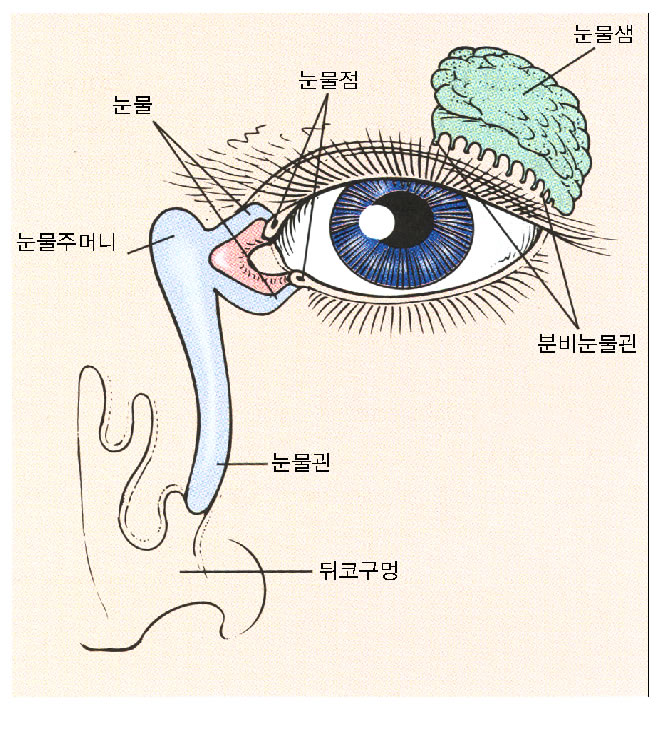 |
||
| 영문 | basement membrane | 한글 | 바닥막, 기저막 |
|---|---|---|---|
| 설명 | 상피세포, 근육세포, 신경조직과 그것들의 바깥쪽 결합조직의 경계에 있는 점액다당질과 단백질로 구성된 얇은 막. 기초막 또는 경계막이라고도 한다. 두께는 50~80nm이다. 기저막은 20~30nm 간격으로 늘어선 족세포로 된 상피세포의 3층으로 되어 있고, 분자량 40,000~60,000의 물질을 투과할 수 있게 한다. 또한 표피와 진피의 경계로 영양을 공급하는 기지 역할을 한다. 주로 섬유를 포함하여 다당류로 되어 있는데, 현저하게 발달되어 있는 부분과 그렇지 않은 부분이 있다. 비점막에서는 점막상피의 밑에 발달한 기저막이 있다. 이 막 위에 청각수용세포인 털세포를 갖는 코르티기관이 존재한다. 기저막은 전제가 음전기 성질을 가지고 있어 양전기를 가진 물질이 투과하기 쉽다. 기저막이 팽화하거나 밀도가 낮아지면 단백질이 통과하여 단백뇨를 일으키고, 기저막에 균열-파괴 등이 일어나면 적혈구 등의 혈액 고형성분이 투과하여 혈뇨가 된다. |
||
| 영문 | hyaline membrane disease | 한글 | 유리질막병 |
|---|---|---|---|
| 설명 | 허파 성숙도의 미숙으로 허파꽈리를 팽창시키는 물질(표면활성제)이 부족하여 호흡곤란이 초래되는 병으로서 미숙아에 호발하는데, 출생시 임신기간보다도 허파 성숙 정도가 더 관여된다. 단일 병으로서는 사망률이 가장 높으며(약 30%), 신생아의 대표적인 병이다. 임상적으로는 미숙아, 생후 6~8시간내 호흡곤란증세 출현과 생후 24~48시간의 증상 악화, 생후 2~3일간 인공적으로 산소를 공급하지 않으면 호흡을 계속시킬 수가 없으며 점점더 산소의 공급 의존도가 높아지며, 동맥혈액속의 산소농도가 내려가고 이산화탄소의 농도가 높으며, 흉부 방사선 소견을 참작하여 진단한다. 환아는 숙련된 간호 인력과 첨단 의료 장비가 설치된 신생아 집중 치료실에서 치료하여야 한다. 예후는 증세의 경중에 따라 다르고 사망률은 30~50% 된다. 어떤 아기에 있어서는 치료 후에 눈이나 기관지허파 계통에 장애를 일으키는 산소중독증이 보고되고 있다. |
||
| 영문 | pancreatic duct | 한글 | 이자관, 췌장관 |
|---|---|---|---|
| 설명 | 이자에서 이자액을 분비하도록 샘창자로 이어진 관. 이자관은 샘창자의 중간부에서 온쓸개관과 같이 개구한다. |
||
| SCM | Schwann cell membrane; sensation, circulation, and motion; Society of Computer Medicine; soluble cyt... |
|---|---|
| MPD | main pancreatic duct; maximum permissible dose; mean population doubling; membrane potential differe... |
| PROM | 1) Premature Rupture of Amniotic Membrane; < Labor Onset 2) Preterm Ruptu... |
| BLM | bilayer lipid membrane; bimolecular liquid membrane; bleomycin; buccolinguomasticatory |
| CM | California mastitis [test]; calmodulin; capreomycin; carboxymethyl; cardiac murmur; cardiac muscle; ... |
| basal cell adenoma | <tumour> A benign tumour of major or minor salivary glands or other organs composed of small cells showing peripheral palisading. (05 Mar 2000) |
|---|---|
| basal cell carcinoma | <oncology, tumour> The most common form of skin cancer. A malignant growth of epidermal tissue, specifically basal cells. most common in the fair-skinned on sun-exposed areas (especially the face). (15 Nov 1997) |
| basal cell epithelioma | <oncology, tumour> The most common form of skin cancer. A malignant growth of epidermal tissue, specifically basal cells. most common in the fair-skinned on sun-exposed areas (especially the face). (15 Nov 1997) |
| basal cell hyperplasia | Increase in the number of cells in an epithelium resembling the basal cells. (05 Mar 2000) |
| basal cell layer | The deepest layer of the epidermis, composed of dividing stem cells and anchoring cells. Synonym: basal cell layer, columnar layer, germinative layer, palisade layer, stratum basale, stratum cylindricum, stratum germinativum. (05 Mar 2000) |
| basal cell nevus | A hereditary disease noted in infancy or adolescence, characterised by lesions of the eyelids, nose, cheeks, neck, and axillae, appearing as uneroded flesh-coloured papules, some becoming pedunculated, and histologically indistinguishable from basal cell epithelioma; also noted are punctate keratotic lesions of the palms and soles; the lesions usually remain benign, but in some cases ulceration and invasion occur and are evidence of malignant change; autosomal dominant inheritance. (05 Mar 2000) |
| basal cell nevus syndrome | <syndrome> An inherited group of defects which involve abnormalities of the skin, eyes, nervous system, endocrine, glands and bones. The condition is characterised by an unusual facial appearance and a predisposition for skin cancer. (27 Sep 1997) |
| basal cell papilloma | A benign skin lesion resulting from excessive growth of the top layer of skin cells. It usually is found in persons over 30 years old and may be few or numerous. (12 Dec 1998) |
| basal cells | Small, round cells found in the lower part, or base, of the epidermis, the outer layer of the skin. (12 Dec 1998) |
| basal cistern | A dilation of the subarachnoid space in front of the pons, where the arachnoid membrane stretches across between the two temporal lobes over the base of the diencephalon. See: interpeduncular fossa. Synonym: cisterna interpeduncularis, basal cistern, cisterna basalis, cisterna cruralis, Tarin's space. (05 Mar 2000) |
| basal corpuscle | <cell biology> Structure found at the base of eukaryotic cilia and flagella consisting of a continuation of the nine outer sets of axonemal microtubules but with the addition of a C tubule to form a triplet (like the centriole). May be self replicating and serves as a nucleating centre for axonemal assembly. Anchored in the cytoplasm by rootlets. Synonymous with kinetosome. (18 Nov 1997) |
| basal diet | A diet having a caloric value equal to the basal heat production and sufficient quanties of essential nutrients to meet basic needs, in experiments in nutrition, a diet from which a given constituent (e.g., a vitamin, mineral, or amino acid), the nutritional value of which is to be determined, is omitted for a period and the effects observed; the subject is observed for a second period during which the ingredient being studied is added to the diet. (05 Mar 2000) |
| basal ganglia | <anatomy> Three large subcortical nuclei of the vertebrate brain: the putamen, the caudate nucleus and the globus pallidus. They participate in the control of movement along with the cerebellum, the corticospinal system and other descending motor systems. Lesions of the basal ganglia occur in a variety of motor disorders including Parkinson's disease and Huntingdon's chorea. (15 Nov 1997) |
| basal ganglia calcification | <radiology> Idiopathic: normal variant (50%), abnormal calcium metabolism, hyperparathyroidism, hypo-, pseudohypo-, and pseudo-pseudohypoparathyroidism, ToRCHS infection (especially CMV, toxo), tuberous sclerosis, Cockayne syndrome, Fahr syndrome (ferrocalcinosis), lipoid proteinosis (hyalinosis cutis) (12 Dec 1998) |
| basal gland | pituitary gland |