
| 영문 | open heart surgery | 한글 | 개심술, 심장절개술 |
|---|---|---|---|
| 설명 | 심장의 한 개 또는 그 이상의 방실 절개하는 수술. 심방사이막결손증, 심실사이막결손증, 순수형 허파동맥판막협착증, 팔로(Fallot) 사징후 등이 적용이 된다. 이 수술을 위해서는 인공심폐장치가 필요하다. |
||
| 영문 | heart | 한글 | 심장 |
|---|---|---|---|
| 설명 | 심장은 가슴의 중앙에 위치하며 오른쪽과 왼쪽반으로 나눌 수 있다. 각각은 정맥에서 피가 들어오는 방과 동맥으로 피를 내보내는 실이 있다. 심장은 정중앙선에서 왼쪽에 놓여 있다. 심장의 2개의 심방과 2개의 심실, 그리고 심방사이의 심방중격, 심실사이의 심실중격이 존재한다. 심실은 혈액을 주로 순환시키는 힘을 내는 곳으로 강한 근육층이 존재를 한다. 반면에 심방은 심실에 들어가기전에 일시적으로 피가 모이는 곳으로 근육층의 발달이 미약하다. 심방과 심실사이에 삼첨판과 승모판, 심실의 유출로에 대동맥판과 폐동맥판이 있다. 이것들은 혈액이 흐르는 방향에 거슬러 진행하는 것을 막는 기능을 한다. 그리고 심장에는 심장의 근육에 혈액을 공급하는 관상동맥이 있다. 이 심장동맥은 심장을 쌓듯이 존재한다. 심장박동의 신호는 특수한 장치에 의해서 발생이 되고 특수한 전도계를 통해서 전체의 심장으로 전도된다. 심장박동의 신호는 우선 우심방에 위치하는 동방결절(SA node)라는 곳에서 우선 생긴다. 여기에서 보내는 전기적 신호가 바로 심장을 뛰게하는 신호인 것이다. 이 신호로 말미암아 심방이 우선 수축을 한다. 그리고는 심방과 심실사이에 위치하는 방실결절(AV node)라는 곳에 일정하게 정해진 통로없이 전체의 심방을 통해서 전달이 되고 이 신호를 받은 방실결절(AV node)는 히스 다발(His bundle)과 심장전도근육섬유를 통해서 심실의 심장근육에게 이 신호를 보내주어 심실근육을 수축하게 한다. 히스다발과 심장전도근육섬유는 전체의 심실의 심근섬유에 동시에 전기적 신호를 보내어 줄 수 있게 하는 일종의 전기줄과 같은 역할을 한다. 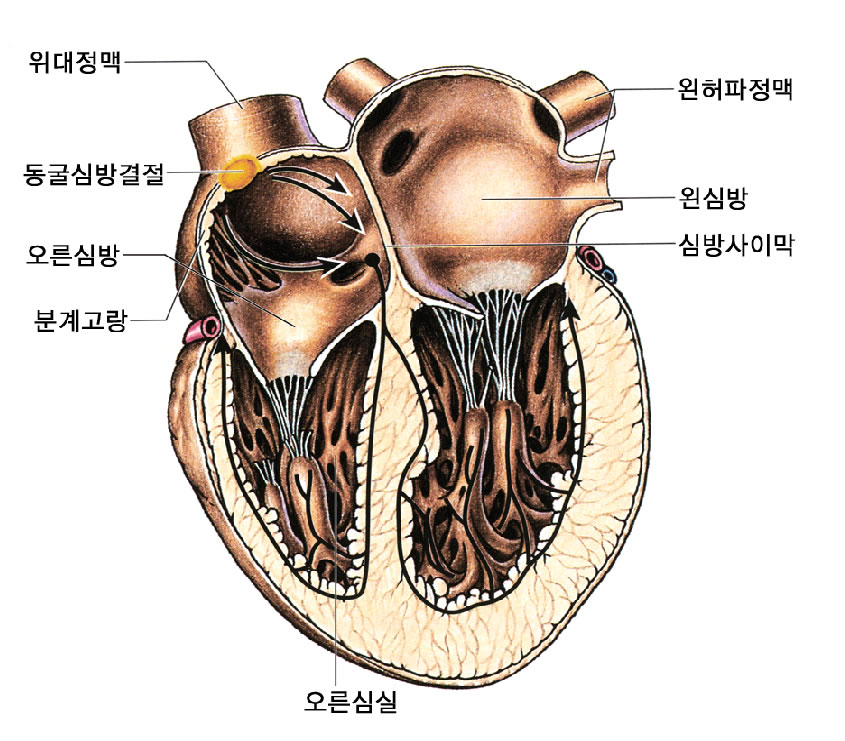 |
||
| 영문 | heart failure | 한글 | 심장기능상실 |
|---|---|---|---|
| 설명 | 몸의 조직이나 기관에서 대사에 필요한 만큼 충분한 양의 혈액을 공급할 수 없을 정도로 심장기능이 저하되어 있는 상태이다. 심장기능상실은 심근이 수축할 능력이 저하되었을 때나 심장에 심박출을 하기 위한 압력이 정상보다 증가되어 정상의 심장의 수축으로는 충분한 양의 혈액을 공급할 수 없는 경우, 그리고 심장근육, 심장에 걸리는 압력은 정상이나 심장박동의 이상에 의해서 정상적인 수축이 불가능할 경우에 생긴다. |
||
| 영문 | pacemaker(of heart) | 한글 | 심장박동기 |
|---|---|---|---|
| 설명 | 심장의 전기적 자극이 병적인 상태로 발생하지 않거나, 혹은 심실로 잘 전해지지 않을 때 사용한다. 일시적 심장박동기와 영구적 심장박동기가 있으며, 각기 쓰이는 용도는 병에 따라 다르다. 요즘에 나오는 심장 박동기는 건전지의 수명도 반영구적이며, 밖에서 조정할 수 있고, 운동이나 스트레스 상황에 대한 심장의 빠른 운동에도 잘 적응할 수 있도록 만들어져 있다. |
||
| 영문 | septal defects of heart | 한글 | 심장의 중격 결손 |
|---|---|---|---|
| 설명 | 선천적으로 심장 내의 심방사이중격(interatrial septum)이나 심실사이중격(interventricular septum)이 결손되어 혈류가 정상적으로 흐르지 않는 경우. 정상적인 경우 혈류는 정맥에서 우심방으로 모여 우심실을 거친뒤 폐로 가서 산소를 공급받고 다시 왼심방, 왼심실을 차례로 거쳐 대동맥으로 간다. 하지만, 이 경우는 혈류가 압력이 높은 왼심방이나 왼심실에서 압력이 낮은 우심방이나 우심실로 흐르게 된다. 따라서 동맥피와 정맥피가 섞이게 되고, 환자는 호흡곤란, 성장발육장애, 심잡음 등이 나타나고, 심한 경우 청색증으로 발전하기도 한다. 치료는 수술적으로 이 결손부위를 막아 주어야 한다. |
||
| CD | cadaver donor; canine distemper; canine dose; carbohydrate dehydratase; carbon dioxide; cardiac dise... |
|---|---|
| MD | Doctor of Medicine [Lat. Medicinae Doctor]; magnesium deficiency; main duct; maintenance dose; major... |
| AD | accident dispensary; acetate dialysis; active disease; acute dermatomyositis; addict, addiction; ade... |
| PD | Doctor of Pharmacy; Dublin Pharmacopoeia; interpupillary distance; Paget disease; pancreatic duct; p... |
| RD | radial deviation; radiology department; rate difference; Raynaud disease; reaction of degeneration; ... |
Kugelberg-Welander disease 근 위축증의 유전성 연소형으로서 보통 상염색체성 열성 형질로 유전된다. 척수 전각의 병변이 그 원인이다.
kukuruku 원인 불명이며, 나이지리아에서 볼 수 있는 질환으로, 열
| acquired drives | Those drives not directly related to biological needs; a secondary drive can be learned as an offshoot of a primary drive, in which case it is often referred to as a motive. Synonym: acquired drives. (05 Mar 2000) |
|---|---|
| acquired eccentric relation | An eccentric relation that is assumed by habit in order to bring the teeth into occlusion. (05 Mar 2000) |
| acquired epileptic aphasia | <syndrome> Acquired epileptic aphasia. The typical history is that of a child whose development is normal for several years and then, either suddenly or in a fluctuating manner, loses comprehension of speech and the ability to use speech to communicate. The seizures are of no specific type, and are mostly mild and infrequent partial or atypical absences. (12 Dec 1998) |
| acquired haemolytic anaemia | Nonhereditary acute or chronic anaemia associated with or caused by extracorpuscular factors, e.g., certain infectious agents, chemicals (including autoantibodies or therapeutic agents), burns, toxic materials from higher plant and animal forms (including snake venoms). (05 Mar 2000) |
| acquired haemolytic icterus | Icterus and anaemia occuring in association with a moderate degree of splenomegaly, increased fragility of red blood cells, and increased amounts of urobilin in the urine. Synonym: icteroanaemia. Origin: G. Ikteros (05 Mar 2000) |
| acquired hyperlipidaemia | <biochemistry> A condition of elevated blood triglycerides or blood cholesterol that is a result of secondary factors (for example poor diet, drug-related causes, diabetes, hypothyroidism, Cushing's syndrome). (27 Sep 1997) |
| acquired hyperlipoproteinaemia | Nonfamilial hyperlipoproteinaemia that develops as a consequence of some primary disease, such as thyroid deficiency. (05 Mar 2000) |
| acquired hypogammaglobulinaemia | Heterogeneous group of immunodeficiency syndromes characterised by hypogammaglobulinaemia of most isotypes, variable B-cell defects, and the presence of recurrent bacterial infections. (12 Dec 1998) |
| acquired ichthyosis | A thickening and scaling of the skin associated with some malignant diseases (e.g., Hodgkin's disease, lymphosarcoma), leprosy, and severe nutritional deficiencies. (05 Mar 2000) |
| acquired immunity | <immunology> A form of cellular defense which identifies certain foreign substances (antigens) as harmful to the body. For this reason, the body can acquire resistance to a particular foreign agent. These foreign agents are then attacked by sensitised T lymphocytes (cellular immunity). White blood cells, plasma cells, B lymphocytes and other specialised immune system cells act in concert with T lymphocytes to produce antibodies (humoral immunity) that attach to the antigen directing T-cells to attack. Antibodies also stimulate the release of special chemical mediators in the blood (for example complement, interferon) that further enhance antigen destruction. (13 Nov 1997) |
| Acquired Immunodeficiency Syndrome | <immunology, syndrome> An epidemic disease caused by an infection by human immunodeficiency virus (HIV-1, HIV-2), a retrovirus that causes immune system failure and debilitation and is often accompanied by infections such as tuberculosis. AIDS is spread through direct contact with bodily fluids. Acronym: AIDS (10 May 1997) |
| acquired leukoderma | <dermatology> This disorder is characterised by regions of otherwise normal skin of nonpigmented white patches of varied sizes, often symmetrically distributed and usually bordered by hyperpigmented areas. Hair in the affected areas is usually, but not always, white. (27 Sep 1997) |
| acquired leukopathia | <dermatology> This disorder is characterised by regions of otherwise normal skin of nonpigmented white patches of varied sizes, often symmetrically distributed and usually bordered by hyperpigmented areas. Hair in the affected areas is usually, but not always, white. (27 Sep 1997) |
| acquired megacolon | Megacolon occurring on the basis of an acquired disease; occurs in inflammatory bowel disease (toxic megacolon) and Chagas' disease (South American trypanosomiasis). (05 Mar 2000) |
| acquired methemoglobinaemia | Methemoglobinaemia caused by various chemical agents, such as nitrites. Synonym: enterogenous methemoglobinaemia, secondary methemoglobinaemia. (05 Mar 2000) |