
| 영문 | spinal cord | 한글 | 척수 |
|---|---|---|---|
| 설명 | 척추내에 위치하는 중추신경계의 일부분. 위에서부터 목척수, 등척수, 허리척수, 엉치척수로 구분됨. 내부는 바깥쪽의 백색질과 안쪽의 회색질로 구분된다. 척수의 아래끝은 척수 원뿔이라 하며 첫번째 허리뼈 높이까지 내려온다. 뇌와 말초신경사이의 신경 통로 역할을 하며 척수반사(예: 무릎반사)에서는 뇌를 통하지 않고 반사의 중추 작용을 한다. 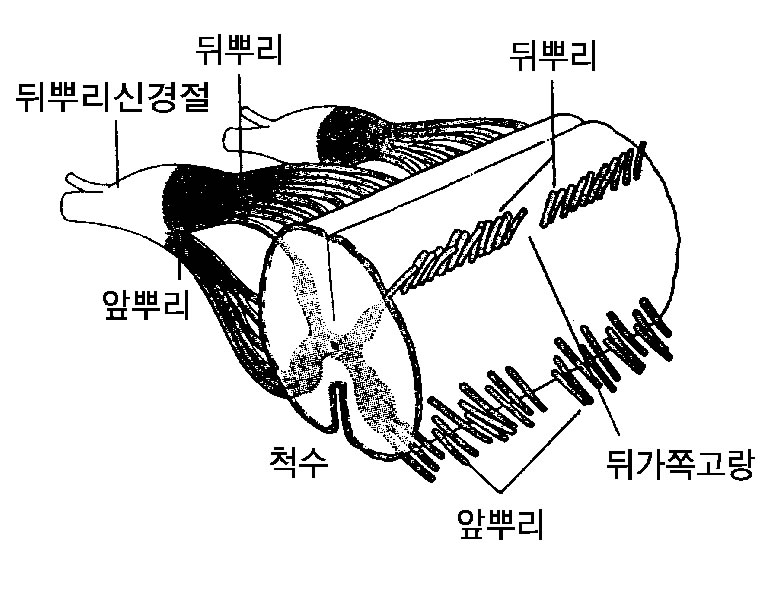 |
||
| 영문 | spinal nerve | 한글 | 척수신경 |
|---|---|---|---|
| 설명 | 척수의 앞뿔에서 출발하는 운동신경과 뒷뿔으로 들어오는 감각신경이 합쳐서 형성되는 신경으로서 총 31쌍이 존재함. 목뼈신경이 8쌍, 자등뼈신경이 12쌍, 허리뼈의 신경이 5쌍, 엉치뼈의 6쌍을 이룸. |
||
| SBMA | spinal bulbar muscular atrophy |
|---|---|
| SMA | sequential multiple analysis or analyzer; sequential multichannel autoanalyzer; simultaneous multich... |
| SPMA | spinal progressive muscular atrophy |
| PSA | parasternal short axis; pleomorphic salivary gland adenoma; polyethylene sulfonic acid; polysacchari... |
| SC | conditioned stimulus; sacrococcygeal; Sanitary Corps; scalenus [muscle]; scapula; Schwann cell; scia... |
| childhood | The period of life between infancy and puberty. (05 Mar 2000) |
|---|---|
| childhood absence epilepsy | A generalised epilepsy syndrome characterised by the onset of absence seizures in childhood, typically at age six or seven years. There is a strong genetic predisposition and girls are affected more often than boys. EEG reveals generalised 3 Hz spike-wave activity on a normal background. Prognosis for remission is good if the patient does not also have generalised tonic-clonic seizures. See: absence. Synonym: petit mal epilepsy, pyknolepsy. (05 Mar 2000) |
| childhood epilepsy with occipital paroxysms | A benign epilepsy syndrome characterised by frequent occipital spikes often activated by eye closure. It has a seizure semiology that includes visual manifestations; not always remitting later in life. (05 Mar 2000) |
| childhood schizophrenia | A severe emotional disturbance of childhood characterised by qualitative impairment in reciprocal social interaction and in communication, language, and social development. Synonym: autistic disorder, childhood schizophrenia, early infantile autism, Kanner's syndrome. (05 Mar 2000) |
| childhood tuberculosis | Initial (primary) infection with Mycobacterium tuberculosis, characterised by pneumonic lesions in middle parts of lungs, rarely cavitary, with rapid spread to lymph nodes in hilar and paratracheal areas; more often seen in childhood, but pattern is not limited to children. (05 Mar 2000) |
| childhood type tuberculosis | First infection by Mycobacterium tuberculosis, typically seen in children but also occurs in adults, characterised in the lungs by the formation of a primary complex consisting of small peripheral pulmonary focus with spread to hilar or paratracheal lymph nodes; may cavitate or heal with scarring or may progress. Synonym: childhood type tuberculosis. (05 Mar 2000) |
| chronic bullous dermatosis of childhood | A rare self-limiting bullous disease, chiefly of the trunk, perioral, and pelvic areas, with onset in the first decade, successively less severe recurrences, and total remission at adolescence; linear epidermal basement membrane zone deposit of IgA is found in involved and in normal skin. Synonym: linear IgA bullous disease in children. (05 Mar 2000) |
| chronic granulomatous disease of childhood | <radiology> Disorder of phagocytosis, two forms: X-linked recessive, autosomal recessive, usually fatal in childhood, infection by nonpathogenic organisms (catalase positive), pneumonia, osteomyelitis, diarrhoea, abdominal pain Findings: recurrent pneumonia (resolves incompletely, with abscess formation), adenopathy (big hila), hepatosplenomegaly, calcified granulomata in liver, spleen, lymph nodes, gastric antral narrowing (!) Cf: Chediak-Higashi syndrome More info: chronic granulomatous disease (12 Dec 1998) |
| schizophrenia, childhood | An obsolete concept, historically used for childhood mental disorders thought to be a form of schizophrenia. (12 Dec 1998) |
| torsion disease of childhood | A genetic, environmental, or idiopathic disorder, usually beginning in childhood or adolescence, marked by muscular contractions that distort the spine, limbs, hips, and sometimes the cranial-innervated muscles. The abnormal movements are increased by excitement and, at least initially, abolished by sleep. The musculature is hypertonic when in action, hypotonic when at rest. Hereditary forms usually begin with involuntary posturing of the foot or hand (autosomal recessive form ) or of the neck or trunk (autosomal dominant form ); both forms may progress to produce contortions of the entire body. Synonym: progressive torsion spasm, torsion disease of childhood, torsion dystonia, Ziehen-Oppenheim disease. (05 Mar 2000) |
| feeding and eating disorders of childhood | Mental disorders related to feeding and eating that are usually diagnosed in infancy or early childhood. (12 Dec 1998) |
| adult pseudohypertrophic muscular dystrophy | Muscular dystrophy of late onset, often in the second or third decade, with relatively mild course; X-linked recessive inheritance; perhaps allelic with Duchenne's dystrophy, but milder and not a genetic lethal. Compare: Duchenne dystrophy. Synonym: Becker type tardive muscular dystrophy. (05 Mar 2000) |
| Becker's muscular dystrophy | An X-linked inherited disorder characterised by slowly progressive muscle weakness of the legs and pelvis. Other symptoms and findings include increased difficulty walking, intellectual retardation, fatigue and pseudohypertrophy of the calf muscles. (27 Sep 1997) |
| Becker type muscular dystrophy | A muscular dystrophy that has many of the clinical features of Duchenne muscular dystrophy e.g., symmetrical involvement of first the pelvicrural muscles and then the pectoral girdle and proximal upper extremity muscles; pseudohypertrophy, especially of the calf muscles but with a much later age of onset (35-45 years), and more benign course. X-linked inheritance. (05 Mar 2000) |
| Becker type tardive muscular dystrophy | Muscular dystrophy of late onset, often in the second or third decade, with relatively mild course; X-linked recessive inheritance; perhaps allelic with Duchenne's dystrophy, but milder and not a genetic lethal. Compare: Duchenne dystrophy. Synonym: Becker type tardive muscular dystrophy. (05 Mar 2000) |