
| 영문 | hypertensive heart disease | 한글 | 고혈압심장병 |
|---|---|---|---|
| 설명 | 고혈압에 의해서 생기는 심장병. 고혈압심장병이라는 진단을 붙이기 위해서는 최소한 다음과 같은 조건이 부합되어야 하는데, 첫째 심장혈관계에 심장병을 유발할 수 있을 만한 다른 병변이 없이 좌심실 비대가 있어야 하며, 둘째 고혈압을 앓았다는 병력이 있어야 한다. 주로 고혈압에 의한 심장병은 초기에는 좌심실이 비후라는 것으로 특징되어진다. 즉 혈압이 높으므로 혈액을 순환시키기 위해서는 그만큼 심장의 혈액을 보내는 힘이 좋아야 한다. 그 힘을 얻기위해서는 심근의 비후가 필요로 하여 좌심실 근육의 비후가 생긴다. 그리고 고혈압이 지속이 될 경우에는 결국 심장이 제 구실을 하지 못하고 펌프로서의 기능을 잃어버리게 되어 심장기능상실에 빠지게 된다. |
||
| 영문 | rheumatic heart disease | 한글 | 류마티스심장병 |
|---|---|---|---|
| 설명 | 사슬알균감염 후 생기는 심장판막병이다. 원인은 A군 -용혈사슬알에 의한 인두염후 일종의 면역반응으로 발병한다. 진단은 존의 기준에 의한다. (1) 주요기준은 관절염 심장염(심장비대, 심장잡음, 심장기능상실 등) 무도증: 무당이 춤을 추는 것 같은 행동의 발작증세. 연변홍반: 빨간 테두리를 가진 피부병변은 피하결절(subcutaneous nodule): 피부 밑에 생긴 결절, (2)참고 기준은 열, 관절통, EKG상 PR연장: 심전도 소견 급성기 반응물질(예: ESR, CRP)의 상승, 류마티스열 치료는 페니실린으로 치료하고 심장의 후유증 또한 페니실린으로 예방한다. |
||
| 영문 | congenital heart disease | 한글 | 선천심장병 |
|---|---|---|---|
| 설명 | 선천적으로 심장의 구조에 이상이 있는 병. |
||
| 영문 | heart | 한글 | 심장 |
|---|---|---|---|
| 설명 | 심장은 가슴의 중앙에 위치하며 오른쪽과 왼쪽반으로 나눌 수 있다. 각각은 정맥에서 피가 들어오는 방과 동맥으로 피를 내보내는 실이 있다. 심장은 정중앙선에서 왼쪽에 놓여 있다. 심장의 2개의 심방과 2개의 심실, 그리고 심방사이의 심방중격, 심실사이의 심실중격이 존재한다. 심실은 혈액을 주로 순환시키는 힘을 내는 곳으로 강한 근육층이 존재를 한다. 반면에 심방은 심실에 들어가기전에 일시적으로 피가 모이는 곳으로 근육층의 발달이 미약하다. 심방과 심실사이에 삼첨판과 승모판, 심실의 유출로에 대동맥판과 폐동맥판이 있다. 이것들은 혈액이 흐르는 방향에 거슬러 진행하는 것을 막는 기능을 한다. 그리고 심장에는 심장의 근육에 혈액을 공급하는 관상동맥이 있다. 이 심장동맥은 심장을 쌓듯이 존재한다. 심장박동의 신호는 특수한 장치에 의해서 발생이 되고 특수한 전도계를 통해서 전체의 심장으로 전도된다. 심장박동의 신호는 우선 우심방에 위치하는 동방결절(SA node)라는 곳에서 우선 생긴다. 여기에서 보내는 전기적 신호가 바로 심장을 뛰게하는 신호인 것이다. 이 신호로 말미암아 심방이 우선 수축을 한다. 그리고는 심방과 심실사이에 위치하는 방실결절(AV node)라는 곳에 일정하게 정해진 통로없이 전체의 심방을 통해서 전달이 되고 이 신호를 받은 방실결절(AV node)는 히스 다발(His bundle)과 심장전도근육섬유를 통해서 심실의 심장근육에게 이 신호를 보내주어 심실근육을 수축하게 한다. 히스다발과 심장전도근육섬유는 전체의 심실의 심근섬유에 동시에 전기적 신호를 보내어 줄 수 있게 하는 일종의 전기줄과 같은 역할을 한다. 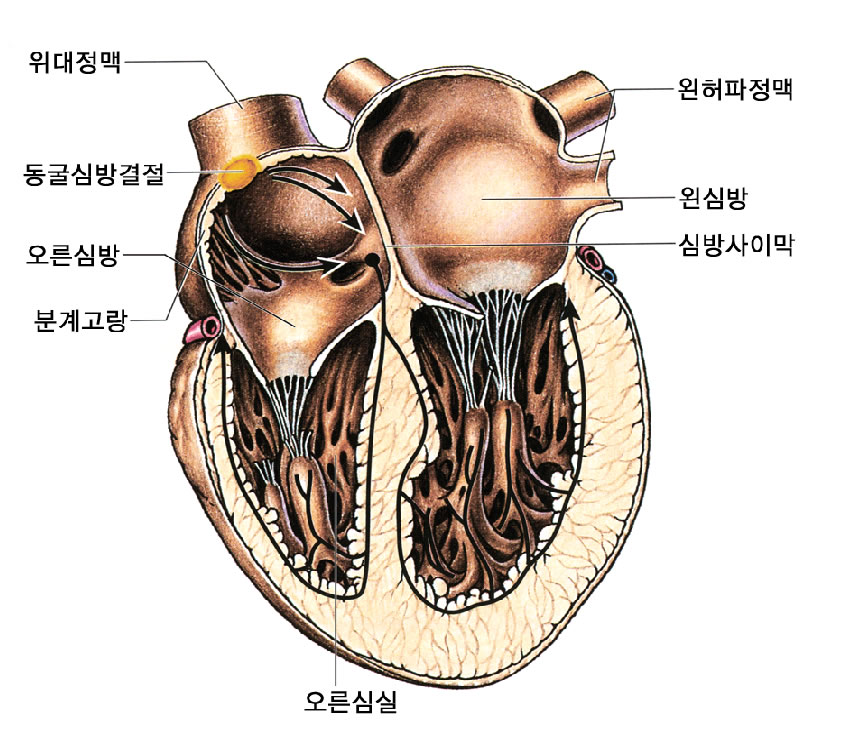 |
||
| 영문 | pacemaker(of heart) | 한글 | 심장박동기 |
|---|---|---|---|
| 설명 | 심장의 전기적 자극이 병적인 상태로 발생하지 않거나, 혹은 심실로 잘 전해지지 않을 때 사용한다. 일시적 심장박동기와 영구적 심장박동기가 있으며, 각기 쓰이는 용도는 병에 따라 다르다. 요즘에 나오는 심장 박동기는 건전지의 수명도 반영구적이며, 밖에서 조정할 수 있고, 운동이나 스트레스 상황에 대한 심장의 빠른 운동에도 잘 적응할 수 있도록 만들어져 있다. |
||
| CR | calculation rate; calculus removed; calorie-restricted; cardiac rehabilitation; cardiac resuscitatio... |
|---|---|
| IHD | Ischemic Heart Disease = Coronary Heart(Artery) Disease = Atheroscler... |
| AHD | acquired hepatocerebral degeneration; acute heart disease; antihyaluronidase; antihypertensive drug;... |
| CHD | Chediak-Higashi disease; childhood disease; chronic hemodialysis; congenital or congestive heart dis... |
| ARF | acute renal failure; acute respiratory failure; acute rheumatic fever; Addiction Research Foundation... |
| rejection | 1. <immunology, surgery> Usually used of grafts. Any process leading to the destruction or detachment of a graft or other specified structure. 2. <psychology> Non-acceptance, negative attitudes, hostility or excessive criticism of the individual which may precipitate feelings of rejection. (12 Dec 1998) |
|---|---|
| graft rejection | <haematology, immunology> When donated bone marrow infused during a bone marrow transplant is rejected by the patients body or does not take. (16 Dec 1997) |
| chronic allograft rejection | Immunologically mediated damage to the allograft, typically a kidney allograft, manifested by diffuse interstitial fibrosis glomerular changes, typically membranous and sclerotic in nature, as well as intimal fibrosis of the blood vessels with tubular atrophy and loss of tubular structures. (05 Mar 2000) |
| chronic rejection | A transplant rejection occurring after a few or many months, mainly from persisting serum antibody action. (05 Mar 2000) |
| primary rejection | A rejection occurring more than seven days after transplantation, mainly from a cellular immune response. (05 Mar 2000) |
| second set rejection | An accelerated rejection of a transplant that occurs when an individual has been previously sensitised to the graft. (05 Mar 2000) |
| hyperacute rejection | A rejection that usually develops in less than one hour from the implantation of a vascular graft, a form of antibody-mediated, usually irreversible damage to a transplanted organ, particularly the kidney, manifested predominantly by diffuse thrombotic lesions, usually confined to the organ itself and only rarely disseminated, for skin allograft rejection of this type, see white graft. (05 Mar 2000) |
| first-set rejection | Allograft transplantation between two organisms not previously sensitised to the graft tissue. Necrosis of the graft usually occurs within 10 days of transplantation. (05 Mar 2000) |
| allogeneic bone marrow transplant | <haematology, procedure> A bone marrow transplant using marrow collected from a matched healthy donor, usually a brother or sister. The risks associated with the transplant increase with age and 50 years of age is generally regarded as the upper limit. (13 Nov 1997) |
| allogeneic transplant | <haematology, procedure> A transplant of an organ or tissue that is donated either by agenetically matched relative of the patient or by an unrelated (but genetically similar) donor. (09 Oct 1997) |
| autologous bone marrow transplant | <haematology, procedure> A process in which a patients healthy bone marrow is withdrawn and preserved. It is later injected back into the patient to replace bone marrow damaged by high doses of radiation therapy. It can then produce healthy blood cells. This treatment is used to offset the detrimental effects of high-dose radiation used in certain types of cancer. (31 Dec 1997) |
| autologous transplant | <procedure> A transplant of an organ or tissue that is taken from the same individual. A person having blood taken a little at a time several months before a surgery to replace the blood they expect to lose during that surgery is a form of autologous transplant. Likewise, the use of muscle tissue taken from a person's back to surgically reconstruct their damaged hand would be another form of autologous transplant. (02 Jan 1998) |
| bone marrow transplant | <procedure> A procedure in which a section of bone marrow is taken from one person and transplanted into another. It is used to replace bone marrow that has been damaged or diseased. It can be a treatment option in leukaemia. Acronym: BMT (16 Dec 1997) |
| Gallie's transplant | Narrow strips of the femoral fascia lata used for suture material. (05 Mar 2000) |
| corneal transplant | A surgical procedure to replace a damaged cornea with a healthy one from a donor's eye. Unlike transplantation of most other organs, the cornea tends to have a problem with transplant rejection. Corneal transplants are indicated in cases of severe corneal injury or corneal infection (corneal ulcer) which has left the cornea scarred. (27 Sep 1997) |