
| 영문 | muscle cell(=muscle fiber) | 한글 | 근육세포 |
|---|---|---|---|
| 설명 | 근육은 수의근(의식에 의해서 조절이 가능한 근육: 예를 들어 다리, 팔, 얼굴근육 등)과 불수의근(의식과 무관하게 조절하지 않아도 움직이는 근육: 예를 들어 심장근, 소화기관에 분포하는 근육 등)으로 나누어지며, 근육세포의 모양은 다음과 같다(수의근, 불수의근 외에 심장에 있는 심장근은 불수의근에 해당하지만 그 모양은 수의근과 같아 따로 분류한다).  |
||
| 영문 | white blood cell(WBC), leukocyte | 한글 | 백혈구 |
|---|---|---|---|
| 설명 | 혈액내에 골수구계세포와 림프계세포, 단핵구계세포를 모두 통틀어 말한다. 백혈구의 증가가 있으면 대개 감염이 있거나, 혹은 탈수현상이 있음을 의미한다. 또한 지나친 백혈구수의 감소는 인체내 면역기능이 떨어져 있음을 의미하며, 다른 질병에 의해 나타나는 이차적인 현상이 아닌지 꼭 진단을 받아보아야 한다. |
||
| 영문 | mast cell | 한글 | 비만 세포 |
|---|---|---|---|
| 설명 | 동물의 결합 조직 가운데 널리 분포하는 세포. 결합조직과 점막조직 내에 있는 호염기성 색소로 이염색성(metachromasia)을 나타내는 과립을 가진 방추형의 세포에 작은 둥근 핵을 가진다. 비만세포의 표면에는 IgE에 대한 수용체가 존재하며, 수용체에 결합한 IgE 분자들끼리 다가의 항원에 의해 서로 연결되면 비만세포 과립탈출 반응이 일어나, 히스타민, 세로토닌, 헤파린 등의 화학전달 물질이 방출되어, 즉시형 알레르기 반응 등의 증상을 일으킨다. 피부, 장막, 혈관 주위, 점막 주변에 있다. |
||
| 영문 | cell | 한글 | 세포 |
|---|---|---|---|
| 설명 | 생명체를 이루는 구조적, 기능적 단위. 핵의 유무에 따라서 유핵세포와 무핵세포로 나눌 수가 있다. 무핵세포란 핵이 없는 세포를 말한다. 핵이란 유전정보를 가지고 있는 염색체를 보관하는 곳인데 무핵세포에서는 염색체가 세포속에 그냥 노출되어 있다. 대개 세포 하나하나가 독립된 생명체의 역할을 하는 단세포생물로서 외부환경으로부터 자신을 보호할 수 있는 견고한 세포벽을 가지고 있다. 유핵세포란 핵을 가지고 있어서 유전정보가 있는 염색체가 세포의 다른 부분과 구분되어 핵속에 들어있다. 세포속에서 핵외의 부분(이를 세포질이라 한다)에는 여러 가지 세포의 소기관이 있어서 세포의 다양한 기능을 분담한다. ◈유핵세포의 기본 구조 1.세포막-세포를 둘러싸서 주위환경과 분리하여 세포의 내환경을 유지한다. 2.형질내세망(endoplasmic reticulum)-단위막으로 둘러쌓여 있는 불규칙한 망상구조이다. 이 망상구조의 내부를 소강, 소조라고 부른다. 여기에는 표면이 매끈한 무과립형질내세망과 표면이 불규칙한 과립형질내세망의 두 가지가 있다. 과립형질내세망의 경우는 표면에 단백질을 합성하는 리보솜이라는 것이 부착되어 있다. 이곳은 주로 세포밖으로 분비할 단백질을 합성하는 장소이다. 무과립형질내세망은 표면에 리보솜이 부착되어 있지 않은 것을 말하며, 이곳에서는 주로 해독작용, 글리코겐의 합성, 스테로이드호르몬의 합성 등이 일어난다. 3.리보솜-단백질을 합성하는 역할을 하는 곳이다.이것은 세포질에 존재하는 자유리보솜과 과립형질내세망에 부착이 되어 존재하는 부착리보솜의 두 가지로 나눈다. 자유리보솜은 주로 세포내에서 필요한 단백질을 만드는 역할을 하고 부착리보솜은 세포밖으로 분비할 단백질을 만드는 역할을 한다. 4.골지장치(Golgi apparatus)-핵주위에 분포하는 납작해진 주머니모양의 것이 중첩되어 형성된 층판 모양의 구조물로 과립형질내세망에서 생성되어 외부로 분비될 단백질을 모아서 농축, 포장하여 과립을 만드는 역할을 한다. 5.사립체(mitochondria)-구형, 난형의 긴 막대기 모양으로 크기가 다양한 구조물. 생물체의 에너지 저장물질인 ATP를 생산하는 역할을 한다. 또 세포와 다른 자신만의 유전정보를 가진 DNA, RNA를 가지고 있다. 모양, 크기가 세균과 비슷하며 자체증식성 등 독립된 생명체로서 필요한 요건을 갖추고 있어서 세포와 공생관계를 가진 독립된 세포로 생각하고 있다. 6.용해소체(lysosome)-작은 구형의 소체로 여러 가지 분해효소를 가진다. 세포외계에서 들어온 물질과 결합하여 그 물질들을 용해하는 역할을 하고, 오래된 세포소기관들을 제거하는 역할도 한다. 7.세포핵(nucleus)-구형, 난형으로 세포의 중심에 위치한다. 핵내에는 유전정보가 있는 물질인 염색체가 존재한다. 8.중심소체(centrosome)-핵주위에 존재하면서 핵의 분열시에 양쪽의 염색체를 당기는 작은 섬유를 만드는 역할을 하는 곳. 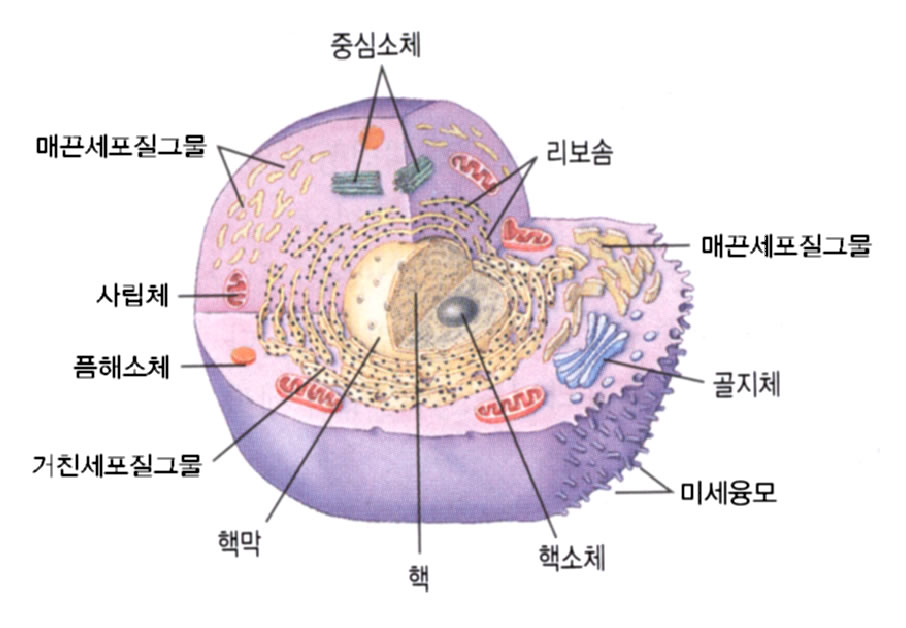 |
||
| 영문 | cell-mediated immunity | 한글 | 세포매개면역 |
|---|---|---|---|
| 설명 | 면역이란 신체를 외부의 물질로부터 보호하는 행위를 말한다. 여기에는 특이적 면역과 비특이적 면역의 두 가지가 있다. 비특이적 면역이라함은 특정한 물질에 관계하는 면역이 아니라 특정 대상이 없이 모든 외부 물체에 작용할 수 있는 면역을 말한다. 여기에는 소변의 흐름, 눈물의 흐름, 피부의 비투과성 등의 기계적인 것도 포함되고 피속에 돌아다니는 세포 중에서 비특이적으로 외부의 물질을 포식하는 세포들(예를 들면 큰포식세포(macrophage)의 활동도 포함이 된다. 세포매개면역이란 특이한 물질을 감지할 수 있는 세포를 생성하게 하여 그것으로 하여금 그 물질을 포식하게 하는 것을 말한다. |
||
| HCG, hCG | Human Chorionic Gonadotropin; 사람융모성성선자극호르몬 1. Placental Glycoprotein Hormone &nbs... |
|---|---|
| ICD | I-cell disease; immune complex disease; implantable cardioverter defibrillator; impulse-control diso... |
| BCDF | B-cell differentiation factor |
| CD | cadaver donor; canine distemper; canine dose; carbohydrate dehydratase; carbon dioxide; cardiac dise... |
| SIDS | Sudden Infant Death Syndrome; 영아 돌연사 증후군 = Crib Death |
| sex differentiation | Differentiation of male and female tissues and organs during embryogenesis, but after sex determination (sex determination (genetic)). (12 Dec 1998) |
|---|---|
| sex differentiation disorders | Disorders in the differentiation process of gonadal tissues and organs during embryogenesis. (12 Dec 1998) |
| neuronal differentiation | Acquisition during development of specific biochemical, physiological and morphological properties by nerve cells. (18 Nov 1997) |
| differentiation | The distinguishing of one thing or disease from another. (18 Nov 1997) |
| differentiation antigen | Any large structural macromolecule that can be detected by immune reagents and that also is associated with the differentiation of a particular cell type or types. Many cells can be identified by their possession of a unique set of differentiation antigens. There should be no implication that the antigens cause differentiation. (18 Nov 1997) |
| invisible differentiation | Differentiation of the cellular chemical constituents in the embryo prior to cytodifferentiation; sometimes recognizable histochemically. Synonym: invisible differentiation. (05 Mar 2000) |
| echocardiographic differentiation | The processing of a signal so that the output depends upon the rate of change of the input; e.g., it will display changes in amplitude but will reduce the duration of the waveform. (05 Mar 2000) |
| attitude to death | Conceptual response of the individual to the various aspects of death, which are based on his psychosocial and cultural experience. (12 Dec 1998) |
| Black Death | <disease, organism> Yersinina pestis is a gram-negative, rod-shaped, faculatively anaerobic bacterial species in the family Enterobacteriaceae. It causes bubonic plaque, which is transmitted by rodent fleas. Historically known as the Black Plague, this disease devastated Europe and Asia in the 1300s. It still exists today and is characterised by sudden high fever, chills, excessively swollen and tender lymph nodes (buboes), followed by tissue bleeding and gangrene. Other complications include pneumonia and septicaemia. (12 Nov 1997) |
| brain death | Total cessation of brain function for 24 hours as manifested by absence of spontaneous movement, absence of spontaneous respiration, and absence of all brainstem reflexes. (12 Dec 1998) |
| rate, death | The number of deaths in the population divided by the average population (or the population at midyear) is the crude death rate. In 1994, for example, the crude death rate per 1,000 population was 8.8 in the united states, 7.1 in Australia, etc. A death rate can also be tabulated according to age or cause. (12 Dec 1998) |
| genetic death | Death of the bearer of a gene at any age before generating living offspring. May be compatible with good health and long life. See: genetic lethal. (05 Mar 2000) |
| maternal death | Death of a woman while pregnant or within 42 days after the termination of gestation, irrespective of the duration and site of pregnancy and the cause of death; two periods are recognised in the 42-day interval: period 1 includes day 1 to day 7; period 2 includes day 8 to day 42. Maternal death's are further classified as: (05 Mar 2000) |
| maternal death rate | The number of maternal deaths that occur as the direct result of the reproductive process per 100,000 live births. See: rate. See: maternal death. (05 Mar 2000) |
| cause of death | Factors which produce cessation of all vital bodily functions. They can be analyzed from an epidemiologic viewpoint. (12 Dec 1998) |