
| 영문 | mast cell | 한글 | 비만 세포 |
|---|---|---|---|
| 설명 | 동물의 결합 조직 가운데 널리 분포하는 세포. 결합조직과 점막조직 내에 있는 호염기성 색소로 이염색성(metachromasia)을 나타내는 과립을 가진 방추형의 세포에 작은 둥근 핵을 가진다. 비만세포의 표면에는 IgE에 대한 수용체가 존재하며, 수용체에 결합한 IgE 분자들끼리 다가의 항원에 의해 서로 연결되면 비만세포 과립탈출 반응이 일어나, 히스타민, 세로토닌, 헤파린 등의 화학전달 물질이 방출되어, 즉시형 알레르기 반응 등의 증상을 일으킨다. 피부, 장막, 혈관 주위, 점막 주변에 있다. |
||
| 영문 | cell | 한글 | 세포 |
|---|---|---|---|
| 설명 | 생명체를 이루는 구조적, 기능적 단위. 핵의 유무에 따라서 유핵세포와 무핵세포로 나눌 수가 있다. 무핵세포란 핵이 없는 세포를 말한다. 핵이란 유전정보를 가지고 있는 염색체를 보관하는 곳인데 무핵세포에서는 염색체가 세포속에 그냥 노출되어 있다. 대개 세포 하나하나가 독립된 생명체의 역할을 하는 단세포생물로서 외부환경으로부터 자신을 보호할 수 있는 견고한 세포벽을 가지고 있다. 유핵세포란 핵을 가지고 있어서 유전정보가 있는 염색체가 세포의 다른 부분과 구분되어 핵속에 들어있다. 세포속에서 핵외의 부분(이를 세포질이라 한다)에는 여러 가지 세포의 소기관이 있어서 세포의 다양한 기능을 분담한다. ◈유핵세포의 기본 구조 1.세포막-세포를 둘러싸서 주위환경과 분리하여 세포의 내환경을 유지한다. 2.형질내세망(endoplasmic reticulum)-단위막으로 둘러쌓여 있는 불규칙한 망상구조이다. 이 망상구조의 내부를 소강, 소조라고 부른다. 여기에는 표면이 매끈한 무과립형질내세망과 표면이 불규칙한 과립형질내세망의 두 가지가 있다. 과립형질내세망의 경우는 표면에 단백질을 합성하는 리보솜이라는 것이 부착되어 있다. 이곳은 주로 세포밖으로 분비할 단백질을 합성하는 장소이다. 무과립형질내세망은 표면에 리보솜이 부착되어 있지 않은 것을 말하며, 이곳에서는 주로 해독작용, 글리코겐의 합성, 스테로이드호르몬의 합성 등이 일어난다. 3.리보솜-단백질을 합성하는 역할을 하는 곳이다.이것은 세포질에 존재하는 자유리보솜과 과립형질내세망에 부착이 되어 존재하는 부착리보솜의 두 가지로 나눈다. 자유리보솜은 주로 세포내에서 필요한 단백질을 만드는 역할을 하고 부착리보솜은 세포밖으로 분비할 단백질을 만드는 역할을 한다. 4.골지장치(Golgi apparatus)-핵주위에 분포하는 납작해진 주머니모양의 것이 중첩되어 형성된 층판 모양의 구조물로 과립형질내세망에서 생성되어 외부로 분비될 단백질을 모아서 농축, 포장하여 과립을 만드는 역할을 한다. 5.사립체(mitochondria)-구형, 난형의 긴 막대기 모양으로 크기가 다양한 구조물. 생물체의 에너지 저장물질인 ATP를 생산하는 역할을 한다. 또 세포와 다른 자신만의 유전정보를 가진 DNA, RNA를 가지고 있다. 모양, 크기가 세균과 비슷하며 자체증식성 등 독립된 생명체로서 필요한 요건을 갖추고 있어서 세포와 공생관계를 가진 독립된 세포로 생각하고 있다. 6.용해소체(lysosome)-작은 구형의 소체로 여러 가지 분해효소를 가진다. 세포외계에서 들어온 물질과 결합하여 그 물질들을 용해하는 역할을 하고, 오래된 세포소기관들을 제거하는 역할도 한다. 7.세포핵(nucleus)-구형, 난형으로 세포의 중심에 위치한다. 핵내에는 유전정보가 있는 물질인 염색체가 존재한다. 8.중심소체(centrosome)-핵주위에 존재하면서 핵의 분열시에 양쪽의 염색체를 당기는 작은 섬유를 만드는 역할을 하는 곳. 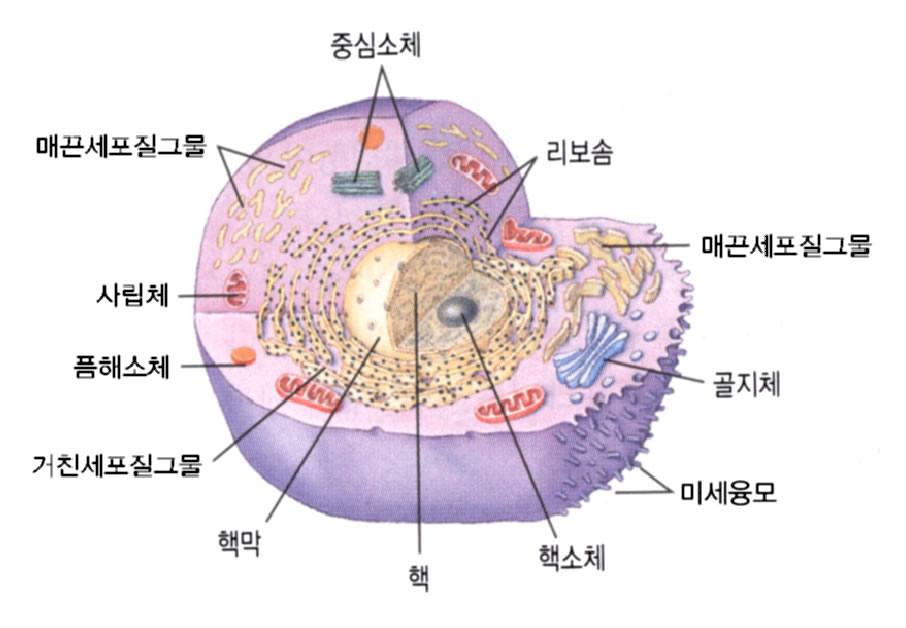 |
||
| 영문 | cell-mediated immunity | 한글 | 세포매개면역 |
|---|---|---|---|
| 설명 | 면역이란 신체를 외부의 물질로부터 보호하는 행위를 말한다. 여기에는 특이적 면역과 비특이적 면역의 두 가지가 있다. 비특이적 면역이라함은 특정한 물질에 관계하는 면역이 아니라 특정 대상이 없이 모든 외부 물체에 작용할 수 있는 면역을 말한다. 여기에는 소변의 흐름, 눈물의 흐름, 피부의 비투과성 등의 기계적인 것도 포함되고 피속에 돌아다니는 세포 중에서 비특이적으로 외부의 물질을 포식하는 세포들(예를 들면 큰포식세포(macrophage)의 활동도 포함이 된다. 세포매개면역이란 특이한 물질을 감지할 수 있는 세포를 생성하게 하여 그것으로 하여금 그 물질을 포식하게 하는 것을 말한다. |
||
| 영문 | nerve cell | 한글 | 신경세포 |
|---|---|---|---|
| 설명 | 신경세포는 올바른 신경전달을 위한 각 부분별로 나뉘어져 있다. 신경세포에서는 전해져오는 자극을 전기적인 신호로 바뀌어 보내거나 받게 된다. 이런 전기적인 현상은 각 신경세포내에 존재하는 각 이온채널(ion channel: ion이란 나트륨, 칼륨 등을 지칭하는 말들로써, 이들이 세포막에 의해 나뉘어질 때 생기는 전압차가 전기적 자극을 일으키고 유지하는데 결정적인 역할을 한다)들의 작용에 의해 이루어지게 된다. |
||
| 영문 | glia cell | 한글 | 아교세포 |
|---|---|---|---|
| 설명 | 신경세포 사이에서 그물구조를 이루며 이를 지지하는 조직. 신경아교세포는 신경모세포와 갈라진 아교모세포가 다시 여러 형태로 분화-성장한 것이다. 뇌실이나 척수중심관의 벽을 덮고 원주상 또는 입방형이며, 초기에는 유리면에 섬모가 있다. 대형세포는 별뇌실막세포는 아교세포라고 하며, 신경세포나 신경섬유 사이에 산재한다. 그 외에 희소돌기아교세포도 포함된다. |
||
| CCA | cephalin cholesterol antigen; chick cell agglutination; chimpanzee coryza agent; choriocarcinoma; ci... |
|---|---|
| ADCC cell | Antibody Dependent Cellular(= Cell-Mediated) Cytotoxicity cell |
| HCG, hCG | Human Chorionic Gonadotropin; 사람융모성성선자극호르몬 1. Placental Glycoprotein Hormone &nbs... |
| Th cell | helper T cell(= T4 cell) |
| Ts cell | suppressor T cell(= T8 cell) |
| FTDP-17 | Frontotemporal dementia and Parkinsonism linked to chromosome 17 |
|---|---|
| FTDP-17 | Frontotemporal dementia with Parkinsonism linked to chromosome 17 |
| MAC | mammalian artificial chromosome |
| MMCT | Microcell-mediated chromosome transfer |
| MCM | Mini-chromosome maintenance |
| chromosome 10 | 10q deletion occurs de novo and shows various malformations, high wide forehead with normocephaly, wide and bulbous tip of the nose, microretrognathia and severe mental retardation. This monosomy is rather rare and is reportedly associated with total colonic aganglionosis with small bowel involvement (TCSA), a variant of Hirschsprung disease. The clinical phenotype of 10p duplication, which is due to malsegregation of a familial translocation, includes severe postnatal growth retardation, profound mental retardation, several major and minor anomalies, dolichocephaly, harelip producing the appearance of a turtle's beak, cleft lip/palate in the absence of harelip, large low set ears, osteoarticular anomalies with hyperflexion of upper limbs and abduction-flexion of lower limbs, etc. Lethality seems considerable. Most cases of trisomy 10qter result from a parental translocation or inversion. More severe clinical manifestations are reported for trisomy 10q24, owing to heart and renal malformations and profound mental retardation. Trisomy 10q25 lacks major malformations, the mental retardation is moderate and the prognosis is favourable. The clinical features include high protruding forehead, round, broad and flat face, fine and arched eyebrows, downward slanting palpebral fissures, blepharophimosis, hypertelorism, hypoplastic and pinched nasal bridge, a small and often beaked nose, cleft palate, ligamentary hyperlaxity, and hypotonia. Inner organ malformations are rare but mental deficiency is severe. 10q monosomy is quite rare and the main features are severe mental retardation, microcephaly, low birth weight, prominent nose bridge, long face, and anomalies of external genitalia. The phenotype of ring chromosome 10 is not very characteristic and includes cardiac and renal anomalies, small stature and moderate mental retardation. Prenatal diagnosis of trisomy 10 is reported. Dysmorphic features include foetal nuchal edema, cleft lip/palate, small lower jaw, rocker-bottom foot, polydactyly, hitch-hiker thumb, syndactyly and inner organ malformations. Genes on chromosome 10 include those encoding glutamate oxaloacetate transaminase, orithine amino transferase and hexokinase 1. Chromosome 10 shows 2 fragile sites in the long arm, 10q23 and 10q25, which probably accounts for its increased involvement in chromosomal anomalies. (05 Mar 2000) |
|---|---|
| chromosome 11 | 11p13 monosomy usually occurs de novo and is called the WAGR syndrome. The most constant anomaly is bilateral Aniridia with other ocular anomalies. It is also associated with mental and growth retardation, ambiguous genitalia, nephroblastoma (Wilms tumour) or gonadoblastoma. Familial Aniridia is described with cryptic inversion involving breakpoints within band 11p13. 11p trisomy involving segment 11p12 to 11p14 shows no characteristic ocular anomaly nor signs of malignancy but rather a high convex forehead, frontal upsweep of hair, wide nose bridge, hypertelorism, short wide beaked nose, round chubby cheeks, cleft lip/palate, hypotonia and severe mental retardation. 11p15 duplication shows features of Beckwith-Wiedemann syndrome, macrosomia, dysmorphic facies, cleft palate and mild mental retardation. 11q2 trisomy nearly always results from a malsegregation of a parental translocation. The phenotype includes long prominent philtrum, retracted lower lip, microretrognathia frequently accompanied by malformations of the palate and by glossoptosis, suggestive of Pierre Robin syndrome, preauricular pits and flexion contracture of the limbs. Mental retardation and inner organ malformations are severe. A specific translocation (11;22) involving most frequently breakpoints 11q23 and 22q11 leads to a trisomy with a phenotype very similar to that of 11q2 trisomy. Some additional features probably due to the associated 22 trisomy are preauricular tags, anal atresia or stenosis. The prognosis is characterised by high frequency of early deaths. 11q-syndrome with deletion 11q24 shows congenital heart defects and coarse facial features. The main clinical features of a terminal deletion 11q23 include trigonocephaly, hypertelorism, micrognathia and heart defects. The critical chromosome segment appears to be within the 11q24.1 segment. Considerable growth and mental retardation are usual. The deletion occurs de novo in the majority of cases. Ring chromosome 11 is rare and the phenotype includes mental retardation, failure to thrive/small stature, microcephaly and cafe-au-lait spots. Paracentric inversion inv(11)(q13q25) is associated with polysplenia syndrome including bilateral left sidedness sequence accompanied by complex cardiac malformations and failure of normal asymmetry in morphogenesis. Important genes are localised on chromosome 11, include those for non-alpha globins, whose mutations are responsible for sickle cell anaemia and |
| chromosome 12 | Deletion of the proximal short arm of chromosome 12 is rare and occurs de novo. Microcephaly, narrow forehead, pointed nose and micrognathia are present. Mental and growth retardation are significant but inner organ malformations are generally not present. 12p trisomy nearly always results from a familial translocation. The phenotype includes turricephaly with flat apex, high bulging forehead, flat rectangular face, pronounced hypertelorism, a very short nose with a broad and poorly defined bridge, a short neck with cutaneous folds, ear abnormalities, hypotonia, severe growth and mental retardation and signs of precocious aging in adolescents. Tetrasomy 12p is consistent with Pallister-Killian syndrome. The critical region appears to be confined to 12p11.2. 12q2 trisomy is uncommon and results most frequently from malsegregation of a parental translocation. The patients show a relatively large head with frontal bossing, rectangular face with chubby cheeks and short limbs, especially in the proximal segment. Mental retardation is severe and growth retardation variable. Among others, genes for lactate dehydrogenase B, phenylalanine hydroxylase and haemolytic anaemia due to glyceraldehyde -3-phosphate dehydrogenase deficiency are assigned to chromosome 12. (05 Mar 2000) |
| chromosome 13 | Trisomy 13 or Patau syndrome is characterised by urogenital, cardiac, craniofacial, central nervous system and growth abnormalities. Defects include mental retardation, bilateral harelip and cleft palate, uni- or bilateral hexadactyly, growth retardation, polycystic kidney, ocular abnormalities, congenital heart disease and holoprosencephaly. Over 95% of human trisomy-13 conceptions spontaneously abort. Viable births rarely have prolonged survival. Approximately 80% of the cases involve free 13 trisomy. In 20% of the cases, either a mosaic or trisomy due to a translocation is involved. In cases of mosaicism, the severity of the clinical features can be diminished. A translocation, almost always t(13qDq) and more expressly t(13q14q), can occur de novo or can be transmitted by one of the parents. Rarely, more complex rearrangements are observed. A number of observations of partial 13q trisomies are reported involving segments of variable length, with breakpoints occurring at different sites on 13q. One of the most frequent sites is the interface between q14 and q21. When the trisomy includes the q2 and q3 regions, it leads to a distinctive clinical syndrome. Facial dysmorphism resembles that of Cornelia de Lange syndrome. Respiratory distress and neonatal feeding difficulties are common. A small percentage of partial trisomies is due to de novo duplication. The majority are the result of a malsegregation of a parental rearrangement (a reciprocal translocation or a pericentric inversion). Either total or partial monosomy 13q3 includes rings and terminal deletions and intercalary deletions which include band q14 and are accompanied by a retinoblastoma. The classical "13q-" syndrome is associated with deletions in 13q32. The most distinctive sign is the absence of a defined nasal bridge producing a Greek profile. Microcephaly is often severe with brain malformations. Upper incisors set in a "rabbitlike" forward slant are highly characteristic. Hypoplasia or absence of the thumb, agenesis of the first metacarpal, fusion of the fourth and fifth metacarpals and syndactyly, eye malformations, bone and GI anomalies and considerable growth and mental retardation are frequently found. Deletions limited to bands more proximal to 13q32 are associated with growth retardation and moderate mental retardation, but not with major malformations. Deletions limited to bands distal to 13q32 have severe mental retardation without major malformations and usually without growth failure. The characterization of 13q14 monosomy is justified by the existence of retinoblastoma. From the cytogenetic standpoint, this is a very heterogeneous group, with the deletion capable of extending on both sides of q14, from q11 to q22. The deletion usually occurs de novo and can also result from a parental insertion. In ring 13, certain features of partial or complete 13 trisomy can be seen, due to partial duplication of the rings. The study of patients afflicted with del(13)-retinoblastoma allowed the precise assignment of the gene for esterase D to 13q14.11. Other important genes on chromosome 13 include those for Wilson disease and propionyl CoA-carboxylase. (05 Mar 2000) |
| chromosome 14 | Trisomy 14 occurs de novo and is due to mosaicism. The distinct phenotype includes postnatal growth retardation, psychomotor retardation, prominent forehead, broad nose, dysmorphic ears, cleft or high arched palate, wide mouth, micrognathia, congenital heart disease, a short neck, asymmetry, abnormal skin pigmentation and hypertelorism. Proximal 14 trisomy (14q1 trisomy) is almost always due to a malsegregation from a parental translocation. Growth and mental retardation are severe and the nose is prominent with broad nasal bridge, the upper lip is long with poorly defined philtrum, the mouth resembles the arc of a circle and the Cupid's bow is replaced by a medial notch. The commissures do not form an acute angle but are ovalised by the sagging of the external portions of the lower lip. Hypotelorism is present and anomalies of the limbs are frequent but longevity is generally not impaired. 14q32 trisomy shows macroglossia, mid-face hypoplasia, hypertelorism, umbilical hernia, hepatomegaly, cardiomegaly and moderately delayed psychomotor development. Seizures are reported. Deletion 14(q11.1q13) is associated with hypotelorism, lack of nasal bridge, flattened nasal tip with no visible septum, wide midline cleft of lip and hard palate, ptosis of upper eyelid and semilobar holoprosencephaly. Ring chromosome 14 shows seizures, mild facial dysmorphism, developmental and moderate growth delay. Chromosome 14 carries the family of genes which encode the heavy chain of immunoglobulins. (05 Mar 2000) |
| chromosome 15 | Mosaic trisomy 15 is reported with no major or visible dysmorphia and severe inner organ defect. Duplication in the 15q11-13 region is also reported, although rarely, and can be associated with Prader-Willi syndrome. The phenotype includes developmental delay, particularly concerning acquisition of speech, ataxic gait with similarities to Angelman syndrome and seizures. Craniofacial dysmorphism includes oval face, high cheekbones and deep orbits. The trisomy can result from a malsegregation of a parental translocation, or can occur de novo with the presence of a supernumerary acrocentric chromosome of the size of a G-group chromosome or a supernumerary chromosome carrying satellites at both extremities. The latter rearrangement causes partial 15 tetrasomy results from an inverted duplication of chromosome 15. Patients with inv dup(15) show normal growth, moderate to severe mental retardation, seizures, poor motor coordination, behavioural problems, autism and mild dysmorphic features. Triplication in the same 15q11-13 region is also reported. Clinically, the patients present with hypotonia, developmental delay, visual impairment and minor dysmorphic features. 15q2 trisomy results from malsegregation of a parental translocation and shows a highly characteristic craniofacial dysmorphism including microdolichocephaly, narrow palpebral fissures, protuberant philtral borders and micrognathia. Various osteoarticular anomalies are observed. Inner organ malformations include heart disease. Mental retardation is severe. Prader-Willi syndrome and Angelman syndrome are distinct mental retardation disorders which result from paternal and maternal deficiency, respectively, for chromosome 15q11-q13. Approximately half of the patients with Prader-Willi syndrome show microscopically detectable paternally derived deletions, duplications and other chromosomal rearrangements of 15q11.2, or maternal uniparental disomy for chromosome 15. In contrast, Angelman syndrome can result from either maternally inherited deletions of this region or paternal uniparental disomy for chromosome 15. Major features of Prader-Willi syndrome include neonatal hypotonia with feeding difficulties, poor spontaneous movement, spells of cyanosis, a weak or absent cry, hypogonadism with cryptorchidism, mental retardation, obesity, hyperphagia and short stature. Features of Angelman syndrome include severe mental deficiency, ataxic (puppet-like) gait, prognathia and wide mouth, seizures and paroxysmal laughter. The phenotype of an interstitial deletion 15q13 includes gross congenital anomalies consisting of large fontanelles and sutures, midface hypoplasia, flat ears with thin cartilage, prominent eyes, anteverted nostrils, cleft palate, positional deformation of hands and feet, hypertonia and inner organ malformations. The phenotype shows few overlapping features with Prader-Willi syndrome or Angelman syndrome. Ring chromosome 15 is a rare cytogenetic disorder characterised by growth retardation, microcephaly, triangular facies, hypertelorism, brachydactyly, variable mental retardation and speech delay. Gene assignments to chromosome 15 include the gene coding for hexosaminidase-A, whose mutation causes Tay-Sachs disease, and the major gene for Marfan syndrome. (05 Mar 2000) |
| chromosome 16 | Trisomy 16, the most common autosomal aneuploidy encountered in spontaneous abortuses, is rarely diagnosed in ongoing pregnancies and is considered lethal. However, cases of trisomy 16 mosaicism ascertained either by amniocentesis or in liveborn infants are reported. The liveborns exhibit a distinct and recognizable phenotype of highly variable severity, with multiple congenital anomalies and dysmorphic features including asymmetry, intrauterine growth retardation, congenital heart disease, respiratory tract and musculoskeletal defects. The phenotype of 16p trisomy includes considerable intrauterine and postnatal growth retardation, small round skull, scant lashes and eyebrows, round flat face, prominent maxillae, micrognathia, round low-set ears with hypoplastic tragus and helix and protuberant anthelix, aplasia or hypoplasia of the thumb and severe mental impairment. All reported cases of complete or partial duplication of 16q result from a parental translocation. Frequent findings include growth retardation, mental handicap, asymmetrical head, high forehead, short prominent or beaked nose, long philtrum and thin upper lip. Osteoarticular and perineal anomalies are constant. Duplication 16q13 shows multiple malformations including ambiguous genitalia, congenital heart disease, syndactyly and unusual facies including downslanting palpebral fissures, low set ears with severe unilateral microtia, micrognathia and cleft palate. Chromosome 16 gene assignments include the alpha-globin genes, whose mutations cause thalassaemias, and the genes for haptoglobin, adult polycystic kidney disease, and others. (05 Mar 2000) |
| Chromosome 17 | Chromosome 17 imbalances are not compatible with life. The phenotype of 17q2 trisomy, which is caused by a malsegregation of a parental translocation, includes microcephaly with high forehead, frontal bossing, high hairline with widow's peak, short thick neck, squinty eyes, large mouth with downturned corners, brachyrhizomelia, hexadactyly and severe mental retardation. Severe inner organ malformations are reported in patients with trisomy 17q23. Charcot-Marie-Tooth is the most common peripheral neuropathy, occurring at a frequency of 1 in 2500. The most prevalent form of the disease, type 1 Charcot-Marie-Tooth , is characterised by significantly reduced nerve conduction velocities. The disease phenotype has been shown to segregate with a submicroscopic DNA duplication within 17p11.2, and Charcot-Marie-Tooth 1a patients are reported with cytogenetically visible duplication of 17p11.1-17p12. The disease phenotype is probably due to a gene dosage effect. Miller-Dieker syndrome is comprised of a characteristic facial appearance and lissencephaly (smooth brain). Most Miller-Dieker syndrome patients have microdeletions of 17p13.3, detectable cytogenetically or submicroscopically. Smith-Magenis syndrome is a clinically recognizable multiple congenital anomaly/MR syndrome associated with deletion of chromosome 17(p11.2). The patients show dysmorphic features including broad flat midface with brachycephaly, broad nasal bridge, brachydactyly, speech delay and hoarse deep voice, short stature, developmental delay and self- destructive behaviour, primarily onychotillomania and polyembolokoilamania, and sleep disturbances. Gene assignments include the p53 tumour suppressor, Charcot-Marie-Tooth type 1a,8 galactokinase and Niemann-Pick disease. (05 Mar 2000) |
| chromosome 18 | Edwards syndrome (trisomy 18), the second most common autosomal trisomy with an occurrence rate of 1 in 8,000 live births, is associated with a distinct pattern of dysmorphogenesis and congenital abnormalities which results in early death. Marked growth deficiency is a major trait of the phenotype. Other striking clinical features of this syndrome include congenital heart abnormalities, mental and developmental delays, prominent occiput, faunlike ears, micrognathia, short sternum, narrow pelvis, overlapping fingers and rocker-bottom feet. The 18q12.2 subband is identified as the critical region in the trisomy 18 phenotype. Trisomy 18 mosaicism can present with minimal non-specific signs and no typical stigmata of the full trisomy. Although Edwards syndrome is typically associated with duplication of the entire chromosome 18, several individuals with partial trisomies of chromosome 18 (18q2 trisomy, 18p & q1 trisomy) are reported. These patients display a range of severity from a relatively mild phenotype with no internal organ malformations to the classic characteristics of Edwards syndrome. Isochromosome 18p [i(18p)] is described 6 and is associated with a distinctive syndrome, tetrasomy 18p, which includes low birth weight, characteristic facies, neonatal hypotonia with subsequent limb spasticity, short stature, microcephaly, mental retardation and seizure disorders. Isochromosome 18q is a rare cytogenetic abnormality resulting in trisomy for the q arm and monosomy for the p arm of chromosome 18. Phenotypic characteristics are not yet fully delineated. Clinical and pathological examination reveals features characteristic of both trisomy 18 and monosomy 18p or features characteristic of trisomy 18 alone. Severe cephalic malformations such as holoprosencephaly, cebocephaly and cyclopia are reported in i(18q), but are rarely described in trisomy 18 and are only occasional findings in monosomy 18p. Isodicentric chromosome 18 was described and the clinical findings are associated with both the trisomy 18 and 18p- syndromes. The 18q- syndrome or 18q2 monosomy is a well-described partial aneusomy disorder resulting from the deletion of a portion of the long arm of chromosome 18. Typically, patients with this syndrome show growth deficiency, dysmorphic facial features, limb defects, genitourinary malformations, neurologic and ocular anomalies, and developmental delay with mental retardation. The dysmorphic features are mild and include midfacial hypoplasia, carp-shaped mouth and abnormally folded ears. Neurologic findings consist of hypotonia, poor coordination, choreoathetotic movements and ophthalmologic abnormalities. Proximal interstitial deletion of 18q involving band 18q12.3 is recognised with a distinctive phenotype including moderate to severe MR, high forehead, deep-set eyes, hypotelorism, flat nasal bridge, dysplastic ears, excess dermatoglyphic whorls and aggressive behaviour. In the majority of deletions of the short arm of chromosome 18 (18p monosomy or 18p- syndrome), dysmorphism is not very distinctive. Psychomotor retardation is more or less severe. The ring 18 phenotype shares features of the 18p- syndrome and those of the 18q- syndrome with predominance of the features of the 18q monosomy. Mosaicism is frequently observed with ring chromosomes. The gene for peptidase A is localised to 18q23. (05 Mar 2000) |
| chromosome 19 | The phenotype of 19q trisomy, which is caused by malsegregation from familial translocation, includes microcephaly with brachycephaly, flat face, widely gaping cranial sutures, hypertelorism and palpebral ptosis, fishlike mouth, short neck, small pudgy hands and feet, growth retardation, slight to very severe mental retardation. Duplication of 19p13.1 and part of 19p13.2 is associated with developmental delay, unusual lower facial features including vertical ridging on the chin, extra philtral pillar, midline ridge on the anterior portion of the tongue and congenital heart defect. A placental karyotype of nonmosaic trisomy 19 was described with an abnormal foetus surviving to midtrimester. Gene assignments on chromosome 19 include the gene for myotonic dystrophy at 19q13.3, Lewis and Lutheran blood groups and the chorionic gonadotrophin |
| chromosome 20 | The phenotype of trisomy 20p, which results from a parental translocation, includes mild to moderate developmental delay, round face with telecanthus, flat nasal bridge and short palpebral fissures but major pre- and postnatal growth development malformations are rare. The phenotype of interstitial 20p deletion is consistent with Alagille syndrome, an autosomal dominant disease with reduced penetrance and variable expressivity, and is defined by bile duct paucity in association with cardiac, skeletal, ocular and facial abnormalities. 20q13 trisomy shows brachycephaly, hypertelorism, ear anomalies, cleft palate, micrognathia, chin dimple, anteverted nares, CNS malformations, heart defects, psychomotor retardation and reduced life expectancy. Ring chromosome 20 presents with absence of major congenital malformations and paucity of dysmorphic features. Patients can show behavioural problems, seizures, mild dysmorphic features and variable degrees of mental retardation. Sipple syndrome, or multiple endocrine neoplasia type 2, is assigned to chromosome 20p. (05 Mar 2000) |
| chromosome 21 | Down syndrome is the most common chromosome disorder seen in live births and is a leading cause of mental retardation. The frequency of the syndrome is estimated at 1 per 700 births and the risk increases exponentially with maternal age. Some of the manifestations are mental retardation, flat facies, oblique palpebral fissures, epicanthic folds, short broad hands, flattened occiput, cardiac abnormalities, hypotonia, Brushfield spots of the iris, abnormal dermatoglyphics, seizures, increased susceptibility to respiratory infections, increased incidence of leukaemia and premature ageing with Alzheimer-like brain degeneration. 92% to 95% of children born with Down syndrome have a free trisomy as a result of maternal nondisjunction (95%) or paternal nondisjunction (5%). Translocations account for the rest of the trisomies with t(14q21q) or t(15q2q) representing 54.2% of the cases, and t(21q21q) or t(21q22q)5 accounting for 40.9% of the cases. There are a few cases involving other chromosomes. In 55% of the cases, translocations involving the D group chromosomes arise de novo and in 45% of cases a parent carries the translocation. When a G group chromosome is involved t(21q21q) occurs 83.3% of the time. In the vast majority of cases t(21qGq) occurs de novo. Partial trisomy or tetrasomy 21 due to duplication of the distal segment 21q22 results in the classical Down phenotype. Partial trisomy of the proximal segment of 21q21 shows a fairly normal phenotype with moderate mental retardation. Monosomy-21 is not compatible with life. Deletions of chromosome 21 are associated with psychomotor and growth retardation, congenital heart disease, holoprosencephaly, microphthalmia, skeletal malformation, genital hypoplasia and other dysmorphisms. Infants with ring chromosome 21 syndrome, a countertype of trisomy-21, show hypotonia, growth retardation, microcephaly and protruding occiput. Other malformations include ocular, cardiac, digestive, urogenital and skeletal malformation. Mental retardation is severe. (05 Mar 2000) |
| chromosome 3p kinase | <enzyme> Located in the small cell lung cancer tumour suppressor gene region; shows extensive homology to mitogen-activated protein kinase-activated protein kinase 2 (mapkap kinase 2); genbank u09578 Registry number: EC 2.7.10.- Synonym: 3pk protein, 3pk gene product (26 Jun 1999) |
| chromosome 8 | Trisomy 8 mosaicism, one of the major cytogenetic syndromes, is characterised by a very suggestive facial dysmorphism, as well as osteoarticular anomalies. Craniofacial dysmorphism includes long face, lop-ear deformities, prominent forehead and overhang of lower lip. Osteoarticular anomalies include camptodactyly, brachydactyly or arachnodactyly, clinodactyly, clubfoot and joint contractures leading to permanent deformities. Deep palmar and plantar creases can be noted in young infants. Skeletal malformations are frequent and severe. Inner organ malformations are rare and kidney or congenital heart defect can be observed. Mental deficiency is not very pronounced. 8p monosomy often occurs de novo. Patients present with a small skull with protruding occiput, short nose, small mouth, and a short and wide neck. Cardiac malformations are frequent. The degree of mental retardation is variable. Inverted duplications of chromosome 8p with distal deletion of 8p are reported. Common clinical traits are hypotonia at birth, large mouth with thin upper lip, bulbous and broad nose, malformed ears, hand and feet anomalies and severe mental retardation. 8p trisomy can result from a parental translocation or can occur de novo. Patients have high prominent forehead, everted fleshy lower lip and flexion contractures of the limbs. Cardiac and cerebral malformations can be observed. Mental retardation is considerably more severe than with trisomy 8 mosaicism. Mosaic tetrasomy 8p resulting from an isochromosome 8p was described. The clinical phenotype can overlap in part with those of trisomy 8 or trisomy 8p, but shows distinctive features including agenesis of the corpus callosum, cardiac malformations and minimal facial dysmorphism. 8q2 trisomy usually results from a parental translocation or inversion. The phenotype includes prominent forehead with hypertelorism, very wide bridge of the nose with blunt nasofrontal angle, microretrognathia, detached and poorly folded ears, buccal deformities including bifid tip of the tongue, cleft upper gum, high arched or cleft palate and bifid uvula. Joint contractures are also noted. Cardiac malformations are frequent and severe. Mental retardation is variable. The Langer-Giedion syndrome, characterised by craniofacial dysmorphism and skeletal abnormalities, is caused by a genetic defect in 8q24.1. Among the gene assignments known for chromosome 8 is the gene for glutathione reductase, the deficiency of which causes a variety of haemolytic anaemia. (05 Mar 2000) |
| chromosome 9 | Trisomy 9 can be homogenous or mosaic. Microcephaly with dolichocephaly, enophthalmy and microretrognathia are present. Characteristic osteoarticular anomalies include dislocation of the hips, knees or elbows, deformities of the spinal cord and rib anomalies. Inner organ malformations involve cardiac, cerebral, renal and occasionally digestive anomalies. The prognosis is most severe. The 9p monosomy syndrome is characterised by trigonocephaly, long upper lip with undefined philtral borders, short nose, anteverted nares, psychomotor retardation, upward slant of palpebral fissures, dolichomesophalangy. Malformations are severe. The majority of the cases occur de novo, or can result from a parental translocation. 9p trisomy was the first partial trisomy identified before the use of banding techniques and is probably one of the most frequently detected. The majority of pure 9p trisomies occur de novo. In 9q trisomy and associated 9p trisomy, malsegregation of a parental rearrangement is always involved. Craniofacial dysmorphism includes brachycephaly, bulbous nose and short upper lip with a very characteristic asymmetric grin when the mouth opens. The knit brows, slanted palpebral fissures and mouth give a particularly distinctive worried look. The palms are long in comparison with the fingers. A single palmar crease is constant. Malformations are rare in cases of pure 9p trisomy but they are numerous and diverse in cases of associated 9p trisomy. Mental retardation is variable. Life expectancy is not impaired. Tetrasomy 9p is remarkable due to the infrequency of autosomal tetrasomies. The phenotype is variable and the facial dysmorphism can resemble that of 9p trisomy. Malformations are severe and numerous. Homogeneous tetrasomies lead to early death. Mosaicism appears to diminish the severity of the outlook. 9q32 trisomy shows dolichocephaly, deep set eyes with short palpebral fissures, large poorly folded ears, beaked nose, marked microretrognathia, long abnormally implanted fingers and toes and severe developmental delay. Inner organ malformations involve the heart. The trisomy results from a tandem duplication arising de novo or from malsegregation of a parental rearrangement. Interstitial deletion 9q22-q32 is reported with multiple congenital anomalies. The phenotype of ring chromosome 9 is variable and the principal features of 9p monosomy can be observed, as well as certain malformations seen in trisomy 9. Some major genes on chromosome 9 are those for the ABO blood group, fibroblast and leukocyte interferons, familial dysautonomia, Friedreich ataxia, nail-patella syndrome and galactose-1-phosphate uridyltransferase, whose deficiency causes galactosaemia. (05 Mar 2000) |