
| 영문 | thymus(gland) | 한글 | 가슴샘 |
|---|---|---|---|
| 설명 | 가슴의 앞 위쪽에 위치한 림프성 장기로서, 사춘기에 최고의 무게에 달했다가 이후에 퇴축한다. 이것은 세포매개 면역(cell-mediated immunity: 주로 T-림프구에 의해 일어나며, 자기와 다른 세포에 대한 인식과 이식거부반응에 관여함)기능의 발달과 성숙에 필요한 장기이며, 회백적색으로 보통 정중면에서 결합조직에 의해 결합된 두 개의 엽으로 되어 있다. 가슴샘은 상피세포, 림프구, 가슴샘세포로 구성되어 있으며 전구세포가 가슴샘에 이행하여 림프구로 분화되고, 그 대부분은 파괴되나 나머지는 T림프구를 형성한다. 가슴샘은 또한 호르몬 유사물질인 thymine, thymopoietin, thymosin 등을 분비한다. |
||
| 영문 | muscle cell(=muscle fiber) | 한글 | 근육세포 |
|---|---|---|---|
| 설명 | 근육은 수의근(의식에 의해서 조절이 가능한 근육: 예를 들어 다리, 팔, 얼굴근육 등)과 불수의근(의식과 무관하게 조절하지 않아도 움직이는 근육: 예를 들어 심장근, 소화기관에 분포하는 근육 등)으로 나누어지며, 근육세포의 모양은 다음과 같다(수의근, 불수의근 외에 심장에 있는 심장근은 불수의근에 해당하지만 그 모양은 수의근과 같아 따로 분류한다).  |
||
| 영문 | white blood cell(WBC), leukocyte | 한글 | 백혈구 |
|---|---|---|---|
| 설명 | 혈액내에 골수구계세포와 림프계세포, 단핵구계세포를 모두 통틀어 말한다. 백혈구의 증가가 있으면 대개 감염이 있거나, 혹은 탈수현상이 있음을 의미한다. 또한 지나친 백혈구수의 감소는 인체내 면역기능이 떨어져 있음을 의미하며, 다른 질병에 의해 나타나는 이차적인 현상이 아닌지 꼭 진단을 받아보아야 한다. |
||
| 영문 | mast cell | 한글 | 비만 세포 |
|---|---|---|---|
| 설명 | 동물의 결합 조직 가운데 널리 분포하는 세포. 결합조직과 점막조직 내에 있는 호염기성 색소로 이염색성(metachromasia)을 나타내는 과립을 가진 방추형의 세포에 작은 둥근 핵을 가진다. 비만세포의 표면에는 IgE에 대한 수용체가 존재하며, 수용체에 결합한 IgE 분자들끼리 다가의 항원에 의해 서로 연결되면 비만세포 과립탈출 반응이 일어나, 히스타민, 세로토닌, 헤파린 등의 화학전달 물질이 방출되어, 즉시형 알레르기 반응 등의 증상을 일으킨다. 피부, 장막, 혈관 주위, 점막 주변에 있다. |
||
| 영문 | cell | 한글 | 세포 |
|---|---|---|---|
| 설명 | 생명체를 이루는 구조적, 기능적 단위. 핵의 유무에 따라서 유핵세포와 무핵세포로 나눌 수가 있다. 무핵세포란 핵이 없는 세포를 말한다. 핵이란 유전정보를 가지고 있는 염색체를 보관하는 곳인데 무핵세포에서는 염색체가 세포속에 그냥 노출되어 있다. 대개 세포 하나하나가 독립된 생명체의 역할을 하는 단세포생물로서 외부환경으로부터 자신을 보호할 수 있는 견고한 세포벽을 가지고 있다. 유핵세포란 핵을 가지고 있어서 유전정보가 있는 염색체가 세포의 다른 부분과 구분되어 핵속에 들어있다. 세포속에서 핵외의 부분(이를 세포질이라 한다)에는 여러 가지 세포의 소기관이 있어서 세포의 다양한 기능을 분담한다. ◈유핵세포의 기본 구조 1.세포막-세포를 둘러싸서 주위환경과 분리하여 세포의 내환경을 유지한다. 2.형질내세망(endoplasmic reticulum)-단위막으로 둘러쌓여 있는 불규칙한 망상구조이다. 이 망상구조의 내부를 소강, 소조라고 부른다. 여기에는 표면이 매끈한 무과립형질내세망과 표면이 불규칙한 과립형질내세망의 두 가지가 있다. 과립형질내세망의 경우는 표면에 단백질을 합성하는 리보솜이라는 것이 부착되어 있다. 이곳은 주로 세포밖으로 분비할 단백질을 합성하는 장소이다. 무과립형질내세망은 표면에 리보솜이 부착되어 있지 않은 것을 말하며, 이곳에서는 주로 해독작용, 글리코겐의 합성, 스테로이드호르몬의 합성 등이 일어난다. 3.리보솜-단백질을 합성하는 역할을 하는 곳이다.이것은 세포질에 존재하는 자유리보솜과 과립형질내세망에 부착이 되어 존재하는 부착리보솜의 두 가지로 나눈다. 자유리보솜은 주로 세포내에서 필요한 단백질을 만드는 역할을 하고 부착리보솜은 세포밖으로 분비할 단백질을 만드는 역할을 한다. 4.골지장치(Golgi apparatus)-핵주위에 분포하는 납작해진 주머니모양의 것이 중첩되어 형성된 층판 모양의 구조물로 과립형질내세망에서 생성되어 외부로 분비될 단백질을 모아서 농축, 포장하여 과립을 만드는 역할을 한다. 5.사립체(mitochondria)-구형, 난형의 긴 막대기 모양으로 크기가 다양한 구조물. 생물체의 에너지 저장물질인 ATP를 생산하는 역할을 한다. 또 세포와 다른 자신만의 유전정보를 가진 DNA, RNA를 가지고 있다. 모양, 크기가 세균과 비슷하며 자체증식성 등 독립된 생명체로서 필요한 요건을 갖추고 있어서 세포와 공생관계를 가진 독립된 세포로 생각하고 있다. 6.용해소체(lysosome)-작은 구형의 소체로 여러 가지 분해효소를 가진다. 세포외계에서 들어온 물질과 결합하여 그 물질들을 용해하는 역할을 하고, 오래된 세포소기관들을 제거하는 역할도 한다. 7.세포핵(nucleus)-구형, 난형으로 세포의 중심에 위치한다. 핵내에는 유전정보가 있는 물질인 염색체가 존재한다. 8.중심소체(centrosome)-핵주위에 존재하면서 핵의 분열시에 양쪽의 염색체를 당기는 작은 섬유를 만드는 역할을 하는 곳. 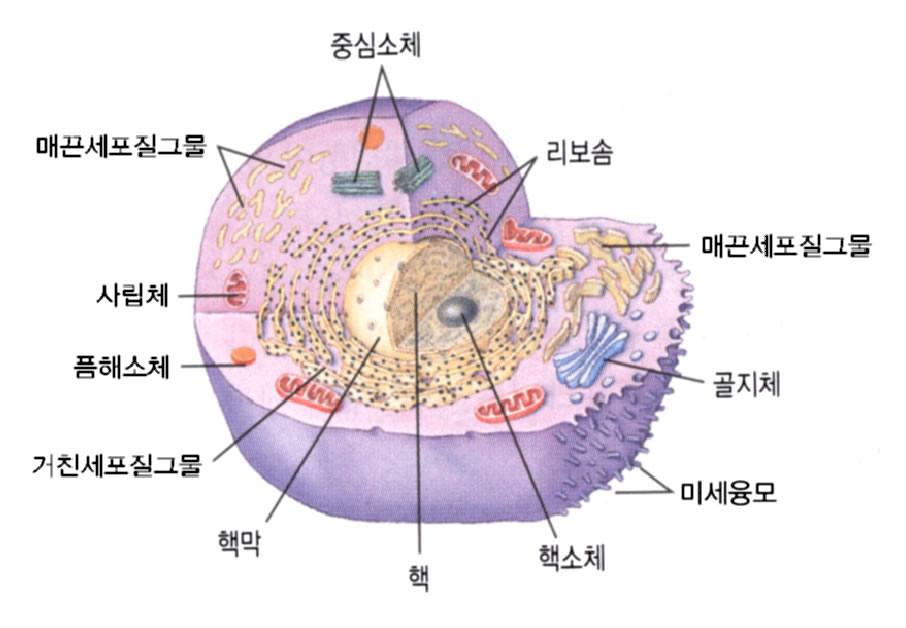 |
||
| TL | temporal lobe; terminal limen; thermolabile; thermoluminescence; threat to life; thymus-leukemia [an... |
|---|---|
| TCE | T-cell enriched; tetrachlorodiphenyl ethane; trichloroethylene T-cell thymus-derived cell |
| TP | temperature and pressure; temperature probe; temporal peak; temporoparietal; tension pneumothorax; t... |
| TPF | thymus permeability factor; thymus to peak flow; true positive fraction |
| MC | mass casualties; mast cell; Master of Surgery [Lat. Magister Chirurgiae]; maximum concentration; Med... |
| CTL | Cytotoxic thymus-derived lymphocytes |
|---|---|
| CT | Calf thymus |
| FTOC | Fetal Thymus Organ Culture |
| FT | fetal thymus |
| TL | Thymus Leukemia |
| thymus derived lymphocyte | <haematology, immunology> A class of lymphocytes, so called because they are derived from the thymus and have been through thymic processing. Involved primarily in controlling cell-mediated immune reactions and in the control of B-cell development. The T-cells coordinate the immune system by secreting lymphokine hormones. There are 3 fundamentally different types of t cells : helper, killer, and suppressor. Each has many subdivisions. T-cells are also called t lymphocytes. They bear T-cell antigen receptors (CD3) and lack Fc or C3b receptors. Major T-cell subsets are CD4 (mainly helper cells) and CD8 (mostly cytotoxic or suppressor T-cells). Uncontrolled proliferation of this type of cell gives rise to T-cell leukaemia/lymphoma. (21 Jun 1999) |
|---|---|
| brain-derived growth factor | <growth factor> Small basic protein purified from pig brain, a member of the family of neurotrophic factors that also includes Nerve Growth Factor and neurotrophin 3. In contrast to nerve growth factor, brain-derived neurotrophic factor is predominanantly (though not exclusively) localised in the CNS. It supports the survival of primary sensory neurons originating from the neural crest and ectodermal placodes that are not responsive to NGF. In the brain brain-derived neurotrophic factor has a trophic action on retinal, cholinergic, and dopaminergic neurons, and in the peripheral nervous system it acts on both motor and sensory neurons. Acronym: BDGF (12 Dec 1998) |
| brain-derived neurotrophic factor | <growth factor> Small basic protein purified from pig brain, a member of the family of neurotrophic factors that also includes Nerve Growth Factor and neurotrophin 3. In contrast to nerve growth factor, brain-derived neurotrophic factor is predominanantly (though not exclusively) localised in the CNS. It supports the survival of primary sensory neurons originating from the neural crest and ectodermal placodes that are not responsive to NGF. In the brain brain-derived neurotrophic factor has a trophic action on retinal, cholinergic, and dopaminergic neurons, and in the peripheral nervous system it acts on both motor and sensory neurons. Acronym: BDGF (12 Dec 1998) |
| mammary derived growth inhibitor | Fatty acid binding protein that inhibits proliferation of mammary carcinoma cells. (18 Nov 1997) |
| receptors, platelet-derived growth factor | Specific molecular sites or structures on cell membranes that react with platelet-derived growth factor, its analogs, or antagonists, to elicit or to inhibit the specific response of the cell to this factor. Pdgf binds with different affinities and specificities to two structurally related receptors, the alpha-receptor and the beta-receptor. Both of these receptors are transmembrane proteins with an intracellular, ligand-stimulatable protein kinase domain. (12 Dec 1998) |
| refuse-derived fuel | (RDF) Fuel prepared from municipal solid waste. Noncombustible materials such as rocks, glass, and metals are removed, and the remaining combustible portion of the solid waste is choped or shreaded. RDF facilities process between 100 and 3000 tons of MSW per day. (05 Dec 1998) |
| monocyte derived neutrophil chemotactic factor | <cytokine> A cytokine that activates neutrophils and attracts neutrophils and T-lymphocytes. It is released by several cell types including monocytes, macrophages, T-lymphocytes, fibroblasts, endothelial cells, and keratinocytes by an inflammatory stimulus. Il-8 is a member of the beta-thromboglobulin superfamily and structurally related to platelet factor 4. Acronym: IL-8 (12 Dec 1998) |
| platelet-derived growth factor | <growth factor> The major mitogen in serum for growth in culture of cells of connective tissue origin. It consists of 2 different but homologous polypeptides A and B (~30,000 D) linked by disulphide bonds. Believed to play a role in wound healing. It is carried in the alpha-granules of platelets and is released when platelets adhere to traumatised tissues. Connective tissue cells near the traumatised region respond by initiating the process of replication. The B chain is almost identical in sequence to p28sis, the transforming protein of simian sarcoma virus, that can transform only those cells that express receptors for platelet derived growth factor, suggesting that transformation is caused by autocrine stimulation. The receptor is a tyrosine kinase. Acronym: PDGF (12 Dec 1998) |
| schwannoma derived growth factor | <growth factor> A growth factor containing an EGF like domain, mitogenic for astrocytes, Schwann cells and fibroblasts. (18 Nov 1997) |
| derived protein | A derivative of protein effected by chemical change, e.g., hydrolysis. (05 Mar 2000) |
| oxygen derived free radicals | An atom or atom group having an unpaired electron on an oxygen atom, typically derived from molecular oxygen. For example, one-electron reduction of O2 produces the superoxide radical, O2-; other examples include the hydroperoxyl radical (HOO-), the hydroxyl radical (HO-), and nitric oxide (NO-). (05 Mar 2000) |
| endothelium-derived growth factor synthase | <enzyme> Converts l-arginine to a smooth muscle relaxing factor and stimulates the formation of cyclic-GMP Registry number: EC 1.5.1.- Synonym: edrf synthase (26 Jun 1999) |
| endothelium derived relaxation factor | <biochemistry> This compound is produced from L arginine by the enzyme nitric oxide synthase. Acts as a potent vasorelaxant via elevation of intracellular cGMP in vascular smooth muscle. Synthesis of nitric oxide is not confined to endothelium, isoforms of nitric oxide synthase are also found in brain, neutrophils and platelets. Synonym: endothelium derived relaxation factor. Acronym: NO (29 Dec 1997) |
| endothelium-derived relaxing factor | A labile humoral agent released by the vascular endothelium that mediates the relaxation induced by some vasodilators such as acetylcholine and bradykinin. Edrf also inhibits platelet aggregation, induces disaggregation of aggregated platelets, and inhibits platelet adhesion to the vascular endothelium. These actions are believed to be mediated through stimulation of guanylate cyclase and the consequent elevation of cyclic guanosine 3',5'-monophosphate. Edrf is thought to be nitric oxide or a ready source of it. The factor is believed to be unstable and acts only locally in vivo. (12 Dec 1998) |
| ribonuclease h, calf thymus | <enzyme> A ribonuclease that specifically cleaves the RNA moiety of RNA:DNA hybrids. It has been isolated from a wide variety of prokaryotic and eukaryotic organisms (particularly calf thymus) as well as retroviruses. Registry number: EC 3.1.26.4 (12 Dec 1998) |
제품명 |
판매사 |
보험코드 | 성분/함량 | 구분/보험급여 |
|---|
제품명 |
판매사 |
보험코드 | 성분/함량 | 구분/보험급여 |
|---|