
| 영문 | target tissue | 한글 | 표적조직 |
|---|---|---|---|
| 설명 | 호르몬에 대하여 표적이 되는 세포라는 의미로서 그 호르몬에 대한 수용체를 가지고 있는 세포. 예를 들어 인슐린은 인슐린 수용체를 가진 세포를 표적세포로 하여 이 세포에만 작용한다. |
||
| 영문 | muscle cell(=muscle fiber) | 한글 | 근육세포 |
|---|---|---|---|
| 설명 | 근육은 수의근(의식에 의해서 조절이 가능한 근육: 예를 들어 다리, 팔, 얼굴근육 등)과 불수의근(의식과 무관하게 조절하지 않아도 움직이는 근육: 예를 들어 심장근, 소화기관에 분포하는 근육 등)으로 나누어지며, 근육세포의 모양은 다음과 같다(수의근, 불수의근 외에 심장에 있는 심장근은 불수의근에 해당하지만 그 모양은 수의근과 같아 따로 분류한다).  |
||
| 영문 | white blood cell(WBC), leukocyte | 한글 | 백혈구 |
|---|---|---|---|
| 설명 | 혈액내에 골수구계세포와 림프계세포, 단핵구계세포를 모두 통틀어 말한다. 백혈구의 증가가 있으면 대개 감염이 있거나, 혹은 탈수현상이 있음을 의미한다. 또한 지나친 백혈구수의 감소는 인체내 면역기능이 떨어져 있음을 의미하며, 다른 질병에 의해 나타나는 이차적인 현상이 아닌지 꼭 진단을 받아보아야 한다. |
||
| 영문 | mast cell | 한글 | 비만 세포 |
|---|---|---|---|
| 설명 | 동물의 결합 조직 가운데 널리 분포하는 세포. 결합조직과 점막조직 내에 있는 호염기성 색소로 이염색성(metachromasia)을 나타내는 과립을 가진 방추형의 세포에 작은 둥근 핵을 가진다. 비만세포의 표면에는 IgE에 대한 수용체가 존재하며, 수용체에 결합한 IgE 분자들끼리 다가의 항원에 의해 서로 연결되면 비만세포 과립탈출 반응이 일어나, 히스타민, 세로토닌, 헤파린 등의 화학전달 물질이 방출되어, 즉시형 알레르기 반응 등의 증상을 일으킨다. 피부, 장막, 혈관 주위, 점막 주변에 있다. |
||
| 영문 | cell | 한글 | 세포 |
|---|---|---|---|
| 설명 | 생명체를 이루는 구조적, 기능적 단위. 핵의 유무에 따라서 유핵세포와 무핵세포로 나눌 수가 있다. 무핵세포란 핵이 없는 세포를 말한다. 핵이란 유전정보를 가지고 있는 염색체를 보관하는 곳인데 무핵세포에서는 염색체가 세포속에 그냥 노출되어 있다. 대개 세포 하나하나가 독립된 생명체의 역할을 하는 단세포생물로서 외부환경으로부터 자신을 보호할 수 있는 견고한 세포벽을 가지고 있다. 유핵세포란 핵을 가지고 있어서 유전정보가 있는 염색체가 세포의 다른 부분과 구분되어 핵속에 들어있다. 세포속에서 핵외의 부분(이를 세포질이라 한다)에는 여러 가지 세포의 소기관이 있어서 세포의 다양한 기능을 분담한다. ◈유핵세포의 기본 구조 1.세포막-세포를 둘러싸서 주위환경과 분리하여 세포의 내환경을 유지한다. 2.형질내세망(endoplasmic reticulum)-단위막으로 둘러쌓여 있는 불규칙한 망상구조이다. 이 망상구조의 내부를 소강, 소조라고 부른다. 여기에는 표면이 매끈한 무과립형질내세망과 표면이 불규칙한 과립형질내세망의 두 가지가 있다. 과립형질내세망의 경우는 표면에 단백질을 합성하는 리보솜이라는 것이 부착되어 있다. 이곳은 주로 세포밖으로 분비할 단백질을 합성하는 장소이다. 무과립형질내세망은 표면에 리보솜이 부착되어 있지 않은 것을 말하며, 이곳에서는 주로 해독작용, 글리코겐의 합성, 스테로이드호르몬의 합성 등이 일어난다. 3.리보솜-단백질을 합성하는 역할을 하는 곳이다.이것은 세포질에 존재하는 자유리보솜과 과립형질내세망에 부착이 되어 존재하는 부착리보솜의 두 가지로 나눈다. 자유리보솜은 주로 세포내에서 필요한 단백질을 만드는 역할을 하고 부착리보솜은 세포밖으로 분비할 단백질을 만드는 역할을 한다. 4.골지장치(Golgi apparatus)-핵주위에 분포하는 납작해진 주머니모양의 것이 중첩되어 형성된 층판 모양의 구조물로 과립형질내세망에서 생성되어 외부로 분비될 단백질을 모아서 농축, 포장하여 과립을 만드는 역할을 한다. 5.사립체(mitochondria)-구형, 난형의 긴 막대기 모양으로 크기가 다양한 구조물. 생물체의 에너지 저장물질인 ATP를 생산하는 역할을 한다. 또 세포와 다른 자신만의 유전정보를 가진 DNA, RNA를 가지고 있다. 모양, 크기가 세균과 비슷하며 자체증식성 등 독립된 생명체로서 필요한 요건을 갖추고 있어서 세포와 공생관계를 가진 독립된 세포로 생각하고 있다. 6.용해소체(lysosome)-작은 구형의 소체로 여러 가지 분해효소를 가진다. 세포외계에서 들어온 물질과 결합하여 그 물질들을 용해하는 역할을 하고, 오래된 세포소기관들을 제거하는 역할도 한다. 7.세포핵(nucleus)-구형, 난형으로 세포의 중심에 위치한다. 핵내에는 유전정보가 있는 물질인 염색체가 존재한다. 8.중심소체(centrosome)-핵주위에 존재하면서 핵의 분열시에 양쪽의 염색체를 당기는 작은 섬유를 만드는 역할을 하는 곳. 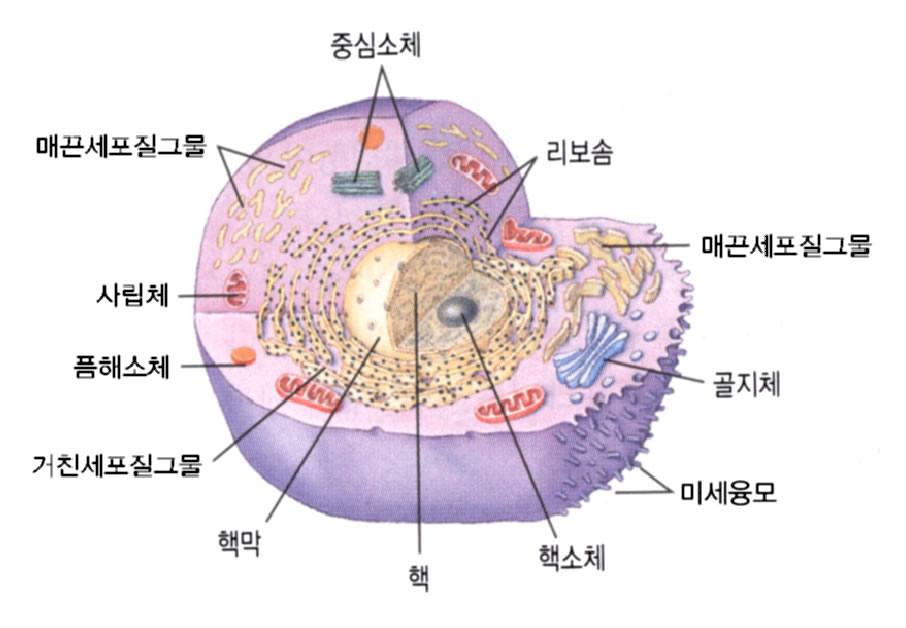 |
||
| MC | mass casualties; mast cell; Master of Surgery [Lat. Magister Chirurgiae]; maximum concentration; Med... |
|---|---|
| TC | target cell; taurocholate; temperature compensation; teratocarcinoma; tertiary cleavage; tetracyclin... |
| ACC | accommodation; acetyl coenzyme A carboxylase; acinic cell carcinoma; acute care center; adenoid cyst... |
| DOTC | Dameshek's oval target cell |
| OTC | ornithine transcarbamylase; oval target cell; over-the-counter; oxytetracycline |
| E/T | effector to target cell |
|---|---|
| TC | target cell |
| SCA | Sickle cell anaemia |
| CTV | Clinical Target Volume |
| FRT | FLP recognition target |
| target cell anaemia | Any anaemia with a conspicuous number of target cells in the peripheral blood; characteristic of the thalassaemias and also found in several haemoglobinopathies. (05 Mar 2000) |
|---|
| target cell | An erythrocyte in target cell anaemia, with a dark centre surrounded by a light band that again is encircled by a darker ring; it thus resembles a shooting target; such cell's also appear after splenectomy. A cell lysed by cytotoxic T lymphocytes, as in graft rejection. Synonym: Mexican hat cell. (05 Mar 2000) |
|---|---|
| GI-tract target lesion | <radiology> Metastatic melanoma, primary neoplasm, spindle cell tumour (benign or malignant), lymphoma, carcinoid, carcinoma, metastasis, breast carcinoma, lung carcinoma, renal carcinoma, Kaposi's sarcoma, eosinophilic granuloma, ectopic pancreas (12 Dec 1998) |
| molybdenum target tube | An X-ray tube with an anode surface made of molybdenum instead of tungsten, used in mammography. (05 Mar 2000) |
| target | 1. An object fixed as goal or point of examination. 2. In the ophthalmometer, the mire. Synonym: target organ. 4. Anode of an X-ray tube. See: X-ray. Origin: It. Targhetta, a small shield (05 Mar 2000) |
| target behaviour | Operant in behaviour modification therapy, the prescribed behaviour. (05 Mar 2000) |
| target gland | The effector that functions when stimulated by the internal secretion of another gland or by some other stimulus. (05 Mar 2000) |
| target lesions of liver/spleen | <radiology> Lymphosarcoma (including Kaposi sarcoma), melanoma (12 Dec 1998) |
| target organ | A tissue or organ upon which a hormone exerts its action; generally, a tissue or organ with appropriate receptors for a hormone. Synonym: target. (05 Mar 2000) |
| target patient | In group therapy, the patient being analyzed in turn by another member patient. (05 Mar 2000) |
| target plasma | <radiobiology> Plasma used to trap a neutral atom beam. A background plasma of sufficiently high density and temperature can ionize neutral atoms more effectively than the Lorentz process (where v cross B creates effective electric field). (09 Oct 1997) |
| target regulation | <physiology> General term for an interaction between neurons and their targets by which target derived signals influence the differentiation of the innervating neurons. (18 Nov 1997) |
| target response | In conditioning, any behaviour or specific response chosen by the experimenter; its frequency is intended to increase or decrease by the judicious pairing with it of a reinforcer when it occurs. Synonym: target behaviour, target response. (05 Mar 2000) |
| anaemia, sickle cell | A disease characterised by chronic haemolytic anaemia, episodic painful crises, and pathologic involvement of many organs. It is the clinical expression of homozygosity for haemoglobin s. (12 Dec 1998) |
| globe cell anaemia | <haematology> A hereditary disorder that leads to a chronic haemolytic anaemia due to an abnormality in the red blood cell membrane. This disorder is caused by a defective gene. Red cells are resistant to stress and rupture easily. Infants may appear jaundiced and pale. Fatigue, weakness and shortness of breath are other symptoms that may be seen in older patients. The spleen may also be enlarged. Treatment includes splenectomy (removal of the spleen). After this is accomplished the life-span of the red blood cells returns to normal. (27 Sep 1997) |
| crescent cell anaemia | <haematology> Disease common in races of people from areas in which malaria is endemic. The cause is a point mutation in the allele that codes for the beta chain of haemoglobin with a substitution of (valine for glutamic acid at position 6. The defective haemoglobin (HbS) crystallizes readily at low oxygen tension. In consequence, erythrocytes from homozygotes change from the normal discoid shape to a sickled shape when the oxygen tension is low and these sickled cells become trapped in capillaries or damaged in transit, leading to severe anaemia. In heterozygotes, the disadvantages of the abnormal haemoglobin are apparently outweighed by increased resistance to Plasmodium falciparum malaria, probably because parasitised cells tend to sickle and are then removed from circulation. Symptoms include joint pain, acute abdominal pain, and ulcerations of the lower extremities. Origin: Gr. Haima = blood (18 Nov 1997) |
제품명 |
판매사 |
보험코드 | 성분/함량 | 구분/보험급여 |
|---|
제품명 |
판매사 |
보험코드 | 성분/함량 | 구분/보험급여 |
|---|