
| 영문 | spinal tap, spinal puncture | 한글 | 허리천자, 요추천자, 요추뚫기 |
|---|---|---|---|
| 설명 | 질병의 진단이나 치료 또는 마취를 하기 위해 피부에서 거미막밑공간으로 바늘을 찌를 때가 있다. 이것은 셋째 허리뼈 아래쪽에서 시행한다. 척수가 첫째 허리뼈 아랫모서리에서 끝나고, 거미막밑공간은 둘째 엉치뼈 분절까지 뻗어 있기 때문에 이 부위는 바늘로 척수를 찌를 위험이 없다. 또 척추뼈고리판이 짧아 서로 겹쳐있지 않기 때문에 허리뼈 사이로 바늘을 찌를 수 있다. 이 부위의 거미막밑공간에는 척수신경 뿌리가 있으나, 이들은 뇌척수액속에 있기 때문에 바늘을 넣을 때 한쪽으로 밀려 손상받는 경우는 거의 없다. 배를 넓적다리에 붙일정도로 허리를 구부리면 고리판 사이가 더 벌어져 틈이 커진다. 바늘이 뚫고 지나가는 구조는 바깥에서 속으로 ① 피부, ② 피부밑조직, ③ 근육막, ④ 가시끝인대, ⑤ 가시사이인대, ⑥ 황색인대, ⑦ 경질막, ⑧ 거미막, ⑨ 뇌척수액이 된다.  |
||
| 영문 | parasympathetic nerves | 한글 | 부교감신경 |
|---|---|---|---|
| 설명 | 자율신경계의 하나로써 주로 긴장이 풀어져 있을 때 작용한다. 특히 심장에 대한 부교감 작용을 보면, 주로 미주신경을 통해 작용을 한다. 미주신경은 심장의 박동원(박동을 일으키는 작용을 하는 곳으로 굴심방결절)을 억제시켜 심장의 운동을 억제한다. 하지만, 실제적으로는 심장의 박동을 억제하는 대신에 심실의 수축을 강화시킴으로 심장의 수축력을 증가시켜 심장으로부터 대동맥으로 나가는 혈액량은 증가한다. 이에 비해 교감신경은 심장의 운동을 빠르게 하여 혈압을 증가시키고, 맥박을 증가시킨다. |
||
| 영문 | spinal cord | 한글 | 척수 |
|---|---|---|---|
| 설명 | 척추내에 위치하는 중추신경계의 일부분. 위에서부터 목척수, 등척수, 허리척수, 엉치척수로 구분됨. 내부는 바깥쪽의 백색질과 안쪽의 회색질로 구분된다. 척수의 아래끝은 척수 원뿔이라 하며 첫번째 허리뼈 높이까지 내려온다. 뇌와 말초신경사이의 신경 통로 역할을 하며 척수반사(예: 무릎반사)에서는 뇌를 통하지 않고 반사의 중추 작용을 한다. 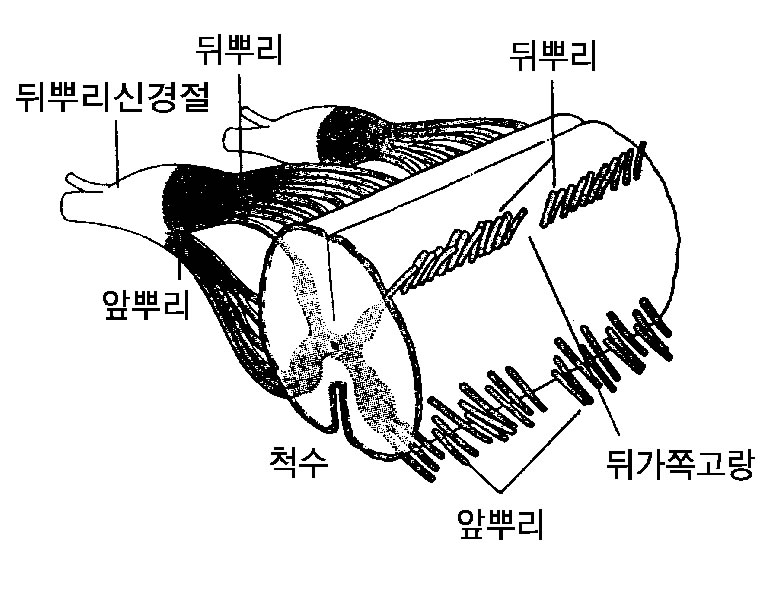 |
||
| 영문 | spinal nerve | 한글 | 척수신경 |
|---|---|---|---|
| 설명 | 척수의 앞뿔에서 출발하는 운동신경과 뒷뿔으로 들어오는 감각신경이 합쳐서 형성되는 신경으로서 총 31쌍이 존재함. 목뼈신경이 8쌍, 자등뼈신경이 12쌍, 허리뼈의 신경이 5쌍, 엉치뼈의 6쌍을 이룸. |
||
| parasym | parasympathetic |
|---|---|
| PNS | paraneoplastic syndrome; parasympathetic nervous system; partial nonprogressive stroke; peripheral n... |
| PS | pacemaker syndrome; paired stimulation; paradoxical sleep; paraspinal; parasympathetic; Parkinson sy... |
| PSA | parasternal short axis; pleomorphic salivary gland adenoma; polyethylene sulfonic acid; polysacchari... |
| SC | conditioned stimulus; sacrococcygeal; Sanitary Corps; scalenus [muscle]; scapula; Schwann cell; scia... |
| PNS | Parasympathetic Nervous System |
|---|---|
| SPN | sacral parasympathetic nucleus |
| ASIA | American Spinal Injury Association |
| aCSF | Artificial cerebral spinal fluid |
| CSF | Cerebral Spinal Fluid |
| ganglia, parasympathetic | Ganglia of the parasympathetic nervous system, including the ciliary, pterygopalatine, submandibular, and otic ganglia in the cranial region and intrinsic (terminal) ganglia associated with target organs in the thorax and abdomen. (12 Dec 1998) |
|---|---|
| parasympathetic | Pertaining to a division of the autonomic nervous system. See: autonomic nervous system. (05 Mar 2000) |
| parasympathetic fibres, postganglionic | Nerve fibres which project from parasympathetic ganglia to synapses on target organs. Parasympathetic postganglionic fibres use acetylcholine as transmitter. They may also release peptide cotransmitters. (12 Dec 1998) |
| parasympathetic ganglia | Those ganglia of the autonomic nervous system composed of cholinergic neurons receiving afferent fibres from preganglionic visceral motor neurons in either the brainstem or the middle sacral spinal segments (S2 to S4); on the basis of their location with respect to the organs they innervate, most parasympathetic ganglia, at least outside the head, can be categorised as juxtamural or intramural ganglia. See: autonomic nervous system. (05 Mar 2000) |
| parasympathetic nerve | <anatomy, nerve> One of the nerve's of the parasympathetic nervous system. (05 Mar 2000) |
| parasympathetic nervous system | <anatomy, neurology> One of the two divisions of the vertebrate autonomic nervous sytem. Parasympathetic nerves emerge cranially as pre ganglionic fibres from oculomotor, facial, glossopharyngeal and vagus and from the sacral region of the spinal cord. most neurons are cholinergic and responses are mediated by muscarinic receptors. The parasympathetic system innervates, for example: salivary glands, thoracic and abdominal viscera, bladder and genitalia. Compare:. Sympathetic nervous system. (18 Nov 1997) |
| parasympathetic root of ciliary ganglion | A branch of the oculomotor nerve supplying parasympathetic preganglionic nerve fibres to the ciliary ganglion. Synonym: radix parasympathica ganglii ciliaris, radix oculomotoria ganglii ciliaris, motor root of ciliary ganglion, oculomotor root of ciliary ganglion, radix brevis ganglii ciliaris, short root of ciliary ganglion. (05 Mar 2000) |
| nervous system, parasympathetic | A part of the nervous system that slows the heart rate, increases intestinal and gland activity, and relaxes sphincter muscles. The parasympathetic nervous system together with the sympathetic nervous system (that accelerates the heart rate, constricts blood vessels, and raises blood pressure) constitute the autonomic nervous system. (12 Dec 1998) |
| system, parasympathetic nervous | : A part of nervous system that slows the heart rate, increases intestinal and gland activity, and relaxes sphincter muscles. The parasympathetic nervous system together with the sympathetic nervous system (that accelerates the heart rate, constricts blood vessels, and raises blood pressure) constitute the autonomic nervous system. (12 Dec 1998) |
| accessory portion of spinal accessory nerve | <anatomy, nerve> The roots of the accessory nerve which arise from the medulla; the nerve fibres of the cranial root join the intracranial portion of the vagus nerve and are distributed to the pharyngeal plexus, providing the motor innervation of the soft palate (except the tensor veli palati) and the pharynx. Synonym: pars vagalis nervi accessorii, radices craniales, accessory portion of spinal accessory nerve, cranial roots, vagal part of accessory nerve, vagal part. (05 Mar 2000) |
| acute spinal cord compression | <radiology> Signs and symptoms of cord compression show progression within 24 hours or less: pain, weakness, autonomic dysfunction, sensory loss, ataxia Diagnostic considerations: Primary or secondary malignancy of epidural space or vertebrae, Trauma, Inflammatory process, Osteoarthritis REF: MacNeil BJ, Abrams HL. Brigham and Women's Hospital Handbook of Diagnostic Imaging. Chapter 35. (12 Dec 1998) |
| anterior median fissure of spinal cord | A deep median fissure on the anterior surface of the spinal cord. Synonym: fissura mediana anterior medullae spinalis, anteromedian groove, sulcus ventralis. (05 Mar 2000) |
| anterior spinal artery | <anatomy, artery> Origin, intracranial part of vertebral; distribution, spinal cord and pia mater; anastomoses, spinal of intercostal and lumbar arteries. Synonym: arteria spinalis anterior. (05 Mar 2000) |
| anterolateral column of spinal cord | The lateral white column of the spinal cord between the lines of exit and entrance of the anterior and posterior nerve roots. Synonym: funiculus lateralis, anterolateral column of spinal cord, lateral funiculus of spinal cord. (05 Mar 2000) |
| arachnoid of spinal cord | That portion of the arachnoid which lies within the vertebral canal and surrounds the spinal cord and the vertebral portion of the subarachnoid space. It extends from the foramen magnum above to the S-2 vertebral level. Since the spinal cord ends at the L-2 vertebral level, a wide separation occurs between the arachnoid and pia mater, the lumbar cistern, filled with cerebrospinal fluid in which the cauda equina is suspended. Synonym: arachnoidea mater spinalis, spinal part of arachnoid. (05 Mar 2000) |
제품명 |
판매사 |
보험코드 | 성분/함량 | 구분/보험급여 |
|---|
제품명 |
판매사 |
보험코드 | 성분/함량 | 구분/보험급여 |
|---|