
| 영문 | Apgar score | 한글 | 아프가점수 |
|---|---|---|---|
| 설명 | 신생아의 건강 상태를 알아보기 위해서 태어나자마자 시행하는 검사. 신생아의 피부색깔, 심박수, 호흡, 근육의 힘, 자극에 대한 반응 등의 5가지 항목을 검사하며 각 항목당 2점씩으로 채점하여 10점 만점으로 한다. 10점 만점인 경우가 가장 좋으며, 6점이하인 경우엔 태아의 가사 상태를 의미하며 즉시 응급처치가 필요하다. 아프가점수의 채점은 생후 1분과 5분에 각각 두번 판정하여 점수를 낸다. 생후 1 분에 측정한 아프가점수는 신생아의 가사의 유무를 판단하여 응급 처치의 필요성 여부를 조사하는 지표가 되며, 생후 5분에 측정한 아프가점수는 신생아의 예후를 판정하는데 좋은 지표가 된다. 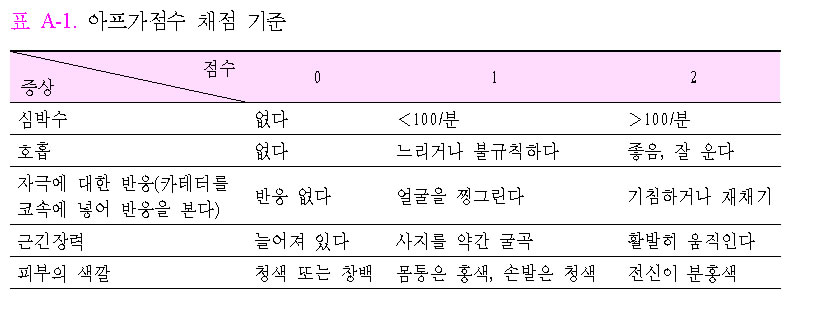 |
||
| 영문 | speech center | 한글 | 언어중추 |
|---|---|---|---|
| 설명 | 언어의 생성과 이해를 관장하는 대뇌겉질의 특정한 부위. 인간의 특징인 언어는 특정한 상대와 마음의 내용을 서로 전하기 위해 쓰는 소리이다. 상대방으로부터 들은 소리를 의미가 있는 언어로 이해하고 마음의 내용에 대응하는 언어를 소리로 내는 얼개를 영위하는 곳이 언어중추이다. 대뇌반구의 표층에 있는 대뇌겉질에 세 개의 언어중추가 있다. 여기에 관여하는 대뇌겉질의 영역을 언어야(speech area)라 한다. 이 영역은 통상적으로 왼쪽대뇌 반구에 있다. 주요 영역으로는 운동성 언어중추(브로카 중추)와 감각성 언어중추(워니케 중추)가 있다. 언어야가 손상되면 실어증이 생긴다. 운동성 언어중추의 장애가 있는 사람은 이야기나 써있는 글자는 잘 이해하지만 자발적으로 말을 잘할 수는 없다. 이것을 운동성 실어증이라 한다. 감각성 언어중추의 장애가 있는 사람은 청각은 정상적임에도 불구하고 말하는 언어나 쓰여진 문자의 의미를 알 수 없게 된다. 이것을 감각성 실어증이라 한다. |
||
| 영문 | speech therapy | 한글 | 언어치료 |
|---|---|---|---|
| 설명 | 말을 정확하게 발음할 수 없거나 더듬는 환자에게 발음, 대화 따위의 훈련을 전문적으로 행하는 치료법. |
||
| SDL | serum digoxin level; speech discrimination level |
|---|---|
| SSD | shaded surface display; single saturating dose; Social Security disability; source-skin distance; so... |
| SRT | sedimentation rate test; simple reaction time; sinus node recovery time; sitting root test; speech r... |
| DS | dead air space; dead space; deep sedative; deep sleep; defined substrate; dehydroepiandrosterone sul... |
| TS | Takayasu syndrome; Tay-Sachs; temperature sensitivity; temperature, skin; temporal stem; tensile str... |
| SDS | Speech Discrimination Scores |
|---|---|
| Z-score | score |
| DD | Drug discrimination |
| PD | Power of Discrimination |
| 2-PD | Two-point discrimination |
| speech discrimination tests | Tests of the ability to hear and understand speech as determined by scoring the number of words in a word list repeated correctly. (12 Dec 1998) |
|---|---|
| pitch discrimination | The ability to differentiate tones. (12 Dec 1998) |
| discrimination | <psychology> Differential response to different stimuli. (12 Dec 1998) |
| discrimination learning | Learning that is manifested in the ability to respond differentially to various stimuli. (12 Dec 1998) |
| APACHE score | Acute physiology and chronic health evaluation. The most widely used method of assessing the severity of illness in acutely ill patients in intensive care units. (05 Mar 2000) |
| APGAR score | <paediatrics> A recording of the physical health of a newborn infant, determined after examination of the adequacy of respiration, heart action, muscle tone, skin colour and reflexes. Total numerical score is 10. (10 Jan 1998) |
| raw score | The actual score, measurement, or value obtained before any statistics are applied to it. Compare: standard score. (05 Mar 2000) |
| recovery score | A number expressing the condition of an infant at various stipulated intervals greater than 1 minute after birth and based on the same features assessed by the Apgar score at 60 seconds after birth. (05 Mar 2000) |
| Gleason's score | A classification of adenocarcinoma of the prostate by evaluation of the pattern of glandular differentiation; the tumour grade, know as Gleason's score, is the sum of the dominant and secondary patterns, each numbered on a scale of 1 to 5. (05 Mar 2000) |
| score | 1. A notch or incision; especially, one that is made as a tally mark; hence, a mark, or line, made for the purpose of account. "Whereas, before, our forefathers had no other books but the score and the tally, thou hast caused printing to be used." (Shak) 2. An account or reckoning; account of dues; bill; hence, indebtedness. "He parted well, and paid his score." (Shak) 3. Account; reason; motive; sake; behalf. "But left the trade, as many more Have lately done on the same score." (Hudibras) "You act your kindness in Cydria's score." (Dryden) 4. The number twenty, as being marked off by a special score or tally; hence, in pl, a large number. "Amongst three or four score hogsheads." (Shak) "At length the queen took upon herself to grant patents of monopoly by score." (Macaulay) 5. A distance of twenty yards; a term used in ancient archery and gunnery. 6. A weight of twenty pounds. 7. The number of points gained by the contestants, or either of them, in any game, as in cards or cricket. 8. Line drawn; a groove or furrow. 9. The original and entire draught, or its transcript, of a composition, with the parts for all the different instruments or voices written on staves one above another, so that they can be read at a glance; so called from the bar, which, in its early use, was drawn through all the parts. In score, having all the parts arranged and placed in juxtaposition. To quit scores, to settle or balance accounts; to render an equivalent; to make compensation. "Does not the earth quit scores with all the elements in the noble fruits that issue from it?" (South) Origin: AS. Scor twenty, fr. Sceran, scieran, to shear, cut, divice; or rather the kindred Icel. Skor incision, twenty, akin to Dan. Skure a notch, Sw. Skara. See Shear. 1. To mark with lines, scratches, or notches; to cut notches or furrows in; to notch; to scratch; to furrow; as, to score timber for hewing; to score the back with a lash. "Let us score their backs." (Shak) "A briar in that tangled wilderness Had scored her white right hand." (M. Arnold) 2. Especially, to mark with significant lines or notches, for indicating or keeping account of something; as, to score a tally. 3. To mark or signify by lines or notches; to keep record or account; to set down; to record; to charge. "Madam, I know when, Instead of five, you scored me ten." (Swift) "Nor need I tallies thy dear love to score." (Shak) 4. To engrave, as upon a shield. 5. To make a score of, as points, runs, etc, in a game. 6. To write down in proper order and arrangement; as, to score an overture for an orchestra. See Score. 7. <geology> To mark with parallel lines or scratches; as, the rocks of new England and the Western States were scored in the drift epoch. Origin: Scored; Scoring. Source: Websters Dictionary (01 Mar 1998) |
| score, apgar | A practical method to assess a newborn infant, the Apgar score is a number arrived at by scoring the heart rate, respiratory effort, muscle tone, skin colour, and response to a catheter in the nostril. Each of these objective signs can receive 0, 1, or 2 points. An apgar score of 10 means an infant is in the best possible condition. The apgar score is done routinely 60 seconds after the complete birth of the infant. An infant with a score of 0-3 needs immediate resusitation. The apgar score is commonly repeated 5 minutes after birth and in the event of a difficult resusitation, the apgar may be done again at 10, 15, and 20 minutes. An apgar score of 0-3 at 20 minutes of age is predictive of high morbidity (disease) and mortality. The score is named for the american anaesthesiologist virginia apgar (1909-1974) at columbia university in new york who originated the scoring method. (12 Dec 1998) |
| standard score | A statistically referenced or derived score representing the deviation of a raw score from its mean in standard deviation units. (05 Mar 2000) |
| symptom score | American Urological Association's scoring system to evaluate prostatic obstruction. (05 Mar 2000) |
| Dubowitz score | A method of clinical assessment of gestational age in the newborn that includes neurological criteria for the infant's maturity and other physical criteria to determine the gestational age of the infant; useful from birth to 5 days of life. (05 Mar 2000) |
| injury severity score | An anatomic severity scale based on the abbreviated injury scale (ais) and developed specifically to score multiple traumatic injuries. It has been used as a predictor of mortality. (12 Dec 1998) |
제품명 |
판매사 |
보험코드 | 성분/함량 | 구분/보험급여 |
|---|
제품명 |
판매사 |
보험코드 | 성분/함량 | 구분/보험급여 |
|---|