
| 영문 | activation | 한글 | 활성, 활성화 |
|---|---|---|---|
| 설명 | 일반적으로, 생체나 생체 물질이 그 기능을 활발하게 나타내게 되는 것, 예를 들면 ① 촉매 등에서, 그 표면 상태의 변화나, 다른 물질의 첨가 등에 의하여, 그 기능이 현저하게 높아지는 것. ② 효소전구체의 활성화로서 효소작용을 가지지 않는 효소 전구체가 활성있는 효소로 변화는 것. 또 황화수소나 시안화수소산 등으로 파파인이 활성화되는 경우도 있다. |
||
| 영문 | muscle cell(=muscle fiber) | 한글 | 근육세포 |
|---|---|---|---|
| 설명 | 근육은 수의근(의식에 의해서 조절이 가능한 근육: 예를 들어 다리, 팔, 얼굴근육 등)과 불수의근(의식과 무관하게 조절하지 않아도 움직이는 근육: 예를 들어 심장근, 소화기관에 분포하는 근육 등)으로 나누어지며, 근육세포의 모양은 다음과 같다(수의근, 불수의근 외에 심장에 있는 심장근은 불수의근에 해당하지만 그 모양은 수의근과 같아 따로 분류한다).  |
||
| 영문 | white blood cell(WBC), leukocyte | 한글 | 백혈구 |
|---|---|---|---|
| 설명 | 혈액내에 골수구계세포와 림프계세포, 단핵구계세포를 모두 통틀어 말한다. 백혈구의 증가가 있으면 대개 감염이 있거나, 혹은 탈수현상이 있음을 의미한다. 또한 지나친 백혈구수의 감소는 인체내 면역기능이 떨어져 있음을 의미하며, 다른 질병에 의해 나타나는 이차적인 현상이 아닌지 꼭 진단을 받아보아야 한다. |
||
| 영문 | mast cell | 한글 | 비만 세포 |
|---|---|---|---|
| 설명 | 동물의 결합 조직 가운데 널리 분포하는 세포. 결합조직과 점막조직 내에 있는 호염기성 색소로 이염색성(metachromasia)을 나타내는 과립을 가진 방추형의 세포에 작은 둥근 핵을 가진다. 비만세포의 표면에는 IgE에 대한 수용체가 존재하며, 수용체에 결합한 IgE 분자들끼리 다가의 항원에 의해 서로 연결되면 비만세포 과립탈출 반응이 일어나, 히스타민, 세로토닌, 헤파린 등의 화학전달 물질이 방출되어, 즉시형 알레르기 반응 등의 증상을 일으킨다. 피부, 장막, 혈관 주위, 점막 주변에 있다. |
||
| 영문 | cell | 한글 | 세포 |
|---|---|---|---|
| 설명 | 생명체를 이루는 구조적, 기능적 단위. 핵의 유무에 따라서 유핵세포와 무핵세포로 나눌 수가 있다. 무핵세포란 핵이 없는 세포를 말한다. 핵이란 유전정보를 가지고 있는 염색체를 보관하는 곳인데 무핵세포에서는 염색체가 세포속에 그냥 노출되어 있다. 대개 세포 하나하나가 독립된 생명체의 역할을 하는 단세포생물로서 외부환경으로부터 자신을 보호할 수 있는 견고한 세포벽을 가지고 있다. 유핵세포란 핵을 가지고 있어서 유전정보가 있는 염색체가 세포의 다른 부분과 구분되어 핵속에 들어있다. 세포속에서 핵외의 부분(이를 세포질이라 한다)에는 여러 가지 세포의 소기관이 있어서 세포의 다양한 기능을 분담한다. ◈유핵세포의 기본 구조 1.세포막-세포를 둘러싸서 주위환경과 분리하여 세포의 내환경을 유지한다. 2.형질내세망(endoplasmic reticulum)-단위막으로 둘러쌓여 있는 불규칙한 망상구조이다. 이 망상구조의 내부를 소강, 소조라고 부른다. 여기에는 표면이 매끈한 무과립형질내세망과 표면이 불규칙한 과립형질내세망의 두 가지가 있다. 과립형질내세망의 경우는 표면에 단백질을 합성하는 리보솜이라는 것이 부착되어 있다. 이곳은 주로 세포밖으로 분비할 단백질을 합성하는 장소이다. 무과립형질내세망은 표면에 리보솜이 부착되어 있지 않은 것을 말하며, 이곳에서는 주로 해독작용, 글리코겐의 합성, 스테로이드호르몬의 합성 등이 일어난다. 3.리보솜-단백질을 합성하는 역할을 하는 곳이다.이것은 세포질에 존재하는 자유리보솜과 과립형질내세망에 부착이 되어 존재하는 부착리보솜의 두 가지로 나눈다. 자유리보솜은 주로 세포내에서 필요한 단백질을 만드는 역할을 하고 부착리보솜은 세포밖으로 분비할 단백질을 만드는 역할을 한다. 4.골지장치(Golgi apparatus)-핵주위에 분포하는 납작해진 주머니모양의 것이 중첩되어 형성된 층판 모양의 구조물로 과립형질내세망에서 생성되어 외부로 분비될 단백질을 모아서 농축, 포장하여 과립을 만드는 역할을 한다. 5.사립체(mitochondria)-구형, 난형의 긴 막대기 모양으로 크기가 다양한 구조물. 생물체의 에너지 저장물질인 ATP를 생산하는 역할을 한다. 또 세포와 다른 자신만의 유전정보를 가진 DNA, RNA를 가지고 있다. 모양, 크기가 세균과 비슷하며 자체증식성 등 독립된 생명체로서 필요한 요건을 갖추고 있어서 세포와 공생관계를 가진 독립된 세포로 생각하고 있다. 6.용해소체(lysosome)-작은 구형의 소체로 여러 가지 분해효소를 가진다. 세포외계에서 들어온 물질과 결합하여 그 물질들을 용해하는 역할을 하고, 오래된 세포소기관들을 제거하는 역할도 한다. 7.세포핵(nucleus)-구형, 난형으로 세포의 중심에 위치한다. 핵내에는 유전정보가 있는 물질인 염색체가 존재한다. 8.중심소체(centrosome)-핵주위에 존재하면서 핵의 분열시에 양쪽의 염색체를 당기는 작은 섬유를 만드는 역할을 하는 곳. 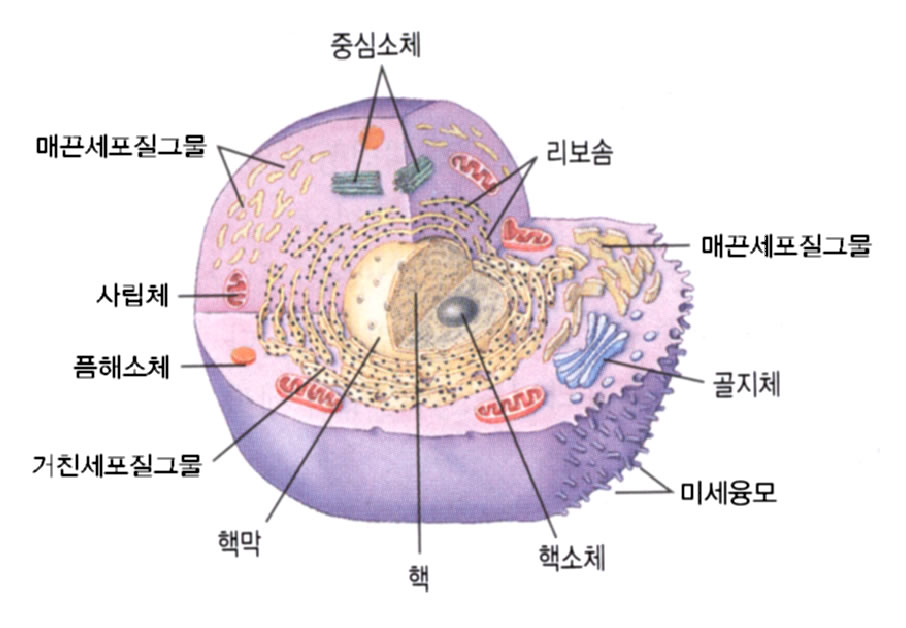 |
||
| PBA | polyclonal B-cell activity; pressure breathing assist; prolactin-binding assay; prune belly anomaly;... |
|---|---|
| PCA | para-chloramphetamine; parietal cell antibody; passive cutaneous anaphylaxis; patient care assistant... |
| MC | mass casualties; mast cell; Master of Surgery [Lat. Magister Chirurgiae]; maximum concentration; Med... |
| PGG | polyclonal gamma globulin |
| pRF | polyclonal rheumatoid factor |
| PBA | Polyclonal B cell activation |
|---|---|
| PPBL | Persistent polyclonal B cell lymphocytosis |
| PBA | polyclonal B cell activator |
| PAb | Polyclonal |
| PAB | Polyclonal antibodies |
| polyclonal | Derived from different types of cells. (14 Nov 1997) |
|---|---|
| polyclonal activator | A substance that will activate T-cells, B-cells, or both regardless of their specificities. (05 Mar 2000) |
| polyclonal antibodies | A group of antibodiesproduced by different B lymphocytes in responseto the same antigen, different antibodies in the group recognise different parts of the antigen. (09 Oct 1997) |
| polyclonal antibody | An antibody produced by several clones of B lymphocytes as would be the case in a whole animal. Usually refers to antibodies raised in immunised animals, whereas a monoclonal antibody is the product of a single clone of B lymphocytes, usually maintained in vitro. (18 Nov 1997) |
| polyclonal antiserum | A mixture of antibodies to a variety of antigens or to a variety of determinants on a single antigen. (09 Oct 1997) |
| polyclonal compartment | When the progeny of several cells occupy an area or volume with a defined boundary, it is referred to as a polyclonal compartment, for example clones lying close to the mid line of the wing of Drosophila. (18 Nov 1997) |
| activation | <radiobiology> Activation occurs when a particle interacts with an atomic nucleus, shifting the nucleus into an unstable state, and causing it to become radioactive. In fusion research, where deuterium-tritium is a common fuel mixture, the neutron released when (D + T) combine to form (4He + n) can activate the reactor structure. In this case the 4He is inert, the neutron sticks to another nucleus, and the neutron + nucleus reaction creates an actvation product. Sometimes called radioactivation. See: activation product, activation analysis. (09 Oct 1997) |
| activation analysis | <radiobiology> Method for identifying and measuring chemical elements in a sample of material. Sample is first made radioactive by bombardment with neutrons, charged particles, or gamma rays. Newly formed radioactive atoms in the sample then give off characteristic radiations (such as gamma rays) that tell what kinds of atoms are present, and how many. (09 Oct 1997) |
| activation energy | <chemistry> The amount of energy (expressed in joules) that is needed to convert all the molecules in one mole of a reacting substance from a ground state to the transition state. (06 May 1997) |
| activation product | <radiobiology> The unstable nucleus formed when activation occurs. (See activation above.) (09 Oct 1997) |
| amino acid activation | The first step of protein synthesis, whereby an amino acid reacts with adenosine triphosphate in the presence of aminoacyl RNA synthetase to produce an amino acid adenylate, which provides the energy necessary for the attachment of the amino acid to a specific transfer RNA molecule. (12 Dec 1998) |
| macrophage activation | The process of altering the morphology and functional activity of macrophages so that they become avidly phagocytic. It is initiated by lymphokines, such as the macrophage activation factor (maf) and the macrophage migration-inhibitory factor (mmif), immune complexes, c3b, and various peptides, polysaccharides, and immunologic adjuvants. (12 Dec 1998) |
| gene activation | The process of activation of a gene so that it is expressed at a particular time. This process is crucial in growth and development. (05 Mar 2000) |
| Gibbs energy of activation | The Gibbs energy that must be added to that already possessed by a molecule or molecules in order to initiate a reaction. (05 Mar 2000) |
| virus activation | The mechanism by which latent viruses, such as genetically transmitted tumour viruses or prophages of lysogenic bacteria, are induced to replicate and are released as infectious viruses. It may be effected by various endogenous and exogenous stimuli, including B-cell lipopolysaccharides, glucocorticoid hormones, halogenated pyrimidines, ionizing radiation, ultraviolet light, and superinfecting viruses. (12 Dec 1998) |
제품명 |
판매사 |
보험코드 | 성분/함량 | 구분/보험급여 |
|---|
제품명 |
판매사 |
보험코드 | 성분/함량 | 구분/보험급여 |
|---|