
| 영문 | antefletxio uteri | 한글 | 자궁전굴, 자궁앞굽이 |
|---|---|---|---|
| 설명 | 정상적으로 자궁은 앞으로 굽어 있다. 이런 상태를 자궁앞굽이라고 한다. 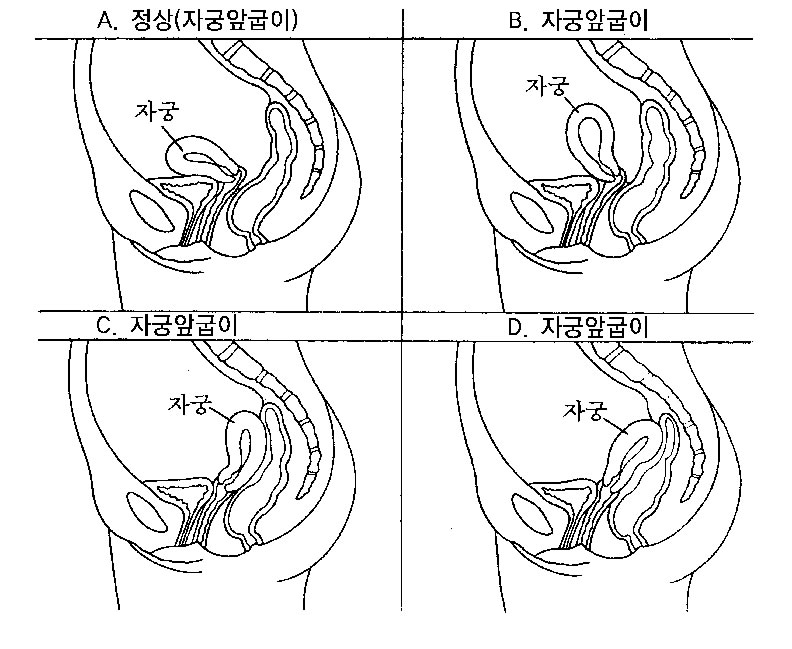 |
||
| 영문 | cervix, neck | 한글 | 목, 경부 |
|---|---|---|---|
| 설명 | 목, 경부를 지칭하는 말. 특히 자궁의 목을 지칭하는데 쓰인다. 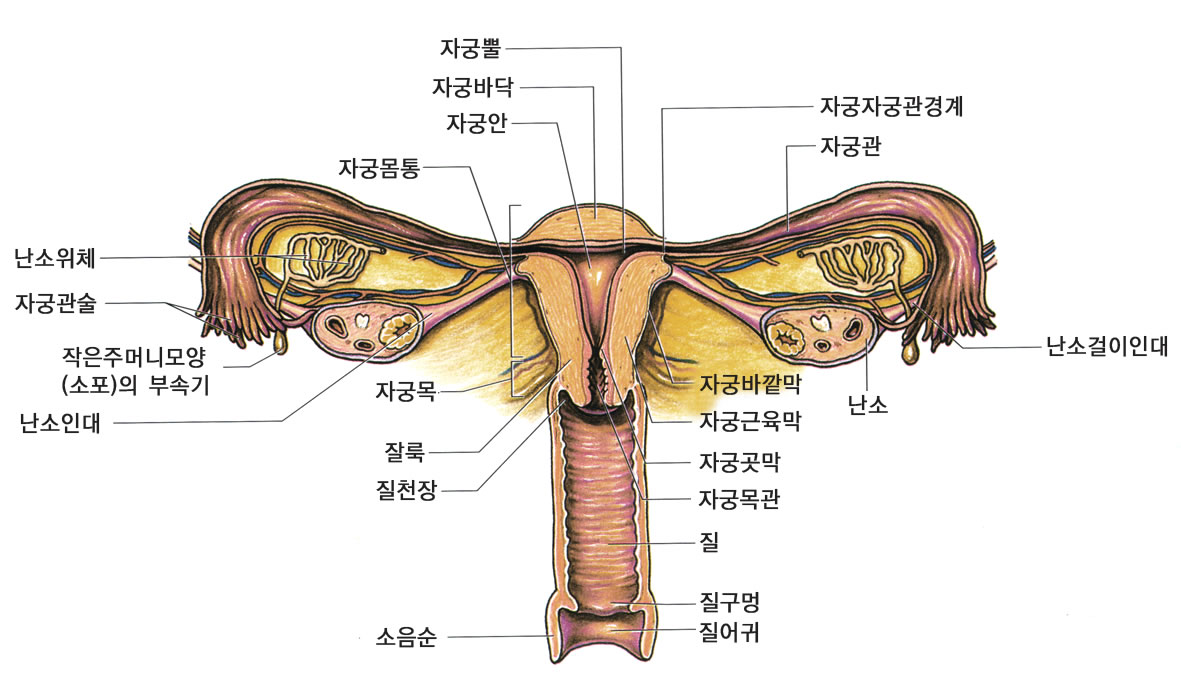 |
||
| 영문 | cervix cancer | 한글 | 자궁목암, 자궁경부암 |
|---|---|---|---|
| 설명 | 자궁의 목은 자궁이 질과 연결된 부위로 자궁의 입구에 해당하는 부위이다. 이곳의 상피세포에서 발생하는 암을 자궁목암이라고 한다. 자궁목암의 발생을 살펴보면 자궁목의 상피세포가 여러 가지 자극에 의해서 정상세포와 차이나는 암성변화를 한 세포가 생기게 된다. 이 암성변화를 한 세포는 처음에는 자궁목의 상피세포층의 일부를 이루고 있게 된다. 그러다가 점점 더 진행이 되면 암성세포가 자궁목 상피세포의 모든 층을 꽉채우게 된다. 그리고 계속 진행하면 상피세포의 맨 밑에 있는 바닥막을 뚫고 버팀조직으로 침윤해 들어가게 된다. 암성변화를 한 세포가 자궁의 상피층의 일부를 채우는 것을 자궁목형성이상(cervical dysplasia)라고 하고 암성변화를 한 세포가 자궁의 상피층을 모두 채워버려 정상적인 세포가 없는 경우를 상피내암종(carcinoma in situ)라고 한다. 그리고 바닥막을 뚫고 밑의 버팀조직으로 침범해 나가는 경우를 침윤암(invasive cancer)라고 한다. 자궁목암은 여러 명의 상대와 성관계를 가지는 여자, 그리고 첫 성경험의 나이가 어린 여자에게서 흔하고 또 사회적, 경제적 수준이 낮은 사람에게서 잘 걸리는 것으로 되어 있다. 이런 것으로 미루어 자궁목세포의 암성변화에는 성병과 같은 감염이 중요할 것으로 생각되고, 또 몇가지 바이러스의 감염이 자궁목암의 원인이라는 것이 밝혀져 있다. 자궁목암의 진단방법으로는 질세포검사, 콜포스코피, 생검(biopsy) 등이 있다. 세포검사란 조기진단 목적으로 가장 많이 사용되는 방법으로 솜봉으로 자궁목을를 문질러서 자궁목상피세포를 얻고 이것을 현미경으로 관찰하여 상피세포의 변화를 보는 것이다. 콜포스코피란 자궁의 목을 4~10배 정도 확대해서 보는 일종의 확대경검사으로 자궁목암으로 인한 자궁목의 병적변화를 관찰하여 진단하는 것이다. 생검란 진단을 위해서 직접 자궁목의 조직을 떼어 채취하여 현미경으로 관찰하여 진단하는 것으로 가장 정확한 진단법이다. 치료로는 병의 진행정도에 따라 다르겠지만 암의 진행이 거의 없어 형성이상이나 제자리암종 또는 아주 조금 침윤하였을 경우에는 수술적요법으로 자궁을 적출하는 것이 치료의 원칙이고 많은 진행을 보여 다른 조직으로 암의 침윤이 있을 경우에는 방사선 치료를 원칙으로 한다. |
||
| MMR | mass miniature radiography; masseter muscle rigidity; maternal mortality rate; measles-mumps-rubella... |
|---|---|
| HCU | homocystinuria; hyperplasia cystica uteri |
| HIU | hyperplasia interstitialis uteri |
| IDA | 1) Imino-Diacetic Acid 2) Iron Deficiency Anemia &nb... |
| AIPS | American Institute of Pathologic Science |
| PCR | Pathologic complete response |
|---|---|
| PS | pathologic Stage |
| pathologic rigidity | Rigidity of the cervix uteri in labour, due to fibrosis, scarring, cancer, or other condition. (05 Mar 2000) |
|---|---|
| cervix uteri | The lower part of the uterus extending from the isthmus of the uterus into the vagina. It is divided into supravaginal and vaginal parts by its passage through the vaginal wall. Synonym: cervix uteri, cervix, neck of uterus, neck of womb. (05 Mar 2000) |
| cadaveric rigidity | Muscular rigidity which develops in the cadaver usually from 4 to 10 hours after death and lasts 3 or 4 days. (12 Dec 1998) |
| catatonic rigidity | Rigidity associated with catatonic psychotic states in which all muscles exhibit flexibilitas cerea. (05 Mar 2000) |
| cerebellar rigidity | Increased tone of the extensor muscles, related to injury of the vermis of the cerebellum. (05 Mar 2000) |
| rigidity | Stiffness or inflexibility, chiefly that which is abnormal or morbid, rigor. Origin: L. Rigiditas, rigidus = stiff (18 Nov 1997) |
| clasp-knife rigidity | Initial increased resistance to stretch of the extensor muscles of a joint that give way rather suddenly allowing the joint then to be easily flexed; the rigidity is due to an exaggeration of the stretch reflex. See: lengthening reaction. Synonym: clasp-knife effect, clasp-knife rigidity. (05 Mar 2000) |
| cogwheel rigidity | <clinical sign, neurology> A type of rigidity seen in parkinsonism in which the muscles respond with cogwheel-like jerks to the use of constant force in bending the limb. (21 Jun 2000) |
| muscle rigidity | Continuous tonic contraction of skeletal muscle. (12 Dec 1998) |
| postmortem rigidity | Muscular rigidity which develops in the cadaver usually from 4 to 10 hours after death and lasts 3 or 4 days. (12 Dec 1998) |
| scleral rigidity | The resistance of the eye to changes in shape with changes in intraocular pressure. (05 Mar 2000) |
| nuchal rigidity | <neurology> Resistance to flexion of the neck, seen in individuals with meningitis. (27 Sep 1997) |
| decerebrate rigidity | <clinical sign, neurology> Spontaneous extension of elbows, wrists and legs which suggests damage to the diencephalon (midbrain). Seen in cases of stroke and some cases of encephalitis. The decerebrate reflex is a clinical finding characterised by rigid contraction of the extensor and other muscles which maintain an animal in the standing position (antigravity muscles), may be seen in association with a severe stroke, intracranial haemorrhage, cerebral haemorrhage, cerebral toxin or transection of the brain below the level of the anterior corpora quadrigemina but above the vestibular nuclei, clinically may be preceded by decortication. (27 Sep 1997) |
| decorticate rigidity | A unilateral or bilateral postural change, consisting of the upper extremities flexed and adducted and the lower extremities in rigid extension; due to structural lesions of the thalamus, internal capsule, or cerebral white matter. Synonym: decorticate state. (05 Mar 2000) |
| ocular rigidity | The resistance offered by the eyeball to a change in intraocular volume; manifested as a change in intraocular pressure. (05 Mar 2000) |
제품명 |
판매사 |
보험코드 | 성분/함량 | 구분/보험급여 |
|---|
제품명 |
판매사 |
보험코드 | 성분/함량 | 구분/보험급여 |
|---|