
| 영문 | memory | 한글 | 기억 |
|---|---|---|---|
| 설명 | 지각, 인상, 관념을 불러일으키는 정신기능으로 이전의 인상이나 경험을 의식 속에 간직하거나 다시 생각해 내는 것. 즉, 사람이 경험한 것이 어떤 형태로 간직되었다가 후에 재생 또는 재인식-재구성되어 나타나는 현상을 말한다. 신체적 습관 컴퓨터 등 기계적 기억도 넓은 의미에서의 기억에 포함시키는 경우도 있다. 기억과정에는 다음의 네 가지 단계를 나누어 볼 수 있다. 기억은 현재 체험하고 있는 전부의 것이 남는 것이 아니라, 특별히 인상적이었던 것만이 기억되는 것을 가리킨다. 기억에는 또한 의지를 움직여서 하는 능독적 기억과 별로 기억할 일도 없이 자연히 이루어지는 수동적 기억이 있다. 전자는 영어단어나 수학공식을 열심히 암기하려고 하는 경우이고, 후자는 굳이 외려고 하지 않았는데도 모르는 사이에 텔레비전의 CM송을 흥얼거리게 되는 경우이다. |
||
| 영문 | muscle cell(=muscle fiber) | 한글 | 근육세포 |
|---|---|---|---|
| 설명 | 근육은 수의근(의식에 의해서 조절이 가능한 근육: 예를 들어 다리, 팔, 얼굴근육 등)과 불수의근(의식과 무관하게 조절하지 않아도 움직이는 근육: 예를 들어 심장근, 소화기관에 분포하는 근육 등)으로 나누어지며, 근육세포의 모양은 다음과 같다(수의근, 불수의근 외에 심장에 있는 심장근은 불수의근에 해당하지만 그 모양은 수의근과 같아 따로 분류한다).  |
||
| 영문 | white blood cell(WBC), leukocyte | 한글 | 백혈구 |
|---|---|---|---|
| 설명 | 혈액내에 골수구계세포와 림프계세포, 단핵구계세포를 모두 통틀어 말한다. 백혈구의 증가가 있으면 대개 감염이 있거나, 혹은 탈수현상이 있음을 의미한다. 또한 지나친 백혈구수의 감소는 인체내 면역기능이 떨어져 있음을 의미하며, 다른 질병에 의해 나타나는 이차적인 현상이 아닌지 꼭 진단을 받아보아야 한다. |
||
| 영문 | mast cell | 한글 | 비만 세포 |
|---|---|---|---|
| 설명 | 동물의 결합 조직 가운데 널리 분포하는 세포. 결합조직과 점막조직 내에 있는 호염기성 색소로 이염색성(metachromasia)을 나타내는 과립을 가진 방추형의 세포에 작은 둥근 핵을 가진다. 비만세포의 표면에는 IgE에 대한 수용체가 존재하며, 수용체에 결합한 IgE 분자들끼리 다가의 항원에 의해 서로 연결되면 비만세포 과립탈출 반응이 일어나, 히스타민, 세로토닌, 헤파린 등의 화학전달 물질이 방출되어, 즉시형 알레르기 반응 등의 증상을 일으킨다. 피부, 장막, 혈관 주위, 점막 주변에 있다. |
||
| 영문 | cell | 한글 | 세포 |
|---|---|---|---|
| 설명 | 생명체를 이루는 구조적, 기능적 단위. 핵의 유무에 따라서 유핵세포와 무핵세포로 나눌 수가 있다. 무핵세포란 핵이 없는 세포를 말한다. 핵이란 유전정보를 가지고 있는 염색체를 보관하는 곳인데 무핵세포에서는 염색체가 세포속에 그냥 노출되어 있다. 대개 세포 하나하나가 독립된 생명체의 역할을 하는 단세포생물로서 외부환경으로부터 자신을 보호할 수 있는 견고한 세포벽을 가지고 있다. 유핵세포란 핵을 가지고 있어서 유전정보가 있는 염색체가 세포의 다른 부분과 구분되어 핵속에 들어있다. 세포속에서 핵외의 부분(이를 세포질이라 한다)에는 여러 가지 세포의 소기관이 있어서 세포의 다양한 기능을 분담한다. ◈유핵세포의 기본 구조 1.세포막-세포를 둘러싸서 주위환경과 분리하여 세포의 내환경을 유지한다. 2.형질내세망(endoplasmic reticulum)-단위막으로 둘러쌓여 있는 불규칙한 망상구조이다. 이 망상구조의 내부를 소강, 소조라고 부른다. 여기에는 표면이 매끈한 무과립형질내세망과 표면이 불규칙한 과립형질내세망의 두 가지가 있다. 과립형질내세망의 경우는 표면에 단백질을 합성하는 리보솜이라는 것이 부착되어 있다. 이곳은 주로 세포밖으로 분비할 단백질을 합성하는 장소이다. 무과립형질내세망은 표면에 리보솜이 부착되어 있지 않은 것을 말하며, 이곳에서는 주로 해독작용, 글리코겐의 합성, 스테로이드호르몬의 합성 등이 일어난다. 3.리보솜-단백질을 합성하는 역할을 하는 곳이다.이것은 세포질에 존재하는 자유리보솜과 과립형질내세망에 부착이 되어 존재하는 부착리보솜의 두 가지로 나눈다. 자유리보솜은 주로 세포내에서 필요한 단백질을 만드는 역할을 하고 부착리보솜은 세포밖으로 분비할 단백질을 만드는 역할을 한다. 4.골지장치(Golgi apparatus)-핵주위에 분포하는 납작해진 주머니모양의 것이 중첩되어 형성된 층판 모양의 구조물로 과립형질내세망에서 생성되어 외부로 분비될 단백질을 모아서 농축, 포장하여 과립을 만드는 역할을 한다. 5.사립체(mitochondria)-구형, 난형의 긴 막대기 모양으로 크기가 다양한 구조물. 생물체의 에너지 저장물질인 ATP를 생산하는 역할을 한다. 또 세포와 다른 자신만의 유전정보를 가진 DNA, RNA를 가지고 있다. 모양, 크기가 세균과 비슷하며 자체증식성 등 독립된 생명체로서 필요한 요건을 갖추고 있어서 세포와 공생관계를 가진 독립된 세포로 생각하고 있다. 6.용해소체(lysosome)-작은 구형의 소체로 여러 가지 분해효소를 가진다. 세포외계에서 들어온 물질과 결합하여 그 물질들을 용해하는 역할을 하고, 오래된 세포소기관들을 제거하는 역할도 한다. 7.세포핵(nucleus)-구형, 난형으로 세포의 중심에 위치한다. 핵내에는 유전정보가 있는 물질인 염색체가 존재한다. 8.중심소체(centrosome)-핵주위에 존재하면서 핵의 분열시에 양쪽의 염색체를 당기는 작은 섬유를 만드는 역할을 하는 곳. 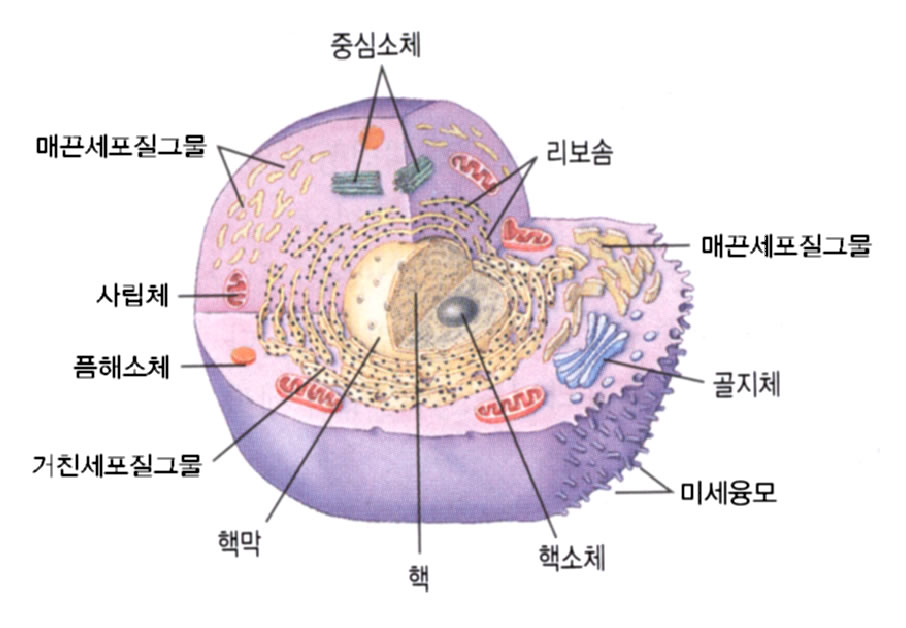 |
||
| MC | mass casualties; mast cell; Master of Surgery [Lat. Magister Chirurgiae]; maximum concentration; Med... |
|---|---|
| ACC | accommodation; acetyl coenzyme A carboxylase; acinic cell carcinoma; acute care center; adenoid cyst... |
| IMC | indigent medical care; information-memory-concentration [test]; interdigestive migrating contraction... |
| GC | ganglion cell; gas chromatography; general circulation; general closure; general condition; generali... |
| AMS | ablepharon-microstomia syndrome; acute mountain sickness; adenosylmethionine synthetase; aggravated ... |
| AAMI | Age-Associated Memory Impairment |
|---|---|
| LTM | Long-Term Memory |
| MQ | Memory Quotient |
| RBMT | Rivermead Behavioural Memory Test |
| STM | Short-Term Memory |
| memory cell | <immunology> Cells of the immune system that do not respond immediately when it first encounters an antigen but facilitates the more rapid secondary response when the antigen is encountered on a subsequent occasion. The long lasting immune memory is humoral and resides in B-cells, although it appears that persistence of the antigen may be essential. T-cell memory is shorter. (14 Oct 1997) |
|---|
| memory T-cell | A T-cell that bears receptors for a specific foreign antigen encountered during a prior infection or vaccination. After an infection or a vaccination, some of the T-cells that participated in the response remain as memory T-cells, which can rapidly mobilize and clone themselves should the same antigen be re-encountered during a second infection at a later time. (09 Oct 1997) |
|---|---|
| affect memory | The emotional element recurring whenever a significant experience is recalled. (05 Mar 2000) |
| anterograde memory | Memory for that which occurred after an event such as a brain injury. (05 Mar 2000) |
| remote memory | Memory for events of long ago as opposed to recent events. (05 Mar 2000) |
| retrograde memory | Memory for that which occurred before an event such as a brain injury. (05 Mar 2000) |
| memory | Complex mental function having four distinct phases: (1) memorizing or learning, (2) retention, (3) recall, and (4) recognition. Clinically, it is usually subdivided into immediate, recent, and remote memory. (12 Dec 1998) |
| memory disorder | Disturbances in registering an impression, in the retention of an acquired impression or in the recall of an impression. (12 Dec 1998) |
| memory loop | An electronic device for retrieving data that had been stored and/or displayed upon the oscilloscope at an earlier time; used for reviewing electrical events immediately preceding a specific disturbance. (05 Mar 2000) |
| memory span | The maximum number of items recalled after a single presentation (auditory or visual). (05 Mar 2000) |
| memory trace | See: engram. (05 Mar 2000) |
| screen memory | In psychoanalysis, a consciously tolerable memory that unwittingly serves as a cover for another associated memory which would be emotionally painful if recalled. (05 Mar 2000) |
| selective memory | <psychology> Reception or retrieval of only some of the events in an experience. (05 Mar 2000) |
| senile memory | Memory that is good for remote events, often in contrast to current events; characteristically seen in aged or demented persons. (05 Mar 2000) |
| short-term memory | <psychology> Temporary storage of information for a few seconds to hours, as opposed to long-term memory which refers to material stored for days, years, or a lifetime. (12 Dec 1998) |
| subconscious memory | Information not immediately available for recall. (05 Mar 2000) |
| memory cell |
Memory B cells are B cells that although activated by the immune system, they are stored inside the circulatory system for later use, for long periods of time, possibly a whole lifetime. Like other cells such as helper T cells, killer T cells, and plasma cells they never become directly involved in the immune response to foreign objects in a living body. If a pathogen the body has already encountered invades, memory B cells can recognize the pathogen and start to divide. ...
출처: en.wikipedia.org/wiki/Memory_cell
|
|---|---|
| memory cell |
Immune cells that remain in the body after initial exposure to an antigen. They patrol the body for subsequent exposure(s) to the same antigen. Upon detection, these cells initiate a more rapid immune response.
출처: www.biobasics.gc.ca/english/View.asp
|
| memory cell |
long-living cells which are produced as part of a normal immune response. These cells are responsible for rapid immunologic response to second and subsequent infections by a particular agent.
출처: www.accessexcellence.org/AE/AEC/CC/vaccine_glossar...
|
| memory cell |
memory cells are a subset of T cells and B cells that have been exposed to specific antigens and can then proliferate (recognize the antigen and divide) more readily when the immune system re-encounters the same antigens.
출처: www.opendoorclinic.org/hivglossary.htm
|
| memory cell |
clonally expanded progeny of T and B cells fomred during the primary response following intial exposure to an antigen. Memory cells are more easily activated than naive lymphocytes and when they encounter antigen in subsequent exposure, they mediate a faster and greater secondary response.
출처: www.brown.edu/Courses/Bio_160/Projects1999/vaccine...
|
제품명 |
판매사 |
보험코드 | 성분/함량 | 구분/보험급여 |
|---|
제품명 |
판매사 |
보험코드 | 성분/함량 | 구분/보험급여 |
|---|