
| 영문 | alimentary tract | 한글 | 소화관, 영양관 |
|---|---|---|---|
| 설명 | 입에서 시작하여 항문으로 끝나는 소화를 담당하는 이르는 말. 위창자관이라고도 불린다. |
||
| 영문 | alimentary canal | 한글 | 소화관 |
|---|---|---|---|
| 설명 | 입에서 항문에 이르는 음식의 소화-흡수에 관여하는 관상 또는 확대되어 낭상으로 된 부분의 총칭. 소화기관 중 소화샘을 제외한 것이다. 고등척추동물에서는 구강→인두→식도→들문→위→날문→작은창자(샘창자→돌창자)→큰창자(잘룩창자→곧창자)→항문까지 하나로 잊는 관으로 작은창자 말단부와 큰창자가 시작되는 곳의 접점에는 막창자이 연결된다. 구강에서 위에 이르는 소화관의 전반부에서는 ① 음식의 섭취와 그 확보, ② 씹는 일, ③ 음식의 저류가 이루어지는 데, 소화는 구강 안에서의 침 속의 프티알린에 의한 녹말 일부의 분해, 위에서의 펩신에 의한 단백질 일부의 분해뿐이며, 흡수는 알코올 및 알코올에 녹은 물질이 위벽에서 흡수될 뿐이다. |
||
| 영문 | biliary tract | 한글 | 쓸개길, 담도, 담관 |
|---|---|---|---|
| 설명 | 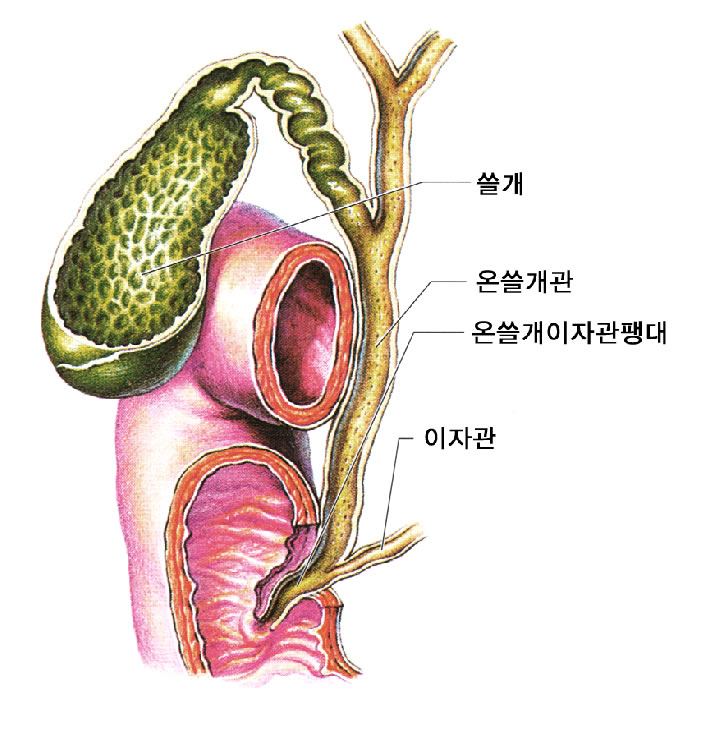 간에서 만들어진 쓸개즙을 수송하는 관조직의 일부. 간에서 만들어진 담즙은 간관, 쓸개관을 거쳐서 쓸개에 보관되었다가 온쓸개관을 통해서 샘창자로 보내진다. 이처럼 간에서 만들어진 담즙이 샘창자까지 배설되는 길로서 길이는 6~7cm 이며 간관, 쓸개관, 온쓸개관 따위로 이루어져 있다. |
||
| 영문 | urinary tract | 한글 | 요로 |
|---|---|---|---|
| 설명 | 오줌을 몸 밖으로 배출하기 위한 길. 콩팥, 요관, 방광, 요도로 이루어져 있다. |
||
| ECG | Electro-Cardio-Graphy(-Gram); 심전도 = EKG 1. Conducting System Structu... |
|---|---|
| ATA | alimentary toxic aleukia; American Thyroid Association; aminotriazole; antithymic activity; antithyr... |
| BAPV | bovine alimentary papilloma virus |
| ASD | aldosterone secretion defect; Alzheimer senile dementia; antisiphon device; arthritis syphilitica de... |
| IASD | interatrial septal defect; inter-auricular septal defect |
| CARDIAC | Cardiovascular Disease and Alimentary Comparison |
|---|---|
| ASD | Atrial septal defect |
| CHD | Congenital heart defect |
| CSD | critical size defect |
| LPD | Luteal phase defect |
| alimentary tract | The passage leading from the mouth to the anus through the pharynx, oesophagus, stomach, and intestine. Synonym: alimentary canal, alimentary tract, digestive tube, tubus digestorius. (05 Mar 2000) |
|---|---|
| alimentary tract smear | A group of cytologic specimens containing material from the mouth (oral smear), oesophagus and stomach (gastric smear), duodenum (paraduodenal smear), and colon, obtained by specialised lavage techniques; used principally for the diagnosis of cancer of those areas. (05 Mar 2000) |
| alimentary | <gastroenterology> Pertaining to food or nutritive material or to the organs of digestion. (18 Nov 1997) |
| alimentary apparatus | The organs that are responsible for getting food into and out of the body and for making use of food to keep the body healthy. These include the mouth, oesophagus, stomach, liver, gallbladder, pancreas, small intestine, colon, and rectum. (12 Dec 1998) |
| alimentary canal | <anatomy> The digestive tract. (27 Sep 1997) |
| alimentary diabetes | Glycosuria developing after the ingestion of a moderate amount of sugar or starch, which normally is disposed of without appearing in the urine, because rate of intestinal absorption exceeds capacity of the liver and the other tissues to remove the glucose, thus allowing blood glucose levels to become high enough for renal excretion to occur. Synonym: alimentary diabetes, digestive glycosuria. (05 Mar 2000) |
| alimentary glycosuria | Glycosuria developing after the ingestion of a moderate amount of sugar or starch, which normally is disposed of without appearing in the urine, because rate of intestinal absorption exceeds capacity of the liver and the other tissues to remove the glucose, thus allowing blood glucose levels to become high enough for renal excretion to occur. Synonym: alimentary diabetes, digestive glycosuria. (05 Mar 2000) |
| alimentary lipaemia | Relatively transient lipaemia occurring after the ingestion of foods with a large content of fat. Synonym: postprandial lipaemia. (05 Mar 2000) |
| alimentary osteopathy | Bone disease due to dietary deficiency. (05 Mar 2000) |
| alimentary system | The organs that are responsible for getting food into and out of the body and for making use of food to keep the body healthy. These include the mouth, oesophagus, stomach, liver, gallbladder, pancreas, small intestine, colon, and rectum. (12 Dec 1998) |
| acquired platelet function defect | <haematology> Platelet function can be affected by a number of different disease processes including polycythaemia vera, leukaemia, myelofibrosis, renal failure, multiple myeloma and some medications (for example penicillins, salicylates, phenothiazines). Disturbed blood clotting can be manifested by: easy bruising, bleeding gums, nosebleeds, abnormal vaginal bleeding, rectal bleeding, skin rash, vomiting blood, coughing up blood or blood in the urine. A measure of bleeding time and coagulation profile will be part of the evaluation. (29 Dec 1997) |
| aortic septal defect | A small congenital opening between the aorta and pulmonary artery about 1 cm above the semilunar valves, e.g., aorticopulmonary window. Synonym: aorticopulmonary window. (05 Mar 2000) |
| aortopulmonary septal defect | A congenital anomaly in which there is abnormal communication between the ascending aorta and pulmonary artery just above the semilunar valves. (12 Dec 1998) |
| atrial septal defect | <cardiology> An inherited condition where there is nonclosure of the foramen ovale at birth, resulting in congenital heart disease. Usually asymptomatic until the third or fourth decades of life. Symptoms include exertional shortness of breath, fatigue and palpitations. Acronym: ASD (12 Jan 1998) |
| atrial ventricular canal defect | A defect caused by deficient or absent septal tissue immediately above and below the normal level of the atrioventricular valves, including the region normally occupied by the A-V septum in hearts with two ventricles. The A-V valves are abnormal to a varying degree. (05 Mar 2000) |
제품명 |
판매사 |
보험코드 | 성분/함량 | 구분/보험급여 |
|---|
제품명 |
판매사 |
보험코드 | 성분/함량 | 구분/보험급여 |
|---|