
| 영문 | urinary bladder | 한글 | 방광 |
|---|---|---|---|
| 설명 | 골반강의 배쪽에 있는, 요의 저장역할을 하는 근막성의 주머니로 요는 요관으로부터 유입되고 방광은 다시 오줌을 요도로 배출한다. 방광에서 요도로 이행되는 부위는 모양에 따라 삼각부(trigone)이라 한다. 남성에서는 뒤에 전립샘(prostate)이 있다. |
||
| 영문 | vocal cord | 한글 | 성대 |
|---|---|---|---|
| 설명 | 목소리를 내는 데 꼭 필요한 중요한 구조물이다. 성대주위에는 작은 근육들이 존재하여, 하는 소리가 나오도록 해 주는 데, 이 근육들은 주로 되돌이후두신경의 지배를 받고 있으며, 성대의 감각신경은 위후두신경이 맡고 있다. 이중 왼쪽 반회후두신경은 신경의 주행경로상 밑으로 내려갔다 다시 올라와 분포하게 되므로 폐암으로 인한 폐수술시에 손상받기 쉬워서, 수술합병증으로 목쉰소리가 남기도 한다. 또한 성대가 막히면, 공기의 통로가 막히게 되므로 호흡곤란을 유발한다. 성대나 그 주위에서 종양이 발생할 수 있으며, 흡연이 주요한 원인이다. 성대자체에서 종양이 발생하면 목쉰소리가 나타나 쉽게 알 수 있으나, 성대이하부위나, 이상부위에서 발생하면 증상이 늦게 나타나므로, 다른 곳으로의 전이소견이나, 혹은 호흡곤란으로 나타나기도 한다. |
||
| 영문 | spermatic cord | 한글 | 정삭 |
|---|---|---|---|
| 설명 | 고환의 위쪽끝에서부터 샅고랑의 안쪽 끝까지의 사이에 있는 끈 모양의 조직. 정관, 혈관, 신경, 민무늬근, 지방조직 따위로 이루어져 있다. |
||
| 영문 | spinal cord | 한글 | 척수 |
|---|---|---|---|
| 설명 | 척추내에 위치하는 중추신경계의 일부분. 위에서부터 목척수, 등척수, 허리척수, 엉치척수로 구분됨. 내부는 바깥쪽의 백색질과 안쪽의 회색질로 구분된다. 척수의 아래끝은 척수 원뿔이라 하며 첫번째 허리뼈 높이까지 내려온다. 뇌와 말초신경사이의 신경 통로 역할을 하며 척수반사(예: 무릎반사)에서는 뇌를 통하지 않고 반사의 중추 작용을 한다. 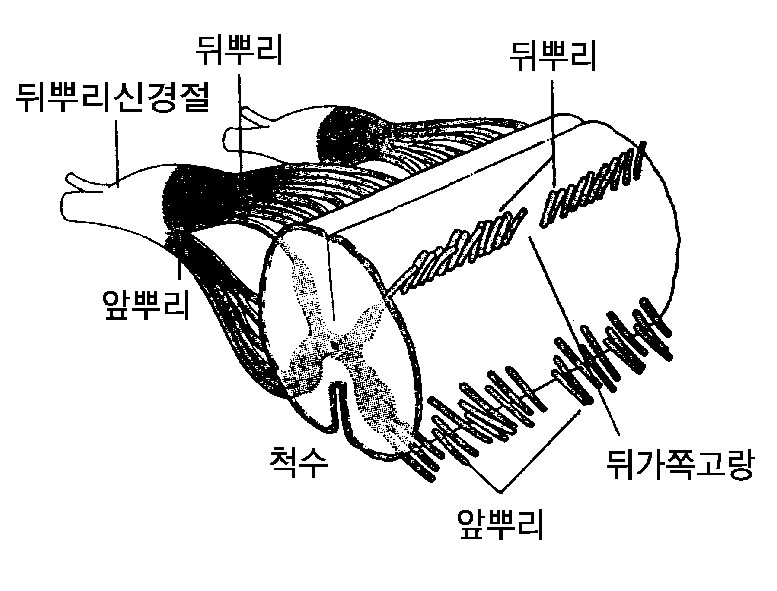 |
||
| 영문 | umbilical cord | 한글 | 탯줄, 제대 |
|---|---|---|---|
| 설명 | 태아의 배꼽을 태반과 연결시키는 유일한 구조로 2개의 탯줄동맥과 1개의 탯줄정맥이 지나간다. 신생아때에는 길이가 약 50cm이다. 태생기 발생 약 5주경에 요막경(allantoic diverticulum, body stalk)으로부터 형성되며 배꼽창자관(vitello- intestinal duct) 및 요막(allantoic membrane)을 포함하고 있다. 약 1%에서 제대동맥이 하나뿐인 경우가 있는데 이때에는 선천성기형의 동반률이 증가한다. |
||
| KUB | kidneys and upper bladder; [x-ray examination of the] kidneys, ureter, and bladder |
|---|---|
| GB | Gall Bladder; 담낭 |
| KUB | Kidney, Ureter & Bladder; 신장, 요관, 방광; 단순 요로 촬영 = Plain Film = Scout F... |
| ABSe | ascending bladder septum |
| BBS | Barolet-Biedl syndrome; bashful bladder syndrome; benign breast syndrome; bilateral breath sounds; b... |
| BOO | Bladder Outlet Obstruction |
|---|---|
| BD | Bladder drainage |
| BNI | Bladder neck incision |
| BTA | Bladder tumor antigen |
| GB | Gall Bladder |
| air bladder | 1. <anatomy> An air sac, sometimes double or variously lobed, in the visceral cavity of many fishes. It originates in the same way as the lungs of air-breathing vertebrates, and in the adult may retain a tubular connection with the pharynx or oesophagus. 2. A sac or bladder full of air in an animal or plant; also an air hole in a casting. Source: Websters Dictionary (01 Mar 1998) |
|---|---|
| allantoic bladder | A type of bladder formed as an outgrowth of the cloaca. (05 Mar 2000) |
| apex of urinary bladder | The junction of the superior and anteroinferior surfaces of the bladder, continuous above with the median umbilical ligament. Synonym: apex vesicae. (05 Mar 2000) |
| atonic bladder | A large, dilated, and nonemptying bladder; usually due to disturbance of innervation or to chronic obstruction. (05 Mar 2000) |
| autonomic neurogenic bladder | Malfunctioning bladder, secondary to low spinal cord lesions. (05 Mar 2000) |
| bar of bladder | A fold of mucous membrane extending from the orifice of the ureter of one side to that of the other side. Synonym: plica interureterica, bar of bladder, Mercier's bar, plica ureterica, torus uretericus, ureteric fold. (05 Mar 2000) |
| base of bladder | The fundus is formed by the posterior wall which is somewhat convex. Synonym: fundus vesicae urinariae, bas-fond, base of bladder. (05 Mar 2000) |
| bladder | A membranous sac that serves as a reservoir for urine. Contraction of the bladder results in urination. (27 Sep 1997) |
| bladder calcification | <radiology> Schistosomiasis (bilharziasis), major cause worldwide, 50% have calcification, can cause squamous cell carcinoma, TB and other infections, radiation cystitis, calculi, bladder neoplasms, transitional cell carcinoma, squamous cell carcinoma, leiomyosarcoma, haemangioma, neuroblastoma, osteosarcoma (12 Dec 1998) |
| bladder calculi | Calculi of the urinary bladder; also known as vesical calculi, bladder stones or gravel, and cystoliths. Vesicoprostatic calculi are prostatic calculi extending into the bladder. (12 Dec 1998) |
| bladder cancer | The most common warning sign of bladder cancer is blood in the urine. The diagnosis of bladder cancer is supported by findings in the medical history and examination, blood, urine, and X-ray tests, and confirmed with a biopsy (usually during a cystoscope exam). Treatment of bladder cancer depends on the growth, size, and location of the tumour. (12 Dec 1998) |
| bladder cancer risks | Smoking is a major risk factor. Cigarette smokers develop bladder cancer 2-3 times more often than do nonsmokers. Quitting smoking reduces the risk of bladder cancer, lung cancer, several other types of cancer, and a number of other diseases as well. Workers in some occupations are at higher risk of developing bladder cancer because of exposure to carcinogens (cancer-causing substances) in the workplace. These workers include people in the rubber, chemical, and leather industries, as well as hairstylists, machinists, metal workers, printers, painters, textile workers, and truck drivers. (12 Dec 1998) |
| bladder compliance | Relationship of volume to pressure; can be calculated from a cytometrogram's pressure volume curve. Synonym: compliance of bladder. (05 Mar 2000) |
| bladder exstrophy | Congenital eversion of the urinary bladder. It is characterised by the absence of a portion of the lower abdominal wall and the anterior vesical wall, with eversion of the posterior vesical wall through the deficit. (12 Dec 1998) |
| bladder fistula | An abnormal passage in the bladder or between the bladder and another organ. (12 Dec 1998) |
| cord bladder |
Distention of the bladder without discomfort. Symptoms include a tendency to void frequently and dribbling after urination. The condition is caused by a lesion affecting the posterior roots of the spinal column at the level of bladd
출처:
|
|---|
제품명 |
판매사 |
보험코드 | 성분/함량 | 구분/보험급여 |
|---|
제품명 |
판매사 |
보험코드 | 성분/함량 | 구분/보험급여 |
|---|