
| 영문 | open heart surgery | 한글 | 개심술, 심장절개술 |
|---|---|---|---|
| 설명 | 심장의 한 개 또는 그 이상의 방실 절개하는 수술. 심방사이막결손증, 심실사이막결손증, 순수형 허파동맥판막협착증, 팔로(Fallot) 사징후 등이 적용이 된다. 이 수술을 위해서는 인공심폐장치가 필요하다. |
||
| 영문 | hypertensive heart disease | 한글 | 고혈압심장병 |
|---|---|---|---|
| 설명 | 고혈압에 의해서 생기는 심장병. 고혈압심장병이라는 진단을 붙이기 위해서는 최소한 다음과 같은 조건이 부합되어야 하는데, 첫째 심장혈관계에 심장병을 유발할 수 있을 만한 다른 병변이 없이 좌심실 비대가 있어야 하며, 둘째 고혈압을 앓았다는 병력이 있어야 한다. 주로 고혈압에 의한 심장병은 초기에는 좌심실이 비후라는 것으로 특징되어진다. 즉 혈압이 높으므로 혈액을 순환시키기 위해서는 그만큼 심장의 혈액을 보내는 힘이 좋아야 한다. 그 힘을 얻기위해서는 심근의 비후가 필요로 하여 좌심실 근육의 비후가 생긴다. 그리고 고혈압이 지속이 될 경우에는 결국 심장이 제 구실을 하지 못하고 펌프로서의 기능을 잃어버리게 되어 심장기능상실에 빠지게 된다. |
||
| 영문 | rheumatic heart disease | 한글 | 류마티스심장병 |
|---|---|---|---|
| 설명 | 사슬알균감염 후 생기는 심장판막병이다. 원인은 A군 -용혈사슬알에 의한 인두염후 일종의 면역반응으로 발병한다. 진단은 존의 기준에 의한다. (1) 주요기준은 관절염 심장염(심장비대, 심장잡음, 심장기능상실 등) 무도증: 무당이 춤을 추는 것 같은 행동의 발작증세. 연변홍반: 빨간 테두리를 가진 피부병변은 피하결절(subcutaneous nodule): 피부 밑에 생긴 결절, (2)참고 기준은 열, 관절통, EKG상 PR연장: 심전도 소견 급성기 반응물질(예: ESR, CRP)의 상승, 류마티스열 치료는 페니실린으로 치료하고 심장의 후유증 또한 페니실린으로 예방한다. |
||
| 영문 | congenital heart disease | 한글 | 선천심장병 |
|---|---|---|---|
| 설명 | 선천적으로 심장의 구조에 이상이 있는 병. |
||
| 영문 | heart | 한글 | 심장 |
|---|---|---|---|
| 설명 | 심장은 가슴의 중앙에 위치하며 오른쪽과 왼쪽반으로 나눌 수 있다. 각각은 정맥에서 피가 들어오는 방과 동맥으로 피를 내보내는 실이 있다. 심장은 정중앙선에서 왼쪽에 놓여 있다. 심장의 2개의 심방과 2개의 심실, 그리고 심방사이의 심방중격, 심실사이의 심실중격이 존재한다. 심실은 혈액을 주로 순환시키는 힘을 내는 곳으로 강한 근육층이 존재를 한다. 반면에 심방은 심실에 들어가기전에 일시적으로 피가 모이는 곳으로 근육층의 발달이 미약하다. 심방과 심실사이에 삼첨판과 승모판, 심실의 유출로에 대동맥판과 폐동맥판이 있다. 이것들은 혈액이 흐르는 방향에 거슬러 진행하는 것을 막는 기능을 한다. 그리고 심장에는 심장의 근육에 혈액을 공급하는 관상동맥이 있다. 이 심장동맥은 심장을 쌓듯이 존재한다. 심장박동의 신호는 특수한 장치에 의해서 발생이 되고 특수한 전도계를 통해서 전체의 심장으로 전도된다. 심장박동의 신호는 우선 우심방에 위치하는 동방결절(SA node)라는 곳에서 우선 생긴다. 여기에서 보내는 전기적 신호가 바로 심장을 뛰게하는 신호인 것이다. 이 신호로 말미암아 심방이 우선 수축을 한다. 그리고는 심방과 심실사이에 위치하는 방실결절(AV node)라는 곳에 일정하게 정해진 통로없이 전체의 심방을 통해서 전달이 되고 이 신호를 받은 방실결절(AV node)는 히스 다발(His bundle)과 심장전도근육섬유를 통해서 심실의 심장근육에게 이 신호를 보내주어 심실근육을 수축하게 한다. 히스다발과 심장전도근육섬유는 전체의 심실의 심근섬유에 동시에 전기적 신호를 보내어 줄 수 있게 하는 일종의 전기줄과 같은 역할을 한다. 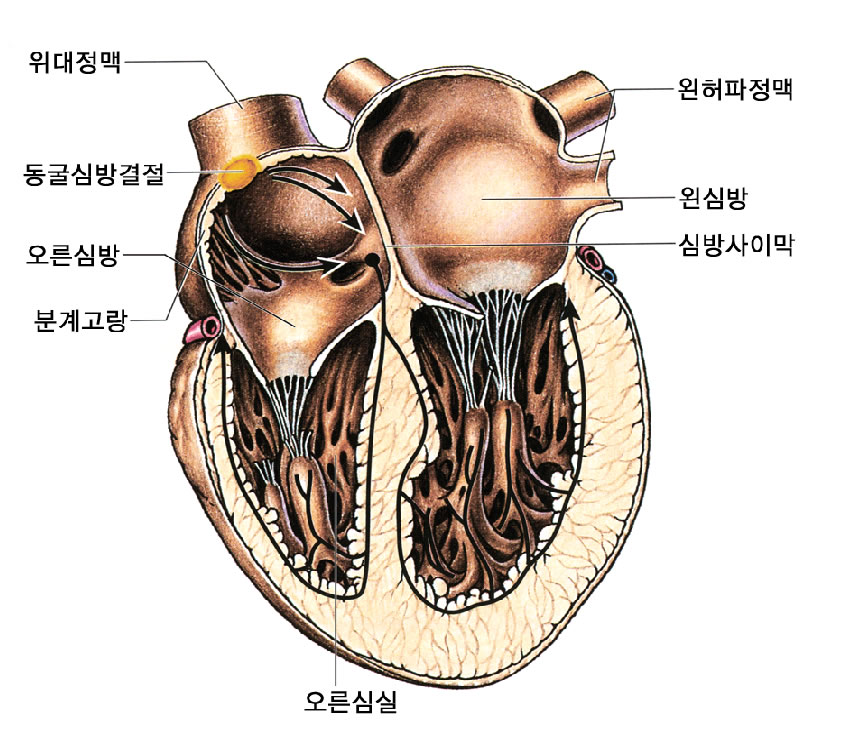 |
||
| ECG | Electro-Cardio-Graphy(-Gram); 심전도 = EKG 1. Conducting System Structu... |
|---|---|
| AC/BC | air conduction/bone conduction [time ratio] |
| CSD | carotid sinus denervation; cat scratch disease; combined system disease; conditionally streptomycin ... |
| ISIS | image selected in vivo spectroscopy; imaging science and information system; information system-imag... |
| IHD | Ischemic Heart Disease = Coronary Heart(Artery) Disease = Atheroscler... |
| T system | tubular system |
|---|---|
| AC | Air Conduction |
| BC | Bone conduction |
| CCT | Central Conduction Time |
| CMCT | Central Motor Conduction Time |
| heart conduction system | An impulse-conducting system composed of modified cardiac muscle and having the power of spontaneous rhythmicity and conduction more highly developed than the rest of the heart. (12 Dec 1998) |
|---|---|
| conducting system of heart | The system of atypical cardiac muscle fibres comprising the sinoatrial node, internodal tracts, atrioventricular node and bundle, the bundle branches, and their terminal ramifications into the Purkinje network; sometimes also called cardionector. (05 Mar 2000) |
| aberrant ventricular conduction | Abnormal intraventricular conduction of a supraventricular beat, especially where surrounding beats are normally conducted. Synonym: ventricular aberration. (05 Mar 2000) |
| accelerated conduction | Any pathologically increased speed of conduction; usually occurs between the atrium and ventricles as in the Wolff-Parkinson-White and Lown-Ganong-Levine syndromes; such accelerated pathways provide the bases for particular forms of reentry tachycardia. (05 Mar 2000) |
| A-H conduction time | Forward conduction of the cardiac impulse from atria to ventricles via the A-V node or any bypass tract, represented in the electrocardiogram by the P-R interval. P-H conduction time is from the onset of the P wave to the first high frequency component of the His bundle electrogram (normally 119 ± 38 msec); A-H conduction time is from the onset of the first high frequency component of the atrial electrogram to the first high frequency component of the His bundle electrogram (normally 92 ± 38 msec); P-A conduction time is from the onset of the P wave to the onset of the atrial electrogram (normally 27 ± 18 msec). (05 Mar 2000) |
| air conduction | In relation to hearing, the transmission of sound to the inner ear through the external auditory canal and the structures of the middle ear. (05 Mar 2000) |
| anomalous conduction | Conduction of cardiac electrical impulses through any abnormal pathway. (05 Mar 2000) |
| antegrade conduction | Conduction in the expected normal direction between any cardiac structures. Synonym: antegrade conduction, forward conduction, orthograde conduction. (05 Mar 2000) |
| anterograde conduction | Conduction in the expected normal direction between any cardiac structures. Synonym: antegrade conduction, forward conduction, orthograde conduction. (05 Mar 2000) |
| aphasia, conduction | A type of fluent aphasia in which there is normal comprehension of spoken language but words are repeated incorrectly. It results from a lesion of the arcuate fasciculus connecting broca's and wernicke's areas. Like patients with wernicke's aphasia (aphasia, wernicke), patients with conduction aphasia are fluent but have many paraphasic errors (incorrect words or sounds substituted for correct ones). The degree of fluency is less than that in wernicke's aphasia, but comprehension is good. (12 Dec 1998) |
| atrioventricular conduction | Forward conduction of the cardiac impulse from atria to ventricles via the A-V node or any bypass tract, represented in the electrocardiogram by the P-R interval. P-H conduction time is from the onset of the P wave to the first high frequency component of the His bundle electrogram (normally 119 ± 38 msec); A-H conduction time is from the onset of the first high frequency component of the atrial electrogram to the first high frequency component of the His bundle electrogram (normally 92 ± 38 msec); P-A conduction time is from the onset of the P wave to the onset of the atrial electrogram (normally 27 ± 18 msec). (05 Mar 2000) |
| atrioventricular conduction abnormalities | <cardiology, physiology> Any condition which involves abnormal (blocked, delayed or aberrant) electrical conduction through the atrioventricular node (for example atrioventricular block). Some medications may precipitate atrioventricular conduction abnormalities. (02 Jan 1998) |
| avalanche conduction | <physiology> The discharge of an impulse from a neuron into a large number of neurons of the same physiologic system. This produces an amplification effect, thus producing a very large amount of nervous energy for a given stimulus. (05 Mar 2000) |
| A-V conduction | Forward conduction of the cardiac impulse from atria to ventricles via the A-V node or any bypass tract, represented in the electrocardiogram by the P-R interval. P-H conduction time is from the onset of the P wave to the first high frequency component of the His bundle electrogram (normally 119 ± 38 msec); A-H conduction time is from the onset of the first high frequency component of the atrial electrogram to the first high frequency component of the His bundle electrogram (normally 92 ± 38 msec); P-A conduction time is from the onset of the P wave to the onset of the atrial electrogram (normally 27 ± 18 msec). (05 Mar 2000) |
| A-V conduction abnormalities | <cardiology, physiology> Any condition which involves abnormal (blocked, delayed or aberrant) electrical conduction through the atrioventricular node (for example atrioventricular block). Some medications may precipitate atrioventricular conduction abnormalities. (02 Jan 1998) |
제품명 |
판매사 |
보험코드 | 성분/함량 | 구분/보험급여 |
|---|
제품명 |
판매사 |
보험코드 | 성분/함량 | 구분/보험급여 |
|---|