
| 영문 | muscle cell(=muscle fiber) | 한글 | 근육세포 |
|---|---|---|---|
| 설명 | 근육은 수의근(의식에 의해서 조절이 가능한 근육: 예를 들어 다리, 팔, 얼굴근육 등)과 불수의근(의식과 무관하게 조절하지 않아도 움직이는 근육: 예를 들어 심장근, 소화기관에 분포하는 근육 등)으로 나누어지며, 근육세포의 모양은 다음과 같다(수의근, 불수의근 외에 심장에 있는 심장근은 불수의근에 해당하지만 그 모양은 수의근과 같아 따로 분류한다).  |
||
| 영문 | white blood cell(WBC), leukocyte | 한글 | 백혈구 |
|---|---|---|---|
| 설명 | 혈액내에 골수구계세포와 림프계세포, 단핵구계세포를 모두 통틀어 말한다. 백혈구의 증가가 있으면 대개 감염이 있거나, 혹은 탈수현상이 있음을 의미한다. 또한 지나친 백혈구수의 감소는 인체내 면역기능이 떨어져 있음을 의미하며, 다른 질병에 의해 나타나는 이차적인 현상이 아닌지 꼭 진단을 받아보아야 한다. |
||
| 영문 | mast cell | 한글 | 비만 세포 |
|---|---|---|---|
| 설명 | 동물의 결합 조직 가운데 널리 분포하는 세포. 결합조직과 점막조직 내에 있는 호염기성 색소로 이염색성(metachromasia)을 나타내는 과립을 가진 방추형의 세포에 작은 둥근 핵을 가진다. 비만세포의 표면에는 IgE에 대한 수용체가 존재하며, 수용체에 결합한 IgE 분자들끼리 다가의 항원에 의해 서로 연결되면 비만세포 과립탈출 반응이 일어나, 히스타민, 세로토닌, 헤파린 등의 화학전달 물질이 방출되어, 즉시형 알레르기 반응 등의 증상을 일으킨다. 피부, 장막, 혈관 주위, 점막 주변에 있다. |
||
| 영문 | cell | 한글 | 세포 |
|---|---|---|---|
| 설명 | 생명체를 이루는 구조적, 기능적 단위. 핵의 유무에 따라서 유핵세포와 무핵세포로 나눌 수가 있다. 무핵세포란 핵이 없는 세포를 말한다. 핵이란 유전정보를 가지고 있는 염색체를 보관하는 곳인데 무핵세포에서는 염색체가 세포속에 그냥 노출되어 있다. 대개 세포 하나하나가 독립된 생명체의 역할을 하는 단세포생물로서 외부환경으로부터 자신을 보호할 수 있는 견고한 세포벽을 가지고 있다. 유핵세포란 핵을 가지고 있어서 유전정보가 있는 염색체가 세포의 다른 부분과 구분되어 핵속에 들어있다. 세포속에서 핵외의 부분(이를 세포질이라 한다)에는 여러 가지 세포의 소기관이 있어서 세포의 다양한 기능을 분담한다. ◈유핵세포의 기본 구조 1.세포막-세포를 둘러싸서 주위환경과 분리하여 세포의 내환경을 유지한다. 2.형질내세망(endoplasmic reticulum)-단위막으로 둘러쌓여 있는 불규칙한 망상구조이다. 이 망상구조의 내부를 소강, 소조라고 부른다. 여기에는 표면이 매끈한 무과립형질내세망과 표면이 불규칙한 과립형질내세망의 두 가지가 있다. 과립형질내세망의 경우는 표면에 단백질을 합성하는 리보솜이라는 것이 부착되어 있다. 이곳은 주로 세포밖으로 분비할 단백질을 합성하는 장소이다. 무과립형질내세망은 표면에 리보솜이 부착되어 있지 않은 것을 말하며, 이곳에서는 주로 해독작용, 글리코겐의 합성, 스테로이드호르몬의 합성 등이 일어난다. 3.리보솜-단백질을 합성하는 역할을 하는 곳이다.이것은 세포질에 존재하는 자유리보솜과 과립형질내세망에 부착이 되어 존재하는 부착리보솜의 두 가지로 나눈다. 자유리보솜은 주로 세포내에서 필요한 단백질을 만드는 역할을 하고 부착리보솜은 세포밖으로 분비할 단백질을 만드는 역할을 한다. 4.골지장치(Golgi apparatus)-핵주위에 분포하는 납작해진 주머니모양의 것이 중첩되어 형성된 층판 모양의 구조물로 과립형질내세망에서 생성되어 외부로 분비될 단백질을 모아서 농축, 포장하여 과립을 만드는 역할을 한다. 5.사립체(mitochondria)-구형, 난형의 긴 막대기 모양으로 크기가 다양한 구조물. 생물체의 에너지 저장물질인 ATP를 생산하는 역할을 한다. 또 세포와 다른 자신만의 유전정보를 가진 DNA, RNA를 가지고 있다. 모양, 크기가 세균과 비슷하며 자체증식성 등 독립된 생명체로서 필요한 요건을 갖추고 있어서 세포와 공생관계를 가진 독립된 세포로 생각하고 있다. 6.용해소체(lysosome)-작은 구형의 소체로 여러 가지 분해효소를 가진다. 세포외계에서 들어온 물질과 결합하여 그 물질들을 용해하는 역할을 하고, 오래된 세포소기관들을 제거하는 역할도 한다. 7.세포핵(nucleus)-구형, 난형으로 세포의 중심에 위치한다. 핵내에는 유전정보가 있는 물질인 염색체가 존재한다. 8.중심소체(centrosome)-핵주위에 존재하면서 핵의 분열시에 양쪽의 염색체를 당기는 작은 섬유를 만드는 역할을 하는 곳. 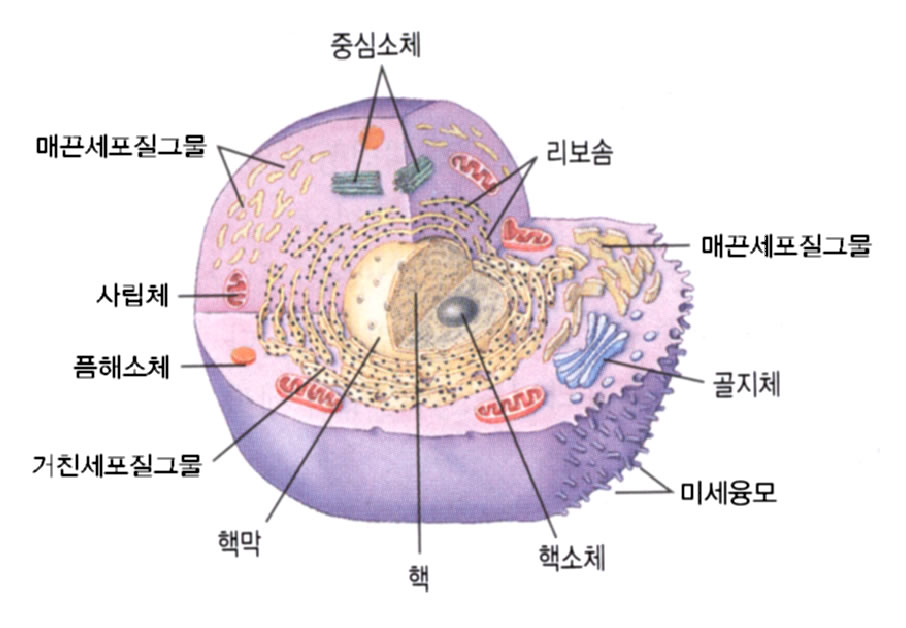 |
||
| 영문 | cell-mediated immunity | 한글 | 세포매개면역 |
|---|---|---|---|
| 설명 | 면역이란 신체를 외부의 물질로부터 보호하는 행위를 말한다. 여기에는 특이적 면역과 비특이적 면역의 두 가지가 있다. 비특이적 면역이라함은 특정한 물질에 관계하는 면역이 아니라 특정 대상이 없이 모든 외부 물체에 작용할 수 있는 면역을 말한다. 여기에는 소변의 흐름, 눈물의 흐름, 피부의 비투과성 등의 기계적인 것도 포함되고 피속에 돌아다니는 세포 중에서 비특이적으로 외부의 물질을 포식하는 세포들(예를 들면 큰포식세포(macrophage)의 활동도 포함이 된다. 세포매개면역이란 특이한 물질을 감지할 수 있는 세포를 생성하게 하여 그것으로 하여금 그 물질을 포식하게 하는 것을 말한다. |
||
| SDT | sensory detection theory; right sacrotransverse [fetal position] [Lat. sacrodextra transversa]; sign... |
|---|---|
| MC | mass casualties; mast cell; Master of Surgery [Lat. Magister Chirurgiae]; maximum concentration; Med... |
| DOI | date of injury; died of injuries; diffusion of innovations [theory] |
| MAUT | multi-attribute utility theory |
| theor | theory, theoretical |
| DFT | Density Functional Theory |
|---|---|
| IRT | Item Response Theory |
| SDT | Signal Detection Theory |
| TOM | Theory of Mind |
| TPB | Theory of Planned Behavior |
| cell theory | <biology> The theory that all cells come from previously existing cells, and that cells are the most fundamental structural units of all living things. (26 Mar 1998) |
|---|
| T-cell-rich, B-cell lymphoma | <tumour> A B-cell lymphoma in which more than 90% of the cells are of T-cell origin, masking the large cells that form the neoplastic B-cell component. See: adult T-cell lymphoma. (05 Mar 2000) |
|---|---|
| Abbe theory of image formation | <optics, physics> Abbe's theory is based on the fact that a non-self-luminous particle, which is illuminated by an extraneous source, gives rise to diffracted light rays, in addition to the dioptric pencil. He stated that to form a good microscopical image as many of the diffracted rays as possible should be intercepted by the objective. With closely ruled lines, his theory is easily demonstrated by observing the back lens of the objective, for here the diffracted rays can be observed directly if the aperture diaphragm is closed. It can be shown that, when the illumination is arranged to exclude the diffracted images, resolution is lost. (11 Mar 1998) |
| adsorption theory of narcosis | That a drug becomes concentrated at the surface of the cell as a result of adsorption, and thus alters permeability and metabolism. (05 Mar 2000) |
| Altmann's theory | A theory that protoplasm consists of granular particles (called bioblasts) that are clustered and enclosed in indifferent matter. (05 Mar 2000) |
| Arrhenius-Madsen theory | That the reaction of an antigen with its antibody is a reversible reaction, the equilibrium being determined according to the law of mass action by the concentrations of the reacting substances. (05 Mar 2000) |
| atomic theory | That chemical compounds are formed by the union of atoms in certain definite proportions; in its modern form, first advanced in 1803 by John Dalton. (05 Mar 2000) |
| Baeyer's theory | That carbon bonds are set at fixed angles (109 |
| balance theory | In social psychology, a theory which assumes that steady and unsteady states can be specified for cognitive units, such as an individual and his or her attitudes or acts, and that such units tend to seek steady states (balance); e.g., balance exists when both parts of a unit are evaluated the same, but disequilibrium arises when both parts are not evaluated the same, which causes either cognitive reevaluation of the parts or their segregation. See: cognitive dissonance theory, consistency principle. (05 Mar 2000) |
| beta-oxidation-condensation theory | <biochemistry> That the two carbon fragments split from the fatty acid molecule by beta-oxidation are converted to acetic acid and then condensed to acetoacetic acid. (05 Mar 2000) |
| Bohr's theory | That spectrum lines are produced 1) by the quantised emission of radiant energy when electrons drop from an orbit of a higher to one of a lower energy level, or 2) by absorption of radiation when an electron rises from a lower to a higher energy level. (05 Mar 2000) |
| Bordeau theory | That each organ of the body manufactured a specific humor which it secreted into the bloodstream. (05 Mar 2000) |
| Bowman's theory | That the urine is formed by passive filtration through the glomeruli and secretion by the epithelium of the tubules, the water and salts being separated from the plasma in the former situation, the urea and other urinary constituents in the latter. Parts of this theory are now known to be wrong. (05 Mar 2000) |
| Bronsted theory | That an acid is a substance, charged or uncharged, liberating hydrogen ions in solution, and that a base is a substance that removes them from solution (e.g., NH4+, CH3COOH, and HSO4- are acids; NH3, CH3COO-, and SO4- are bases); useful in the concept of weak electrolytes and buffers. Compare: Bronsted acid, Bronsted base. (05 Mar 2000) |
| Burn and Rand theory | That stimulation of sympathetic fibres results first in the production of acetylcholine in the postganglionic nerve endings, which then release norepinephrine to act on the active site of the effector cell. (05 Mar 2000) |
| Cannon-Bard theory | The view that the feeling aspect of emotion and the pattern of emotional behaviour are controlled by the hypothalamus. (05 Mar 2000) |
| cell theory |
(biology) the theory that cells form the fundamental structural and functional units of all living organisms; proposed in 1838 by Matthias Schleiden and by Theodor Schwann
출처: wordnet.princeton.edu/perl/webwn
|
|---|---|
| cell theory |
The theory that all organisms are made of cells, and that all cells come from pre-existing cells. Cells are the structural and functional units of life.
출처: blue.utb.edu/biology/Oliva/terms_and_definitions_f...
|
| cell theory | (biology) the theory that cells form the fundamental structural and functional units of all living organisms |
|---|
제품명 |
판매사 |
보험코드 | 성분/함량 | 구분/보험급여 |
|---|
제품명 |
판매사 |
보험코드 | 성분/함량 | 구분/보험급여 |
|---|