
| 영문 | Dilatation and Curettage(D & C) | 한글 | 자궁긁어냄술, 자궁목확장 |
|---|---|---|---|
| 설명 | 자궁이란 태아가 수태되어서 분만전까지 발육하고 성장하는 공간이다. 자궁속에 병변이 있어 임신이 계속될 수 없거나 아니면 다른 이유로 임신되어 있는 태아를 제거하고자 할 경우에 사용되는 방법이다. 여기서 긁어내기 위하여는 우선 자궁의 입구에 해당하는 자궁목을 확장시켜야 한다. 여기에는 급속히 확장을 시도하는 법과 서서히 확장을 시도하는 2가지 방법이 있다. 자궁목을 급속히 확장할 때는 헤가르 목관확장기(Hegar's dilatator)를 사용한다. 이것은 작은 금속막대로 작은 크기부터 큰 크기까지 다양한 크기가 있어서 우선 작은 막대로 시작하여 점점 큰 크기의 막대를 자궁목에 넣어서 자궁목을 확장시킨다. 서서히 확장시킬 때는 Laminaria tent를 목관에 삽입하는 방법을 사용한다. Laminaria tent란 해초로 만든 작은 막대로 수분을 흡수하면 점점 늘어나는 성질이 있다. 이것을 자궁의 목에 넣으면 이것이 수분을 흡수하여 늘어나므로 천천히 자궁의 목이 늘어난다. 자궁목이 충분히 늘어나면 그 속으로 끝이 숟가락처럼 생긴 기구를 넣어서 자궁속의 병변이나 임신된 태아를 긁어내는데 여기에 사용되는 숟가락처럼 생긴 기구를 큐렛이라고 한다. 초기 임신중절 즉 유산과 같은 임신과 관련된 경우뿐만 아니라, 비임신 자궁의 자궁내막조직의 채취 및 제거를 위해서도 행해지는 수기이다. 이는 원칙적으로 마취하에 실시되는 것으로 자궁목관을 확장하고 기구로 자궁 내용물을 제거하고 큐렛으로 자궁내벽을 깨끗이 한다. 자궁천공이나 자궁목의 파열 등의 위험이 따르며, 수술후 감염 또는 출혈 등에 대한 주의가 필요하다. |
||
| 영문 | muscle cell(=muscle fiber) | 한글 | 근육세포 |
|---|---|---|---|
| 설명 | 근육은 수의근(의식에 의해서 조절이 가능한 근육: 예를 들어 다리, 팔, 얼굴근육 등)과 불수의근(의식과 무관하게 조절하지 않아도 움직이는 근육: 예를 들어 심장근, 소화기관에 분포하는 근육 등)으로 나누어지며, 근육세포의 모양은 다음과 같다(수의근, 불수의근 외에 심장에 있는 심장근은 불수의근에 해당하지만 그 모양은 수의근과 같아 따로 분류한다).  |
||
| 영문 | white blood cell(WBC), leukocyte | 한글 | 백혈구 |
|---|---|---|---|
| 설명 | 혈액내에 골수구계세포와 림프계세포, 단핵구계세포를 모두 통틀어 말한다. 백혈구의 증가가 있으면 대개 감염이 있거나, 혹은 탈수현상이 있음을 의미한다. 또한 지나친 백혈구수의 감소는 인체내 면역기능이 떨어져 있음을 의미하며, 다른 질병에 의해 나타나는 이차적인 현상이 아닌지 꼭 진단을 받아보아야 한다. |
||
| 영문 | mast cell | 한글 | 비만 세포 |
|---|---|---|---|
| 설명 | 동물의 결합 조직 가운데 널리 분포하는 세포. 결합조직과 점막조직 내에 있는 호염기성 색소로 이염색성(metachromasia)을 나타내는 과립을 가진 방추형의 세포에 작은 둥근 핵을 가진다. 비만세포의 표면에는 IgE에 대한 수용체가 존재하며, 수용체에 결합한 IgE 분자들끼리 다가의 항원에 의해 서로 연결되면 비만세포 과립탈출 반응이 일어나, 히스타민, 세로토닌, 헤파린 등의 화학전달 물질이 방출되어, 즉시형 알레르기 반응 등의 증상을 일으킨다. 피부, 장막, 혈관 주위, 점막 주변에 있다. |
||
| 영문 | cell | 한글 | 세포 |
|---|---|---|---|
| 설명 | 생명체를 이루는 구조적, 기능적 단위. 핵의 유무에 따라서 유핵세포와 무핵세포로 나눌 수가 있다. 무핵세포란 핵이 없는 세포를 말한다. 핵이란 유전정보를 가지고 있는 염색체를 보관하는 곳인데 무핵세포에서는 염색체가 세포속에 그냥 노출되어 있다. 대개 세포 하나하나가 독립된 생명체의 역할을 하는 단세포생물로서 외부환경으로부터 자신을 보호할 수 있는 견고한 세포벽을 가지고 있다. 유핵세포란 핵을 가지고 있어서 유전정보가 있는 염색체가 세포의 다른 부분과 구분되어 핵속에 들어있다. 세포속에서 핵외의 부분(이를 세포질이라 한다)에는 여러 가지 세포의 소기관이 있어서 세포의 다양한 기능을 분담한다. ◈유핵세포의 기본 구조 1.세포막-세포를 둘러싸서 주위환경과 분리하여 세포의 내환경을 유지한다. 2.형질내세망(endoplasmic reticulum)-단위막으로 둘러쌓여 있는 불규칙한 망상구조이다. 이 망상구조의 내부를 소강, 소조라고 부른다. 여기에는 표면이 매끈한 무과립형질내세망과 표면이 불규칙한 과립형질내세망의 두 가지가 있다. 과립형질내세망의 경우는 표면에 단백질을 합성하는 리보솜이라는 것이 부착되어 있다. 이곳은 주로 세포밖으로 분비할 단백질을 합성하는 장소이다. 무과립형질내세망은 표면에 리보솜이 부착되어 있지 않은 것을 말하며, 이곳에서는 주로 해독작용, 글리코겐의 합성, 스테로이드호르몬의 합성 등이 일어난다. 3.리보솜-단백질을 합성하는 역할을 하는 곳이다.이것은 세포질에 존재하는 자유리보솜과 과립형질내세망에 부착이 되어 존재하는 부착리보솜의 두 가지로 나눈다. 자유리보솜은 주로 세포내에서 필요한 단백질을 만드는 역할을 하고 부착리보솜은 세포밖으로 분비할 단백질을 만드는 역할을 한다. 4.골지장치(Golgi apparatus)-핵주위에 분포하는 납작해진 주머니모양의 것이 중첩되어 형성된 층판 모양의 구조물로 과립형질내세망에서 생성되어 외부로 분비될 단백질을 모아서 농축, 포장하여 과립을 만드는 역할을 한다. 5.사립체(mitochondria)-구형, 난형의 긴 막대기 모양으로 크기가 다양한 구조물. 생물체의 에너지 저장물질인 ATP를 생산하는 역할을 한다. 또 세포와 다른 자신만의 유전정보를 가진 DNA, RNA를 가지고 있다. 모양, 크기가 세균과 비슷하며 자체증식성 등 독립된 생명체로서 필요한 요건을 갖추고 있어서 세포와 공생관계를 가진 독립된 세포로 생각하고 있다. 6.용해소체(lysosome)-작은 구형의 소체로 여러 가지 분해효소를 가진다. 세포외계에서 들어온 물질과 결합하여 그 물질들을 용해하는 역할을 하고, 오래된 세포소기관들을 제거하는 역할도 한다. 7.세포핵(nucleus)-구형, 난형으로 세포의 중심에 위치한다. 핵내에는 유전정보가 있는 물질인 염색체가 존재한다. 8.중심소체(centrosome)-핵주위에 존재하면서 핵의 분열시에 양쪽의 염색체를 당기는 작은 섬유를 만드는 역할을 하는 곳. 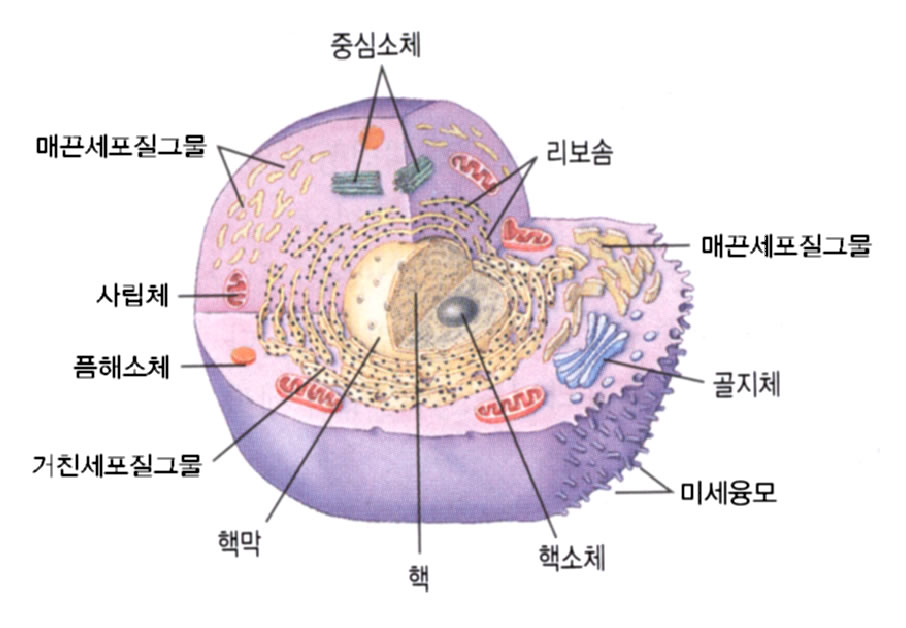 |
||
| MGG | May-Grunwald-Giemsa [staining]; molecular and general genetics; mouse gammaglobulin; multinucleated ... |
|---|---|
| MC | mass casualties; mast cell; Master of Surgery [Lat. Magister Chirurgiae]; maximum concentration; Med... |
| ASG | advanced cell group; American Society for Genetics; Army Surgeon General; aspermiogenesis |
| ACC | accommodation; acetyl coenzyme A carboxylase; acinic cell carcinoma; acute care center; adenoid cyst... |
| ASHG | American Society for Human Genetics |
| COGA | Collaborative Study of the Genetics of Alcoholism |
|---|---|
| ACCESS | Access to Community Care and Effective Services and Support |
| EPSDT | Early and Periodic Screening Diagnosis and Treatment |
| SUPPORT | Study to Understand Prognoses and Preferences for Outcomes and Risks of Treatment |
acute angle
| clinical cytogenetics | The application of chromosome studies to clinical medicine. For example, clinical cytogenetic testing is done to see if a child with possible Down syndrome has an extra chromosome 21, as is most often the case. Clinical Cytogenetics is a specialty certified by the American Board Of Medical Genetics. (12 Dec 1998) |
|---|---|
| cytogenetics | <study> The study of the structure of chromosomes. Cytogenetic tests are carried out on samples of blood and bone marrow taken from leukaemia patients to detect any chromosomal abnormalities associated with the disease. These help in the diagnosis and selection of optimal treatment. (13 Nov 1997) |
| cytogenetics, clinical | The application of cytogenetics to clinical medicine. For example, clinical cytogenetic studies might be done to determine whether a child with possible Down syndrome has an extra chromosome 21. (12 Dec 1998) |
| somatic cell genetics | Method for identifying the chromosomal location of a particular gene without sexual crossing. Unstable heterokaryons are made between the cell of interest and another cell with identifiably different characteristics (or without the gene in question) and a series of clones isolated. By correlating retention of gene expression with the remaining chromosomes, it is possible to deduce which chromosome must carry the gene. Human mouse heterokaryons have been extensively used in this sort of work. (18 Nov 1997) |
| behavioural genetics | The study of heritable factors in behavioural patterns, as by pedigree analysis, biochemical abnormality, or karyotypic analysis. (05 Mar 2000) |
| biochemical genetics | The study of genetics in terms of the chemical (biochemical) events involved, as in the manner in which DNA molecules replicate and control the synthesis of specific enzymes by the genetic code. (05 Mar 2000) |
| biometrical genetics | <study> The mathematical approach to the study of the inheritance of different phenotypes, or physical characteristics, as a result of plant or animal breeding. (09 Oct 1997) |
| Galtonian-Fisher genetics | The genetics of measurable traits determined by multiple loci which make contributions that are independent, additive, and approximately equal. Synonym: multilocal genetics. (05 Mar 2000) |
| galtonian genetics | The study of traits by analysis of the first two moments of metrical data; the preferred method for analysis of traits following the multivariate gaussian distribution. (05 Mar 2000) |
| palindrome in genetics | A palindrome is a word that reads the same in both directions as, for example, the names eve or anna. In genetics, a palindrome is a DNA or RNA sequence that reads the same in both directions. The sites of many restriction enzymes that cut (restrict) DNA are palindromes. Palindromic rheumatism is a form of joint inflammation whereby the joints involved appears to change periodically from one region of the body to another and back again. (12 Dec 1998) |
| variation (genetics) | The phenotypic differences among individuals in a population. (12 Dec 1998) |
| genetics | <study> The study of the patterns of inheritance of specific traits. (09 Oct 1997) |
| genetics, behavioural | The experimental study of the relationship between the genotype of an organism and its behaviour. The scope includes the effects of genes on simple sensory processes to complex organization of the nervous system. (12 Dec 1998) |
| genetics, biochemical | A branch of genetics which deals with the chemical structure of the genes and with the mechanisms by which the genes control and regulate the structure and synthesis of proteins. (12 Dec 1998) |
| genetics, medical | A field of human genetics which entails the reliable prediction of certain human disorders as a function of the lineage and/or genetic makeup of any two parents or potential parents. (12 Dec 1998) |
제품명 |
판매사 |
보험코드 | 성분/함량 | 구분/보험급여 |
|---|
제품명 |
판매사 |
보험코드 | 성분/함량 | 구분/보험급여 |
|---|