
| 영문 | inflammation | 한글 | 염, 염증 |
|---|---|---|---|
| 설명 | 생체에 해로운 자극에 대한 방어반응이며 자극이 가해지고 나서 수복과정까지의 모든 경과를 가리킨다. 물리적 자극, 기계적 자극, 화학적 자극, 생물학적 자극 등이 있다. 제1기는 혈관의 확장과 혈관투과성의 항진, 제2기는 백혈구의 유주와 점착, 제3기는 육아의 형성과 혈관의 신생을 보여 준다. 모두 염증부위로부터의 히스타민, 브라디키닌, 프로스타글란딘 등 화학전달 물질에 의해 진행된다. 국소증상은 발적, 종창, 열감, 동통, 기능장애 등의 징후가 있으며, 급성염증에서는 그 모두가 발견되지만 만성염증에서는 그 증세가 경감되어 있다. |
||
| 영문 | lacrimal duct | 한글 | 눈물관 |
|---|---|---|---|
| 설명 | 눈물이 흘러내리는 통로에 해당한다. 눈물은 대개 눈물샘에서 만들어져 눈을 적신 뒤에, 여기를 거쳐서 눈물주머니에 모인 뒤, 코눈물관으로 흘러 코 안쪽으로 내려가게 된다. 만약 여기가 막히면, 눈물이 계속 고이게 되어 계속 눈물을 흘리게 되며, 또한 병균의 서식처가 되어 감염의 위험성이 높아진다. 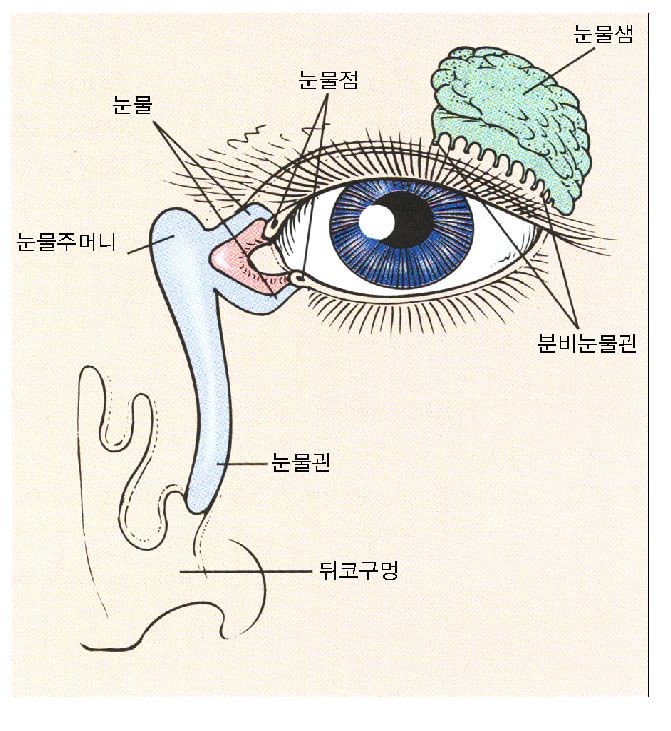 |
||
| 영문 | lacrimal glands | 한글 | 눈물샘 |
|---|---|---|---|
| 설명 | 눈물을 만드는 곳이다. 눈물은 눈의 건조를 막고 이물질을 씻어내리는 역할을 한다. 눈물은 대개 눈물샘에서 만들어져 눈을 적신 뒤 눈물관을 거친뒤에 눈물주머니에 모여서 코눈물관으로 흘러 코 안쪽으로 내려가게 된다. |
||
| 영문 | lacrimal sac | 한글 | 눈물주머니 |
|---|---|---|---|
| 설명 | 눈물샘에서 만들어진 눈물이 지나가는 한 경로에 해당한다. |
||
| 영문 | chronic lymphocytic leukemia | 한글 | 만성림프성 백혈병 |
|---|---|---|---|
| 설명 | 백혈병(leukemia)란 비정상적인 백혈구 세포의 증식에 의해 일어나는 병적인 상태를 말하는데, 흔히 말초혈액에 미분화세포가 나타나며, 정상적인 적혈구세포와 백혈구세포, 혈소판의 급격한 감소를 가져와 정상적인 세포에 의해 행해지는 여러 기능의 감소를 주증상으로 하여 병원에 찾아오게 된다. 따라서 적혈구세포의 감소로 인한 빈혈, 백혈구세포의 감소로 인한 많은 감염증세(흔히 걸리지 않는 세균에 의한 감염, 지나치게 잦은 감기, 폐렴 등), 혈소판세포의 감소로 인한 출혈증상이 나타난다. 또한 피를 생산하는 골수 조직에서는 이런 비정상적인 세포의 증식만을 볼 수 있으며, 정상적인 세포의 증식은 보기 힘들다. 만성림프성 백혈병은 서양에서는 비교적 백혈병 중에서 흔한 형이지만 동양권에서는 아주 드문 백혈병의 형태이다. 대개 60세 이상의 고령층에서 많이 생기고 30세 이하에서는 거의 찾아볼 수가 없다. 혈액검사상에서 림프구의 많은 증가를 볼 수가 있고, 대신에 다른 혈액세포들은 감소를 나타낸다. 백혈병 중 예후가 좋은 편이며 대개 치료는 항암제를 이용한 화학요법을 많이 사용하며, 평균 생존기간은 4~5년이다. |
||
| lacr | lacrimal |
|---|---|
| CP | candle power; capillary pressure; cardiac pacing; cardiac performance; cardiopulmonary; caudate puta... |
| CRD | carbohydrate-recognition domain; chronic renal disease; chronic respiratory disease; child restraint... |
| CGI | chronic granulomatous inflammation; Clinical Global Impression [scale]; common gateway interface [of... |
| CPH | Certificate in Public Health; chronic paroxysmal hemicrania; chronic persistent hepatitis; chronic p... |
| LG | Lacrimal gland |
|---|---|
| CGL | 9--chronic granulocytic leukemia |
| APACHE | ACUTE PHYSIOLOGY AND CHRONIC HEALTH EVALUATION |
| ACA | acrodermatitis chronic atrophicans |
| APACHE II | Acute Physiology And Chronic Health Evaluation |
| chronic active inflammation | The coexistence of chronic inflammation and superimposed acute inflammation. (05 Mar 2000) |
|---|---|
| chronic inflammation | An inflammation that may begin with a relatively rapid onset or in a slow, insidious, and even unnoticed manner, tends to persist for several weeks, months, or years and has a vague and indefinite termination; results when the injuring agent (or products resulting from its presence) persists in the lesion, and the host's tissues respond in a manner (or to a degree) that is not sufficient to overcome completely the continuing effects of the injuring agent. (05 Mar 2000) |
| active inflammation | Any inflammation that has a fairly rapid onset, quickly becomes severe, usually manifested for only a few days, but may persist for several days or even a few weeks. Synonym: active inflammation. (05 Mar 2000) |
| acute inflammation | Any inflammation that has a fairly rapid onset, quickly becomes severe, usually manifested for only a few days, but may persist for several days or even a few weeks. Synonym: active inflammation. (05 Mar 2000) |
| adhesive inflammation | Inflammation in which the amount of fibrin in the exudate is sufficient to result in a slight or moderate degree of adherence of adjacent tissues, as in healing by first intention. (05 Mar 2000) |
| allergic inflammation | <immunology> The bodys response to an allergic stimulus. This can be localised to one area or generalised and may include: rash, itching, hives, swelling, difficulty breathing, and/or low blood pressure. (27 Sep 1997) |
| alterative inflammation | A local reaction to injury, occasionally observed in the walls of blood vessels and in parenchymal cells of various organs in reacting to certain chemicals, viruses, and other intracellular agents; the response is characterised by degenerative changes in the cytoplasm and nucleus, frequently resulting in necrosis, but exudation (if any) is ordinarily observed only in the wall of the affected vessel, or in the interstices immediately adjacent to the affected vessel or parenchymal cells. Synonym: degenerative inflammation. (05 Mar 2000) |
| atrophic inflammation | A form of chronic inflammation or repeated episodes of acute inflammation in which the continued or recurrent proliferation of fibroblasts results in the formation of fibrous tissue that eventually contracts and leads to compression and atrophy of parenchymal tissue. Synonym: fibroid inflammation. (05 Mar 2000) |
| bladder inflammation | Also referred to as cystitis. Cystitis most commonly occurs because of bacterial infection. Another form of bladder inflammation, interstitial cystitis (IC) involves inflammation or irritation of the bladder wall. This can lead to scarring and stiffening of the bladder, and even ulcerations and bleeding. Diagnosis is based on symptoms, findings on cystoscopy and biopsy, and eliminating other treatable causes such as infection. Because doctors do not know what causes IC, treatments are aimed at relieving symptoms. Most people are helped for variable periods of time by one or a combination of treatments. (12 Dec 1998) |
| catarrhal inflammation | An inflammatory process that is most frequent in the respiratory tract, but may occur in any mucous membrane, and is characterised by hyperaemia of the mucosal vessels, oedema of the interstitial tissue, enlargement of the secretory epithelial cells (which proliferate and form conspicuous globules of mucus), and an irregular layer of viscous, mucinous material on the surface; as exudation progresses, variable numbers of neutrophils migrate into the affected tissue and are included in the exudate, along with fragments of degenerated and necrotic epithelial cells; such an inflammation may frequently become mucopurulent. (05 Mar 2000) |
| granulomatous inflammation | A form of proliferative inflammation See: granuloma. (05 Mar 2000) |
| productive inflammation | A vague term ordinarily used with reference to proliferative inflammation, with or without an exudate; also sometimes used to indicate any inflammation in which grossly visible exudate is formed. (05 Mar 2000) |
| proliferative inflammation | An inflammatory reaction in which the distinguishing feature is an actual increase in the number of tissue cells, especially the reticuloendothelial macrophages, in contrast to cells exuded from blood vessels; in addition, exudates of various types are likely to be observed in granulomas and other forms of proliferative inflammation, but the latter may occur without an exudate being formed (as in certain infections caused by virus). Synonym: hyperplastic inflammation. (05 Mar 2000) |
| sclerosing inflammation | Inflammation leading to extensive formation of fibrous and scar tissue. (05 Mar 2000) |
| pseudomembranous inflammation | A form of exudative inflammation that involves mucous and serous membranes; relatively large quantities of fibrin in the exudate result in a rather tenacious membrane-like covering that is fairly adherent to the underlying acutely inflamed tissue; the pseudomembrane usually contains (in addition to the dense network of fibrin) varying quantities of plasma protein, degenerated and necrotic elements from the affected tissue, polymorphonuclear leukocytes, bacteria, etc. (05 Mar 2000) |
제품명 |
판매사 |
보험코드 | 성분/함량 | 구분/보험급여 |
|---|
제품명 |
판매사 |
보험코드 | 성분/함량 | 구분/보험급여 |
|---|