
| 영문 | hemoglobin | 한글 | 혈색소 |
|---|---|---|---|
| 설명 | 척추동물의 적혈구 속에 다량으로 들어있는 색소단백질. 철을 품는 포르피린 고리와 단백질의 일종(글로빈)으로 되어 있다. 철(Fe)에는 산소와 가역적으로 결합하는 능력이 있어, 생체 내에서는 산소를 운반하는 일을 한다. 혈색소 한 분자는 네 개의 폴리펩티드 사슬로 되어 있고, 각각의 폴리펩티드 사슬에는 한 개씩의 헴이 함유되어 있다. 따라서 혈색소 한 분자에는 철원자가 네 개 함유되고, 철원자 한 개에 대해 한 분자씩의 산소가 결합하므로, 혈색소 한 분자에는 산소 4분자가 결합한다. 혈색소는 산소압이 높은 허파나 아가미에서는 산소와 결합하고, 산소압이 낮은 조직에 이르면 산소를 유리한다. 더욱이 산소의 방출은 pH가 낮아짐에 따라 촉진되므로, 이산화탄소가 많고 pH가 낮은 말초조직에서는 산소를 보다 유리하기 쉽게 된다. 이산화탄소는 혈장 속에 녹아 허파에 운반되어 허파호흡으로 체외에 방출되면 pH는 다시 원상태로 돌아가고 혈색소는 다시 산소와 결합한다. 분자량 약 6,500의 색소단백질로 혈액 속에서의 함유량은 혈액 100 mL중의 그램수로 나타낸다. 정상치는 남자 16g/dL(14~18g/dL), 여자 14g/dL (12~16g/dL)이다. |
||
| 영문 | muscle cell(=muscle fiber) | 한글 | 근육세포 |
|---|---|---|---|
| 설명 | 근육은 수의근(의식에 의해서 조절이 가능한 근육: 예를 들어 다리, 팔, 얼굴근육 등)과 불수의근(의식과 무관하게 조절하지 않아도 움직이는 근육: 예를 들어 심장근, 소화기관에 분포하는 근육 등)으로 나누어지며, 근육세포의 모양은 다음과 같다(수의근, 불수의근 외에 심장에 있는 심장근은 불수의근에 해당하지만 그 모양은 수의근과 같아 따로 분류한다).  |
||
| 영문 | white blood cell(WBC), leukocyte | 한글 | 백혈구 |
|---|---|---|---|
| 설명 | 혈액내에 골수구계세포와 림프계세포, 단핵구계세포를 모두 통틀어 말한다. 백혈구의 증가가 있으면 대개 감염이 있거나, 혹은 탈수현상이 있음을 의미한다. 또한 지나친 백혈구수의 감소는 인체내 면역기능이 떨어져 있음을 의미하며, 다른 질병에 의해 나타나는 이차적인 현상이 아닌지 꼭 진단을 받아보아야 한다. |
||
| 영문 | mast cell | 한글 | 비만 세포 |
|---|---|---|---|
| 설명 | 동물의 결합 조직 가운데 널리 분포하는 세포. 결합조직과 점막조직 내에 있는 호염기성 색소로 이염색성(metachromasia)을 나타내는 과립을 가진 방추형의 세포에 작은 둥근 핵을 가진다. 비만세포의 표면에는 IgE에 대한 수용체가 존재하며, 수용체에 결합한 IgE 분자들끼리 다가의 항원에 의해 서로 연결되면 비만세포 과립탈출 반응이 일어나, 히스타민, 세로토닌, 헤파린 등의 화학전달 물질이 방출되어, 즉시형 알레르기 반응 등의 증상을 일으킨다. 피부, 장막, 혈관 주위, 점막 주변에 있다. |
||
| 영문 | cell | 한글 | 세포 |
|---|---|---|---|
| 설명 | 생명체를 이루는 구조적, 기능적 단위. 핵의 유무에 따라서 유핵세포와 무핵세포로 나눌 수가 있다. 무핵세포란 핵이 없는 세포를 말한다. 핵이란 유전정보를 가지고 있는 염색체를 보관하는 곳인데 무핵세포에서는 염색체가 세포속에 그냥 노출되어 있다. 대개 세포 하나하나가 독립된 생명체의 역할을 하는 단세포생물로서 외부환경으로부터 자신을 보호할 수 있는 견고한 세포벽을 가지고 있다. 유핵세포란 핵을 가지고 있어서 유전정보가 있는 염색체가 세포의 다른 부분과 구분되어 핵속에 들어있다. 세포속에서 핵외의 부분(이를 세포질이라 한다)에는 여러 가지 세포의 소기관이 있어서 세포의 다양한 기능을 분담한다. ◈유핵세포의 기본 구조 1.세포막-세포를 둘러싸서 주위환경과 분리하여 세포의 내환경을 유지한다. 2.형질내세망(endoplasmic reticulum)-단위막으로 둘러쌓여 있는 불규칙한 망상구조이다. 이 망상구조의 내부를 소강, 소조라고 부른다. 여기에는 표면이 매끈한 무과립형질내세망과 표면이 불규칙한 과립형질내세망의 두 가지가 있다. 과립형질내세망의 경우는 표면에 단백질을 합성하는 리보솜이라는 것이 부착되어 있다. 이곳은 주로 세포밖으로 분비할 단백질을 합성하는 장소이다. 무과립형질내세망은 표면에 리보솜이 부착되어 있지 않은 것을 말하며, 이곳에서는 주로 해독작용, 글리코겐의 합성, 스테로이드호르몬의 합성 등이 일어난다. 3.리보솜-단백질을 합성하는 역할을 하는 곳이다.이것은 세포질에 존재하는 자유리보솜과 과립형질내세망에 부착이 되어 존재하는 부착리보솜의 두 가지로 나눈다. 자유리보솜은 주로 세포내에서 필요한 단백질을 만드는 역할을 하고 부착리보솜은 세포밖으로 분비할 단백질을 만드는 역할을 한다. 4.골지장치(Golgi apparatus)-핵주위에 분포하는 납작해진 주머니모양의 것이 중첩되어 형성된 층판 모양의 구조물로 과립형질내세망에서 생성되어 외부로 분비될 단백질을 모아서 농축, 포장하여 과립을 만드는 역할을 한다. 5.사립체(mitochondria)-구형, 난형의 긴 막대기 모양으로 크기가 다양한 구조물. 생물체의 에너지 저장물질인 ATP를 생산하는 역할을 한다. 또 세포와 다른 자신만의 유전정보를 가진 DNA, RNA를 가지고 있다. 모양, 크기가 세균과 비슷하며 자체증식성 등 독립된 생명체로서 필요한 요건을 갖추고 있어서 세포와 공생관계를 가진 독립된 세포로 생각하고 있다. 6.용해소체(lysosome)-작은 구형의 소체로 여러 가지 분해효소를 가진다. 세포외계에서 들어온 물질과 결합하여 그 물질들을 용해하는 역할을 하고, 오래된 세포소기관들을 제거하는 역할도 한다. 7.세포핵(nucleus)-구형, 난형으로 세포의 중심에 위치한다. 핵내에는 유전정보가 있는 물질인 염색체가 존재한다. 8.중심소체(centrosome)-핵주위에 존재하면서 핵의 분열시에 양쪽의 염색체를 당기는 작은 섬유를 만드는 역할을 하는 곳. 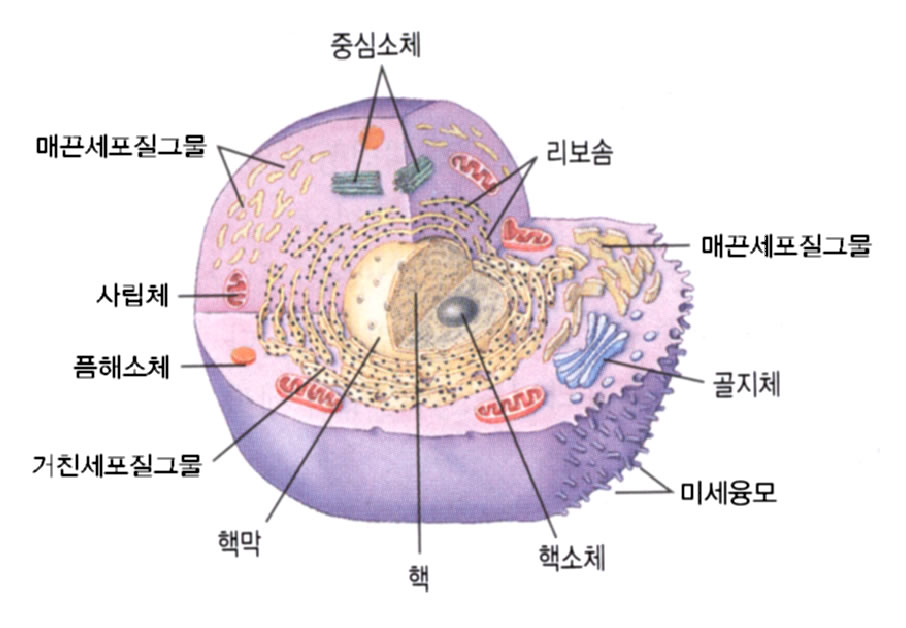 |
||
| HbS | hemoglobin S, sickle-cell hemoglobin |
|---|---|
| S-D | sickle-cell hemoglobin D; suicide-depression |
| SF | Sabin-Feldman [test]; safety factor; salt-free; scarlet fever; screen film; seminal fluid; serosal f... |
| SC | conditioned stimulus; sacrococcygeal; Sanitary Corps; scalenus [muscle]; scapula; Schwann cell; scia... |
| SCA | self-care agency; severe congenital anomaly; sickle-cell anemia; single-camera autostereoscopic [ima... |
| SCD | Sickle Cell Disease |
|---|---|
| SCA | Sickle cell anaemia |
| SCT | Sickle cell trait |
| PSR | Proliferative sickle retinopathy |
| MCHC | Mean cell hemoglobin concentration |
| hemoglobin | <cell biology, haematology> Four subunit globular oxygen carrying protein of the erythrocytes of vertebrates and some invertebrates. It is a conjugated protein containing four haem groups and globin. There are two alpha and two beta chains (very similar to myoglobin) in adult humans, the haem moiety (an iron containing substituted porphyrin) is firmly held in a nonpolar crevice in each peptide chain. There are four globin polypeptide chains, designated alpha, beta, gamma, delta in the adult. Each is composed of several hundred amino acids. (08 Mar 2000) |
|---|---|
| anaemia, sickle cell | A disease characterised by chronic haemolytic anaemia, episodic painful crises, and pathologic involvement of many organs. It is the clinical expression of homozygosity for haemoglobin s. (12 Dec 1998) |
| sickle cell | <haematology, pathology> An erythrocyte that changes from the normal discoid shape to a sickled shape when the oxygen tension is low. The pesence of these cells indicates that the patient is homozygotes for the allele that codes for haemoglobin S and that the patient has sickle cell anaemia. (18 Nov 1997) |
| sickle cell anaemia | <haematology> Disease common in races of people from areas in which malaria is endemic. The cause is a point mutation in the allele that codes for the beta chain of haemoglobin with a substitution of (valine for glutamic acid at position 6. The defective haemoglobin (HbS) crystallizes readily at low oxygen tension. In consequence, erythrocytes from homozygotes change from the normal discoid shape to a sickled shape when the oxygen tension is low and these sickled cells become trapped in capillaries or damaged in transit, leading to severe anaemia. In heterozygotes, the disadvantages of the abnormal haemoglobin are apparently outweighed by increased resistance to Plasmodium falciparum malaria, probably because parasitised cells tend to sickle and are then removed from circulation. Symptoms include joint pain, acute abdominal pain, and ulcerations of the lower extremities. Origin: Gr. Haima = blood (18 Nov 1997) |
| sickle cell anaemia: bone manifestations | <radiology> 8-13% of blacks carry sickling factor, symptoms: chronic ulcers, pain crises, many infections, priapism X-ray findings: deossification due to marrow hyperplasia, decreased bone density in skull with widened diploe, H-shaped vertebrae or fish vertebrae, rib notching, thrombosis and infarction, avascular necrosis, especially femoral head, periosteal treatmentn (bone within bone), secondary osteomyelitis, Staph. Aureus greater than Salmonella, dactylitis = hand foot syndrome, growth effects, bone shortening secondary to diminished blood supply, death less than 40y (12 Dec 1998) |
| sickle cell C disease | A disease resulting from abnormal sickle-shaped erythrocytes (containing haemoglobin C and S) which appear in response to a lowering of the partial pressure of oxygen; characterised by anaemia, crises due to haemolysis or vascular occlusion, chronic leg ulcers and bone deformities, and infarcts of bone or of the spleen. (05 Mar 2000) |
| sickle cell crisis | <haematology> Disease common in races of people from areas in which malaria is endemic. The cause is a point mutation in the allele that codes for the beta chain of haemoglobin with a substitution of (valine for glutamic acid at position 6. The defective haemoglobin (HbS) crystallizes readily at low oxygen tension. In consequence, erythrocytes from homozygotes change from the normal discoid shape to a sickled shape when the oxygen tension is low and these sickled cells become trapped in capillaries or damaged in transit, leading to severe anaemia. In heterozygotes, the disadvantages of the abnormal haemoglobin are apparently outweighed by increased resistance to Plasmodium falciparum malaria, probably because parasitised cells tend to sickle and are then removed from circulation. Symptoms include joint pain, acute abdominal pain, and ulcerations of the lower extremities. Origin: Gr. Haima = blood (18 Nov 1997) |
| sickle cell dactylitis | <syndrome> Recurrent painful swelling of the hands and feet occurring in infants and young children with sickle cell anaemia. Synonym: sickle cell dactylitis. (05 Mar 2000) |
| sickle cell disease | <haematology> Disease common in races of people from areas in which malaria is endemic. The cause is a point mutation in the allele that codes for the beta chain of haemoglobin with a substitution of (valine for glutamic acid at position 6. The defective haemoglobin (HbS) crystallizes readily at low oxygen tension. In consequence, erythrocytes from homozygotes change from the normal discoid shape to a sickled shape when the oxygen tension is low and these sickled cells become trapped in capillaries or damaged in transit, leading to severe anaemia. In heterozygotes, the disadvantages of the abnormal haemoglobin are apparently outweighed by increased resistance to Plasmodium falciparum malaria, probably because parasitised cells tend to sickle and are then removed from circulation. Symptoms include joint pain, acute abdominal pain, and ulcerations of the lower extremities. Origin: Gr. Haima = blood (18 Nov 1997) |
| sickle cell haemoglobin | <haematology> Haemoglobin S is an abnormal version of the protein haemoglobin. The sixth amino acid of the normal beta chain, glutamic acid, is replaced by valine with gluconic acid. This mutation causes the red blood cell to take on a sickle shape, and is the cause of the sickle cell trait condition (when the individual is heterozygous for this mutant haemoglobin) and the disease of sickle cell anaemia (when the individual is homozygous for this mutant haemoglobin). (09 Oct 1997) |
| sickle cell prep | <haematology, investigation> A test which looks at red blood cells under the microscope to detect sickle cells after an agent which lowers the oxygen content of the sample is added. A positive test is result is determined by the presence of sickle cells. Abnormal results indicate sickle cell anaemia or sickle cell trait. (27 Sep 1997) |
| sickle cell retinopathy | A condition marked by dilation and tortuosity of retinal veins, and by microaneurysms and retinal haemorrhages; advanced stages may show neovascularization, vitreous haemorrhage, or retinal detachment. (05 Mar 2000) |
| sickle cell test | <investigation> A test which looks at red blood cells under the microscope to detect sickle cells after an agent which lowers the oxygen content of the sample is added. A positive test is result is determined by the presence of sickle cells. Abnormal results indicate sickle cell anaemia or sickle cell trait. (27 Sep 1997) |
| sickle cell-thalassaemia disease | Anaemia, clinically resembling sickle cell anaemia, in which individuals are compound heterozygous for the sickle cell gene and a thalassaemia gene; about 60 to 80% of haemoglobin is Hb S, up to 20% Hb F, and the remainder Hb anaemia. Synonym: sickle cell-thalassaemia disease. (05 Mar 2000) |
| sickle cell trait | <haematology> This condition occurs in people who have one of two possible genes (i.e., they are heterozygous forthe allele) that code for the defective haemoglobin responsible for sickle cell anaemia. The coditionis diagnosed by exposing an individual's red blood cells to a low oxygen environment, if the trait is present, the cells will turn to a sickle shape. People with this trait may suffer milder symptoms of sickle cell anaemia, or may have no symptoms. Some scientists believe the trait actually provides an evolutionary advantage in tropical environments because the slightly altered shape of the blood cells causes a person to be more resistant to malaria. (09 Oct 1997) |
제품명 |
판매사 |
보험코드 | 성분/함량 | 구분/보험급여 |
|---|
제품명 |
판매사 |
보험코드 | 성분/함량 | 구분/보험급여 |
|---|