
| 영문 | spinal tap, spinal puncture | 한글 | 허리천자, 요추천자, 요추뚫기 |
|---|---|---|---|
| 설명 | 질병의 진단이나 치료 또는 마취를 하기 위해 피부에서 거미막밑공간으로 바늘을 찌를 때가 있다. 이것은 셋째 허리뼈 아래쪽에서 시행한다. 척수가 첫째 허리뼈 아랫모서리에서 끝나고, 거미막밑공간은 둘째 엉치뼈 분절까지 뻗어 있기 때문에 이 부위는 바늘로 척수를 찌를 위험이 없다. 또 척추뼈고리판이 짧아 서로 겹쳐있지 않기 때문에 허리뼈 사이로 바늘을 찌를 수 있다. 이 부위의 거미막밑공간에는 척수신경 뿌리가 있으나, 이들은 뇌척수액속에 있기 때문에 바늘을 넣을 때 한쪽으로 밀려 손상받는 경우는 거의 없다. 배를 넓적다리에 붙일정도로 허리를 구부리면 고리판 사이가 더 벌어져 틈이 커진다. 바늘이 뚫고 지나가는 구조는 바깥에서 속으로 ① 피부, ② 피부밑조직, ③ 근육막, ④ 가시끝인대, ⑤ 가시사이인대, ⑥ 황색인대, ⑦ 경질막, ⑧ 거미막, ⑨ 뇌척수액이 된다.  |
||
| 영문 | hyperbaric oxygenation therapy | 한글 | 고압산소요법 |
|---|---|---|---|
| 설명 | 대기압보다 높은 기압환경을 인공적으로 만들어 그 안에서 고농도의 산소를 흡입시키는 요법. 한국에서 연탄가스로 대표되는 일산화탄소의 급성중독의 치료에 많이 이용된 것으로, 보통 3대기압 정도로 가압된 고압산소실이나 고압산소탱크 속에 환자를 놓고 전신에 산소를 흡입시킨다. 고압실은 크고 작은 여러 가지가 있으며, 구조상 1실식-2실식-다실식이 있다. 가압 가스의 종류에는 산소-공기-혼합 가스등이 있고, 2~3 대기압 또는 그 이상의 고압 환경을 만든다. 임상적으로 응용범위가 넓어서 기계적 효과에 의하여 잠수부병이나 창자관마비에 의한 창자폐색 치료 등에 유효하고, 가스궤저 등의 무산소성 세균감염에서도 이용된다. 또 산소운반효과에 의하여 일산화탄소-심근경색-뇌색전증-출혈쇼크에 의한 급성의 조직산소결핍의 치료에 유효하다. 또 암의 방사선요법에 병용하면 이 요법으로 암세포의 분열이 왕성해져, 세포분열 중인 세포에 방사선을 조사함으로써 분열능력을 없애는 데 유효하여 고압산소흡입조사법이라고 한다. |
||
| 영문 | anesthesia | 한글 | 마취, 무감각 |
|---|---|---|---|
| 설명 | 고통을 느끼지 못하거나 고통을 느끼지 못하게 하는 처지를 이르는 말. |
||
| 영문 | spinal cord | 한글 | 척수 |
|---|---|---|---|
| 설명 | 척추내에 위치하는 중추신경계의 일부분. 위에서부터 목척수, 등척수, 허리척수, 엉치척수로 구분됨. 내부는 바깥쪽의 백색질과 안쪽의 회색질로 구분된다. 척수의 아래끝은 척수 원뿔이라 하며 첫번째 허리뼈 높이까지 내려온다. 뇌와 말초신경사이의 신경 통로 역할을 하며 척수반사(예: 무릎반사)에서는 뇌를 통하지 않고 반사의 중추 작용을 한다. 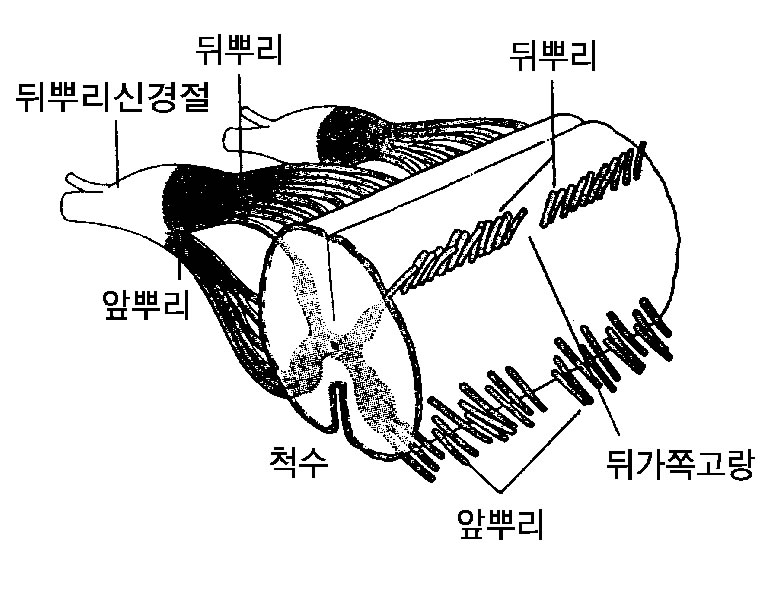 |
||
| 영문 | spinal nerve | 한글 | 척수신경 |
|---|---|---|---|
| 설명 | 척수의 앞뿔에서 출발하는 운동신경과 뒷뿔으로 들어오는 감각신경이 합쳐서 형성되는 신경으로서 총 31쌍이 존재함. 목뼈신경이 8쌍, 자등뼈신경이 12쌍, 허리뼈의 신경이 5쌍, 엉치뼈의 6쌍을 이룸. |
||
| HBO | hyperbaric oxygenation, hyperbaric oxygen |
|---|---|
| sp | an spinal anesthesia |
| PSA | parasternal short axis; pleomorphic salivary gland adenoma; polyethylene sulfonic acid; polysacchari... |
| SC | conditioned stimulus; sacrococcygeal; Sanitary Corps; scalenus [muscle]; scapula; Schwann cell; scia... |
| HBOT | hyperbaric oxygen therapy |
| CSEA | Combined spinal epidural anesthesia |
|---|---|
| SA | Spinal Anesthesia |
| HBO | Hyperbaric Oxygen |
| HBO | Hyperbaric Oxygen Therapy |
| HBO(2) | Hyperbaric oxygen |
| hyperbaric spinal anaesthesia | Spinal anaesthesia in which spread of local anaesthetic solution in the subarachnoid space is controlled by adjusting the position of the patient when the density of local anaesthetic is made greater than the density of cerebrospinal fluid (i.e., hyperbaric) by the addition of glucose. (05 Mar 2000) |
|---|---|
| anesthesia | Loss of normal sensation or feeling. A drug used to produce anesthesia. (09 Oct 1997) |
| hyperbaric | <physics, physiology> Characterised by greater than normal pressure or weight, applied to gases under greater than atmospheric pressure, as hyperbaric oxygen or to a solution of greater specific gravity than another taken as a standard of reference. Origin: Gr. Baros = weight (04 Mar 1998) |
| hyperbaric anaesthesia | Inhalation of depressant gases or vapors at pressures greater than 1 atmosphere, especially as a means of producing general anaesthesia with agents too weak to produce anaesthesia at 1 atmosphere. (05 Mar 2000) |
| hyperbaric chamber | <apparatus> A pressurised chamber that allows for the delivery of oxygen in higher concentrations for therapeutic benefit. Useful in the treatment of severe burns, peripheral vascular disease, carbon monoxide poisoning and decompression illness. (27 Sep 1997) |
| hyperbaric medicine | The medicinal use of high barometric pressure, usually in specially constructed chambers, to increase oxygen content of blood and tissues. (05 Mar 2000) |
| hyperbaric oxygen | High pressure oxygen, oxygen at a pressure greater than 1 atmosphere. See: hyperbaric oxygenation. Singlet oxygen, an excited or higher energy form of oxygen characterised by the spin of a pair of electrons in opposite directions, whereas electron spin is unidirectional in normal molecular oxygen Because of its great reactivity, singlet oxygen is a probable intermediate in most photo-oxidation reactions. Although it exists for no more than 0.1 sec, it may react with atmospheric pollutants to foster smog formation and may have harmful biological effects. Triplet oxygen, the normal unexcited state of O2 in the atmosphere, in which the unpaired pair of electrons are so displaced that their magnetic fields are oriented in the same direction, resulting in paramagnetism; each of the heat-generated spectral lines of such oxygen can be split by a magnetic field into a triplet. Compare: singlet oxygen. (05 Mar 2000) |
| hyperbaric oxygenation | The therapeutic intermittent administration of oxygen in a chamber at greater than sea-level atmospheric pressures (three atmospheres). It is considered effective treatment for air and gas embolisims, smoke inhalation, acute carbon monoxide poisoning, caisson disease, clostridial gangrene, etc. (12 Dec 1998) |
| hyperbaric oxygen therapy | <physiology> A pressurised chamber that allows for the delivery of oxygen in higher concentrations for therapeutic benefit. Useful in the treatment of severe burns, peripheral vascular disease, carbon monoxide poisoning and decompression illness. (04 Mar 1998) |
| accessory portion of spinal accessory nerve | <anatomy, nerve> The roots of the accessory nerve which arise from the medulla; the nerve fibres of the cranial root join the intracranial portion of the vagus nerve and are distributed to the pharyngeal plexus, providing the motor innervation of the soft palate (except the tensor veli palati) and the pharynx. Synonym: pars vagalis nervi accessorii, radices craniales, accessory portion of spinal accessory nerve, cranial roots, vagal part of accessory nerve, vagal part. (05 Mar 2000) |
| acute spinal cord compression | <radiology> Signs and symptoms of cord compression show progression within 24 hours or less: pain, weakness, autonomic dysfunction, sensory loss, ataxia Diagnostic considerations: Primary or secondary malignancy of epidural space or vertebrae, Trauma, Inflammatory process, Osteoarthritis REF: MacNeil BJ, Abrams HL. Brigham and Women's Hospital Handbook of Diagnostic Imaging. Chapter 35. (12 Dec 1998) |
| anterior median fissure of spinal cord | A deep median fissure on the anterior surface of the spinal cord. Synonym: fissura mediana anterior medullae spinalis, anteromedian groove, sulcus ventralis. (05 Mar 2000) |
| anterior spinal artery | <anatomy, artery> Origin, intracranial part of vertebral; distribution, spinal cord and pia mater; anastomoses, spinal of intercostal and lumbar arteries. Synonym: arteria spinalis anterior. (05 Mar 2000) |
| anterolateral column of spinal cord | The lateral white column of the spinal cord between the lines of exit and entrance of the anterior and posterior nerve roots. Synonym: funiculus lateralis, anterolateral column of spinal cord, lateral funiculus of spinal cord. (05 Mar 2000) |
| arachnoid of spinal cord | That portion of the arachnoid which lies within the vertebral canal and surrounds the spinal cord and the vertebral portion of the subarachnoid space. It extends from the foramen magnum above to the S-2 vertebral level. Since the spinal cord ends at the L-2 vertebral level, a wide separation occurs between the arachnoid and pia mater, the lumbar cistern, filled with cerebrospinal fluid in which the cauda equina is suspended. Synonym: arachnoidea mater spinalis, spinal part of arachnoid. (05 Mar 2000) |
제품명 |
판매사 |
보험코드 | 성분/함량 | 구분/보험급여 |
|---|
제품명 |
판매사 |
보험코드 | 성분/함량 | 구분/보험급여 |
|---|