¼±Åà - È­»ìǥŰ/¿£ÅÍŰ ´Ý±â - ESC

 
"rod cell"¿¡ ´ëÇÑ °Ë»ö °á°úÀÔ´Ï´Ù. °Ë»ö °á°ú º¸´Â µµÁß¿¡ Tab ۸¦ ´©¸£½Ã¸é °Ë»ö âÀÌ ¼±Åõ˴ϴÙ.
À̰ÍÀ» ¿øÇϼ̽À´Ï±î?
¾Ë±â½¬¿î ÀÇÇпë¾îÇ®ÀÌÁý, ¼­¿ïÀÇ´ë ±³¼ö ÁöÁ¦±Ù, °í·ÁÀÇÇÐ ÃâÆÇ À¯»ç °Ë»ö °á°ú : 5 ÆäÀÌÁö: 1
¿µ¹® muscle cell(=muscle fiber) ÇÑ±Û ±ÙÀ°¼¼Æ÷
¼³¸í   
  ±ÙÀ°Àº ¼öÀDZÙ(ÀǽĿ¡ ÀÇÇØ¼­ Á¶ÀýÀÌ °¡´ÉÇÑ ±ÙÀ°: ¿¹¸¦ µé¾î ´Ù¸®, ÆÈ, ¾ó±¼±ÙÀ° µî)°ú ºÒ¼öÀDZÙ(Àǽİú ¹«°üÇϰԠÁ¶ÀýÇÏÁö ¾Ê¾Æµµ ¿òÁ÷À̴ ±ÙÀ°: ¿¹¸¦ µé¾î ½ÉÀå±Ù, ¼ÒÈ­±â°ü¿¡ ºÐÆ÷Çϴ ±ÙÀ° µî)À¸·Î ³ª´©¾îÁö¸ç, ±ÙÀ°¼¼Æ÷ÀÇ ¸ð¾çÀº ´ÙÀ½°ú °°´Ù(¼öÀDZÙ, ºÒ¼öÀDZ٠¿Ü¿¡ ½ÉÀå¿¡ Àִ ½ÉÀå±ÙÀº ºÒ¼öÀDZٿ¡ ÇØ´çÇÏÁö¸¸ ±× ¸ð¾çÀº ¼öÀDZٰú °°¾Æ µû·Î ºÐ·ùÇÑ´Ù).
  
  ±ÙÀ°¼¼Æ÷
¿µ¹® white blood cell(WBC), leukocyte ÇÑ±Û ¹éÇ÷±¸
¼³¸í   
  Ç÷¾×³»¿¡ °ñ¼ö±¸°è¼¼Æ÷¿Í ¸²ÇÁ°è¼¼Æ÷, ´ÜÇÙ±¸°è¼¼Æ÷¸¦ ¸ðµÎ ÅëÆ²¾î ¸»ÇÑ´Ù. ¹éÇ÷±¸ÀÇ Áõ°¡°¡ ÀÖÀ¸¸é ´ë°³ °¨¿°ÀÌ Àְųª, È¤Àº Å»¼öÇö»óÀÌ ÀÖÀ½À» ÀǹÌÇÑ´Ù. ¶ÇÇÑ Áö³ªÄ£ ¹éÇ÷±¸¼öÀÇ °¨¼Ò´Â ÀÎü³» ¸é¿ª±â´ÉÀÌ ¶³¾îÁ® ÀÖÀ½À» ÀǹÌÇϸç, ´Ù¸¥ Áúº´¿¡ ÀÇÇØ ³ªÅ¸³ª´Â ÀÌÂ÷ÀûÀΠÇö»óÀÌ ¾Æ´ÑÁö ²À Áø´ÜÀ» ¹Þ¾Æº¸¾Æ¾ß ÇÑ´Ù.
¿µ¹® mast cell ÇÑ±Û ºñ¸¸ ¼¼Æ÷
¼³¸í   
  µ¿¹°ÀÇ °áÇÕ Á¶Á÷ °¡¿îµ¥ ³Î¸® ºÐÆ÷Çϴ ¼¼Æ÷. °áÇÕÁ¶Á÷°ú Á¡¸·Á¶Á÷ ³»¿¡ Àִ ȣ¿°±â¼º »ö¼Ò·Î ÀÌ¿°»ö¼º(metachromasia)À» ³ªÅ¸³»´Â °ú¸³À» °¡Áø ¹æÃßÇüÀÇ ¼¼Æ÷¿¡ ÀÛÀº µÕ±Ù ÇÙÀ» °¡Áø´Ù. ºñ¸¸¼¼Æ÷ÀǠǥ¸é¿¡´Â IgE¿¡ ´ëÇÑ ¼ö¿ëü°¡ Á¸ÀçÇϸç, ¼ö¿ëü¿¡ °áÇÕÇÑ IgE ºÐÀڵ鳢¸® ´Ù°¡ÀÇ Ç׿ø¿¡ ÀÇÇØ ¼­·Î ¿¬°áµÇ¸é ºñ¸¸¼¼Æ÷ °ú¸³Å»Ãâ ¹ÝÀÀÀÌ ÀϾ, È÷½ºÅ¸¹Î, ¼¼·ÎÅä´Ñ, ÇìÆÄ¸° µîÀÇ È­ÇÐÀü´Þ ¹°ÁúÀÌ ¹æÃâµÇ¾î, Áï½ÃÇü ¾Ë·¹¸£±â ¹ÝÀÀ µîÀÇ Áõ»óÀ» ÀÏÀ¸Å²´Ù. ÇǺÎ, À帷, Ç÷°ü ÁÖÀ§, Á¡¸· ÁÖº¯¿¡ ÀÖ´Ù.
¿µ¹® cell ÇÑ±Û ¼¼Æ÷
¼³¸í   
  »ý¸íü¸¦ ÀÌ·ç´Â ±¸Á¶Àû, ±â´ÉÀû ´ÜÀ§.
  
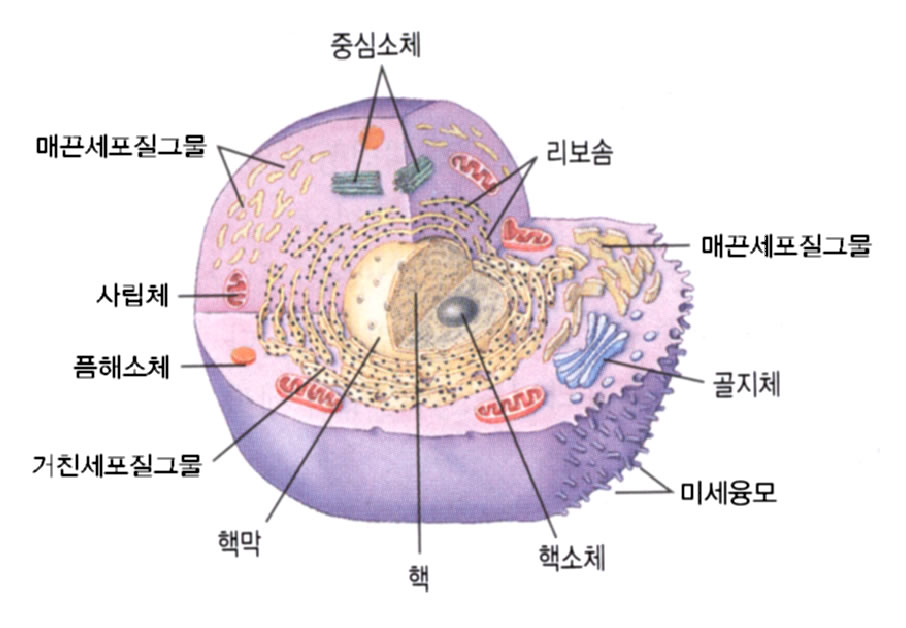
  ÇÙÀÇ À¯¹«¿¡ µû¶ó¼­ À¯ÇÙ¼¼Æ÷¿Í ¹«ÇÙ¼¼Æ÷·Î ³ª´­ ¼ö°¡ ÀÖ´Ù. ¹«ÇÙ¼¼Æ÷¶õ ÇÙÀÌ ¾ø´Â ¼¼Æ÷¸¦ ¸»ÇÑ´Ù. ÇÙÀ̶õ À¯ÀüÁ¤º¸¸¦ °¡Áö°í Àִ ¿°»öü¸¦ º¸°üÇϴ °÷Àε¥ ¹«ÇÙ¼¼Æ÷¿¡¼­´Â ¿°»öü°¡ ¼¼Æ÷¼Ó¿¡ ±×³É ³ëÃâµÇ¾î ÀÖ´Ù. ´ë°³ ¼¼Æ÷ ÇϳªÇϳª°¡ µ¶¸³µÈ »ý¸íüÀÇ ¿ªÇÒÀ» Çϴ ´Ü¼¼Æ÷»ý¹°·Î¼­ ¿ÜºÎȯ°æÀ¸·ÎºÎÅÍ ÀÚ½ÅÀ» º¸È£ÇÒ ¼ö Àִ °ß°íÇÑ ¼¼Æ÷º®À» °¡Áö°í ÀÖ´Ù. À¯ÇÙ¼¼Æ÷¶õ ÇÙÀ» °¡Áö°í À־ À¯ÀüÁ¤º¸°¡ Àִ ¿°»öü°¡ ¼¼Æ÷ÀÇ ´Ù¸¥ ºÎºÐ°ú ±¸ºÐµÇ¾î ÇÙ¼Ó¿¡ µé¾îÀÖ´Ù. ¼¼Æ÷¼Ó¿¡¼­ ÇÙ¿ÜÀÇ ºÎºÐ(À̸¦ ¼¼Æ÷ÁúÀ̶ó ÇÑ´Ù)¿¡´Â ¿©·¯ °¡Áö ¼¼Æ÷ÀÇ ¼Ò±â°üÀÌ À־ ¼¼Æ÷ÀÇ ´Ù¾çÇÑ ±â´ÉÀ» ºÐ´ãÇÑ´Ù.
  
  ¢ÂÀ¯ÇÙ¼¼Æ÷ÀÇ ±âº» ±¸Á¶
  
  1.¼¼Æ÷¸·-¼¼Æ÷¸¦ µÑ·¯½Î¼­ ÁÖÀ§È¯°æ°ú ºÐ¸®ÇÏ¿© ¼¼Æ÷ÀÇ ³»È¯°æÀ» À¯ÁöÇÑ´Ù.
  
  2.ÇüÁú³»¼¼¸Á(endoplasmic reticulum)-´ÜÀ§¸·À¸·Î µÑ·¯½×¿© Àִ ºÒ±ÔÄ¢ÇÑ ¸Á»ó±¸Á¶ÀÌ´Ù. ÀÌ ¸Á»ó±¸Á¶ÀÇ ³»ºÎ¸¦ ¼Ò°­, ¼ÒÁ¶¶ó°í ºÎ¸¥´Ù. ¿©±â¿¡´Â Ç¥¸éÀÌ ¸Å²öÇÑ ¹«°ú¸³ÇüÁú³»¼¼¸Á°ú Ç¥¸éÀÌ ºÒ±ÔÄ¢ÇÑ °ú¸³ÇüÁú³»¼¼¸ÁÀÇ µÎ °¡Áö°¡ ÀÖ´Ù. °ú¸³ÇüÁú³»¼¼¸ÁÀÇ °æ¿ì´Â Ç¥¸é¿¡ ´Ü¹éÁúÀ» ÇÕ¼ºÇϴ ¸®º¸¼ØÀ̶ó´Â °ÍÀÌ ºÎÂøµÇ¾î ÀÖ´Ù. À̰÷Àº ÁַΠ¼¼Æ÷¹ÛÀ¸·Î ºÐºñÇÒ ´Ü¹éÁúÀ» ÇÕ¼ºÇϴ Àå¼ÒÀÌ´Ù. ¹«°ú¸³ÇüÁú³»¼¼¸ÁÀº Ç¥¸é¿¡ ¸®º¸¼ØÀÌ ºÎÂøµÇ¾î ÀÖÁö ¾ÊÀº °ÍÀ» ¸»Çϸç, À̰÷¿¡¼­´Â ÁÖ·Î ÇØµ¶ÀÛ¿ë, ±Û¸®ÄÚ°ÕÀÇ ÇÕ¼º, ½ºÅ×·ÎÀ̵åÈ£¸£¸óÀÇ ÇÕ¼º µîÀÌ ÀϾ´Ù.
  
  3.¸®º¸¼Ø-´Ü¹éÁúÀ» ÇÕ¼ºÇϴ ¿ªÇÒÀ» Çϴ °÷ÀÌ´Ù.À̰ÍÀº ¼¼Æ÷Áú¿¡ Á¸ÀçÇϴ ÀÚÀ¯¸®º¸¼Ø°ú °ú¸³ÇüÁú³»¼¼¸Á¿¡ ºÎÂøÀÌ µÇ¾î Á¸ÀçÇϴ ºÎÂø¸®º¸¼ØÀÇ µÎ °¡Áö·Î ³ª´«´Ù. ÀÚÀ¯¸®º¸¼ØÀº ÁַΠ¼¼Æ÷³»¿¡¼­ ÇÊ¿äÇÑ ´Ü¹éÁúÀ» ¸¸µå´Â ¿ªÇÒÀ» Ç졒ʼÎÂø¸®º¸¼ØÀº ¼¼Æ÷¹ÛÀ¸·Î ºÐºñÇÒ ´Ü¹éÁúÀ» ¸¸µå´Â ¿ªÇÒÀ» ÇÑ´Ù.
  
  4.°ñÁöÀåÄ¡(Golgi apparatus)-ÇÙÁÖÀ§¿¡ ºÐÆ÷Çϴ ³³ÀÛÇØÁø ÁָӴϸð¾çÀÇ °ÍÀÌ ÁßøµÇ¾î Çü¼ºµÈ ÃþÆÇ ¸ð¾çÀÇ ±¸Á¶¹°·Î °ú¸³ÇüÁú³»¼¼¸Á¿¡¼­ »ý¼ºµÇ¾î ¿ÜºÎ·Î ºÐºñµÉ ´Ü¹éÁúÀ» ¸ð¾Æ¼­ ³óÃà, Æ÷ÀåÇÏ¿© °ú¸³À» ¸¸µå´Â ¿ªÇÒÀ» ÇÑ´Ù.
  
  5.»ç¸³Ã¼(mitochondria)-±¸Çü, ³­ÇüÀÇ ±ä ¸·´ë±â ¸ð¾çÀ¸·Î Å©±â°¡ ´Ù¾çÇÑ ±¸Á¶¹°. »ý¹°Ã¼ÀÇ ¿¡³ÊÁö ÀúÀå¹°ÁúÀΠATP¸¦ »ý»êÇϴ ¿ªÇÒÀ» ÇÑ´Ù. ¶Ç ¼¼Æ÷¿Í ´Ù¸¥ ÀڽŸ¸ÀÇ À¯ÀüÁ¤º¸¸¦ °¡Áø DNA, RNA¸¦ °¡Áö°í ÀÖ´Ù. ¸ð¾ç, Å©±â°¡ ¼¼±Õ°ú ºñ½ÁÇϸç ÀÚüÁõ½Ä¼º µî µ¶¸³µÈ »ý¸íü·Î¼­ ÇÊ¿äÇÑ ¿ä°ÇÀ» °®Ãß°í À־ ¼¼Æ÷¿Í °ø»ý°ü°è¸¦ °¡Áø µ¶¸³µÈ ¼¼Æ÷·Î »ý°¢Çϰí ÀÖ´Ù.
  
  6.¿ëÇØ¼Òü(lysosome)-ÀÛÀº ±¸ÇüÀÇ ¼Òü·Î ¿©·¯ °¡Áö ºÐÇØÈ¿¼Ò¸¦ °¡Áø´Ù. ¼¼Æ÷¿Ü°è¿¡¼­ µé¾î¿Â ¹°Áú°ú °áÇÕÇÏ¿© ±× ¹°ÁúµéÀ» ¿ëÇØÇϴ ¿ªÇÒÀ» Çϰí, ¿À·¡µÈ ¼¼Æ÷¼Ò±â°üµéÀ» Á¦°ÅÇϴ ¿ªÇÒµµ ÇÑ´Ù.
  
  7.¼¼Æ÷ÇÙ(nucleus)-±¸Çü, ³­ÇüÀ¸·Î ¼¼Æ÷ÀÇ Á߽ɿ¡ À§Ä¡ÇÑ´Ù. ÇÙ³»¿¡´Â À¯ÀüÁ¤º¸°¡ Àִ ¹°ÁúÀΠ¿°»öü°¡ Á¸ÀçÇÑ´Ù.
  
  8.Á߽ɼÒü(centrosome)-ÇÙÁÖÀ§¿¡ Á¸ÀçÇϸ鼭 ÇÙÀÇ ºÐ¿­½Ã¿¡ ¾çÂÊÀÇ ¿°»öü¸¦ ´ç±â´Â ÀÛÀº ¼¶À¯¸¦ ¸¸µå´Â ¿ªÇÒÀ» Çϴ °÷.
  
  ¼¼Æ÷
¿µ¹® cell-mediated immunity ÇÑ±Û ¼¼Æ÷¸Å°³¸é¿ª
¼³¸í   
  ¸é¿ªÀ̶õ ½Åü¸¦ ¿ÜºÎÀÇ ¹°Áú·ÎºÎÅÍ º¸È£Çϴ ÇàÀ§¸¦ ¸»ÇÑ´Ù. ¿©±â¿¡´Â Æ¯ÀÌÀû ¸é¿ª°ú ºñƯÀÌÀû ¸é¿ªÀÇ µÎ °¡Áö°¡ ÀÖ´Ù.
  
  ºñƯÀÌÀû ¸é¿ªÀ̶óÇÔÀº Æ¯Á¤ÇÑ ¹°Áú¿¡ °ü°èÇϴ ¸é¿ªÀÌ ¾Æ´Ï¶ó Æ¯Á¤ ´ë»óÀÌ ¾øÀÌ ¸ðµç ¿ÜºÎ ¹°Ã¼¿¡ ÀÛ¿ëÇÒ ¼ö Àִ ¸é¿ªÀ» ¸»ÇÑ´Ù. ¿©±â¿¡´Â ¼Òº¯ÀÇ È帧, ´«¹°ÀÇ È帧, ÇǺÎÀÇ ºñÅõ°ú¼º µîÀÇ ±â°èÀûÀΠ°Íµµ Æ÷ÇԵǰí ÇǼӿ¡ µ¹¾Æ´Ù´Ï´Â ¼¼Æ÷ Áß¿¡¼­ ºñƯÀÌÀûÀ¸·Î ¿ÜºÎÀÇ ¹°ÁúÀ» Æ÷½ÄÇϴ ¼¼Æ÷µé(¿¹¸¦ µé¸é Å«Æ÷½Ä¼¼Æ÷(macrophage)ÀǠȰµ¿µµ Æ÷ÇÔÀÌ µÈ´Ù. ¼¼Æ÷¸Å°³¸é¿ªÀ̶õ Æ¯ÀÌÇÑ ¹°ÁúÀ» °¨ÁöÇÒ ¼ö Àִ ¼¼Æ÷¸¦ »ý¼ºÇϰԠÇÏ¿© ±×°ÍÀ¸·Î ÇÏ¿©±Ý ±× ¹°ÁúÀ» Æ÷½ÄÇϰԠÇϴ °ÍÀ» ¸»ÇÑ´Ù.
´ëÇÑÀÇÇù ÀÇÇпë¾î »çÀü °Ë»ö ¸ÂÃã °Ë»ö °á°ú : 1 ÆäÀÌÁö: 1
  • ¿µ¹®
    ÇѱÛ
  • rod cell
    ¸·´ë¼¼Æ÷, °£»ó¼¼Æ÷
´ëÇÑÀÇÇù ÀÇÇпë¾î »çÀü °Ë»ö À¯»ç °Ë»ö °á°ú : 15 ÆäÀÌÁö: 1
  • ¿µ¹®
    ÇѱÛ
  • rod shaped cell
    ¸·´ë¸ð¾ç¼¼Æ÷
  • Auer rod
    ¾Æ¿ì¾î¸·´ë
  • aerobic gram-negative rod
    »ê¼Ò±×¶÷À½¼º¸·´ë±Õ
  • coryneform rod
    ÄÚ¸®³×Çü¸·´ë±Õ
  • glass rod
    À¯¸®¸·´ë
  • retinal rod
    ¸Á¸·¸·´ë¼¼Æ÷, ¸Á¸·°£Ã¼, ¸Á¸·°£»ó¼¼Æ÷
  • rod
    1. ¸·´ë 2. ¸·´ë±Õ, °£±Õ 3. °£»óü
  • rod granule
    ¸·´ë¼¼Æ÷ÇÙ
  • rod monochromatism
    ¸·´ë¼¼Æ÷¿ÏÀü»ö¸Í, °£Ã¼´Ü»öÇü»ö°¢
  • rod sheath
    ¸·´ëÁý, °£»óÃÊ
  • rod spherule
    ¸·´ë¼¼Æ÷³¡, °£»óü¼Ò±¸
  • acantholytic cell
    °¡½Ã¼¼Æ÷ºÐ¸®¼¼Æ÷
  • angioimmunoblastic T-cell lymphoma
    Ç÷°ü¸é¿ª¸ð±¸T¼¼Æ÷¸²ÇÁÁ¾
  • annular elastotic giant cell granuloma
    °í¸®Åº·Â¼¶À¯°Å´ë¼¼Æ÷À°¾ÆÁ¾, ȯ»óź·Â¼¶À¯°Å´ë¼¼Æ÷À°¾ÆÁ¾
  • accessory cell
    º¸Á¶¼¼Æ÷, µ¡¼¼Æ÷
´ëÇÑÀÇÇù Çʼö ÀÇÇпë¾îÁý »çÀü °Ë»ö ¸ÂÃã °Ë»ö °á°ú : 1 ÆäÀÌÁö: 1
  • ¿µ¹®
    ÇѱÛ
  • rod cell
    ¸·´ë¼¼Æ÷
´ëÇÑÀÇÇù Çʼö ÀÇÇпë¾îÁý »çÀü °Ë»ö À¯»ç °Ë»ö °á°ú : 15 ÆäÀÌÁö: 1
  • ¿µ¹®
    ÇѱÛ
  • rod granule
    ¸·´ë¼¼Æ÷ÇÙ
  • rod
    1. ¸·´ë, 2. ¸·´ë±Õ
  • sickle cell anemia
    ³´ÀûÇ÷±¸ºóÇ÷
  • cell
    ¼¼Æ÷
  • accessory cell
    º¸Á¶¼¼Æ÷, µ¡¼¼Æ÷
  • acinar cell
    »ù²Ê¸®¼¼Æ÷
  • amacrine cell
    ¹«Ãà»è¼¼Æ÷
  • balloon cell
    dz¼±¼¼Æ÷
  • basal cell
    ¹Ù´Ú¼¼Æ÷, ±âÀú¼¼Æ÷
  • basal cell carcinoma
    ¹Ù´Ú¼¼Æ÷¾ÏÁ¾, ±âÀú¼¼Æ÷¾ÏÁ¾
  • basket cell
    ¹Ù±¸´Ï¼¼Æ÷
  • basophilic cell
    È£¿°±â¼¼Æ÷
  • beta cell
    º£Å¸¼¼Æ÷
  • bipolar cell
    µÎ±Ø¼¼Æ÷
  • blood cell
    Ç÷¾×¼¼Æ÷, Ç÷±¸
¿¾ ´ëÇÑÀÇÇù ÀÇÇпë¾î »çÀü °Ë»ö ¸ÂÃã °Ë»ö °á°ú : 1 ÆäÀÌÁö: 1
  • ¿µ¹®
    ÇѱÛ
  • rod cell
    ¸·´ë¼¼Æ÷
¿¾ ´ëÇÑÀÇÇù ÀÇÇпë¾î »çÀü °Ë»ö À¯»ç °Ë»ö °á°ú : 15 ÆäÀÌÁö: 1
  • ¿µ¹®
    ÇѱÛ
  • rod shaped cell
    ¸·´ë¸ð¾ç¼¼Æ÷
  • aerobic gram-negative rod
    »ê¼Ò¼º±×¶÷À½¼º¸·´ë±Õ
  • coryneform rod
    ÄÚ¸®³×Çü¸·´ë±Õ
  • glass rod
    À¯¸®¸·´ë
  • rod granule
    ¸·´ë¼¼Æ÷ÇÙ
  • rod monochromatism
    °£Ã¼´Ü»öÇü»ö°¢, ¸·´ë¼¼Æ÷¿ÏÀü»ö¸Í
  • prismatic rod sheath
    »ç±âÁú±âµÕÁý
  • rod
    ¸·´ë, ¸·´ë±Õ
  • retinal rod
    ¸Á¸·¸·´ë¼¼Æ÷, ¸Á¸·°£Ã¼
  • rod sheath
    (¢¡enamel prism sheath) »ç±âÁúÁý
  • rod spherule
    ¸·´ë¼¼Æ÷³¡
  • acantholytic cell
    °¡½Ã¼¼Æ÷ÇØ¸®¼¼Æ÷
  • accessory cell
    º¸Á¶¼¼Æ÷, µ¡¼¼Æ÷
  • acidophilic cell
    È£»ê¼º¼¼Æ÷
  • acinar cell
    »ù²Ê¸®¼¼Æ÷
¿¾ ´ëÇÑÀÇÇù 2 ÀÇÇпë¾î »çÀü °Ë»ö À¯»ç °Ë»ö °á°ú : 15 ÆäÀÌÁö: 1
  • ¿µ¹®
    ÇѱÛ
  • Maddox double rod test
    ÀÌÁ߸¶µ¶½ººÀ°Ë»ç, ¸¶µ¶½ºÀÌÁß°ñÁÙÀ¯¸®°Ë»ç
  • Maddox rod
    ¸¶µ¶½ººÀ, ¸¶µ¶½º°ñÁÙÀ¯¸®
  • Maddox rod test
    ¸¶µ¶½ººÀ°Ë»ç, ¸¶µ¶½º°ñÁÙÀ¯¸®°Ë»ç
  • aerobic gram-negative rod
    È£±â¼º ±×¶÷À½¼º°£±Õ
  • glass rod
    ±Û¶ó½ººÀ(¡­Üê).
  • inner rod fiber
    ³»°£»óü¼¶À¯.
  • prismatic rod sheath
    »ç±âÁú±âµÕÁý
  • NK cell [=natural killer cell]
    ÀÚ¿¬»ì»ó¼¼Æ÷
  • alpha cell glucagon cell
    ¾ËÆÄ¼¼Æ÷ ±Û·çÄ«°ï¼¼Æ÷
  • quiescent cell, Q cell
    Á¤Áö¼¼Æ÷
  • A cell
    A ¼¼Æ÷
  • B cell
    B¼¼Æ÷(~ á¬øà)
  • B cell
    B ¼¼Æ÷
  • B cell
    B ¼¼Æ÷.
  • B cell antigen
    B ¼¼Æ÷Ç׿ø
¿¾ ´ëÇÑÀÇÇù 3 ÀÇÇпë¾î »çÀü °Ë»ö ¸ÂÃã °Ë»ö °á°ú : 4 ÆäÀÌÁö: 1
  • ¿µ¹®
    ÇѱÛ
  • rod cell
    °£»ó¼¼Æ÷(ÊÏßÚá¬øà)
  • rod cell
    °£Ã¼, ¸·´ë¼¼Æ÷
  • rod cell
    °£»ó¼¼Æ÷.
  • rod cell
    ¸·´ë¼¼Æ÷
¿¾ ´ëÇÑÀÇÇù 3 ÀÇÇпë¾î »çÀü °Ë»ö À¯»ç °Ë»ö °á°ú : 15 ÆäÀÌÁö: 1
  • ¿µ¹®
    ÇѱÛ
  • aerobic gram-negative rod
    È£±â¼º ±×¶÷À½¼º°£±Õ
  • cone-rod dystrophy
    Ãßü°£Ã¼ÀÌ¿µ¾ç(Áõ)
  • corynefornm rod
    ÄÚ¸®³×Çü °£±Õ
  • distraction rod
    ½Å¿¬°£»óü
  • ejector rod
    µ¹ÃâºÀ(ÔÍõóÜê).
  • glass rod
    ±Û¶ó½ººÀ(¡­Üê).
  • inner rod fiber
    ³»°£»óü¼¶À¯.
  • nemaline(rod body) myopathy
    ³×¸»¸°(°£¼Òü)(Êàá³ô÷) ±Ùº´º¯, Nemaline ±Ùº´º¯(¡­ÐÉܻܨ)
  • occipitonasal rod
    Èİ£»óü
  • prismatic rod sheath
    »ç±âÁú±âµÕÁý
  • rod
    °£Ã¼
  • rod
    °£±Õ, ¸·´ë±Õ
  • rod acromere
    °£»óü¿ÜÀý(¡­èâï½).
  • rod bipolar
    °£Ã¼À̱ؼ¼Æ÷(ÊÔô÷ì£Ð¿á¬øà).
  • rod dystrophy
    °£Ã¼ÀÌ¿µ¾ç(Áõ)
´ëÇÑÇØºÎÇÐȸ ÀÇÇпë¾î »çÀü °Ë»ö ¸ÂÃã °Ë»ö °á°ú : 1 ÆäÀÌÁö: 1
  • ¿µ¹®
    ÇѱÛ
  • Rod cell
    ¸·´ë¼¼Æ÷
    [¿¾ ¿ë¾î] °£»óü½Ã¼¼Æ÷
´ëÇÑÇØºÎÇÐȸ ÀÇÇпë¾î »çÀü °Ë»ö À¯»ç °Ë»ö °á°ú : 15 ÆäÀÌÁö: 1
  • ¿µ¹®
    ÇѱÛ
  • Rod spherule
    ¸·´ë¼¼Æ÷±¸½½
    [¿¾ ¿ë¾î] °£»óüÁ¾¸»±¸
  • Chief cell [Type I glomus cell]
    °ú¸³¼¼Æ÷
    [¿¾ ¿ë¾î] ÁÖ¼¼Æ÷(Á¦1Çü»ç±¸¼¼Æ÷)
  • Clear cell [Epinephrine cell]
    ¹àÀº¼¼Æ÷ [¿¡Çdz×ÇÁ¸°¼¼Æ÷]
    [¿¾ ¿ë¾î] ¸í¼¼Æ÷(¿¡Çdz×ÇÁ¸°ºÐºñ¼¼Æ÷)
  • Sustentacular cell [Sertoli cell]
    ¹öÆÀ¼¼Æ÷
    [¿¾ ¿ë¾î] ÁöÁÖ¼¼Æ÷
  • Beta cell [Insulin cell]
    º£Å¸¼¼Æ÷ [Àν´¸°¼¼Æ÷]
    [¿¾ ¿ë¾î] º£Å¸¼¼Æ÷
  • Secretory epithelial cell [Glandular cell]
    ºÐºñ»óÇǼ¼Æ÷ [»ù¼¼Æ÷]
    [¿¾ ¿ë¾î] ºÐºñ»óÇǼ¼Æ÷
  • Interstitial cell [Dark cell]
    »çÀÌÁú¼¼Æ÷
    [¿¾ ¿ë¾î] °£Áú¼¼Æ÷
  • Interstitial cell [Leydig`s cell]
    »çÀÌÁú¼¼Æ÷
    [¿¾ ¿ë¾î] °£Áú¼¼Æ÷
  • Bronchiolar cell [Clara cell]
    ¼¼±â°üÁö¼¼Æ÷
    [¿¾ ¿ë¾î] ºÐºñ¼¼Æ÷
  • Parafollicular cell [Calcitonin cell]
    ¼ÒÆ÷°ç¼¼Æ÷
    [¿¾ ¿ë¾î] ¼ÒÆ÷¹æ¼¼Æ÷
  • Neurolemmal cell [Schwann`s cell]
    ½Å°æÁý¼¼Æ÷
    [¿¾ ¿ë¾î] ½Å°æÃʼ¼Æ÷
  • Alpha cell [Glucagon cell]
    ¾ËÆÄ¼¼Æ÷ [±Û·çÄ«°ï¼¼Æ÷]
    [¿¾ ¿ë¾î] ¾ËÆÄ¼¼Æ÷
  • Dark cell [Norepinephrine cell]
    ¾îµÎ¿î¼¼Æ÷ [³ë¸£¿¡Çdz×ÇÁ¸°¼¼Æ÷]
    [¿¾ ¿ë¾î] ¾Ï¼¼Æ÷(³ë¸£¿¡Çdz×ÇÁ¸°ºÐºñ¼¼Æ÷)
  • Chief cell [Type I glomus cell]
    °ú¸³¼¼Æ÷
    [¿¾ ¿ë¾î] ÁÖ¼¼Æ÷
  • Supporting cell [Sertoli cell]
    ¹öÆÀ¼¼Æ÷
    [¿¾ ¿ë¾î] ÁöÁÖ¼¼Æ÷
´ëÇѱâ»ýÃæÇÐȸ ÀÇÇпë¾î »çÀü °Ë»ö À¯»ç °Ë»ö °á°ú : 9 ÆäÀÌÁö: 1
  • ¿µ¹®
    ÇѱÛ
  • excretory cell
    ¹è¼³¼¼Æ÷
  • flame cell
    ºÒ²É¼¼Æ÷
  • G cell G
    ¼¼Æ÷
  • germ cell
    ¹è¼¼Æ÷
  • interstitial plasma cell pneumonia
    °£Áú¼ºÇüÁú¼¼Æ÷Æó¿°
  • nurse cell
    º¸¸ð¼¼Æ÷
  • renette cell
    ¹è¼³¼¼Æ÷
  • tegumental cell
    Ç¥ÇǼ¼Æ÷
  • vitelline cell
    ³­È²¼¼Æ÷
´ëÇÑ»ýÈ­ÇкÐÀÚ»ý¹°ÇÐȸ ¿ë¾î »çÀü °Ë»ö À¯»ç °Ë»ö °á°ú : 15 ÆäÀÌÁö: 1
  • ¿µ¹®
    ÇѱÛ
  • absorption cell
    Èí¼ö¼Ò°ü (ýåâ¥á³Î·)
  • amplifier T cell
    Áõ½Ä T ¼¼Æ÷(ñòãÖ T á¬øà)
  • antigen presenting cell
    Ç׿øº¸À¯¼¼Æ÷(ù÷ê«ÜÁêóá¬øà)
  • APUD cell
    APUD ¼¼Æ÷(á¬øà)
  • argentaffin cell
    ¾Æ¸£Á¨Å¸ÇÉ ¼¼Æ÷(á¬øà)
  • autosynthetic cell
    ÀÚ°¡ÇÕ¼º¼¼Æ÷ (í»Ê«ùêà÷á¬øà)
  • barrier layer cell
    À庮Ãþ(î¡Ûúöµ) ¼¼Æ÷(á¬øà)
  • B cell
    B ¼¼Æ÷(á¬øà)
  • cell adhesion
    ¼¼Æ÷ºÎÂø(á¬øàÜõó·)
  • cell adhesion molecule
    ¼¼Æ÷ºÎÂøºÐÀÚ(á¬øàÜõó·ÝÂí­)
  • cell affinity
    ¼¼Æ÷ģȭ(á¬øàöÑûú)
  • cell blotting
    ¼¼Æ÷(á¬øà) ºí·ÔÆÃ
  • cell cloning
    ¼¼Æ÷(á¬øà) Ŭ·Î´×
  • cell coat
    ¼¼Æ÷(á¬øà)²®Áú
  • cell cycle
    ¼¼Æ÷ÁÖ±â(á¬øàñÎÑ¢)
KI ÀÇÇпë¾î »çÀü °Ë»ö À¯»ç °Ë»ö °á°ú : 15 ÆäÀÌÁö: 1
  • ¿µ¹®
    ÇѱÛ
  • acinar cell
    Æ÷»ó¼¼Æ÷
  • air cell
    ÇԱ⵿
  • alveolar cell carcinoma
    ÆóÆ÷¼¼Æ÷¾ÏÁ¾
  • basal cell carcinoma
    ±âÀú¼¼Æ÷¾ÏÁ¾
  • blast cell
    ¸ð¼¼Æ÷
  • blood cell
    Ç÷±¸
  • cell
    ¼¼Æ÷, ¹úÁý, ºÀ¼Ò, °ÇÀüÁö
  • chromaffin cell
    Å©·Òģȭ¼¼Æ÷
  • clear cell
    Åõ¸í ¼¼Æ÷
  • columnar cell
    ¿øÁÖ¼¼Æ÷
  • cuboidal cell
    ÀԹ漼Æ÷
  • daughter cell
    µþ¼¼Æ÷, ³¶¼¼Æ÷
  • dendrite cell
    ³ª¹«°¡Áö¼¼Æ÷, ¼ö»ó¼¼Æ÷
  • differentiated cell
    ºÐÈ­¼¼Æ÷
  • diffuse large cell lymphoma
    ¹Ì¸¸¼º Å«¼¼Æ÷ÀÓÆÄÁ¾
KMLE ÀÇÇоà¾î »çÀü À¯»ç °Ë»ö °á°ú : 5 ÆäÀÌÁö: 1
MC mass casualties; mast cell; Master of Surgery [Lat. Magister Chirurgiae]; maximum concentration; Med...
CD cadaver donor; canine distemper; canine dose; carbohydrate dehydratase; carbon dioxide; cardiac dise...
ACC accommodation; acetyl coenzyme A carboxylase; acinic cell carcinoma; acute care center; adenoid cyst...
CRD carbohydrate-recognition domain; chronic renal disease; chronic respiratory disease; child restraint...
RFT respiratory function test; rod-and-frame test; right frontotransverse [fetal position]
KMLE ÀÚµ¿ÃßÃâ ÀÇÇоà¾î »çÀü À¯»ç °Ë»ö °á°ú : 5 ÆäÀÌÁö: 1
prcd Progressive rod-cone degeneration
ROD Renal osteodystrophy
ROS Rod outer segment
CRD cone-rod dystrophy
ES cell embryonic stem cell
°æºÏ´ë Ä¡°ú´ëÇÐ ±¸°­³»°ú ±³½Ç »çÀü ¸ÂÃã °Ë»ö °á°ú : 1 ÆäÀÌÁö: 1
  • ¿µ¹®
    ÇѱÛ
    ¼³¸í
  • rod cell
    °£»ó ¼¼Æ÷
    ´«ÀÇ ¸Á¸·¿¡¼­ ºûÀ» °¨ÁöÇÏ´Â ¼¼Æ÷. ºÀ»ó ¼¼Æ÷, °£»óü, °£Ã¼¶ó°íµµ ÇÑ´Ù. ¸·´ë ¸ð¾çÀ» Çϰí ÀÖ¾î, ¿µ¾î·Î ·Îµå
°æºÏ´ë Ä¡°ú´ëÇÐ ±¸°­³»°ú ±³½Ç »çÀü À¯»ç °Ë»ö °á°ú : 15 ÆäÀÌÁö: 1
  • ¿µ¹®
    ÇѱÛ
    ¼³¸í
  • acid-fast nonmotile rod
    Ç׻꼺 ºñ¿îµ¿¼º °£±Õ
  • enamel rod
    ¹ý¶û ¼ÒÁÖ
    1. ´ë·« ¿ø±âµÕ ¸ð¾çÀ¸·Î ¹ý¶ûÁúÀÇ ±âº» ´ÜÀ§ÀÌ´Ù. °áÁ¤ÀÇ ´ëºÎºÐÀº ¹ý¶û ¼ÒÁÖÀÇ ÀåÃà°ú ÆòÇàÇÏ´Ù. 2. ¹ý¶ûÁúÀÇ ±¸Á¶Àû Ư¡À¸·Î ¸¸°îµÈ ¹ý¶û¾Æ¼¼Æ÷¿¡¼­ ¼öÁ÷À¸·Î ÀÚ¶ó±â ½ÃÀÛÇÏ¿©, ¿­¼è ±¸¸Û ¸ð¾çÀÇ ÇüŰ¡ Ư¡À̰í, ¸Ó¸® ºÎºÐ°ú ²¿¸® ºÎºÐÀ» °¡Áø´Ù.
  • Maddox double rod test
    ÀÌÁß ¸¶µ¶½ººÀ °Ë»ç, ¸¶µ¶½º ÀÌÁß°ñ ÁÙ À¯¸® °Ë»ç
  • rod sheath
    ¹ý¶ûÁú ¼ÒÁÖ ÃÊ
  • clear cell basal cell carcinoma
    Åõ¸í ¼¼Æ÷ ±âÀú¼¼Æ÷¾Ï
  • Abbe-Zeiss counting cell
    ¾Ðº£-ÀÚÀ̽º Ç÷±¸ °è»ê
  • abnormality of cell interaction
    ¼¼Æ÷ »óÈ£ÀÛ¿ë ÀÌ»ó
    ¼¼Æ÷ »çÀÌ¿¡ ÀϾ´Â ÀÛ¿ëÀÌ ºñÁ¤»óÀûÀÎ °Í.
  • absolute cell increase
    Àý´ë ¼¼Æ÷ ¼ö Áõ°¡
  • absorptive cell
    Èí¼ö ¼¼Æ÷
  • accessory cell
    ºÎ¼¼Æ÷
    °ñÀú¼± Áß¿¡¼­ ÁÖ¼¼Æ÷, ¹æ¼¼Æ÷¿¡ ¼¯¿©¼­ Á¸ÀçÇÑ´Ù. ÀÔ¹æÇüÀ̸ç Á¡¾×¼ºÀÇ ¹°ÁúÀ» °£Á÷ÇÑ´Ù. ÇÙÀº ¼¼Æ÷Àú¿¡ Ä¡¿ìÃÄ ÀÖ¾î ÆíÆò¿¡ °¡±õ´Ù.
  • acinic cell carcinoma
    ¼±¹æ ¼¼Æ÷ ¾ÏÁ¾
    1. ¼±¹æ ¼¼Æ÷, ±Ù»óÇǼ¼Æ÷°¡ Áõ½ÄÇÏ¿© Çü¼ºµÇ°í ³·Àº ¾Ç¼ºµµ¸¦ º¸ÀδÙ. 2. Ÿ¾×¼± ¾à¼º Á¾¾ç Áß 5¹øÂ°ÀÇ ¹ß»ý ºñÀ²À» °®´Â Á¾¾çÀ¸·Î 90%¿¡¼­ ÀÌÇϼ±¿¡¼­ ¹ß»ýÇÏ¸ç ¾ÇÇϼ±°ú ¼ÒŸ¾×¼±¿¡¼­µµ µå¹°°Ô ¹ß»ýÇÑ´Ù. ¿©¼º¿¡¼­ ´Ù¼Ò È£¹ßÇϰí, ¾î´À ¿¬·É¿¡¼­³ª ¹ß»ýÇϳª ÁÖ·Î 30-70´ë¿¡ °ñ°í·ç ¹ß»ýÇÑ´Ù. ¿¹Àü¿¡´Â ¾ç¼ºÀ¸·Î »ý°¢ÇÏ¿© ¼±¹æ¼¼Æ÷Á¾À̶ó ºÎ¸¥ ÀûÀÌ ÀÖÀ¸³ª ºÐ¸íÇÑ ¾Ç¼ºÀ¸·Î ¼±¾ÏÁ¾À¸·Î ºÎ¸¥´Ù. Á¾¾ç ¼¼Æ÷´Â Àå¾×¼º ¼±¹æ¼¼Æ÷¿Í À¯»çÇÏÁö¸¸ ¿©·¯ °¡Áö ´Ù¸¥ ¼¼Æ÷µéÀÌ ³ªÅ¸³ª¸ç, °³Á¦°ü ¿¹ºñ¼¼Æ÷¿¡¼­ ±â¿øÇÑ´Ù°í º»´Ù.
  • adamantinoid basal cell carcinoma
    ¹ý¶û Á¾¾ç ±âÀú¼¼Æ÷¾Ï
  • adenoid basal cell carcinoma
    ¼±»ó ±âÀú¼¼Æ÷¾Ï
  • adenosquamous cell carcinoma
    ¼± ÆíÆò»óÇÇ ¼¼Æ÷¾Ï
    ¼± ¾Ï°ú ÆíÆò¼¼Æ÷ ¾ÏÀÌ È¥ÀçµÇ¾î ÀÖ´Â °Í. ÀÚ±Ã°æ ³»¸· »óÇÇÀÇ ±âÀú Ãþ¿¡ ÀÖ´Â ¿¹ºñ ¼¼Æ÷¿¡¼­ ¹ß»ý. ÀÌ´Â °°Àº º´±âÀÇ ÆíÆò¼¼Æ÷ ¾Ï°ú ºñ±³ÇÏ¿© ¿¹Èİ¡ ´õ ³ª»Ú´Ù.
  • adipose cell
    Áö¹æ ¼¼Æ÷
    Áö¹æÀ» °¡Áø ¼¼Æ÷·Î¼­ ¼¼Æ÷´Â ±¸ÇüÀ» ÀÌ·ç°í, ÇÙÀº ÇÑ ÂÊÀ¸·Î Ä¡¿ìÃÄ ÀÖ´Ù.
CancerWEB ¿µ¿µ ÀÇÇлçÀü ¸ÂÃã °Ë»ö °á°ú : 2 ÆäÀÌÁö: 1
rod cell <ophthalmology, physiology> Major photoreceptor cell of vertebrate retina (about 125 million in a human eye).
Columnar cells (about 40m long, 1m diameter) having three distinct regions: a region adjacent to and synapsed with, the neural layer of the retina contains the nucleus and other cytoplasmic organelles, below this is the inner segment, rich in mitochondria, that is connected through a thin neck (in which is located a ciliary body) to the outer segment.
The outer segment largely consists of a stack of discs membrane infoldings that are incompletely separated in cones) that are continually replenished near the inner segment and that are shed from the distal end and phagocytosed by the pigmented epithelium. The membranes of the discs are rich in rhodopsin, the pigment that absorbs light.
(03 Jul 1999)
rod cell of retina 1. A straight and slender stick; a wand; hence, any slender bar, as of wood or metal (applied to various purposes). Specifically: An instrument of punishment or correction; figuratively, chastisement. "He that spareth his rod hateth his son." (Prov. Xiii. 24)
A kind of sceptor, or badge of office; hence, figuratively, power; authority; tyranny; oppression. "The rod, and bird of peace." .
A support for a fishing line; a fish pole.
<machinery> A member used in tension, as for sustaining a suspended weight, or in tension and compression, as for transmitting reciprocating motion, etc.; a connecting bar.
An instrument for measuring.
2. A measure of length containing sixteen and a half feet; called also perch, and pole. Black rod.
<anatomy> Rods and cones, the elongated cells or elements of the sensory layer of the retina, some of which are cylindrical, others somewhat conical.
Origin: The same word as rood. See Rood.
Source: Websters Dictionary
(01 Mar 1998)
CancerWEB ¿µ¿µ ÀÇÇлçÀü À¯»ç °Ë»ö °á°ú : 15 ÆäÀÌÁö: 1
rod nuclear cell <pathology> Immature neutrophils released from the bone marrow reserve in response to acute demand.
(18 Nov 1997)
Aaron's rod 1. A rod with one serpent twined around it, thus differing from the caduceus of Mercury, which has two.
2. <botany> A plant with a tall flowering stem; especially. The great mullein, or hag-taper, and the golden-rod.
(19 Mar 1998)
analyzing rod A device used with a surveyor to determine the relative positions of parallel surfaces and undercuts when designing removable partial dentures.
(05 Mar 2000)
basal rod <microbiology> Rod shaped intracellular organelle lying below the undulating membrane of Trichomonas.
Generates active bending associated with local loss of birefringence at the bending zone, probably as a result of conformational change in the longitudinal lamellae. Major protein approximately 90 kD.
(10 Nov 1998)
Maddox's rod A glass rod, or a series of parallel glass rod's, that converts the image of a light source into a streak of light perpendicular to the axis of the rod. The position of this streak in relation to the image of the light source seen by the fellow eye indicates the presence and amount of heterophoria.
(05 Mar 2000)
germinal rod One of the minute elongated bodies resulting from the repeated division of the oocyst during sporogony. In the case of the malarial parasite, it is the form that is concentrated in the salivary glands and introduced into the blood by the bite of a mosquito; it enters the liver cells (exoerythrocytic cycle), whose progeny, the merozoites, infect the red blood cells to initiate clinical malaria.
Synonym: germinal rod, zoite, zygotoblast.
Origin: sporo-+ G. Zoon, animal
(05 Mar 2000)
retinal rod <ophthalmology, physiology> Major photoreceptor cell of vertebrate retina (about 125 million in a human eye).
Columnar cells (about 40m long, 1m diameter) having three distinct regions: a region adjacent to and synapsed with, the neural layer of the retina contains the nucleus and other cytoplasmic organelles, below this is the inner segment, rich in mitochondria, that is connected through a thin neck (in which is located a ciliary body) to the outer segment.
The outer segment largely consists of a stack of discs membrane infoldings that are incompletely separated in cones) that are continually replenished near the inner segment and that are shed from the distal end and phagocytosed by the pigmented epithelium. The membranes of the discs are rich in rhodopsin, the pigment that absorbs light.
(03 Jul 1999)
golden-rod <botany> A tall herb (Solidago Virga-aurea), bearing yellow flowers in a graceful elongated cluster. The name is common to all the species of the genus Solidago.
<botany> Golden-rod tree, a shrub (Bosea Yervamora), a native of the Canary Isles.
Source: Websters Dictionary
(01 Mar 1998)
rod 1. A straight and slender stick; a wand; hence, any slender bar, as of wood or metal (applied to various purposes). Specifically: An instrument of punishment or correction; figuratively, chastisement. "He that spareth his rod hateth his son." (Prov. Xiii. 24)
A kind of sceptor, or badge of office; hence, figuratively, power; authority; tyranny; oppression. "The rod, and bird of peace." .
A support for a fishing line; a fish pole.
<machinery> A member used in tension, as for sustaining a suspended weight, or in tension and compression, as for transmitting reciprocating motion, etc.; a connecting bar.
An instrument for measuring.
2. A measure of length containing sixteen and a half feet; called also perch, and pole. Black rod.
<anatomy> Rods and cones, the elongated cells or elements of the sensory layer of the retina, some of which are cylindrical, others somewhat conical.
Origin: The same word as rood. See Rood.
Source: Websters Dictionary
(01 Mar 1998)
rod disks Membranous disk's of flattened sacs about 14 nm thick that occur in the outer segment of rods of the retina.
(05 Mar 2000)
rod fibre A part of the rod cell of the retina that extends to either side of the cell body; the inner rod fibre terminates in the spherule, a synaptic ending located in the outer plexiform layer.
(05 Mar 2000)
rod granule The nucleus of a retinal cell connecting with one of the rods.
(05 Mar 2000)
rod monochromatism Achromatopsia with absent colour vision, nystagmus, reduced visual acuity, and light aversion.
Synonym: rod monochromatism, typical achromatopsia.
(05 Mar 2000)
rod myopathy A congenital myofibrillar abnormality in which small threadlike or rod-shaped bodies are scattered through the muscle fibres. It is marked by hypotonia and proximal muscle weakness. It is also called rod myopathy with reference to the threadlike (greek nema, thread) rods or myofibrils (latin fibrilla, a little fibre or threadlike structure).
(12 Dec 1998)
rod outer segment <ophthalmology, physiology> Major photoreceptor cell of vertebrate retina (about 125 million in a human eye).
Columnar cells (about 40m long, 1m diameter) having three distinct regions: a region adjacent to and synapsed with, the neural layer of the retina contains the nucleus and other cytoplasmic organelles, below this is the inner segment, rich in mitochondria, that is connected through a thin neck (in which is located a ciliary body) to the outer segment.
The outer segment largely consists of a stack of discs membrane infoldings that are incompletely separated in cones) that are continually replenished near the inner segment and that are shed from the distal end and phagocytosed by the pigmented epithelium. The membranes of the discs are rich in rhodopsin, the pigment that absorbs light.
(03 Jul 1999)
KMLE À¥ ¿ë¾î ¸ÂÃã °Ë»ö °á°ú : 3 ÆäÀÌÁö: 1
rod cell rod: visual receptor cell sensitive to dim light
Ãâó: wordnet.princeton.edu/perl/webwn
rod cell A rod-shaped photoreceptor in the vertebrate retina that is responsible for vision in dim light. Rods, which are far more numerous than cones, have rhodopsin as their photopigment.
Ãâó: www.becomehealthynow.com/popups/120.html
rod cell A type of photoreceptor cell that is located throughout the retina but is more common outside of the central macular region of the retina, ie the periphery of the retina. The rod cell is particularly important for night vision, black and white vision, and side or peripheral vision. In many forms of RP, rod cell loss leads to loss of peripheral vision (ie, tunnel vision)
Ãâó: www.blindness.org/research/glossary.asp
ÇÑ¿µ/¿µÇÑ »çÀü À¯»ç °Ë»ö °á°ú : 15 ÆäÀÌÁö: 1
  • ¿µ¹®
    ÇѱÛ
  • rod
    Àå´ë; ¸·´ë
  • Aaron's rod
    ½Ä¹° ¹Ì¿ªÃë µûÀ§ÀÇ ¼Ó¸í
  • Cuisenaire rod
    ÄûÁ¦³×¸£ ¸·´ë(»ê¼ö ±³À°¿ë±¸)
  • Rod
    (³²ÀÚÀ̸§)
  • carpet rod
    (°è´ÜÀÇ)¾çźÀÚ ´©¸£°³(¿òÁ÷ÀÌÁö ¾Êµµ·Ï ÇÏ´Â)
  • connecting rod
    (±â°üÀÇ)¿¬Á¢ºÀ
  • control rod
    (¿øÀÚ·ÎÀÇ)Á¦¾îºÀ
  • curtain rod
    ĿưÀ» °Å´Â ¸·´ë
  • divining rod
    ÁöÇÏÀÇ ¹°;¼®À¯;±¤¸Æ µûÀ§¸¦ ã¾Æ³»´Â µ¥ ¾²´ø Á¡Áö°úÀÌ
  • dowsing rod
    =DIVINING ROD
  • fishing rod
    ³¬½Ë´ë
  • fly rod
    Á¦¹° ³¬½Ë´ë
  • fuel rod
    ¿¬·áºÀ
  • hot rod
    Äè¼ÓÂ÷
  • piston rod
    ÇǽºÅæ°£
WordNet ÀÏ¹Ý ¿µ¿µ »çÀü °Ë»ö °á°ú : 1 ÆäÀÌÁö: 1
rod cell visual receptor cell sensitive to dim light
ÀÌ ¾Æ·¡ ºÎÅÍ´Â °á°ú°¡ ¾ø½À´Ï´Ù.
KMLE ¾àǰ/ÀǾàǰ ¸ÂÃã °Ë»ö °á°ú : 0 ÆäÀÌÁö: 1
  • Á¦Ç°¸í
    ¼ººÐ/ÇÔ·®
    ±¸ºÐ/º¸Çè±Þ¿©
KMLE ¾àǰ/ÀǾàǰ À¯»ç °Ë»ö °á°ú : 0 ÆäÀÌÁö: 1
  • Á¦Ç°¸í
    ¼ººÐ/ÇÔ·®
    ±¸ºÐ/º¸Çè±Þ¿©
¾Ë±â½¬¿î ÀÇÇпë¾îÇ®ÀÌÁý, ¼­¿ïÀÇ´ë ±³¼ö ÁöÁ¦±Ù, °í·ÁÀÇÇÐ ÃâÆÇ ¸ÂÃã °Ë»ö °á°ú : 0 ÆäÀÌÁö: 1
¿¾ ´ëÇÑÀÇÇù 2 ÀÇÇпë¾î »çÀü °Ë»ö ¸ÂÃã °Ë»ö °á°ú : 0 ÆäÀÌÁö: 1
  • ¿µ¹®
    ÇѱÛ
´ëÇѽŰæ¿Ü°úÇÐȸ ÀÇÇпë¾î »çÀü °Ë»ö ¸ÂÃã °Ë»ö °á°ú : 0 ÆäÀÌÁö: 1
  • ¿µ¹®
    ÇѱÛ
    ÇÑÀÚ
´ëÇѽŰæ¿Ü°úÇÐȸ ÀÇÇпë¾î »çÀü °Ë»ö À¯»ç °Ë»ö °á°ú : 0 ÆäÀÌÁö: 1
  • ¿µ¹®
    ÇѱÛ
    ÇÑÀÚ
´ëÇѱâ»ýÃæÇÐȸ ÀÇÇпë¾î »çÀü °Ë»ö ¸ÂÃã °Ë»ö °á°ú : 0 ÆäÀÌÁö: 1
  • ¿µ¹®
    ÇѱÛ
´ëÇÑ»ýÈ­ÇкÐÀÚ»ý¹°ÇÐȸ ¿ë¾î »çÀü °Ë»ö ¸ÂÃã °Ë»ö °á°ú : 0 ÆäÀÌÁö: 1
  • ¿µ¹®
    ÇѱÛ
KI ÀÇÇпë¾î »çÀü °Ë»ö ¸ÂÃã °Ë»ö °á°ú : 0 ÆäÀÌÁö: 1
  • ¿µ¹®
    ÇѱÛ
KMLE ÀÇÇоà¾î »çÀü ¸ÂÃã °Ë»ö °á°ú : 0 ÆäÀÌÁö: 1
KMLE ÀÚµ¿ÃßÃâ ÀÇÇоà¾î »çÀü ¸ÂÃã °Ë»ö °á°ú : 0 ÆäÀÌÁö: 1
ÀÇÇÐ³í¹® ¾àÀÚ(Pubmed/Entrez) °Ë»ö ¸ÂÃã °Ë»ö °á°ú : 0 ÆäÀÌÁö: 1
Çѱ¹Ç¥ÁØÁúº´»çÀκзù ¾àÀÚ ¸ÂÃã °Ë»ö °á°ú : 0 ÆäÀÌÁö: 1
  • ÄÚµå
    ¿µ¹®
    ÇѱÛ
Çѱ¹Ç¥ÁØÁúº´»çÀκзù ¾àÀÚ À¯»ç °Ë»ö °á°ú : 0 ÆäÀÌÁö: 1
  • ÄÚµå
    ¿µ¹®
    ÇѱÛ
MeSH(Medical Subject Headings) ¸ÂÃã °Ë»ö (http://www.nlm.nih.gov) °á°ú : 0 ÆäÀÌÁö: 1
MeSH(Medical Subject Headings) À¯»ç °Ë»ö (http://www.nlm.nih.gov) °á°ú : 0 ÆäÀÌÁö: 1
¿ÜºÎ ¸µÅ© - Merriam-Webster's ÀÇÇлçÀü ¸ÂÃã °Ë»ö (https://www.merriam-webster.com) °á°ú: 0 ÆäÀÌÁö: 1
¿ÜºÎ ¸µÅ© - Merriam-Webster's ÀÇÇлçÀü À¯»ç °Ë»ö (https://www.merriam-webster.com) °á°ú: 0 ÆäÀÌÁö: 1
¿ÜºÎ ¸µÅ© - A.D.A.M. Medical Encyclopedia ¸ÂÃã °Ë»ö (http://www.nlm.nih.gov) °á°ú: 0 ÆäÀÌÁö: 1
¿ÜºÎ ¸µÅ© - A.D.A.M. Medical Encyclopedia À¯»ç °Ë»ö (http://www.nlm.nih.gov) °á°ú: 0 ÆäÀÌÁö: 1
¿ÜºÎ ¸µÅ© - MedlinePlus Health Topics ¸ÂÃã °Ë»ö (http://www.nlm.nih.gov) °á°ú: 0 ÆäÀÌÁö: 1
¿ÜºÎ ¸µÅ© - MedlinePlus Health Topics À¯»ç °Ë»ö (http://www.nlm.nih.gov) °á°ú: 0 ÆäÀÌÁö: 1
¿ÜºÎ ¸µÅ© - µå·¯±×ÀÎÆ÷ ¾àÇÐ Á¤º¸ ¸ÂÃã °Ë»ö (http://www.druginfo.co.kr) °á°ú: 0 ÆäÀÌÁö: 1
Á¦Ç°¸í
ÆÇ¸Å»ç
º¸ÇèÄÚµå ¼ººÐ/ÇÔ·®
±¸ºÐ/º¸Çè±Þ¿©
¿ÜºÎ ¸µÅ© - µå·¯±×ÀÎÆ÷ ¾àÇÐ Á¤º¸ À¯»ç °Ë»ö (http://www.druginfo.co.kr) °á°ú: 0 ÆäÀÌÁö: 1
Á¦Ç°¸í
ÆÇ¸Å»ç
º¸ÇèÄÚµå ¼ººÐ/ÇÔ·®
±¸ºÐ/º¸Çè±Þ¿©
¿ÜºÎ ¸µÅ© - WebMD.com Drug Reference ¸ÂÃã °Ë»ö (http://www.webmd.com) °á°ú: 0 ÆäÀÌÁö: 1
¿ÜºÎ ¸µÅ© - WebMD.com Drug Reference À¯»ç °Ë»ö (http://www.webmd.com) °á°ú: 0 ÆäÀÌÁö: 1
¿ÜºÎ ¸µÅ© - Drug.com Drugs by Medical Condition ¸ÂÃã °Ë»ö (http://www.drugs.com) °á°ú: 0 ÆäÀÌÁö: 1
¿ÜºÎ ¸µÅ© - Drug.com Drugs by Medical Condition À¯»ç °Ë»ö (http://www.drugs.com) °á°ú: 0 ÆäÀÌÁö: 1
KMLE À¥ ¿ë¾î À¯»ç °Ë»ö °á°ú : 0 ÆäÀÌÁö: 1
ÇÑ¿µ/¿µÇÑ »çÀü ¸ÂÃã °Ë»ö °á°ú : 0 ÆäÀÌÁö: 1
  • ¿µ¹®
    ÇѱÛ
¿ÜºÎ ¸µÅ© - American Heritage Dictionary ¿µ¿µ»çÀü ¸ÂÃã °Ë»ö (https://www.ahdictionary.com) °á°ú: 0 ÆäÀÌÁö: 1
¿ÜºÎ ¸µÅ© - American Heritage Dictionary ¿µ¿µ»çÀü À¯»ç °Ë»ö (https://www.ahdictionary.com) °á°ú: 0 ÆäÀÌÁö: 1
ÅëÇÕ°Ë»ö ¿Ï·á